The Farm Pressures You Can't See at the Grocery Store

Terri Moore
Vice President, Communications
If you bought beef recently, you probably experienced sticker shock over high prices; yet farmers are experiencing the opposite shock, as the price they’re paid for their cattle falls. How can that be? It’s the result of a complex food supply chain, and beef isn’t alone. It’s a scenario playing out across a variety of agricultural products: big disparities between retail prices and farm gate prices. Before we delve into shoppers’ perceptions about it, let’s compare.
According to the Bureau of Labor Statistics, the national average retail ground beef price was 7.4% higher in August 2026 than in August 2025, but farmers were paid 10% less for their cattle. Farm prices for fresh vegetables were 7.3% lower in August than a year earlier, while the prices consumers paid at grocery stores rose 3.2%. Dairy farmers saw milk prices fall 3.5%, but retail dairy prices slipped just 0.3%.
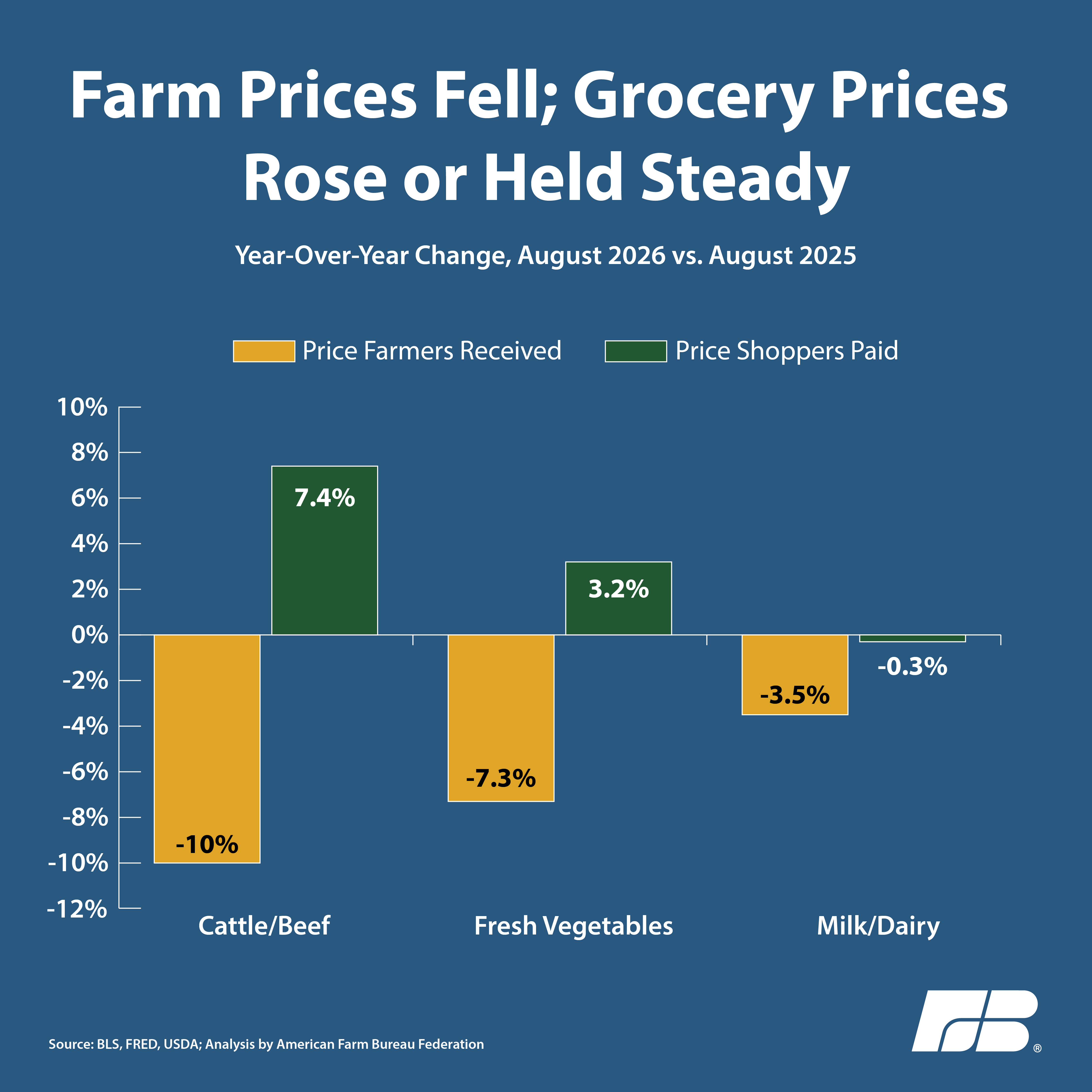
Farmers are Price-Takers, Not Price-Makers
Some of this gap is timing. Farm prices swing far more than grocery prices, and store prices typically trail and are often not very related to price changes at the farm. The costs of getting food from field to shelf, such as diesel, labor and packaging, haven't gone away and continue to get costlier.
But the pattern points to something farmers know well. When prices for their crops and livestock fall, they feel it right away. Yet, when their production costs rise, they can't pass along the increase when they sell their products. Farmers have to sell at whatever price the market sets because they are price-takers, not price-makers.
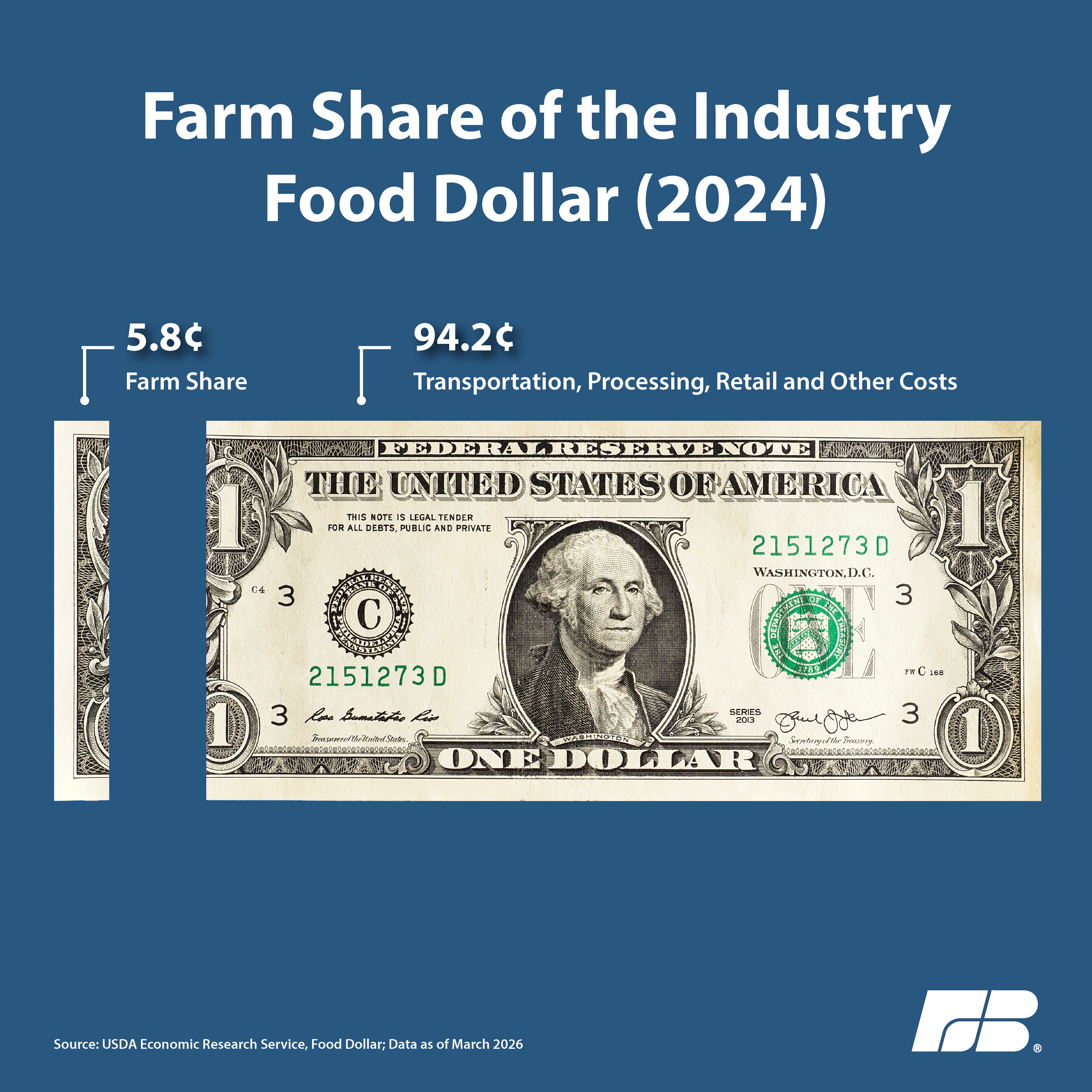
This point is illustrated well in the USDA’s breakdown of the farmer share of the industry food dollar, analyzed in a Farm Bureau Intel earlier this year. In 2024, that share was only 5.8 cents of every dollar spent on domestically produced food. The remaining 94.2 cents of the food dollar went toward costs associated with food processing, transportation, retail and other costs. There are different ways USDA analyzes the food dollar, including what’s referred to as the marketing food dollar, but any way you slice it, the farmer’s share is less than 7 cents.
That's why the farm economy can be in trouble — like it is now — even when grocery prices are normal or elevated. The turbulent winds swirling around farmers have left many underwater ... again. For some, it’s their fifth year in the red. Bottom line: farmers have many obstacles to overcome.
On the brighter side, public perception that they are big beneficiaries of high grocery prices is not among them. I’ve literally had dozens of conversations with farmers worried about this perception. The comment I hear goes something like this: “The public is going to think high food prices mean we’re lining our pockets and we need them to know that’s just not the case.”
Giving Consumers Credit
Shoppers are frustrated too. Nearly two-thirds of consumers across demographics in a recent national survey cited high grocery prices as a top financial pressure. The June survey by Global Strategy Group also revealed that two thirds of respondents consider food prices unfair. So, who do they point the finger at as responsible for the higher prices?
Most consumers blame tariffs (48%) or big corporations raising retail food prices (46%). Notice who’s missing from the list of perceived culprits: farmers. That’s a welcome surprise to many farmers. It seems consumers understand that the U.S. has a complex food supply chain even if they don’t fully comprehend its complexities.
Of course, sometimes public perceptions are way off, and surveys that reveal big gaps in consumer understanding get a lot of attention. They often shape farmers’ assumptions, but concluding that all consumers are ignorant about food and agriculture is neither accurate nor helpful.
Why do farmers care so much about what consumers think? Because farmers take such pride in raising healthy food that families can afford. They don’t take for granted the extraordinarily high level of trust that consumers place in them, which has remained above 80% in our polling for nearly a decade (as noted in a previous Farm Bureau Intel).
The Work Ahead
Addressing the knowledge gaps when it comes to the public’s understanding of agriculture is important to maintaining trust.
A big one is the false notion that most farms are no longer owned by families. An analysis of USDA data indicates 97% of U.S. farms are family-owned. More than 86% are not only family-owned but classified by USDA as small farms. We have large family farms, too, in the U.S. and they play a critical role in providing a secure food supply. At Farm Bureau, we work to ensure Americans know where their food comes from and who grows it - on farms of all sizes.
It’s important work, but equally important is the work needed to solve the structural issues creating generational headwinds in agriculture.
Many conversations are underway about solutions for the farm economy. From creating new demand for agricultural products here at home through the Buy America effort and increased biofuel production, to expanding current export opportunities and developing new ones. This year’s unforeseen spike in farm operational costs created a series of shocks that knocked down farmers’ profits and sent many even further into the red. Ideas to lower input costs – or at least make them more predictable – range from producing more fertilizer and other farm supplies domestically to protecting shipping routes and advancing research into new tools that protect against insects, weeds and plant diseases.
I’ll note one more key to stabilizing agriculture (although there are undoubtedly many more). Farmers are still operating under the 2018 farm bill, which Congress has extended three times. I don’t have to tell you that the world has changed dramatically since 2018 and a modernized farm bill is an obvious need. The stakes extend far beyond the farm. Keeping farms economically viable is essential to ensuring families can continue to count on a secure food supply.
Everyone has a Role
There is no silver bullet that sets up U.S. agriculture for a vibrant future, but each of us has an opportunity to contribute.
Shoppers should remember that food prices on the shelf tell you little about what farm families earn, and it's important to seek out accurate information about agriculture.
As some of the most trusted people in America, every farmer and rancher can help supply that information, whether in conversations, presentations or interviews.
Congress and the administration can modernize policies and programs that support agriculture to lay the foundation for future farm success, which is a fundamental part of our country's success.
Together, farm and ranch families, consumers, policymakers and our food supply chain partners can ensure we have a vibrant, secure and safe food supply for generations to come.