Desalination Doesn’t Pencil Out for Western Agriculture

Daniel Munch
Former AFBF Economist
Key Takeaways
- Desalination may help expand municipal and industrial supplies, but its cost, energy and infrastructure requirements make it unfeasible as a direct replacement for large-scale agricultural irrigation.
- Estimates for new seawater desalination in California reach $3,400 to $3,700 per acre-foot — more than twice the roughly $1,444 in average gross farm revenue generated per acre-foot of applied water.
- Even at $3,000 per acre-foot, desalinated water would add roughly $6,900 to $11,250 per acre for representative lettuce, strawberry and almond operations already facing negative margins.
- Farm and household water are not the same product. City water must be treated to drinking-water standards and pumped through pressurized systems to homes and businesses, while irrigation water generally requires much less treatment and distribution infrastructure.
The Colorado River is one of the most economically important water systems in the West, supporting communities, businesses and some of the nation's most productive agricultural regions. It also underpins food supply chains Americans depend on most heavily during the winter, when areas such as Yuma, Arizona, and California's Imperial Valley become major sources of fresh vegetables.
At the same time, the basin faces a long-term imbalance between available water and existing demands, intensifying debate over conservation, infrastructure and potential new sources of supply. One option that regularly enters that discussion is ocean desalination.
The appeal is easy to understand. Rather than reallocating an existing water supply among users, desalination can create new, drought-resistant freshwater from the ocean. It is already used in communities around the world and could supplement municipal or industrial supplies in parts of the Western U.S.
For agriculture, however, the central question is not whether desalination works. It is whether the water it produces can be supplied at a price compatible with commercial food production. On that question, the economics are difficult to overcome.
Desalinated Water Comes at a Very Different Price
Most large ocean desalination plants use reverse osmosis, forcing seawater under high pressure through membranes that remove salts. The technology is well established, with roughly 16,000 to 17,000 desalination plants operating worldwide, but it has not experienced the dramatic cost declines seen in technologies such as solar and wind.
For California, the most relevant estimates are measured in thousands of dollars per acre-foot. The California State Water Resources Control Board cites projected seawater desalination costs of $3,400 to $3,700 per acre-foot in 2025. The Pacific Institute estimated roughly $2,100 per acre-foot for large California projects and $2,800 for smaller facilities, while water from the Carlsbad Desalination Plant is estimated at roughly $2,500 to $2,800 per acre-foot when adjusted for electricity prices.
Lower costs are often cited overseas. Israel’s Sorek B facility has contracted water near $505 per acre-foot, while Dubai’s Hassyan project reached roughly $450. Those projects show what desalination can achieve under favorable conditions, but differences in energy costs, scale, infrastructure, financing and regulation make them difficult to replicate in the American West.
The economic mismatch becomes clearer when those costs are compared with what agricultural water produces. California agriculture generated about $1,444 in gross farm revenue per acre-foot of applied water in 2020. Agricultural output per unit of water has nearly doubled since 1967, while total applied water increased only 8%.
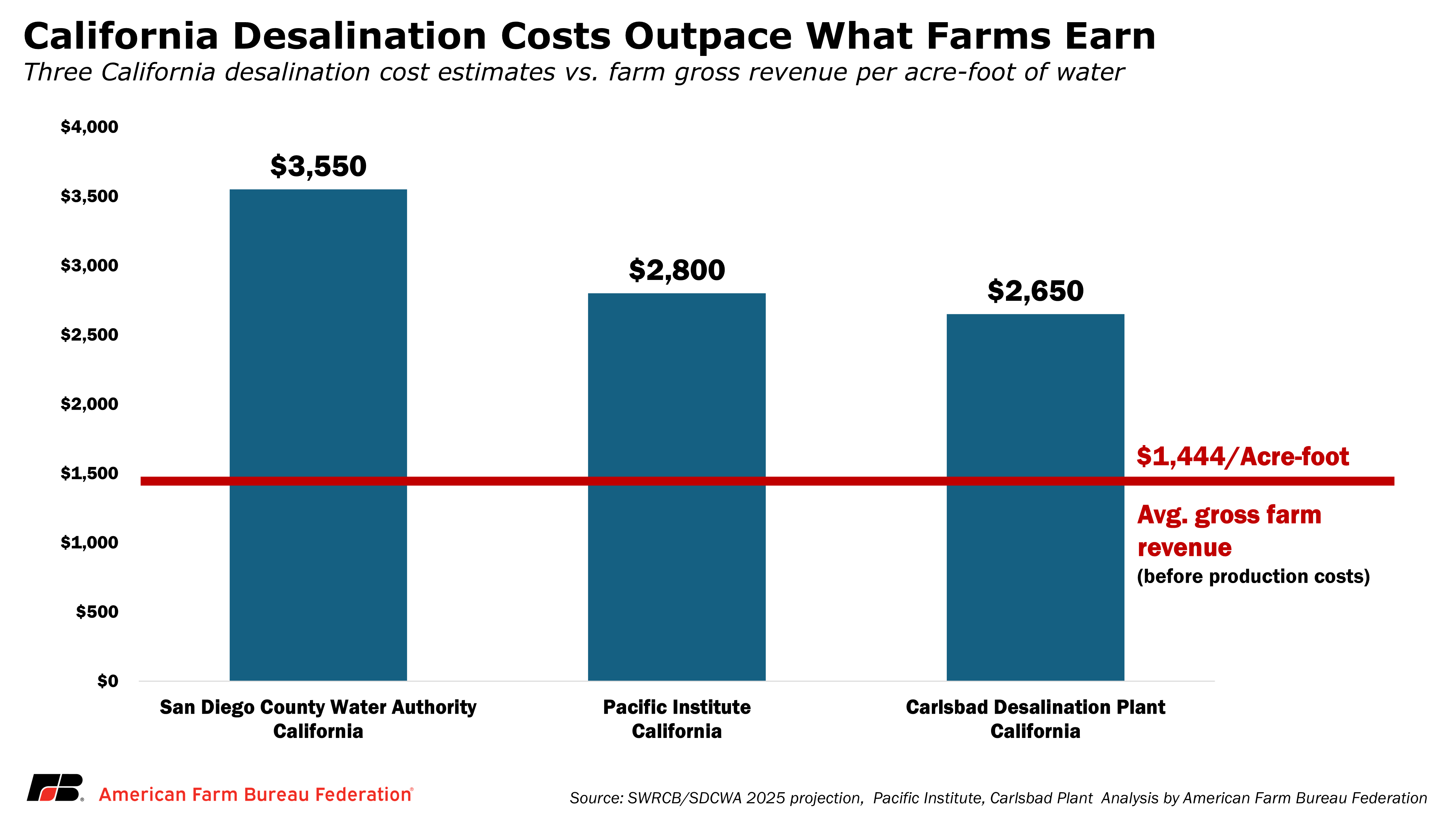
Even after those efficiency gains, desalinated water costing $3,400 to $3,700 per acre-foot would cost more than twice the average gross farm revenue generated by an acre-foot of applied water — before labor, land, fertilizer, equipment and other production expenses are paid.
This is also not a simple comparison between what farmers and households pay for the same water. Drinking water must be treated to higher standards and delivered through pressurized systems to homes and businesses, while irrigation water generally requires much less treatment and distribution infrastructure. The relevant question is whether agricultural production can support a replacement water source costing several thousand dollars per acre-foot. For open-field production, the numbers suggest it cannot.
What $3,000 Water Means on the Farm
The statewide comparison is stark, but crop-level budgets show how quickly desalination costs would overwhelm farm economics.
Using UC Davis and University of California Cooperative Extension cost-of-production studies, Farm Bureau estimated that under 2025 market conditions California lettuce growers would lose about $2,533 per acre, strawberry growers about $4,525 per acre and almond growers about $2,658 per acre after accounting for production costs. These are not crops operating with large margins that could simply absorb a higher water bill.
Applying a desalination cost of $3,000 per acre-foot (below the State Water Resources Control Board’s $3,400 to $3,700 estimate) would translate into roughly $11,100 per acre for lettuce, $6,900 for strawberries and $11,250 for almonds based on their representative water needs.
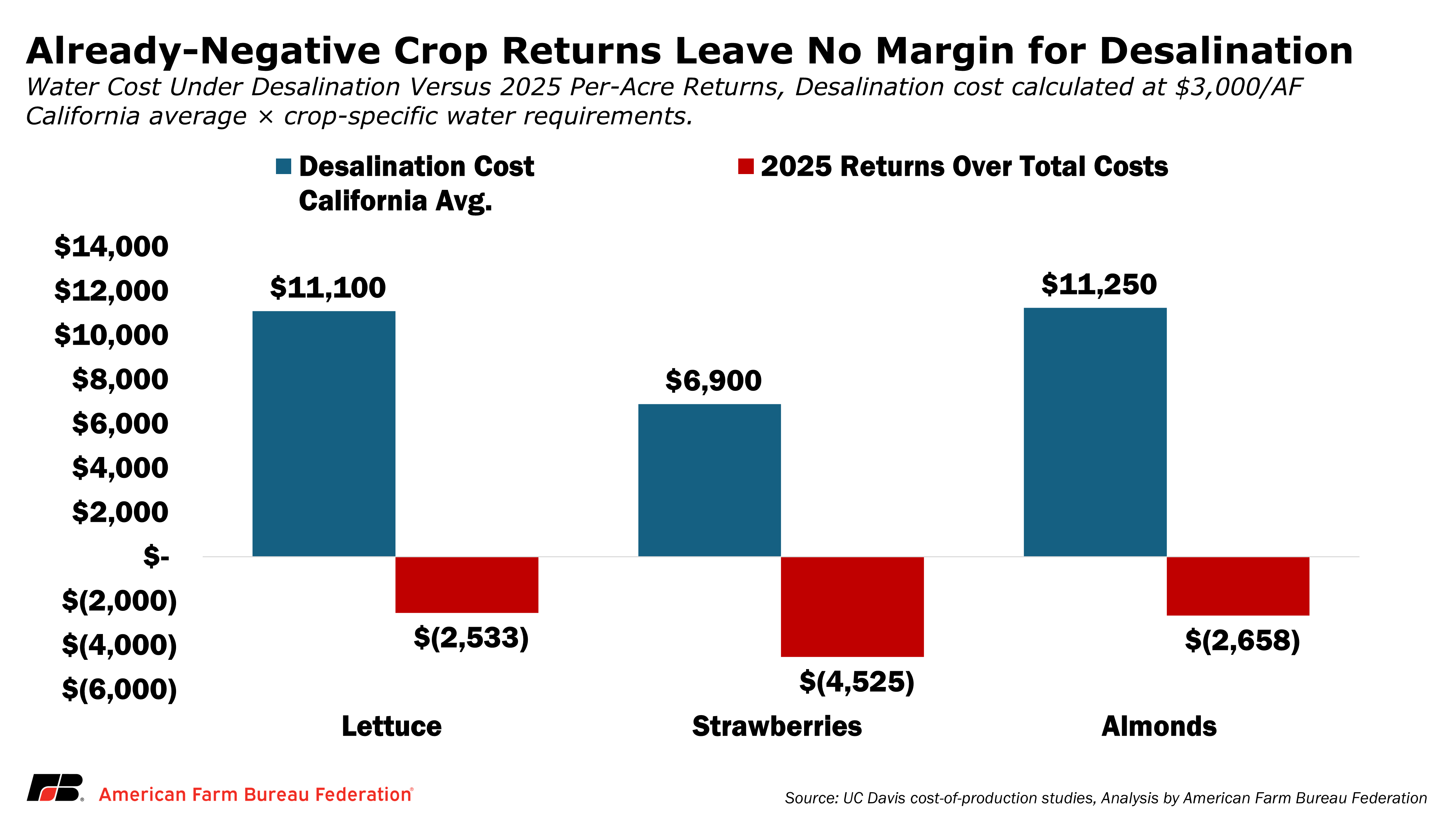
Those figures represent the total cost of purchasing desalinated water before subtracting existing irrigation-water expenses. Farmers would no longer pay the water costs already included in their production budgets, but removing those smaller expenses does little to change the overall result. The replacement water bill alone would exceed or consume a substantial share of the value generated by crops already facing negative returns.
For open-field agriculture, the use of desalinated water would therefore do more than tighten margins. At current costs, it would make commercial-scale production economically unworkable.
Why Desalination Remains Expensive
The high cost of desalination is not tied to one piece of technology that can simply become cheaper over time. Producing freshwater from the ocean requires large amounts of electricity, major coastal infrastructure and systems to manage both seawater intake and the concentrated brine left behind.
Energy is a major part of the equation. Seawater reverse osmosis requires roughly 4,000 kilowatt-hours of electricity per acre-foot of water produced, about twice the energy needed just to move an acre-foot of Colorado River water through the Colorado River Aqueduct to Southern California. The Carlsbad Desalination Plant alone uses about 38 megawatts of electricity continuously.
The facilities themselves are also expensive. Carlsbad cost roughly $1 billion to build and produces about 56,000 acre-feet of water per year. That price does not include the broader challenge of building pipelines, pumping systems and other infrastructure needed to move newly produced water to where it is ultimately used.
Then there is the ocean side of the equation. Desalination plants must pull in large quantities of seawater without causing excessive harm to marine life and safely discharge concentrated brine after the freshwater is removed. California requires projects to address those impacts through intake design, dilution, monitoring and other mitigation measures. Those protections can add both time and cost. In 2022, the California Coastal Commission rejected a proposed Huntington Beach desalination plant similar in size to Carlsbad, citing concerns that included marine-life impacts and environmental mitigation.
Despite decades of use around the world, desalination still supplies only about 1% of global freshwater needs, with total capacity of roughly 28 million acre-feet per year. That reflects the practical limits of scaling a process that requires substantial electricity, billion-dollar facilities, pipelines, pumping and environmental safeguards.
Technology can continue to improve, but many of desalination’s largest costs are tied to the basic physical task of turning seawater into a dependable freshwater supply.
Why This Matters for the Food Supply
The economics of desalination matter because Colorado River water supports some of the nation’s most important food-producing regions. Yuma, Arizona, and California’s Imperial Valley together produce roughly 90% of the leafy vegetables consumed in the U.S. from November through March. Across the broader basin and adjacent supply areas, irrigation supports more than $10 billion in annual agricultural production. A 2024 study also estimated that Colorado River irrigation supports 28% of U.S. milk production, 15.5% of beef production and 8.6% of egg production.
If production declines because replacement water is too expensive, it cannot simply be shifted elsewhere. Western growing regions combine climate, soils and irrigation infrastructure that are difficult to replicate at scale. Greater reliance on imports would likely fill part of the gap, but the U.S. already imports about 35% of its fresh vegetables and 59% of its fresh fruit, increasing exposure to transportation disruptions, extreme weather and policy decisions abroad.
Desalination can still add drought-resistant water to the West’s supply and may make sense for municipal, industrial and other higher-value uses. But water costing several thousand dollars per acre-foot is not an economically realistic substitute for the irrigation supplies supporting these major food-producing regions. The challenge is not simply creating more water but maintaining water supplies at a cost that allows domestic agriculture to keep producing.