Drones Taking Off in Ag

photo credit: Philip Gerlach
Bernt Nelson
Economist
Key Takeaways
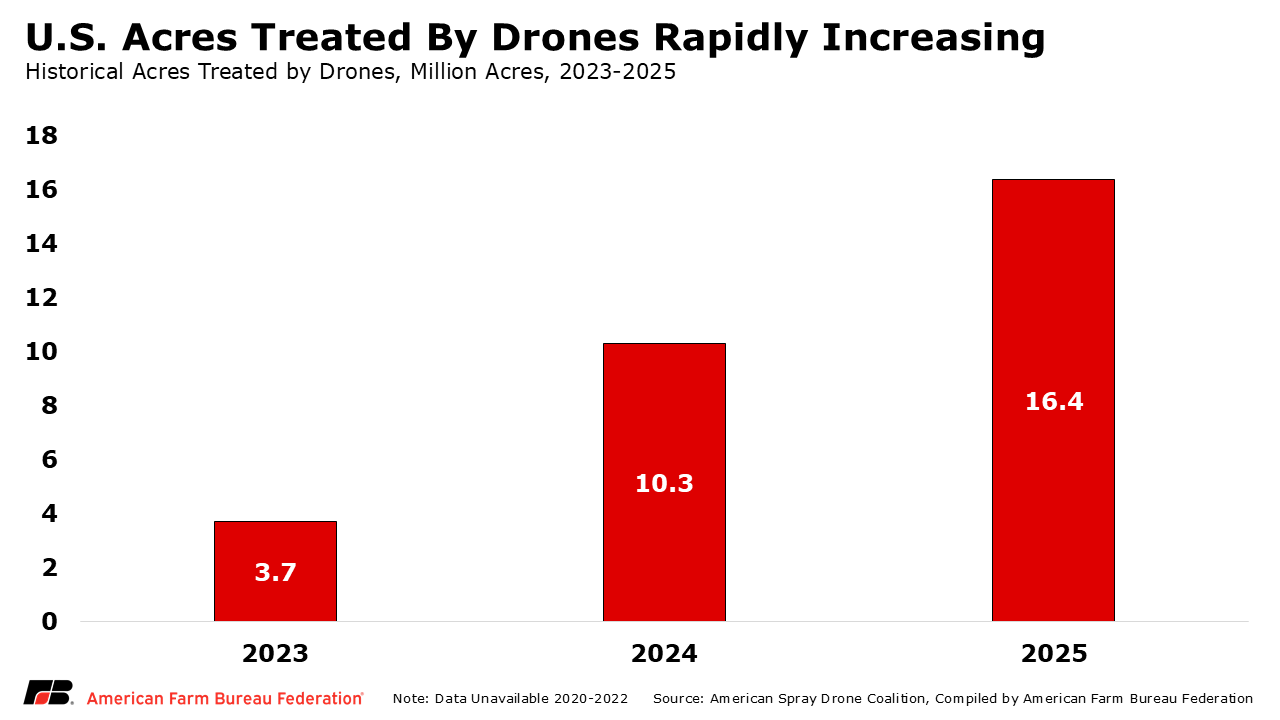
- Agricultural drone adoption is accelerating rapidly in the U.S. Acres treated by drones grew from 3.7 million in 2023 to 16.4 million in 2025.
- The biggest advantages for drones come in wet fields, rough terrain, irregularly shaped fieldsand situations where timely product applications are critical.
- Global adoption reflects differences in agricultural production systems. Farm size, field characteristics and operational needs have supported broader drone adoption in some countries while the United States has developed more specialized applications.
- Drones are creating new business opportunities in rural America. Custom application service, cover crop seeding and crop scouting provide farmers, ranchers and entrepreneurs a new path to revenue, though success requires technical expertise, licensing and business management skills.
American agriculture has a long history of adopting technology to improve productivity and efficiency. From advancement in seed genetics, to the precision technology that guides equipment down the field with remarkable accuracy, innovation has led to growing more food while using fewer resources. Agricultural drones are one of the latest examples, with treated acreage skyrocketing from roughly 3.7 million acres in 2023 to 16.4 million acres in 2025.
Beginnings
While drones are viewed as modern technology, their use in agriculture goes back decades. The first commercial drone was used in agriculture in 1987 when Yamaha released the R-50 unmanned helicopter to help rice farmers apply pesticides and combat labor shortages in Japan. This initial application demonstrated that unmanned aircraft could perform agricultural tasks effectively, particularly in areas where traditional equipment faced limitations.
In the United States, agricultural drone adoption moved slowly until 2010, when researchers began receiving both federal and state authorization to apply pesticides using drones. Since then, advances in software and hardware have transformed drones from an experimental tool into a commercially viable option for many applications in agriculture.
Rapid Adoption in U.S. Agriculture
Growth in drone-treated acreage illustrates how quickly adoption has expanded in recent years. About 16.4 million acres were treated by ag drones in 2025, up 59% from 10.3 million acres in 2024 and more than four times the 3.7 million acres sprayed in 2023.
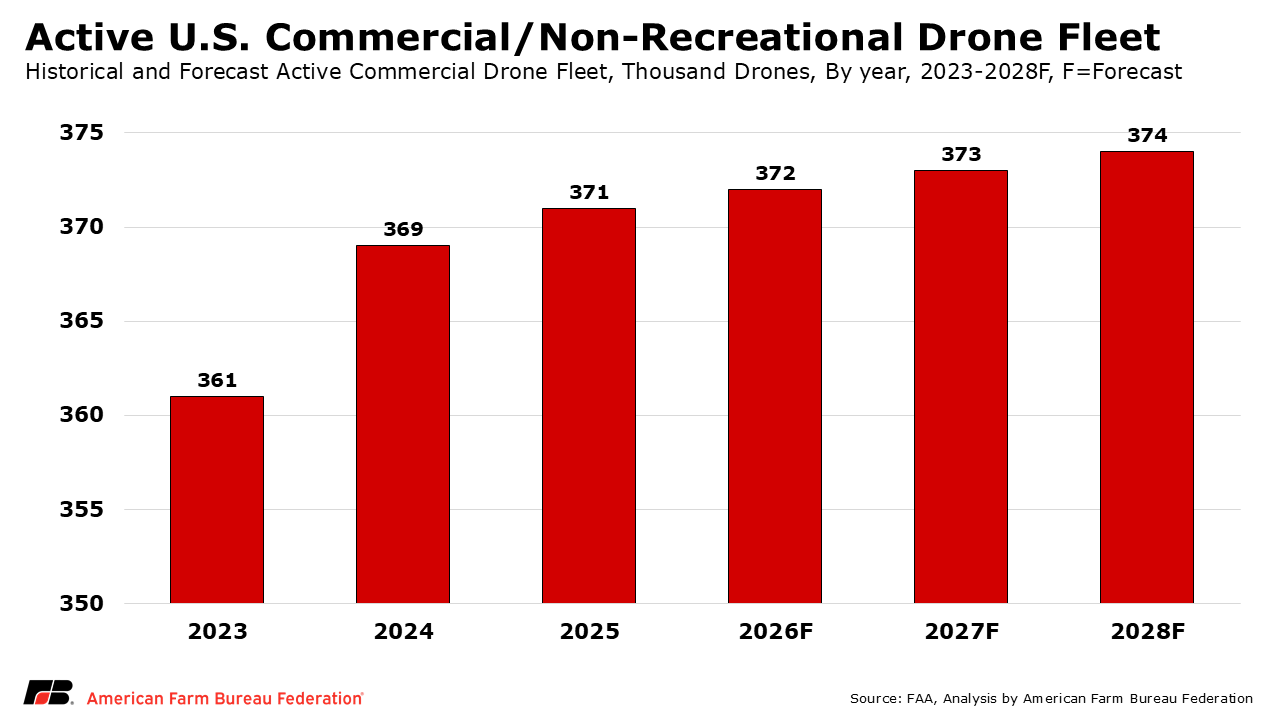
Growth in covered acres has also been accompanied by expansion in the number of active drone pilots and aircraft in use. Data from the Federal Aviation Administration (FAA) shows that over 842,000 commercial/non-recreational drone registrations occurred between 2016 and 2023. FAA estimates that the 2026 fleet of active commercial/non-recreational drones in 2026 is about 372,000 aircraft, supported by about 481,000 certified remote pilots. Agricultural spraying represents a rapidly expanding segment of the commercial drone market with 5,500 registered agricultural spray drones in 2025 linked to 2,588 operations with FAA part 137 agricultural-aircraft status.
Why Farmers are Using Drones
The appeal of drones isn’t necessarily that they replace traditional equipment. Instead, they fill in where traditional equipment and tools leave gaps. Farmers are increasingly finding situations where drones offer both economic and operational advantages over conventional application methods such as ground equipment or airplane applications. Several factors are driving adoption:
- Difficult field conditions. Wet soils, steep or uneven terrain and sensitive crop conditions can limit access for ground rigs. Drones can operate without damaging topsoil, causing compaction or additional crop damage.
- Access to aerial application. In some locations, conventional aerial applicators may be difficult to schedule during periods of high demand. Drones provide an additional option when timing is critical.
- Small or irregular fields. Fields with odd shapes, terraces, waterways or other obstacles are less efficient and can cause challenges for large sprayers or aerial applications. Drones can more easily and accurately move in areas where traditional equipment would be limited.
- Reduced operator exposure. Remote operation limits direct contact between applicators and crop protection products.
The Global Landscape
Agricultural drone adoption varies widely across countries because production systems, field size and terrain are substantially different around the world. In parts of Asia, where farms are often smaller and fields may be difficult to access with conventional equipment, drones have become an important tool for production systems.
China is one example. The country reported more than 120,000 agricultural drones in operation treating approximately 175.5 million acres in 2021. Those totals represent a much larger share (about 65%) of crop production than the United States, where 5,500 agricultural drones treated approximately 16.4 million acres in 2025.
Comparing adoption rates between China and the United States does not necessarily indicate one system is more advanced than the other. The technologies are being used to solve different agricultural production challenges. While drones may serve as a primary application tool in some regions of China, they are more commonly filling specialized roles within U.S. crop production systems.
New Opportunities
Beyond their use on individual farms, drones are creating new opportunities for agricultural businesses. Custom spraying is a business many farmers and ranchers have often used to diversify income. Agricultural drones have opened the door to another pathway for entrepreneurs willing to invest in the equipment, training and certification to use drones for custom applications.
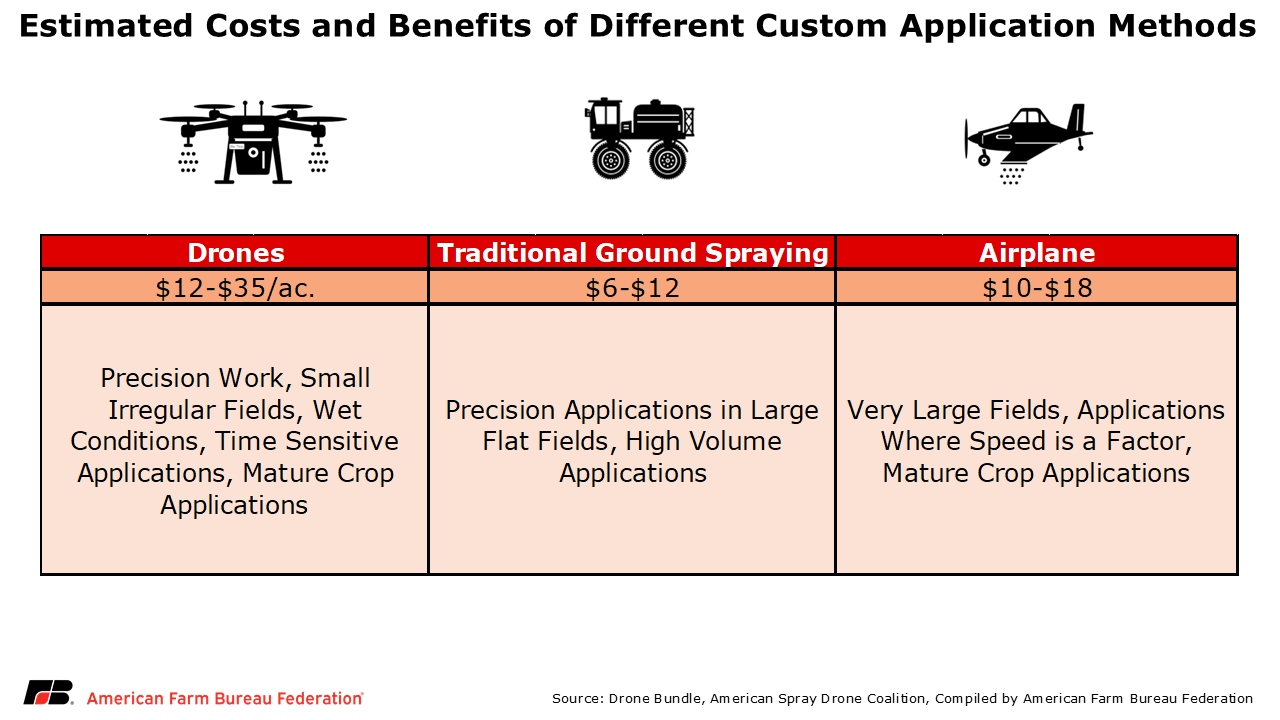
Custom drone spraying offers services ranging from crop protection applications, to cover crop seeding and field scouting. Current custom drone application rates vary by region, crop, complexity, and application type. Costs can range from approximately $12-$18 per acre for row crops and $18-$35 per acre for orchards and specialty crops. These rates can be compared to $6-$12 per acre for traditional ground spraying and $10-$18 per acre for airplane applications. Custom spraying services can be in high demand, especially in places where crops with sensitive application windows are grown and in regions where flexible application options are useful, but don’t justify a farm purchasing drones for their individual operation.
Success in a custom drone application business requires more than purchasing a drone capable of doing the work. Professional applicators must have a deep understanding of agronomy, plant, pest and disease biology, application technology, and state pesticide regulations. Commercial operators also need the proper licensing and business management skills to provide custom services safely and effectively.
Bottom Line
Agricultural drone use continues to evolve in the United States, driven by applications where field conditions, timing constraints or field characteristics can limit conventional equipment. While U.S. adoption remains well below levels in countries such as China, treated acreage has grown rapidly in recent years as this technology fills gaps left by traditional methods. The rapid increase in treated acreage suggests that drones are moving beyond niche technology with limited applications and becoming another management option within modern crop production systems.