Farmland Values Climb to New Highs as Cash Rents Hold Near Records

Daniel Munch
Economist
Key Takeaways
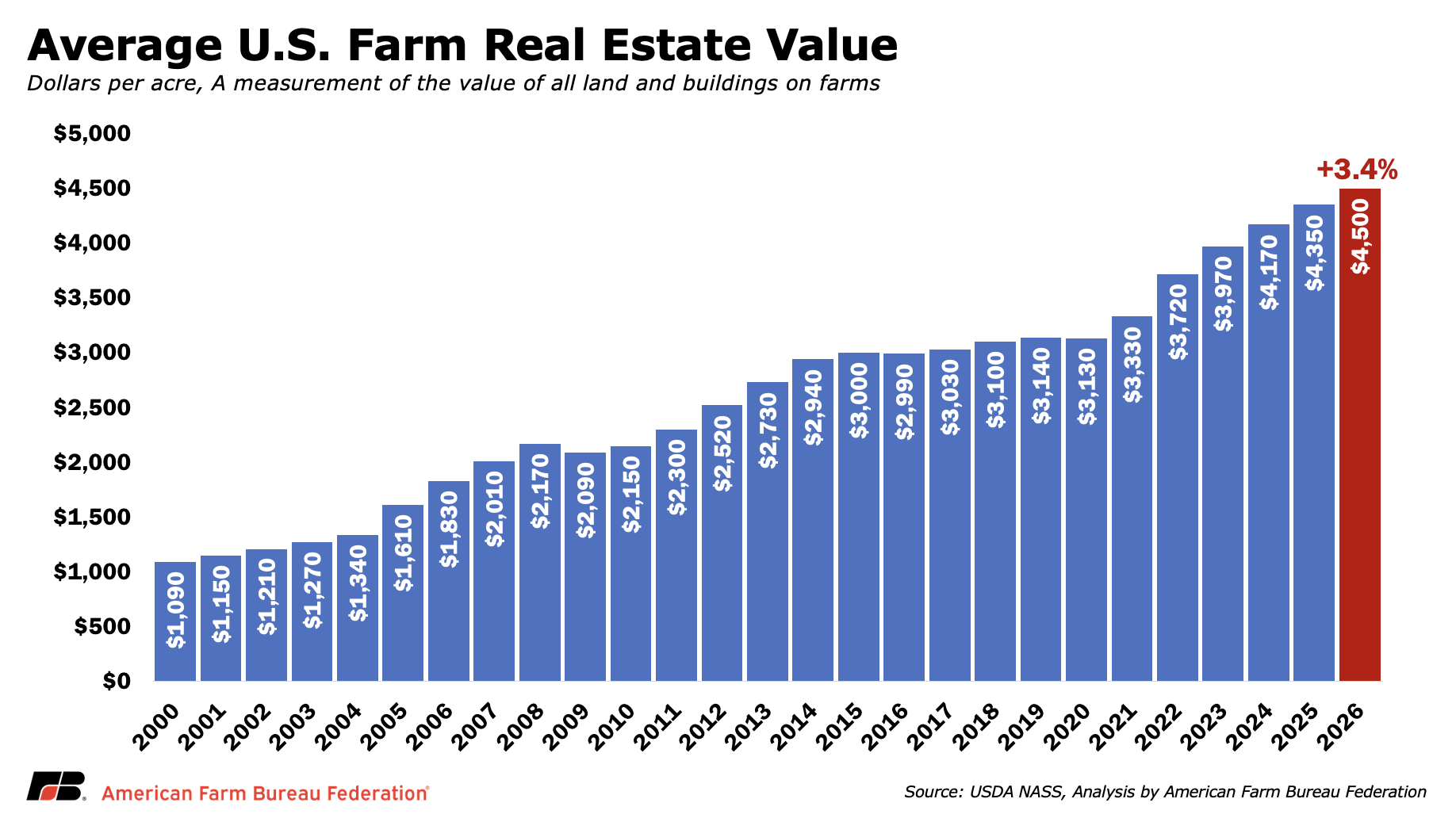
- Farmland values remain at record highs even as growth slows. Average farm real estate values rose 3.4% to $4,500 per acre in 2026, marking a sixth consecutive annual increase and a nearly 44% gain since 2020.
- The post-2020 increase has reshaped the cost of agricultural land. Cropland values are up 48% and pasture values nearly 43%, with the largest gains concentrated across the Plains and Midwest while development, energy and other competing uses add pressure in many local markets.
- Stable cash rents offer little relief for producers. Average cropland rent declined by just $1 to $160 per acre and remains 15% above 2020, leaving renters with elevated costs but none of the equity gains benefiting landowners.
- Rising values strengthen equity and borrowing capacity for landowners, but record purchase prices and near-record rents create additional pressure for tenants, beginning farmers and operations seeking to expand as margins tighten.
USDA-National Agricultural Statistics Service’s recently released annual Land Values 2026 Summary and updated cash-rent estimates show U.S. agricultural land values reached another record in 2026, even as appreciation continued to slow. Average farm real estate value, including land and buildings, rose $150, or 3.4%, to $4,500 per acre. Cropland values increased 3.3% to $6,020, while pasture values rose 4.2% to $2,000 per acre. Since 2020, average farm real estate values have climbed nearly 44%, highlighting farmland’s continued resilience as an asset despite tighter margins across portions of the farm economy.
Cash rents remained near historically high levels but moved little overall. Average cropland rent declined by $1 to $160 per acre in 2026, still 15% above its 2020 level. On a per-acre basis, irrigated cropland rent held at $244, non-irrigated rent declined by $1 to $146, and pasture rent increased by $1 to a record $16.50. Rather than signaling a broad shift in rental markets, the figures show that land costs remain elevated even as farm revenues and margins face pressure.
The continued rise offers a mixed signal for the farm economy. Higher values strengthen farm balance sheets and provide landowners with additional equity and collateral, but they also raise the cost of buying, renting and expanding an operation. Farmland prices increasingly reflect more than agricultural earnings alone. Development, energy projects, outside investment and generational ownership changes can intensify competition for a limited land base, leaving land technically agricultural but less available, affordable or workable for the farmers and ranchers seeking to use it.
Farm Real Estate Value
The average U.S. farm real estate value, which includes all land and buildings on farms, reached a record $4,500 per acre in 2026. The 3.4% increase marks the sixth consecutive annual gain but also the slowest growth since the current upswing began in 2021. Annual appreciation has moderated from 11.7% in 2022 to 6.7% in 2023, 5% in 2024, 4.3% in 2025, and 3.4% this year.
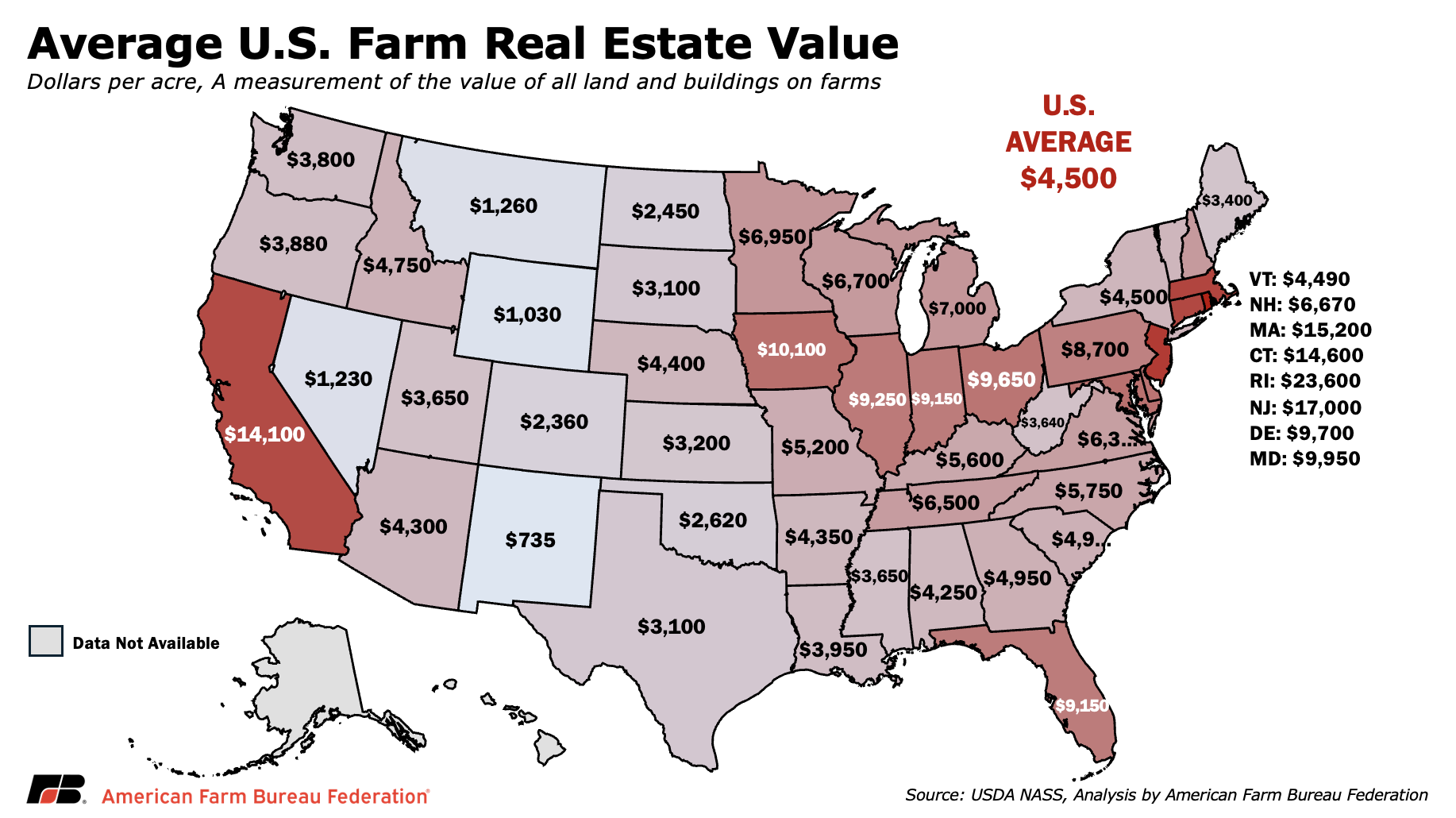
Values remain highly uneven across the country. Rhode Island had the highest average at $23,600 per acre, followed by New Jersey at $17,000, Massachusetts at $15,200, Connecticut at $14,600 and California at $14,100. These markets combine limited land availability with development pressure and high-value agricultural production. At the other end, New Mexico averaged just $735 per acre, followed by Wyoming at $1,030, Nevada at $1,230 and Montana at $1,260. Lower values in much of the Mountain West reflect a larger share of arid rangeland, lower cropping potential and less pressure from development.
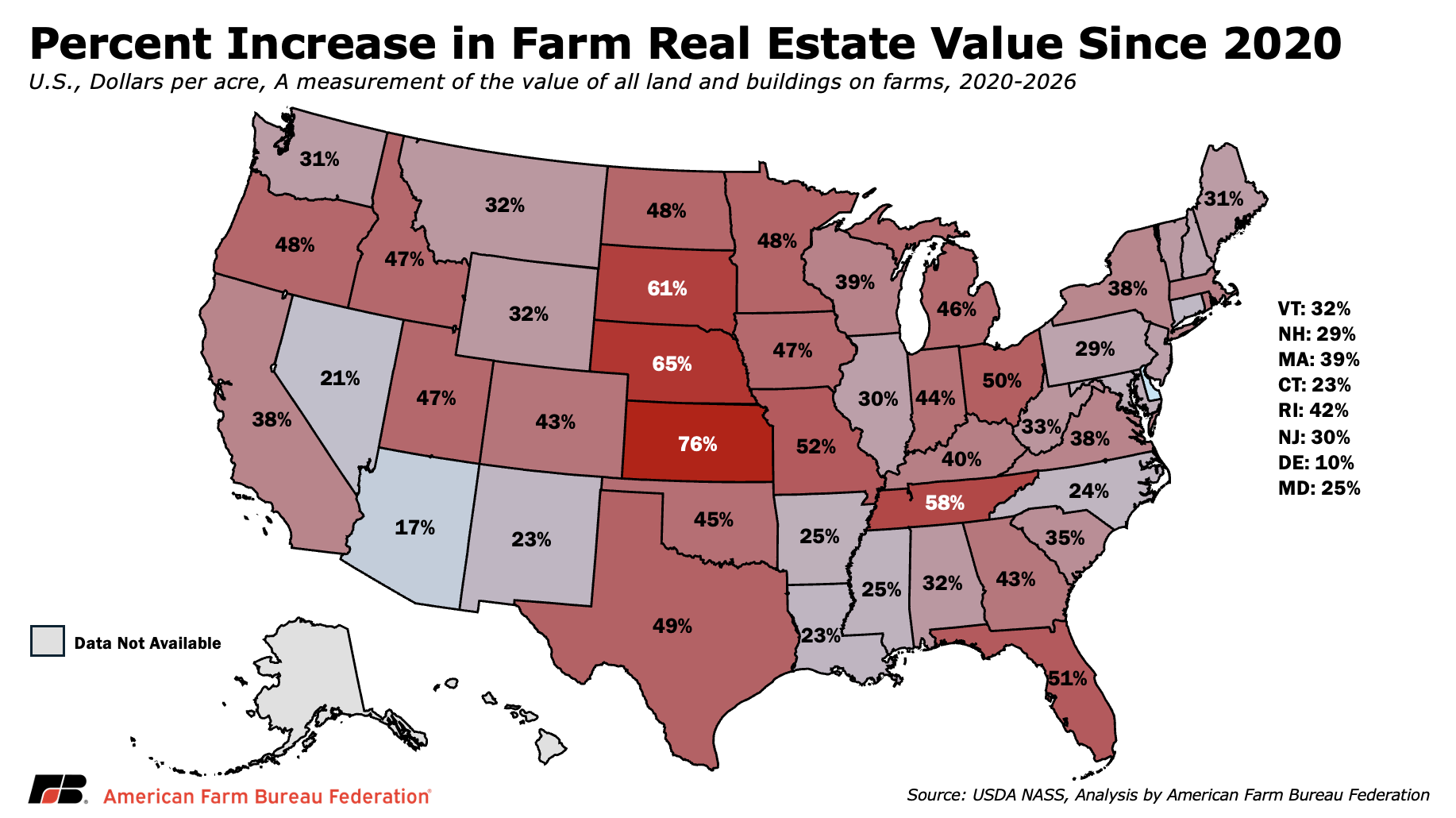
Since 2020, however, the largest percentage gains have been concentrated in the central Plains, with values rising 76% in Kansas, 65% in Nebraska and 61% in South Dakota. These states began from lower per-acre values than many coastal markets, while the 2021–2022 surge in grain and livestock returns, limited land for sale and longer-term productivity gains supported stronger bids for available ground. The result has been a rapid repricing of productive agricultural land even as annual growth has slowed. Higher values strengthen equity for landowners but raise the cost of entry and expansion, particularly where agricultural demand overlaps with development, energy and other competing land uses.
Cropland Value
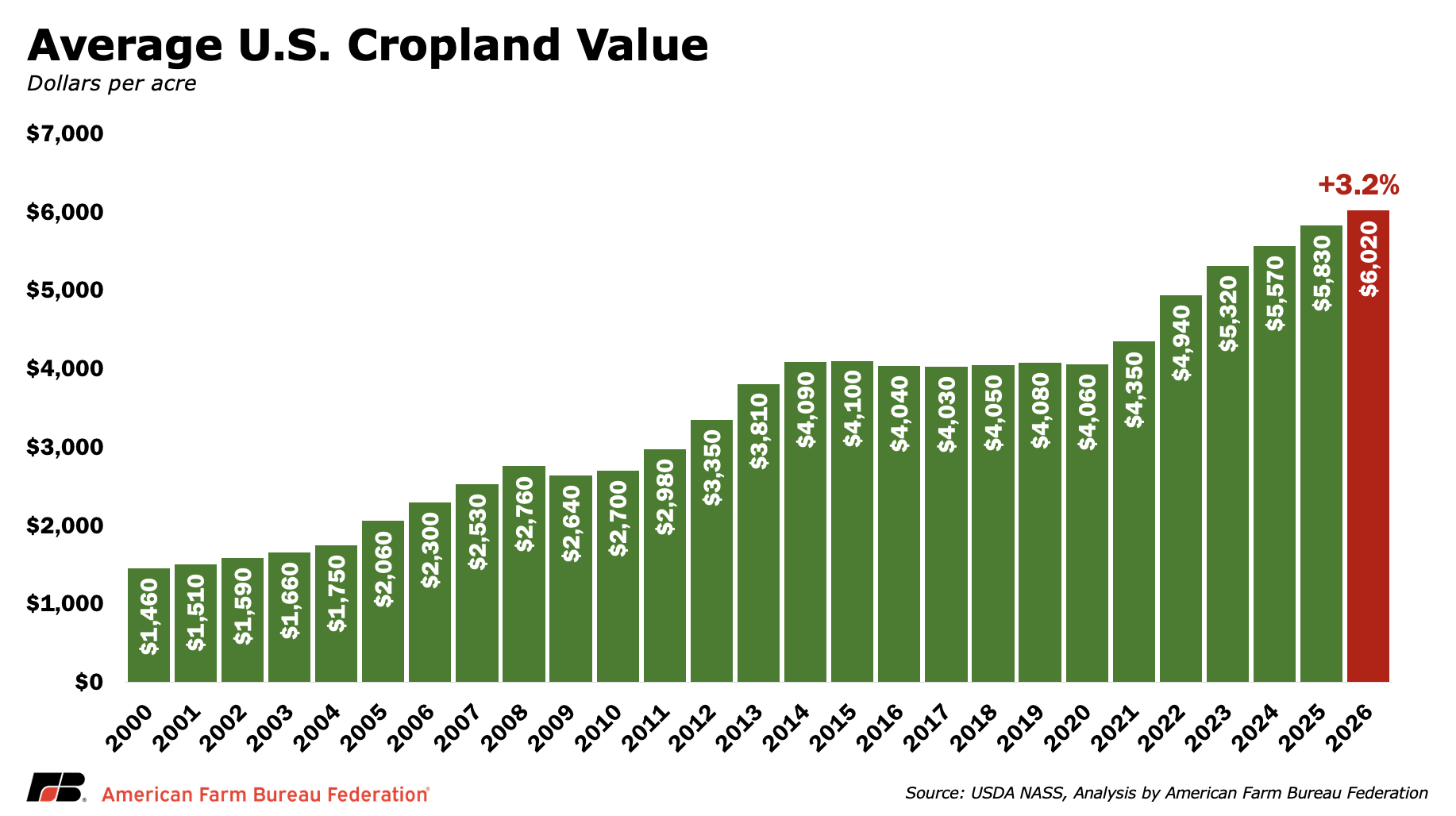
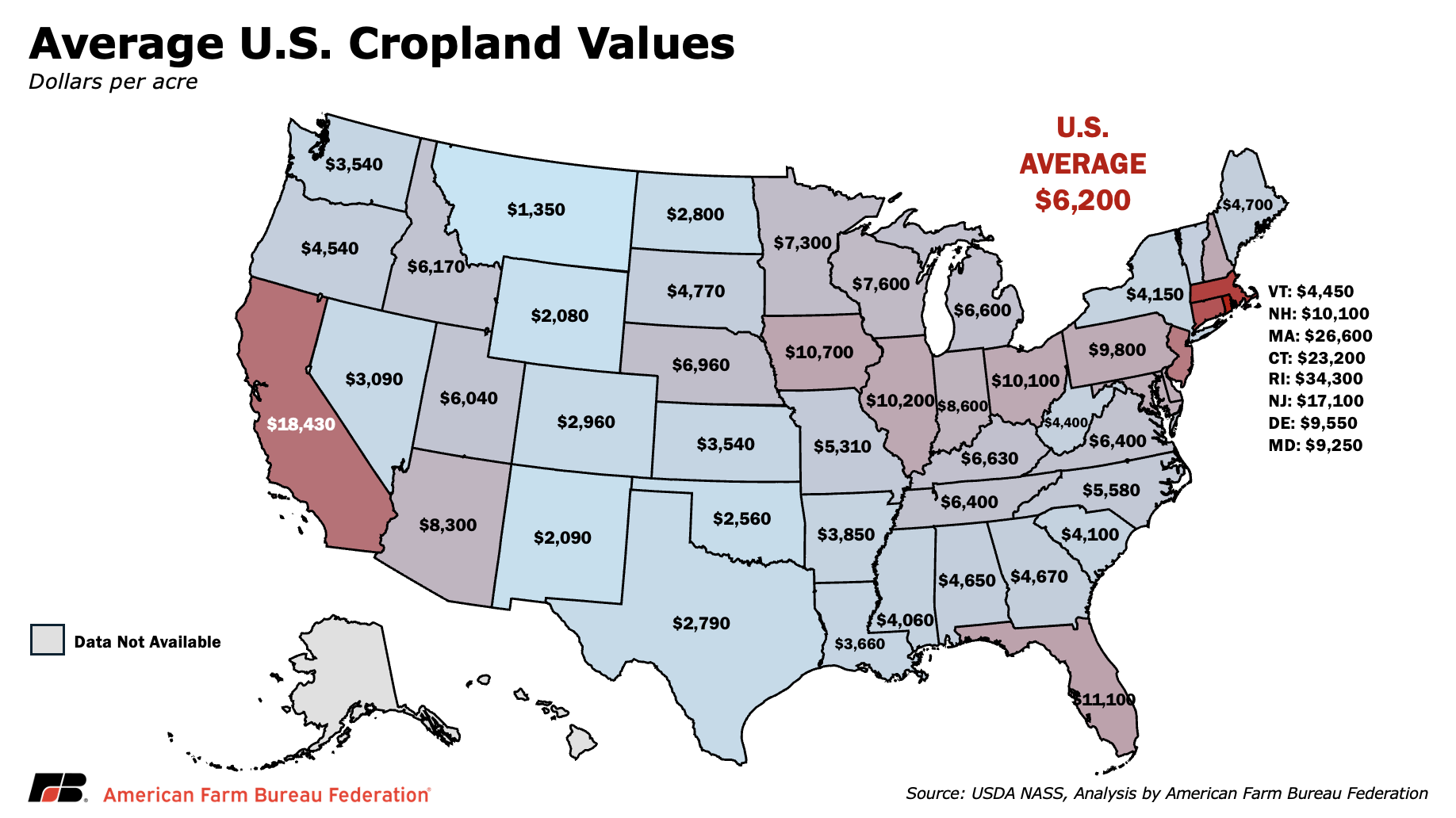
Unlike farm real estate, cropland value measures the land used to grow field crops, vegetables and hay, rather than the combined value of land and farm buildings. The average U.S. cropland value rose 3.3% to a record $6,020 per acre in 2026, an increase of $190 from the previous year. This was the smallest annual gain since the current upswing began in 2021, but values are now 48% higher than in 2020.
Cropland values remain highest in the Northeast and California. Rhode Island led at $34,300 per acre, followed by Massachusetts at $26,600, Connecticut at $23,200, California at $18,430 and New Jersey at $17,100. Limited acreage and intense development pressure support values in the Northeast, while California’s irrigated ground and concentration of high-value fruit, vegetable and nut production raise its agricultural earning potential. At the other end, Montana averaged $1,350 per acre, followed by Wyoming at $2,080, New Mexico at $2,090 and Oklahoma at $2,560. These markets generally have more arid conditions, lower expected crop returns and less pressure from competing land uses.
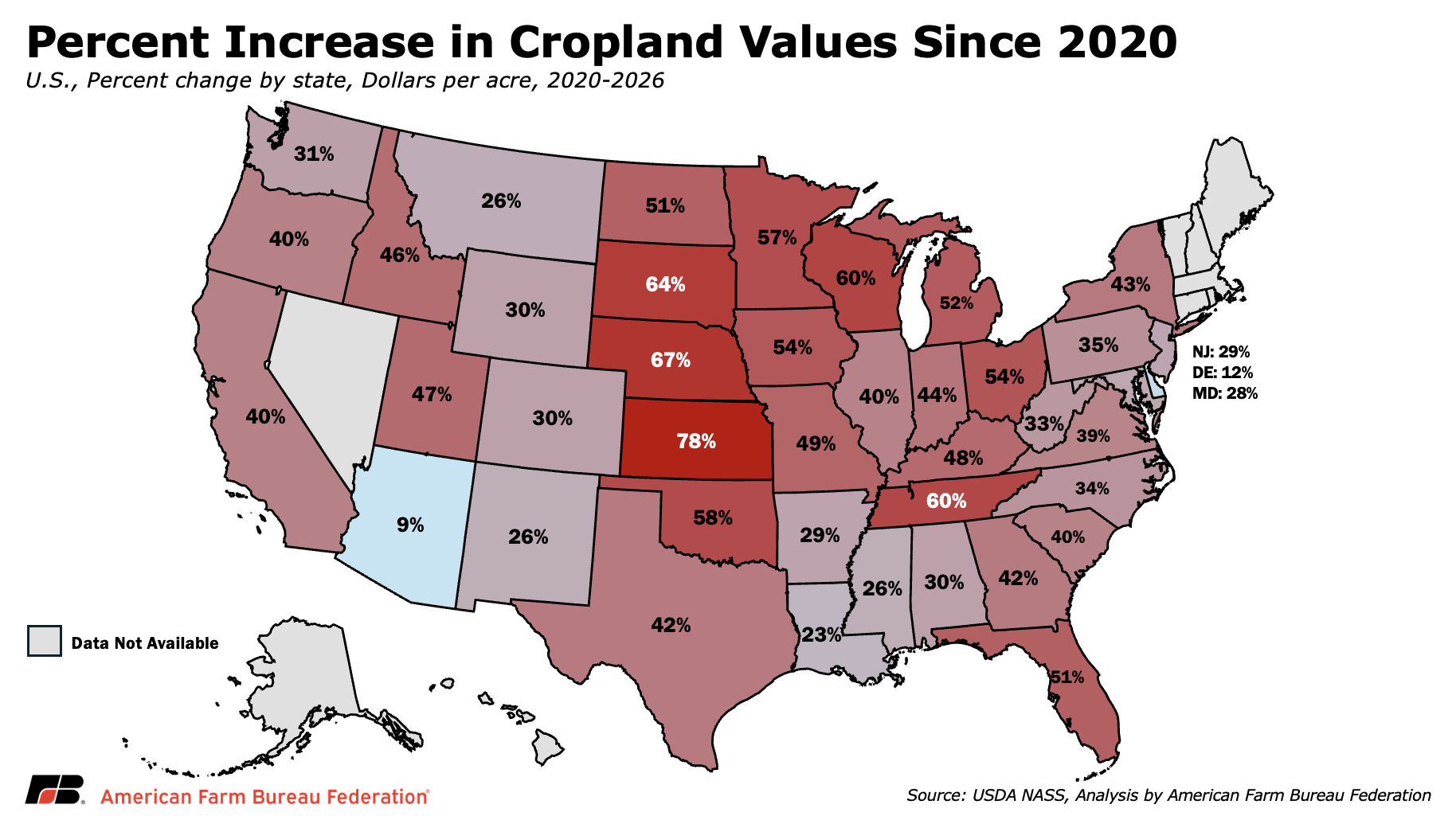
Changes since 2020 broadly mirror the pattern in overall farm real estate values. Kansas led with a 78% increase, followed by Nebraska at 67% and South Dakota at 64%, while Wisconsin and Tennessee each rose 60%. In the Plains and western Corn Belt, the 2021–2022 surge in crop returns, limited land offered for sale and improvements in production potential translated directly to higher cropland prices. In other regions, development, energy projects and other competing uses have also kept values elevated by increasing demand for the same limited acres.
Pastureland Value
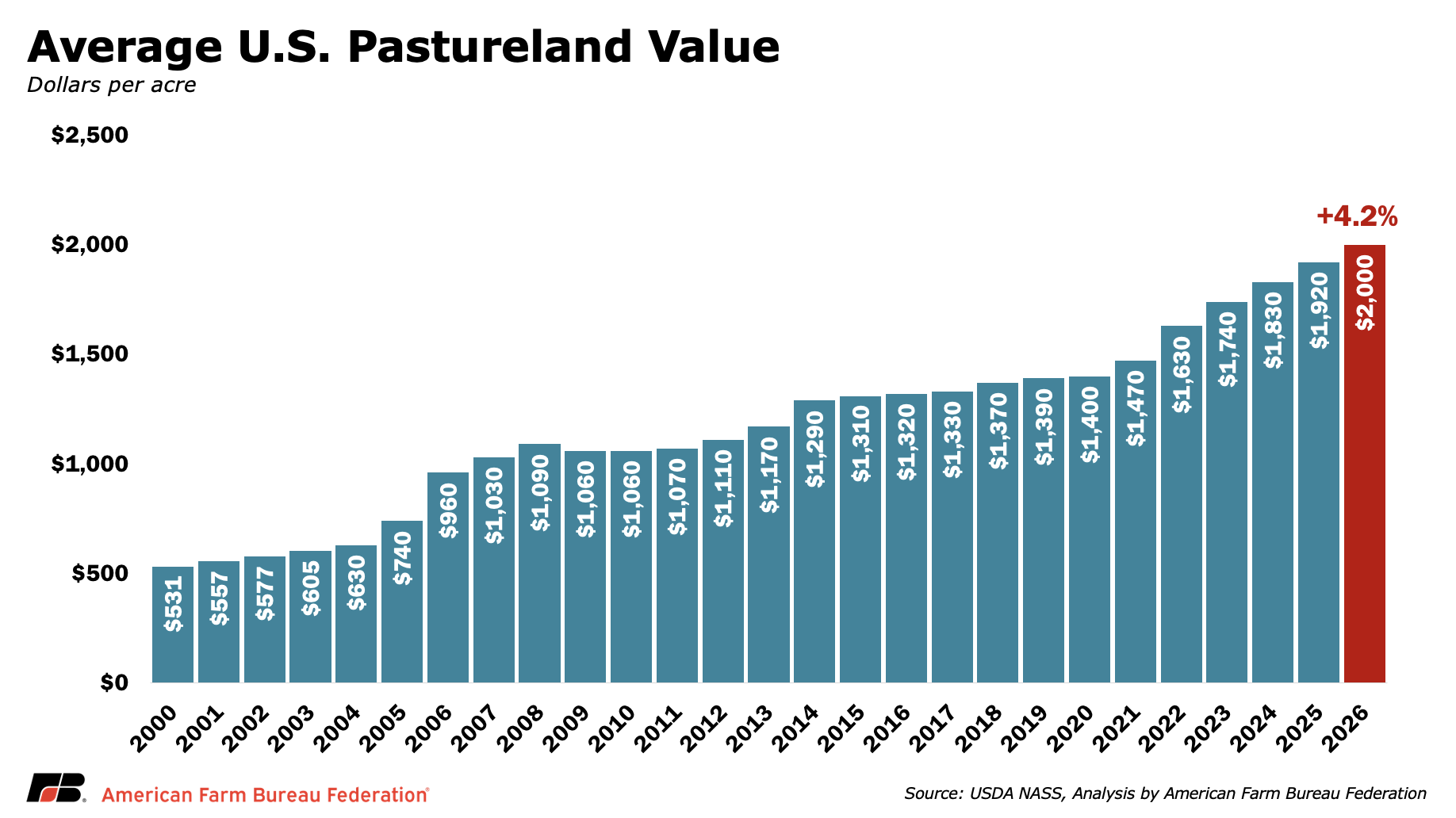
Average U.S. pastureland value increased 4.2% to a record $2,000 per acre in 2026, an $80 increase from the previous year. Pasture values grew faster than both cropland and overall farm real estate values this year and are now nearly 43% higher than in 2020.
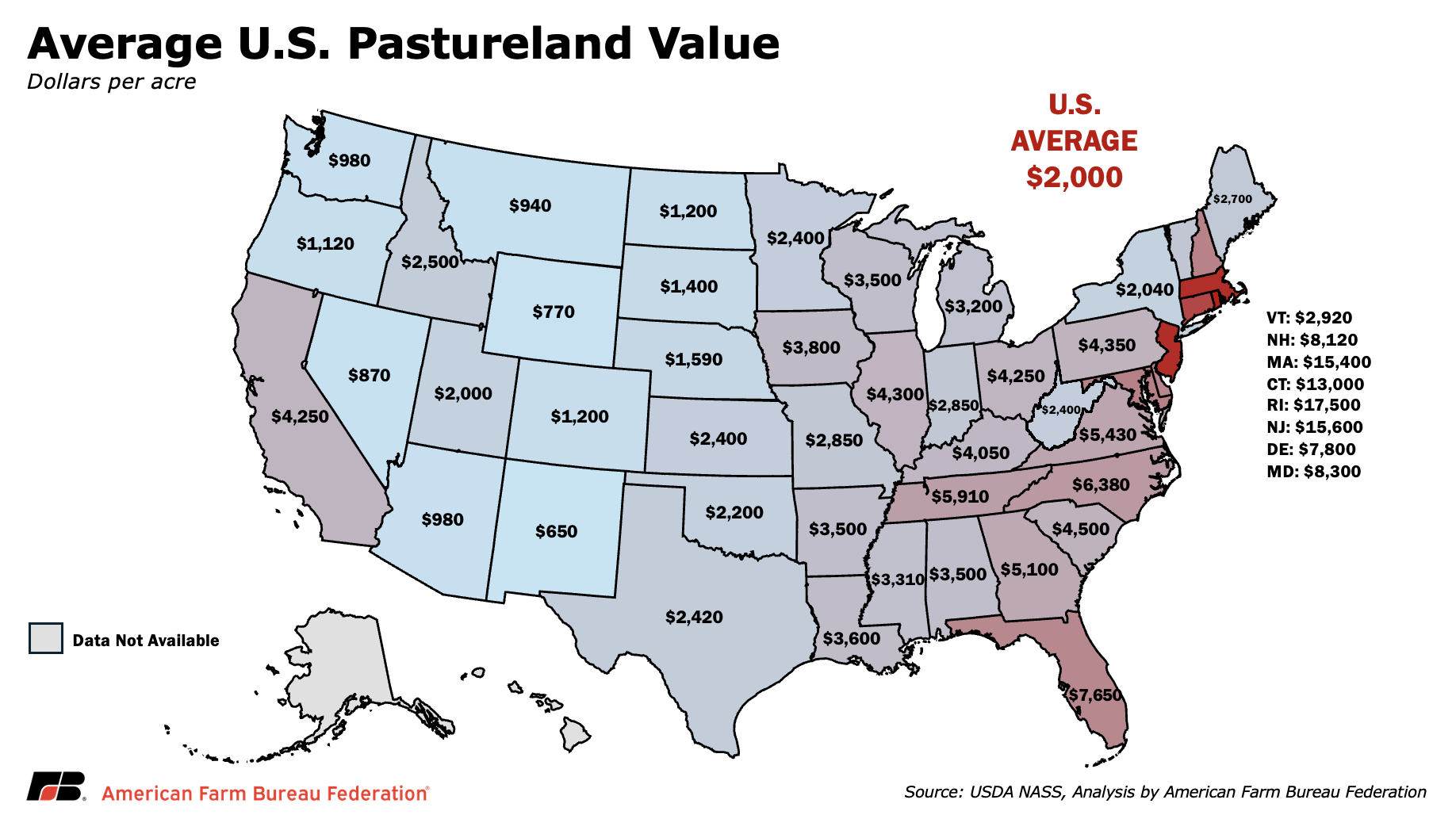
Values again are highest in densely populated Eastern states. Rhode Island led at $17,500 per acre, followed by New Jersey at $15,600. In these markets, limited private open land faces competition from residential development, recreation, rural lifestyle demand and other uses in addition to grazing. At the other end, New Mexico averaged $650 per acre, followed by Wyoming at $770, Nevada at $870 and Montana at $940. Lower forage productivity, arid conditions, larger tracts of rangeland and less development pressure generally keep values lower across much of the Mountain West.
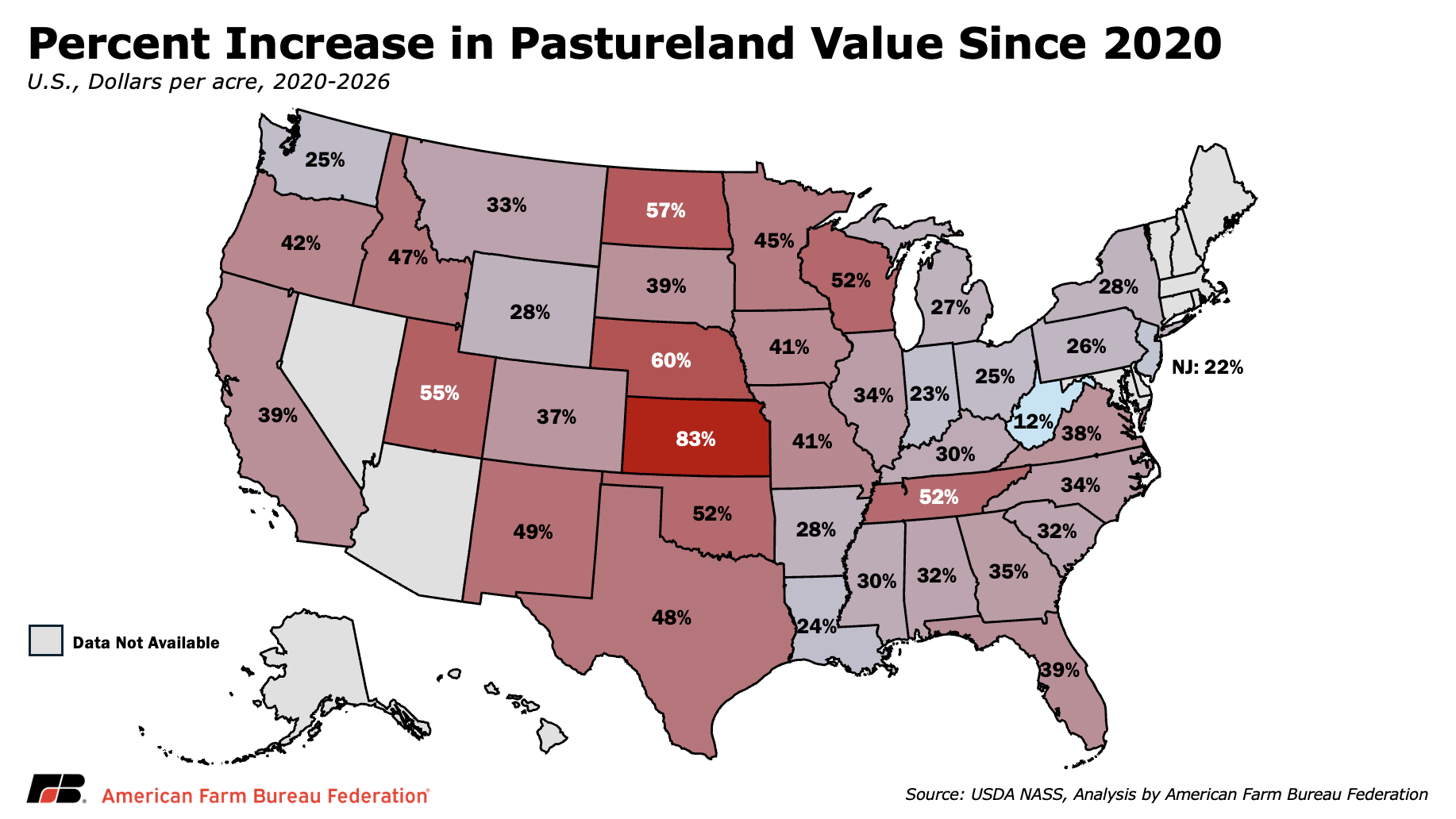
Percentage gains since 2020 were led by Kansas at 83%, followed by Nebraska at 60%, North Dakota at 57% and Utah at 55%. Wisconsin, Oklahoma and Tennessee each increased 52%. The strongest appreciation remained concentrated across the Plains and Midwest.
Cash Rent
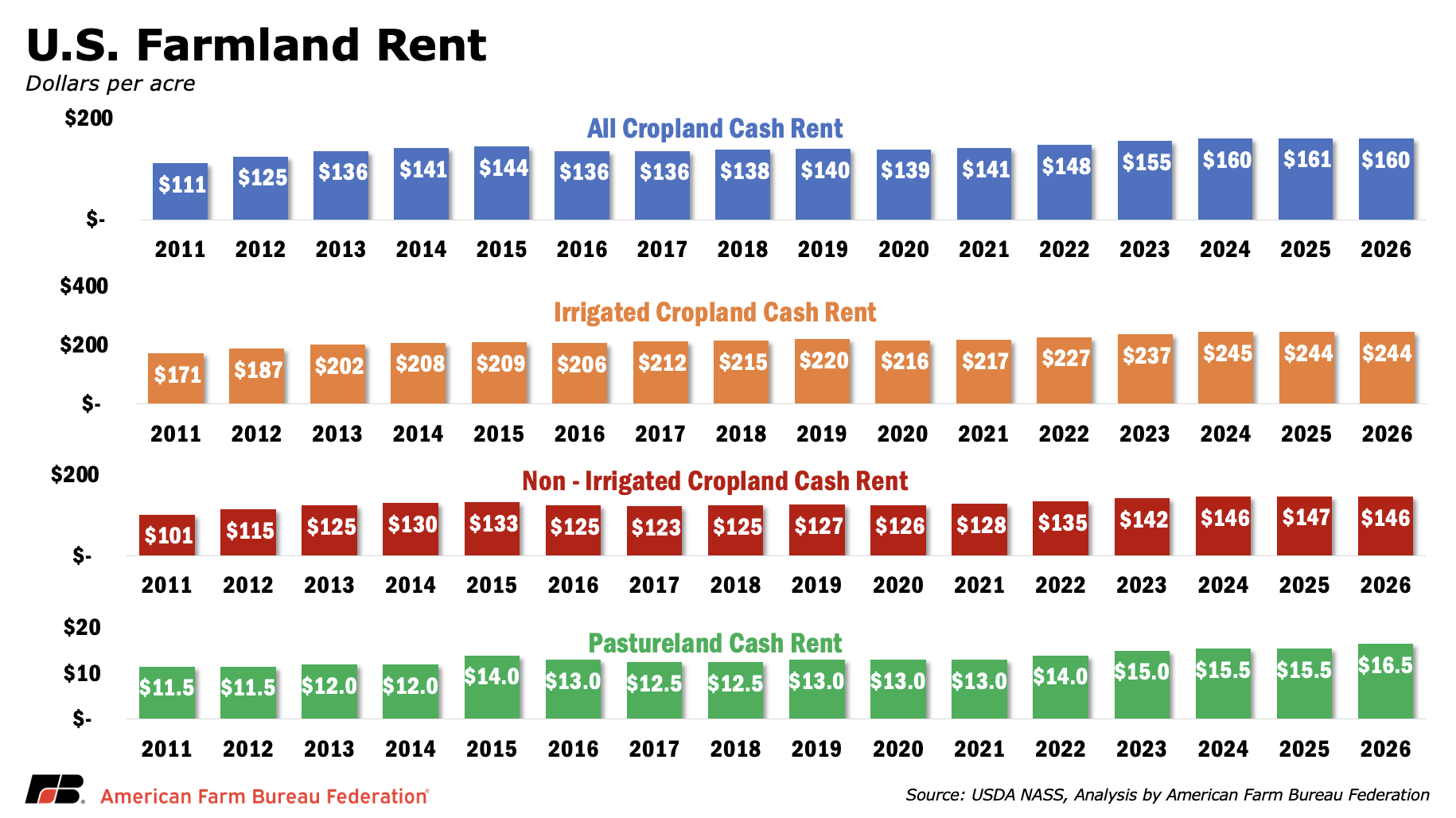
Cash rents generally adjust more slowly than land values and commodity prices because many lease agreements are negotiated before the growing season and reflect earlier income expectations. In 2026, average U.S. cropland rent declined by $1 to $160 per acre, a 0.6% decrease. Irrigated cropland rent held at $244 per acre, non-irrigated rent declined by $1 to $146, and pasture rent increased from $15.50 to a record $16.50 per acre.
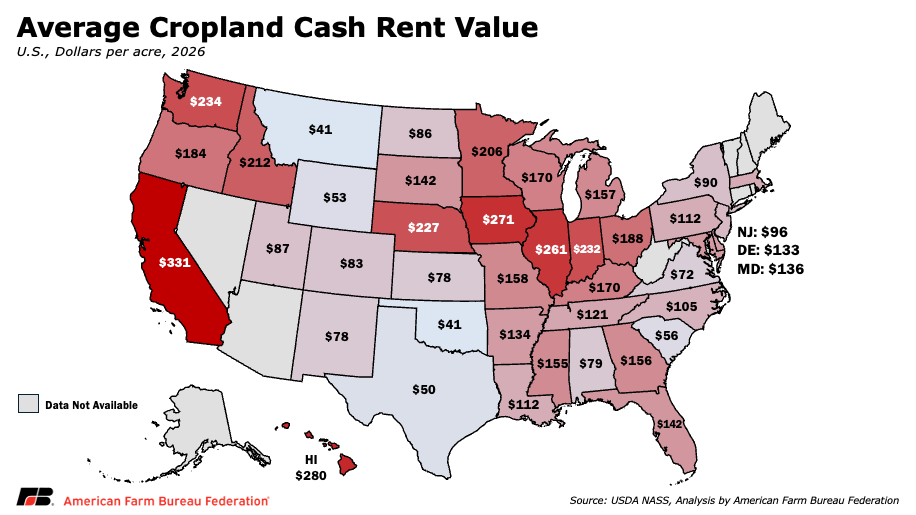
Cash rents remain highest in states where land supports high-value crops or consistently strong yields. California led at $331 per acre, followed by Hawaii at $280, Iowa at $271 and Illinois at $261. Irrigation infrastructure and specialty crop production support rents in California and Hawaii, while highly productive soils and concentrated corn and soybean production underpin rates in Iowa and Illinois. At the other end, Oklahoma and Montana averaged about $41 per acre, followed by Texas at $50 and Wyoming at $53, reflecting lower expected cropping returns across more arid and less intensively cultivated land.
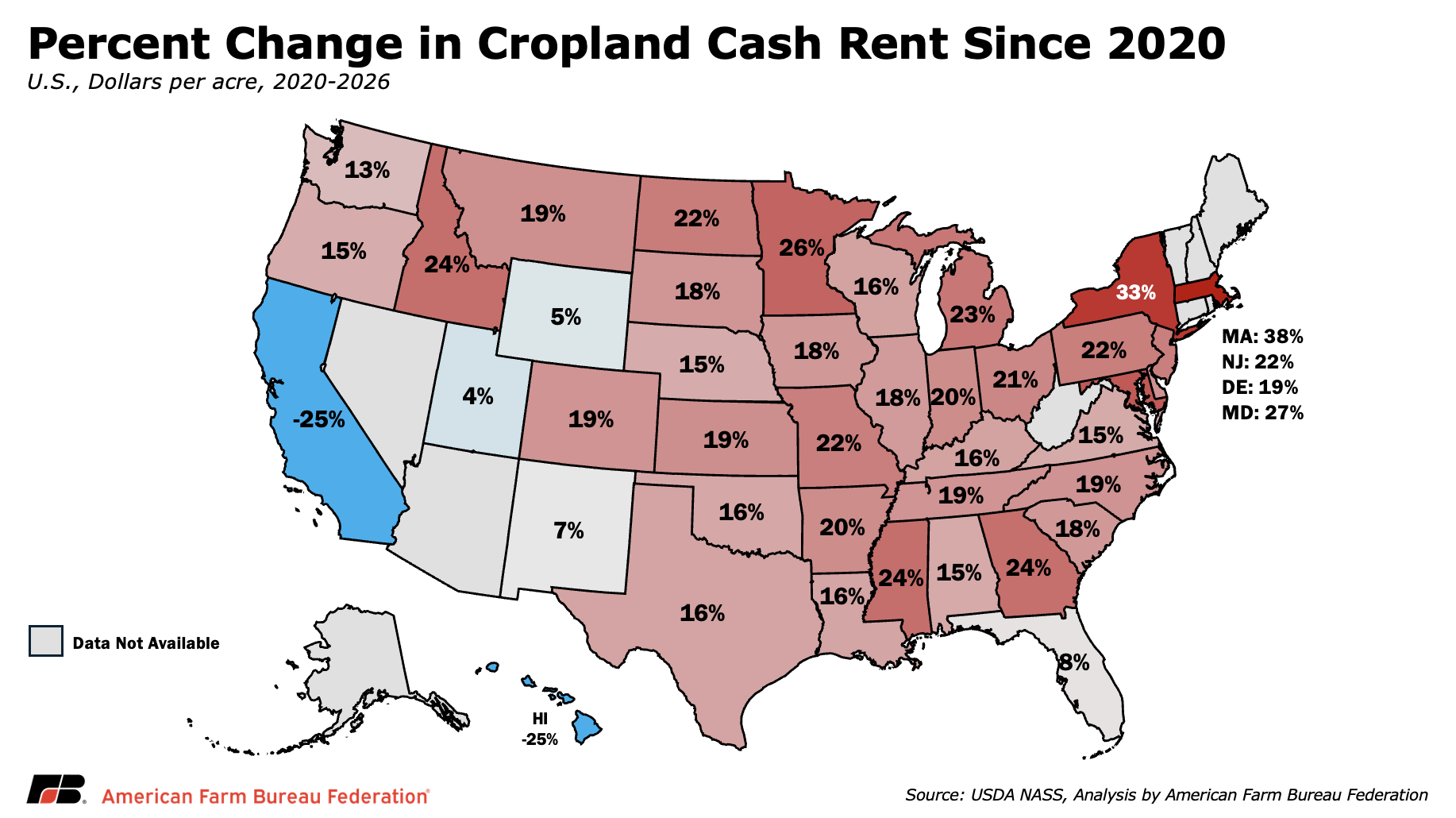
Since 2020, the national average for cropland cash rent has increased 15%, much less than the 48% rise in cropland values over the same period. Most states posted rent increases in the mid-teens or low 20% range, although Massachusetts rose 38%, New York 33% and Maryland 27%. California and Hawaii were notable exceptions, with reported averages down about 25%, though both remained among the country’s highest-rent markets.
For producers, stability near record levels offers little meaningful relief. Rent is a largely fixed expense that may not adjust quickly when commodity prices or farm revenues decline, particularly because leases are often negotiated in advance and based on earlier market conditions. Renters are especially exposed because they bear the elevated operating cost without benefiting from the equity gains associated with rising land values. Competition from other farmers, development, energy projects and rural residential demand can also keep local rents elevated even where agricultural returns are under pressure.
Conclusion
The 2026 report is notable not simply because farmland values reached another record, but because the sharp post-2020 increase is proving durable. Farm real estate values are now nearly 44% higher than in 2020, cropland values are up 48% and pasture values are up nearly 43%. Annual appreciation has slowed, but there is little evidence of a broad reset. Instead, farmland appears to have settled onto a substantially higher cost base.
That shift is creating an increasingly divided experience within the farm economy. Farmers who own land benefit from stronger equity and collateral, while renters, beginning farmers and operations seeking to expand face record purchase prices and rents that remain near historic highs even as crop margins further weaken. Because land values reflect long-term agricultural potential as well as competition from development, energy and other uses, softer commodity markets do not quickly translate into cheaper access. The central issue may therefore be less about whether farmland values rise another 3% or 4% next year and more about who is able to farm it.