Foreign Ownership of U.S. Agricultural Land Still Growing

Faith Parum, Ph.D.
Deputy Chief Economist
Key Takeaways
- The share of foreign-owned U.S. land continues to increase. In 2024, foreign entities held approximately 47.24 million acres of U.S. agricultural land, up 91% since 2010, accounting for 3.6% of agricultural land in the United States.
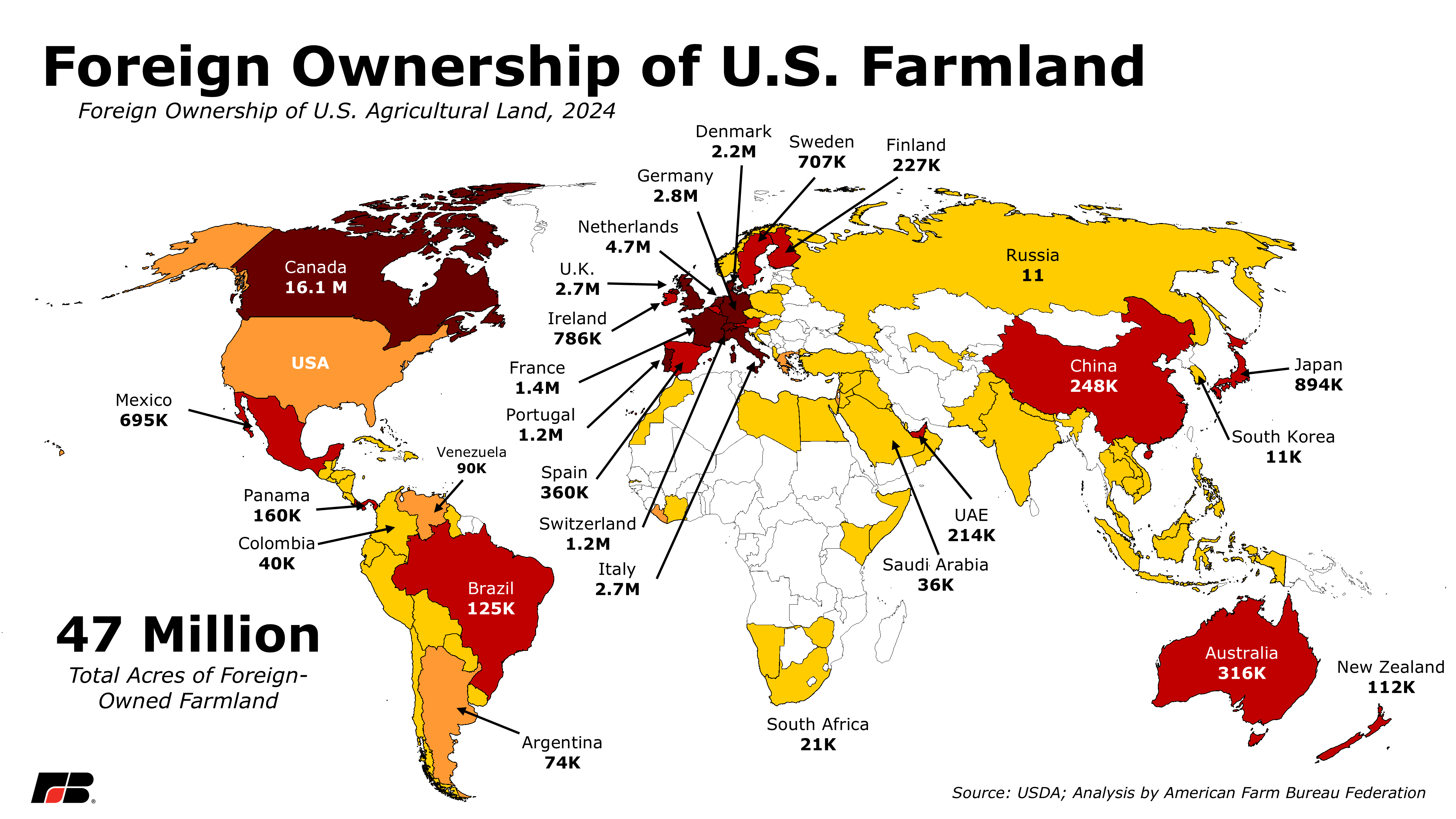
- Entities from Canada and Europe hold the most U.S. land. Canadian investors hold around 16.1 million acres while European countries combined hold more than 18 million acres of U.S. farmland.
- Chinese investment in U.S. farmland has been a large topic of conversation. In 2024, Chinese investors held approximately 245,000 acres. This is less than 1% of foreign-owned agricultural land.
- It is important to note that most of this land is not used in farming. In fact, nearly half is forestland and large amounts are used for renewable energy projects such as solar and wind.
Foreign ownership of U.S. land is a widely debated issue, driven by concerns about national security, agricultural productivity and long-term implications for U.S. agriculture. USDA released updated foreign ownership data for 2024, detailing what foreign investments exist on farmland, where those investments are concentrated and which countries account for the largest holdings.
The latest data show foreign investors holding or leasing around 47.2 million acres of U.S. agricultural land in 2024, representing 3.6% of privately held agricultural land. While this continues a long-term upward trend, the pace has slowed. Most foreign-held agricultural land is forestland or tied to renewable energy projects.
Background
The Agricultural Foreign Investment Disclosure Act of 1978 (AFIDA) requires foreign entities to self-report purchases, sales and other interests in U.S. agricultural land to USDA's Farm Service Agency. Reporting is mandatory, with penalties of up to 25% of the land’s fair market value, but it relies on self-reporting, and enforcement has historically been limited. USDA has proposed regulatory changes to broaden the categories that require reporting and increase penalties for non-compliance. Agricultural land reported under AFIDA includes cropland, pastureland and forestland.
Reportable interests include purchases and leases of 10 years or more, so a foreign-held acre is not always a foreign-owned acre. Much of the land tied to wind and solar projects is leased from U.S. landowners who still own it.
Foreign-Held Agricultural Land Reaches 47.24 Million Acres
According to USDA's 2024 AFIDA report, foreign investors held interests in approximately 47.24 million acres of U.S. agricultural land, an increase of roughly 2.34 million acres compared to 44.9 million acres in 2023. This represents an increase of approximately 3% over the previous year.
Foreign-held acreage has increased substantially since 2010, when foreign investors held approximately 24.8 million acres. The 2024 total represents an increase of approximately 22 million acres, or 90%, over that period.
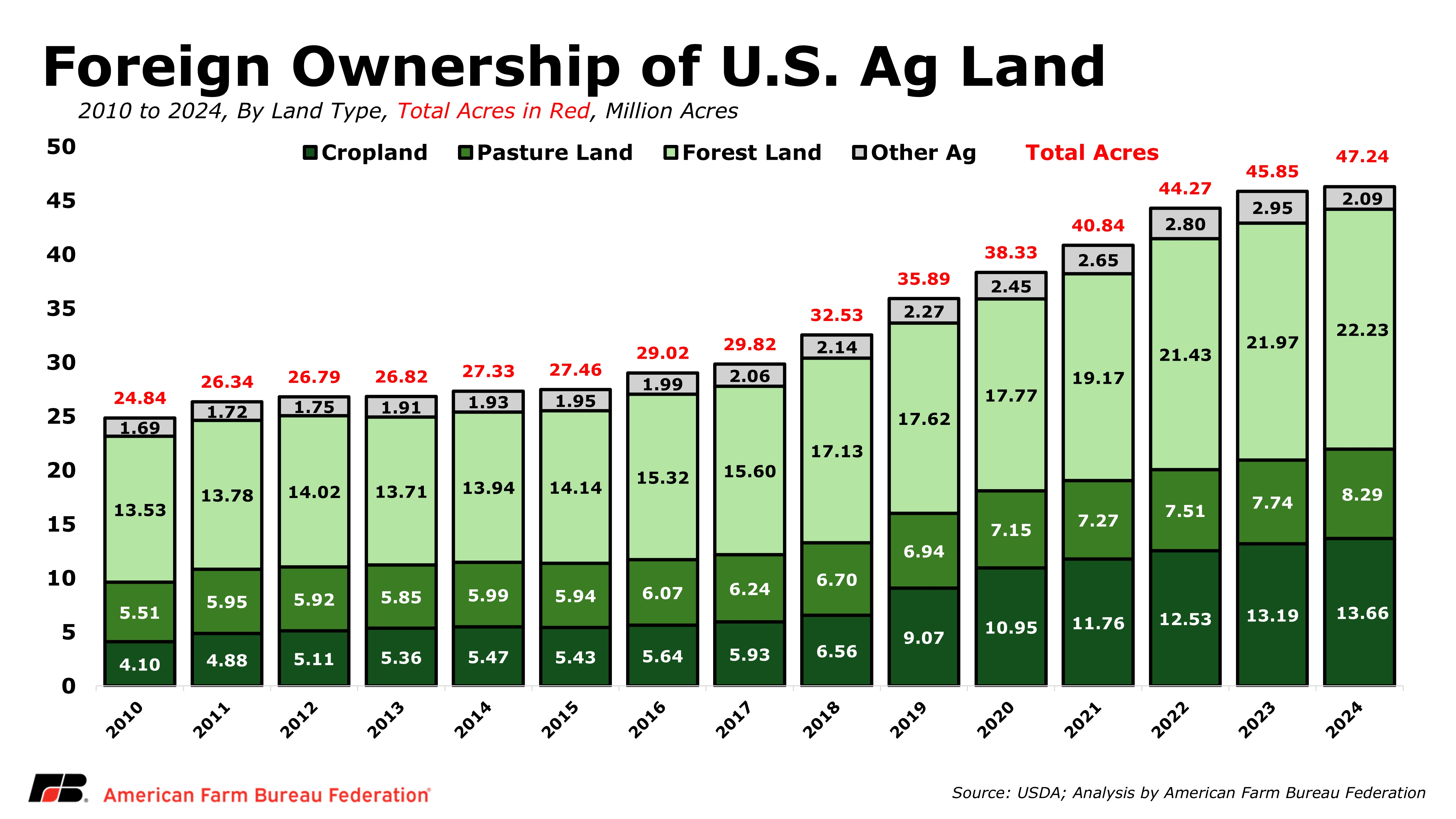
Land use remains an important distinction. Forestland accounted for approximately 22.2 million acres of foreign holdings in 2024, nearly half of the reported acreage. Cropland accounted for approximately 13.7 million acres, with the remainder consisting largely of pastureland and other agricultural land.
The large share of forestland reflects substantial investment by foreign-owned timber and forest products companies. It also underscores why foreign agricultural land holdings should not be interpreted exclusively as foreign purchases of actively cultivated farmland.
Canadian and European Investors Dominate Foreign Holdings
Canadian investors hold 16.1 million acres, about one-third of the total, after adding roughly 781,000 acres in 2024. Investors from the Netherlands, Germany, Italy and the United Kingdom hold another 12.8 million acres, mostly in timber, renewable energy and farming operations. Dutch-linked holdings fell by about 498,000 acres in 2024, while German-linked holdings rose by about 274,000 acres.
Chinese investors held about 245,000 acres in 2024, according to USDA, down roughly 30,000 acres (11%) from 2023 and about 136,000 acres from the 2021 peak. That is 0.02% of privately held U.S. agricultural land, though national security, location and use matter more than acreage.
Where Foreign Holdings are Growing
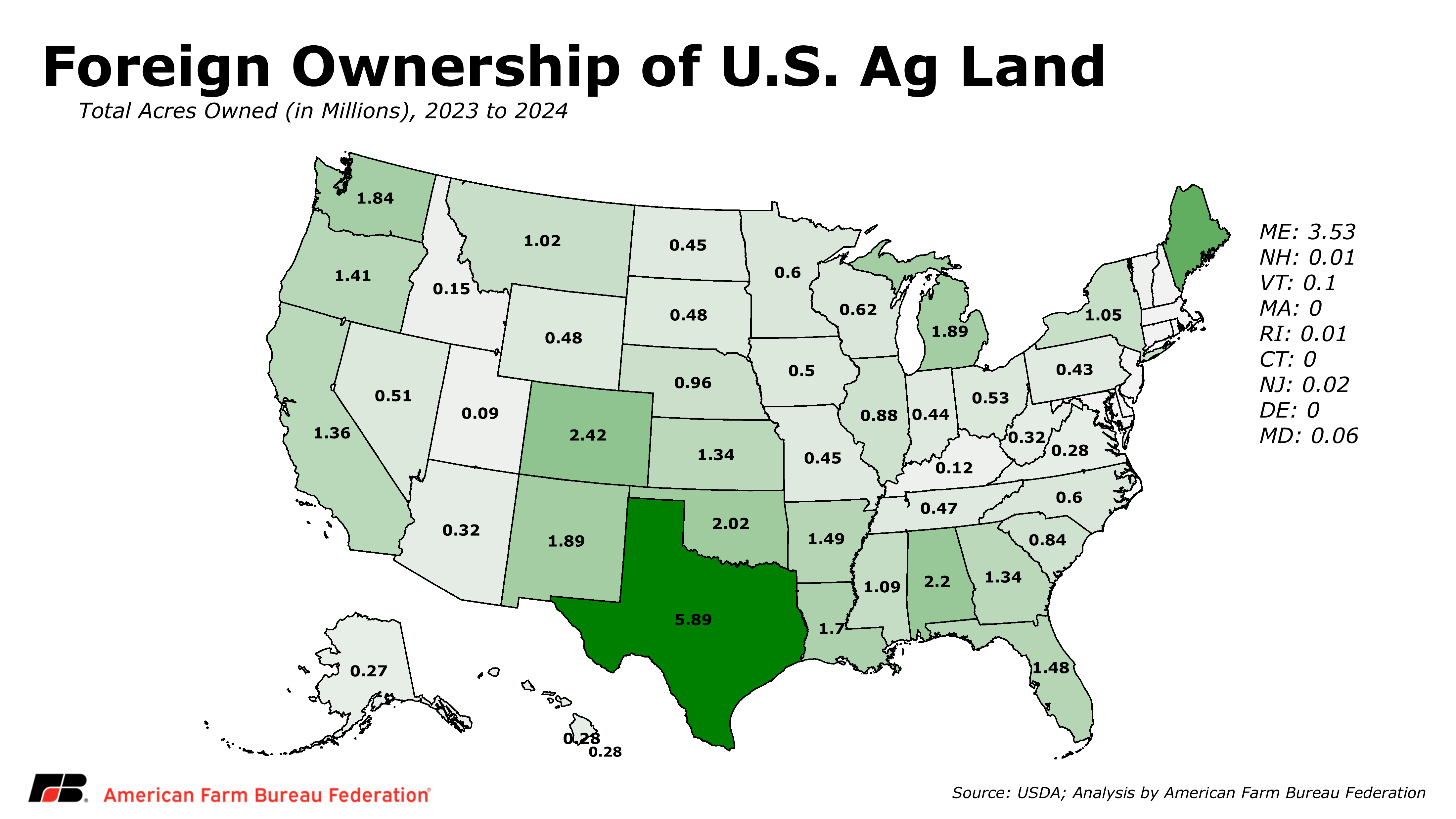
Texas has the most foreign-held agricultural land at 5.9 million acres, a mix of forestland, renewable energy leases and ranchland. Maine follows at 3.5 million acres, nearly all of it timber. As a share of a state's privately held ag land, Maine leads at 21.3%, followed by Hawaii at 17.1%.
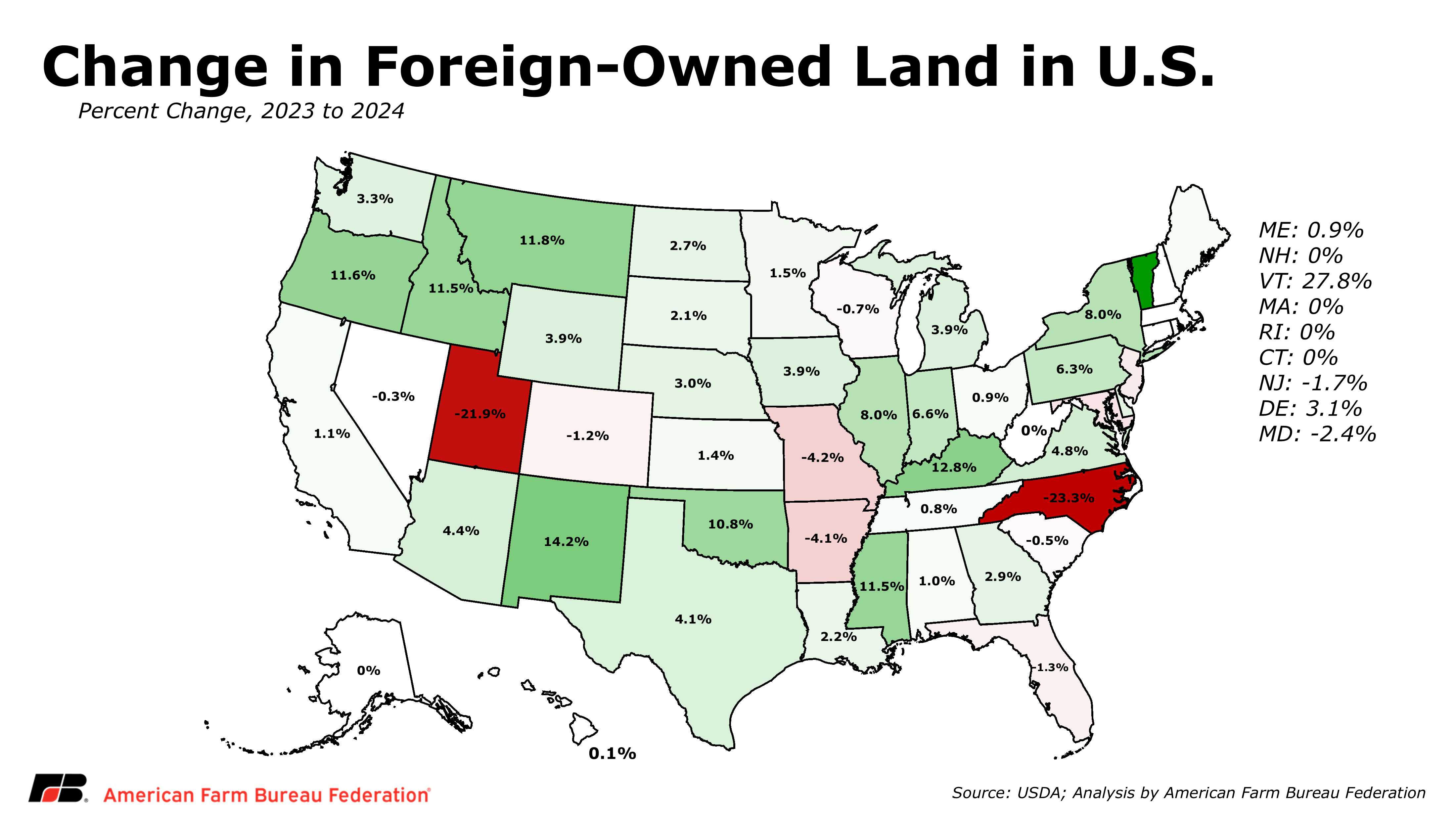
In 2024, 34 states gained foreign-held acreage while 12 lost foreign-held acreage. The largest gains came in New Mexico (+235,000 acres), Texas (+231,000), Oklahoma (+198,000), Oregon (+147,000), and Mississippi (+113,000). Wind and solar leases drove the growth in New Mexico and Texas, while Oklahoma's increase came from a mix of timber and wind. Montana's 108,000-acre gain was almost entirely renewable energy leases.
North Carolina posted the largest decline, down 181,000 acres (23%), almost entirely from one foreign timber company reducing its holdings. Arkansas fell by 64,000 acres.
Renewable Energy Remains an Important Driver
In previous analyses, AFBF looked at the role of renewable energy development in increasing reported foreign agricultural land holdings. Because AFIDA includes long-term leases, foreign energy companies may report substantial acreage associated with wind and solar projects without purchasing the underlying land. In many cases, agricultural production may continue alongside renewable energy development. USDA reports that less than 1% of land tied to foreign wind energy companies is owned outright, and the vast majority keeps the same operator after the lease is signed.
Using the same approach as AFBF's previous analysis, we examined foreign-held acreage associated with entities whose names included terms such as "wind," "solar," "renewable" or "energy." Acreage associated with these companies increased from 2.9 million acres in 2010 to 14.2 million acres in 2024, a nearly 390% increase.
Conclusion
Foreign-held agricultural land grew to 47.2 million acres in 2024, driven mostly by Canadian and European timber and renewable energy interests rather than purchases of working cropland. Holdings linked to China remain small and are shrinking. For farmers and ranchers, the bigger question is how long-term energy leases reshape land use and competition for ground in their communities. Accurate, enforced AFIDA reporting remains essential to tracking these trends.