Hog Profits Persist, but Demand Signals Caution

Bernt Nelson
Economist
Key Takeaways
- USDA’s September Hogs and Pigs report confirmed a smaller U.S. hog herd with total inventories near 74.3 million head, about 2% below a year ago, while the breeding herd remains historically tight.
- Hog farmers continue to resist major expansion but have not entered widespread liquidation. Farrowing intentions point to little growth potential through early 2027.
- USDA lowered pork export expectations for both 2026 and 2027, citing softer global demand and increasing competition from Canada and Brazil, particularly in Mexico, the largest foreign market for U.S. pork.
- Hog farmprofitability remains positive but vulnerable. Rising feed costs, driven by higher corn prices, are narrowing margins and could trigger herd liquidation if hog prices continue to weaken.
The U.S. hog market is sending mixed signals for the remainder of 2026. Hog supplies continue to tighten as farmers resist expansion. Yet lower futures prices are signaling concerns that pork demand may be weakening faster than supplies are shrinking.
USDA’s September Hogs and Pigs report reinforced this reality. The total inventory of hogs and pigs on Sept. 1 was 74.3 million head, about 2% below last year, but up about 1.6% from revised estimates for last quarter’s report. 2026 inventory numbers were down in every market weight category. Breeding inventories remained tight, pig crops were smaller and farrowing intentions point toward slight growth in 2027.
Tight Breeding Herd, But no Evidence of Broad Liquidation
The breeding herd was estimated to be 5.87 million head, down 62,000 head, or 1%, from last year and is the smallest since 2013. The June-August pig crop was estimated at 34.5 million head, down about 1.5% from a year ago. This was the result of fewer farrowings during the same time, estimated to be about 2.89 million, down 2.7% from a year ago. Pigs saved per litter were 11.96 —slightly more than 1% above 11.82 a year ago, partially offsetting the lower farrowings. None of this data suggests expansion in the hog sector, but it also doesn’t suggest major liquidation that is typically tied to a decline in supply.
Recent production trends help explain why ample supplies remain available even with a smaller herd. According to USDA's September Livestock, Dairy and Poultry Outlook, August federally inspected hog slaughter totaled approximately 9.9 million head, down 2.1% from a year earlier. Yet pork production declined by less than 1%. This was largely due to average dressed weights that were 212 pounds per head, about 3 pounds heavier than August 2025. These factors led USDA to estimate 2026 pork production at 27.77 billion pounds, nearly 1% above 2025 levels.
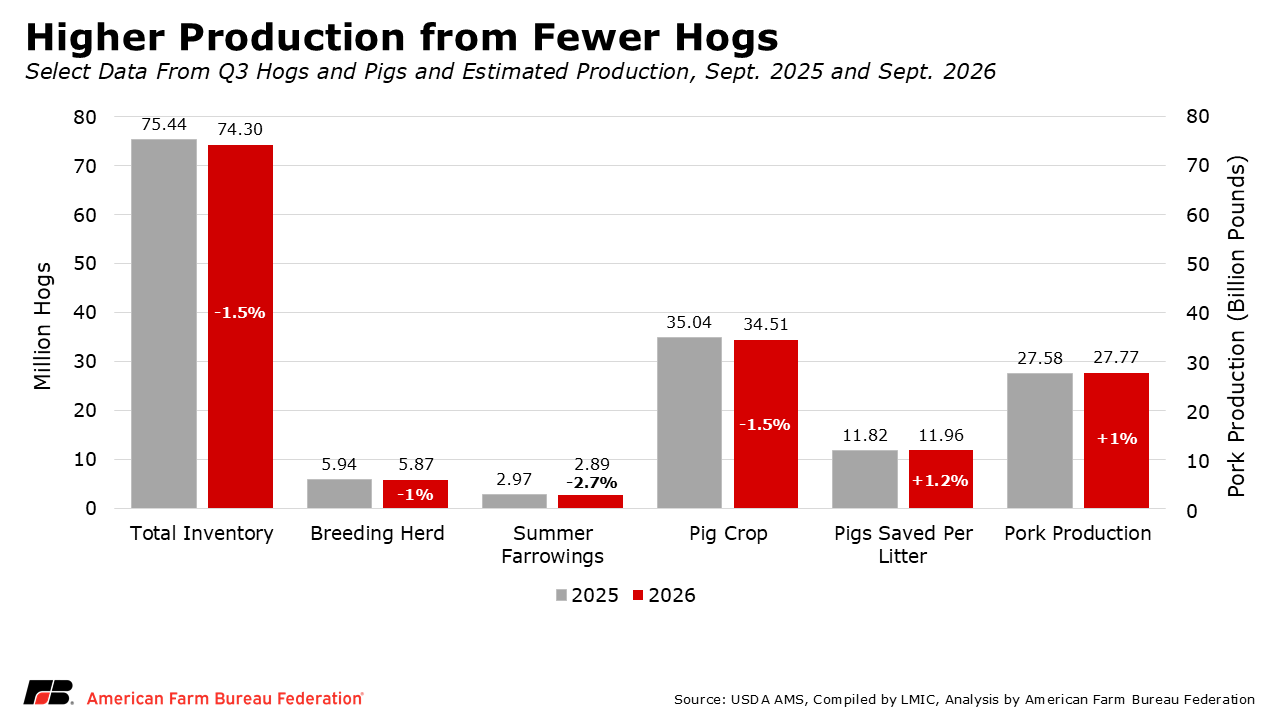
The disconnect between herd size and pork production is one reason behind weakness in the futures markets. Traders appear increasingly convinced that there will not be a shortage of butcher hogs moving into 2027.
Export Demand Losing Momentum
Demand is becoming harder to ignore as the industry moves closer to 2027. About 30% of all U.S. pork production is exported, making international demand a critical source of value for U.S. hog farmers. USDA’s September Livestock, Dairy and Poultry Outlook further reduced quarterly export forecasts for both 2026 (7.11 billion pounds) and 2027 (7.19 billion pounds) due to stronger competition and softer demand in several key markets. Mexico warrants the most attention because it accounts for roughly 40% of U.S. pork exports. USDA data show July pork shipments to Mexico totaled 207 million pounds, down 2% from a year ago at the same time. USDA’s Foreign Agricultural Service (FAS) August Global Agricultural Information Network (GAIN) report indicates that Mexican pork production continues to expand as disease pressures ease and producers adopt improved technology and biosecurity practices.
Mexico isn’t the only market showing signs of pressure. July exports to South Korea fell nearly 30% year-over-year as European suppliers, particularly Spain, continue capturing market share. Stronger competition from the European Union, Canada and Brazil has reduced opportunities for U.S. pork and contributed to USDA’s lower export outlook.
Weekly export data tells a similar story. While export volumes remain respectable, shipments have increasingly shifted toward lower-value cuts. USDA noted that hams accounted for nearly 14% of export loads in August, more than double their share a year ago, as exporters moved product amid sharply weaker ham prices. The bottom line is pork exports are still flowing, but not at the volumes or values needed to create meaningful scarcity in the global pork market.
Demand Weakness Eventually Requires Lower Prices
Right now, demand appears to be cooling faster than pork supplies are tightening. Alongside higher expected production, USDA’s monthly Cold Storage report estimates that stocks of pork in warehouse freezers are up 12% from 2025 levels.
Domestic demand may also be facing additional challenges. Proposition 12 appears to have created a lasting reduction in California pork demand. Researchers found sustained retail pork price increases and a decline in California's share of U.S. pork purchases from 8.5% to 7.1% following implementation. Because California is such a large pork market, even modest reductions in purchases can have big impacts on overall pork demand.
Meanwhile, USDA’s September Outlook notes that August live hog prices averaged $69.43 per hundredweight, nearly 11% below year-ago levels, while the wholesale pork cutout averaged $98.83 per hundredweight, down more than 14% from August 2025.
Much of the weakness in the cutout comes from hams and bellies. USDA reported that late-August ham prices were more than 31% below year-ago levels while belly prices were nearly 17% lower. Together, those cuts account for about 41% of the total carcass value, meaning weakness in just those two primal cuts can have a big impact on overall pork prices.
Meatpackers are feeling the pressure as well. USDA estimates that gross processor spreads averaged about $25.50 per head in August compared to $33.69 per head during the same time a year ago. Even though processors are paying less for hogs, slow demand has eroded profitability throughout the supply chain.
Hog farmers have not yet responded with strong liquidation. Sow herd reductions remain gradual rather than aggressive, and producers continue marketing heavier hogs instead of substantially reducing production capacity. If export demand continues to struggle alongside domestic consumer demand, lower prices and more aggressive liquidation could occur.
Rising Feed Costs Threaten Producer Margins
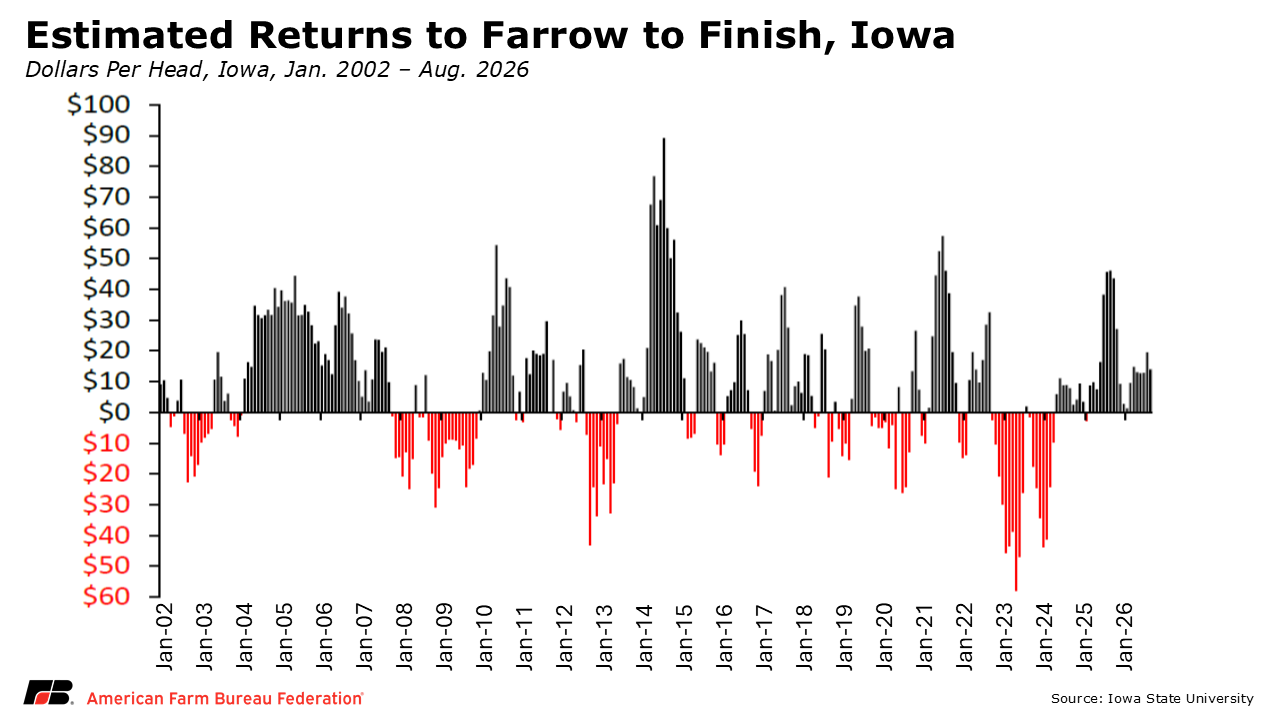
The financial outlook for producers remains mixed. Iowa State University's farrow-to-finish profitability estimates continue to indicate positive returns for much of 2026, but USDA’s latest outlook notes that current price forecasts are putting many hog farmers at or near break-even levels. USDA projects 2026 hog prices to average about $65 per hundredweight and 2027 prices near $64 per hundredweight. The pork cutout has declined roughly 20%, or about $21 per hundredweight, since September 2025 due to lower prices for hams and bellies.
At the same time, feed costs are beginning to move higher due to rising prices for grain, like corn. The University of Illinois FarmDoc analysis estimates average swine feed costs could rise nearly 10% in 2027 compared with 2026, assuming current grain price projections hold.
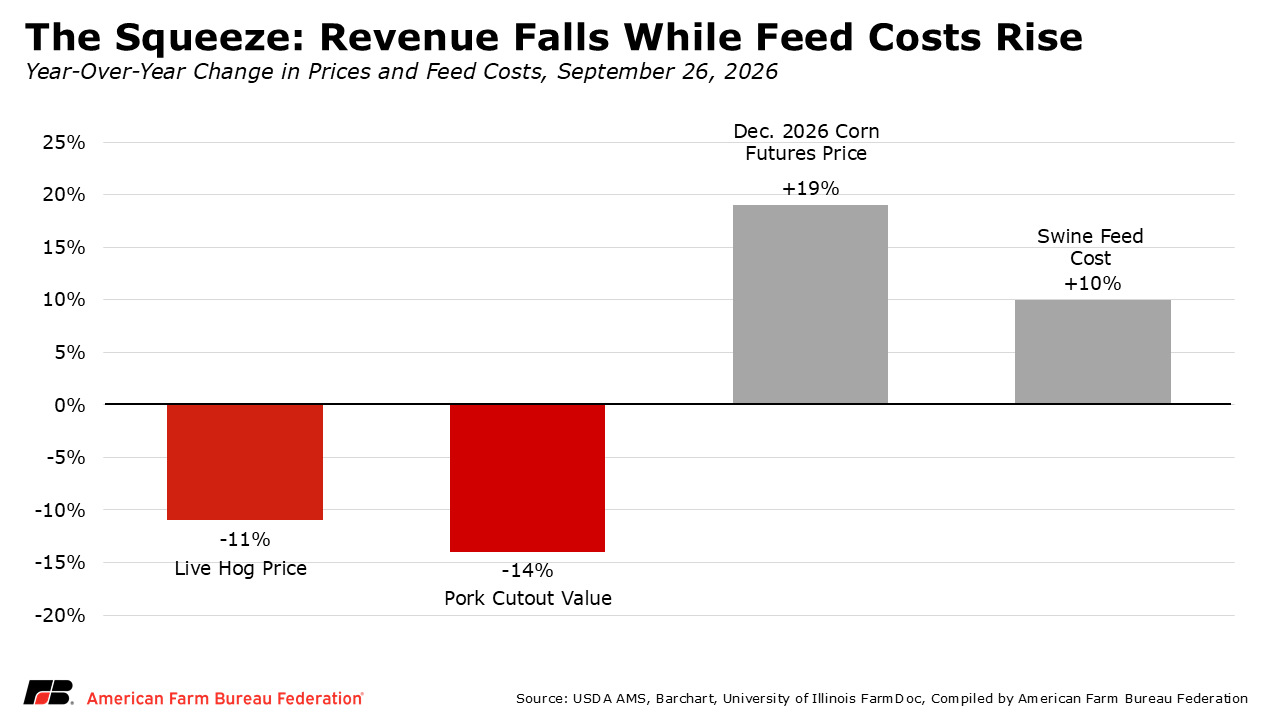
Feed costs are particularly important because feed accounts for as much as 70-75% of operating costs for hog farmers. Even modest increases in corn prices can quickly erode profitability when hog prices are declining.
For now, margins remain positive enough to discourage widespread liquidation. However, if hog prices fall at the same time feed costs rise, the industry's willingness to maintain current production levels could change rapidly.
Outlook Through 2026
The data contained in USDA’s September Hogs and Pigs report confirmed what futures have been signaling for months: A smaller breeding herd has not translated into significantly tighter pork supplies. Heavier market weights and improved productivity continue to offset a smaller hog inventory.
At the same time, export demand is becoming less reliable. Competition from Brazil, Canada and Europe is growing, while key markets like Mexico and South Korea are showing signs of slower demand growth.
For now, positive margins are giving hog farmers little reason to aggressively liquidate herds. But that support could become less certain if feed costs continue to climb and hog prices continue to erode. Heading into 2027, demand is positioned to play a much larger role in determining market direction than herd size alone.