Mandatory Base Acre Update Would Hurt Farmers

Faith Parum, Ph.D.
Economist
Key Takeaways
- H.R. 1 allows eligible farms to voluntarily add base acres as provisions allow up to 30 million new base acres to be allocated to farms that have historically produced program crops but don’t currently have base acres.
- A mandatory base acre update would hurt farmers across the country, costing the farm economy billions in lost risk management support and eliminating any base acre gains for farmers under H.R.1.
- By redistributing and eliminating base acres among farms, commodities, counties and states, it would create new divisions within agriculture and make passage of a new farm bill more difficult, if not impossible.
- A mandatory base acre update would reduce projected commodity program benefits by $2.24 billion annually, or approximately $18 billion from fiscal years 2029 through 2036, with farmers in every state losing risk management support.
As the U.S. Senate Committee on Agriculture, Nutrition, and Forestry prepares to mark up the farm bill (also known as The Agricultural Act of 2026), debate over whether to require a mandatory base acre update has resurfaced.
Farm programs such as Agriculture Risk Coverage-County (ARC-CO) and Price Loss Coverage (PLC) use base acres to determine program payments. Base acres reflect a farm’s historical planting rather than what is planted in the current crop year. This decoupling allows farmers to respond to market signals, weather conditions and agronomic needs without government payments influencing annual planting decisions.
However, production has shifted considerably since many base acres were established. Some farms now produce covered commodities on land with little or no base, while others maintain base for crops that remain part of a larger and more diverse crop rotation.
H.R. 1 addressed this disconnect without taking support away from existing base holders. The law allows USDA to add up to 30 million base acres to eligible farms, including many run by young, beginning and small farmers, where recent planted and prevented-planted acreage exceeds existing base.
A mandatory update would take a different approach by redistributing existing base acres based on more recent planting history. This Market Intel evaluates how such a proposal would affect the farm safety net and the farmers who depend on it.
Losses Reach Every State
Based on USDA Farm Service Agency Crop Acreage Data and estimated program payments from the 2026 Baseline for USDA Mandatory Farm Programs for fiscal years 2029 to 2036 (eight years), it is estimated a mandatory base acre update would reduce commodity program benefits by approximately $2.24 billion annually and reduce the farm safety net across the country. From fiscal year 2029-2036, the farm safety net would have a net loss of $18 billion across commodity program payments. Additionally, a mandatory base acre update would create winners and losers across the country, with some counties gaining support while others lose.
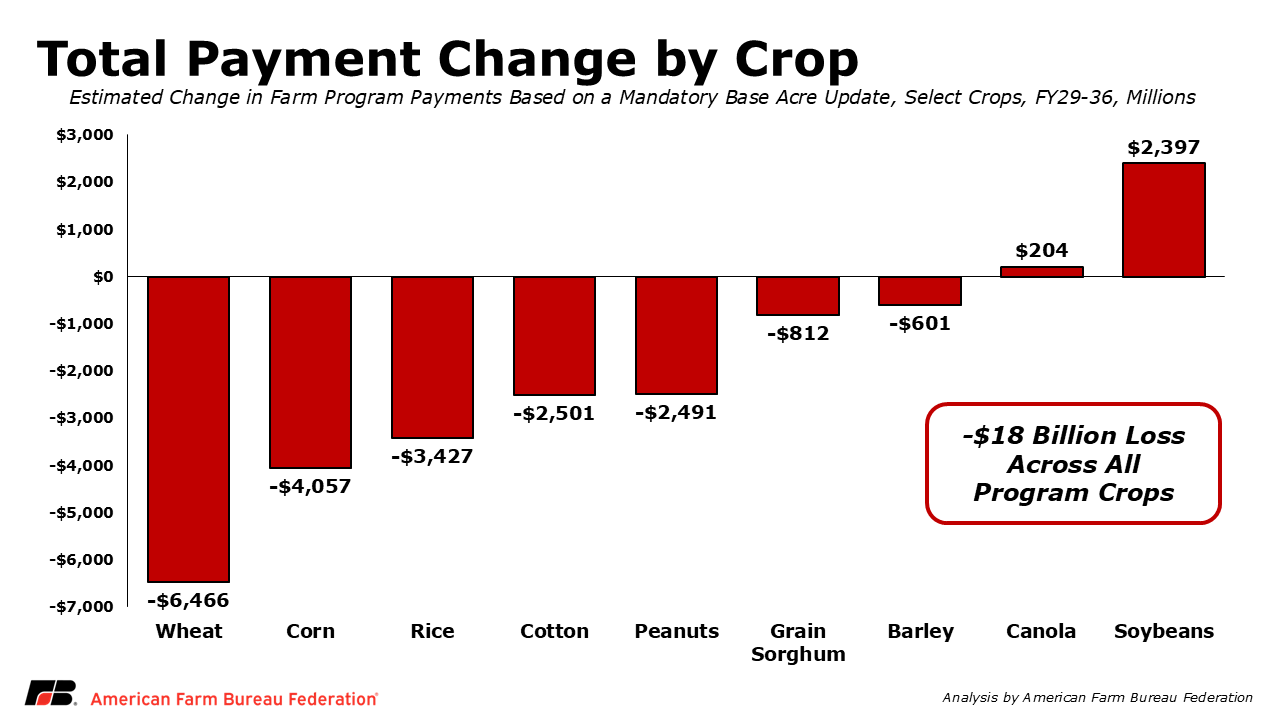
Wheat would account for the largest reduction in annual average ARC-CO and PLC payments, with a total decrease of $6.5 billion over eight years. Corn would lose $4 billion, followed by rice at $3.4 billion, and cotton and peanuts at $2.5 billion each.
Soybeans would gain approximately $2.4 billion in projected benefits, but the increase would cover only a fraction of the losses experienced by other commodities.
The effects would also extend beyond traditional wheat, cotton and rice regions. Every state would experience a net decline in projected support. Texas would face the largest cumulative loss at approximately $2.3 billion, followed by Arkansas and Louisiana at $1.2 billion each, and Mississippi at $1.1 billion.
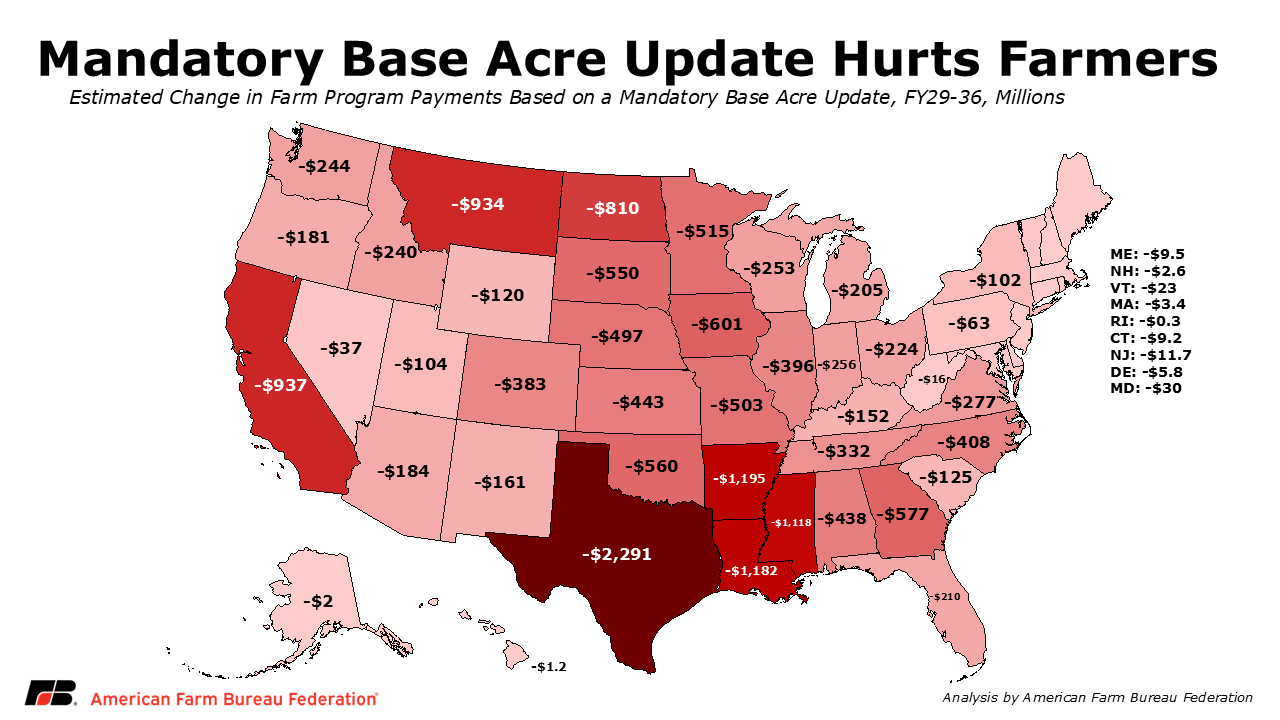
States outside of the South would likewise suffer losses. North Dakota would lose approximately $810 million and Montana would lose $934 million, while California would lose around $937 million.
Bottom Line
A mandatory base acre update would dramatically reduce the farm safety net and risk management options for farmers at a time when there is already bipartisan support to reinforce the farm economy with additional economic support on top of the major investments made in H.R. 1.
That is particularly concerning as Congress works toward a new farm bill. A proposal that would significantly weaken the risk management support Congress strengthened in H.R. 1 at a time when the farm economy is experiencing a multi-year economic downturn runs counter to congressional goals of supporting farmers, ranchers and rural economies.