Optimizing Dairy Diets with High Oleic Soybeans

Faith Parum, Ph.D.
Deputy Chief Economist
Cydney Stables
AFBF Economics Intern
Key Takeaways
- High oleic soybeans (HOSBs) have longer lasting cooking oil and whole roasted soybeans can be used in dairy feed.
- Farmers in 16 states (mainly Midwestern) are currently growing HOSBs, with over 1 million acres planted in 2025 and an estimated 5 million-7 million acres forecasted in the next decade.
- Soybean farmers earn a 75 cent–$1.25 per bushel premium on HOSBs above traditional varieties. HOSB production costs per acre are the same as traditional varieties.
- Dairy farmers can reduce feed costs by 27–65 cents per cow per lactating day by incorporating high oleic soybeans into feed regimens because of the increase in milk fat yields.
- The United Soybean Board and Michigan State University are driving research efforts on the potential value proposition and performance metrics for high oleic soybeans (HOSBs).
A specialty soybean originally developed for food use is increasingly finding a market in dairy cattle feed, creating a potentially valuable new demand source for soybean farmers while helping dairy producers lower feed costs, improve milk components and increase income over feed costs in volatile feed markets.
High oleic soybeans were originally developed for food manufacturers looking for a versatile cooking oil with a neutral flavor, high heat stability and longer shelf life. Today, their fastest-growing market is dairy cattle feed. With roughly 1 million HOSB acres planted in 2025 and more than half of production designated for dairy rations, researchers and industry leaders believe high oleic soybeans could become the next major value-added crop opportunity.
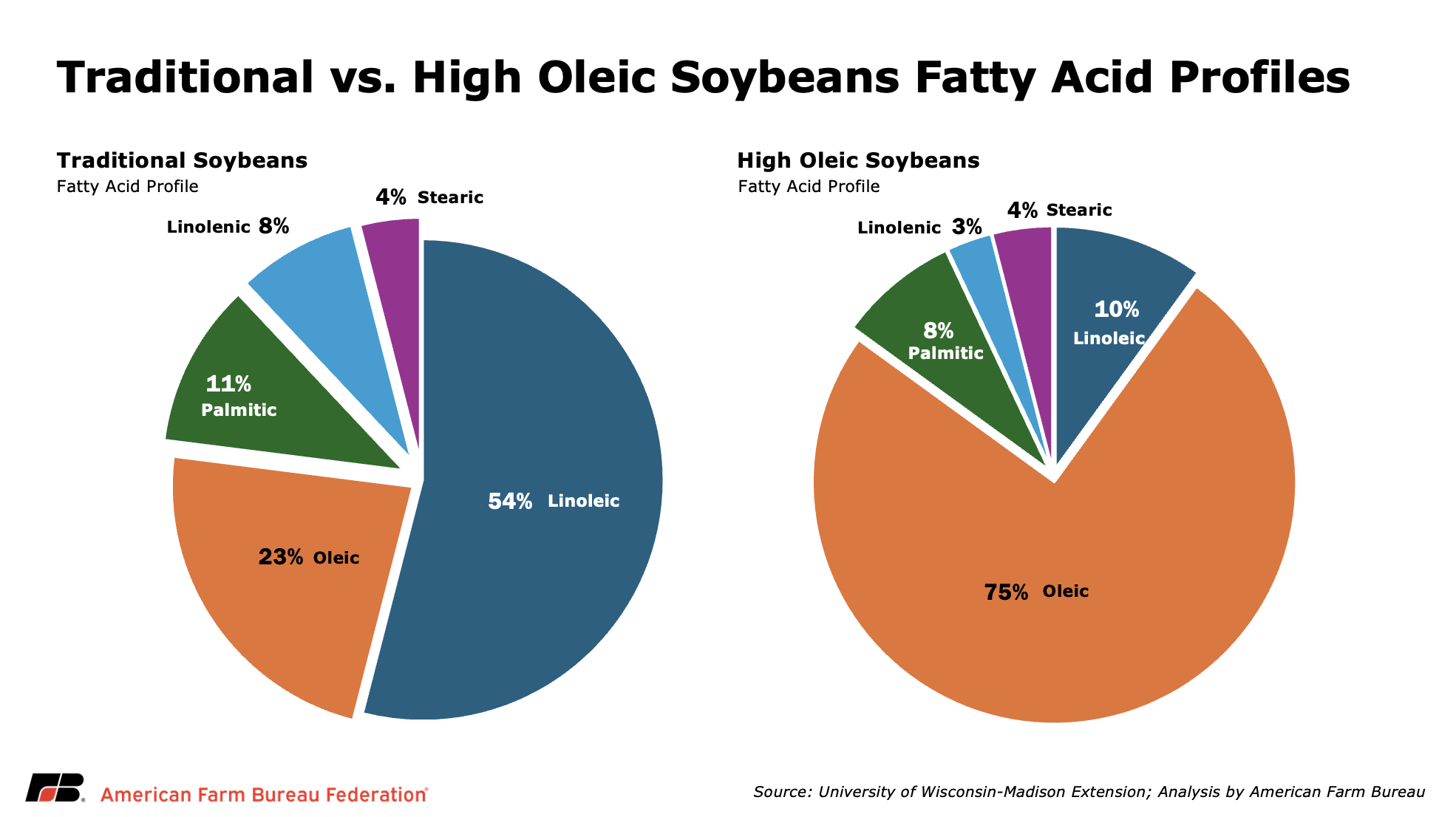
HOSBs are a specialty soy variety with higher levels of oleic acid (75% compared to 23% in traditional soybeans) and lower levels of linoleic acid–fatty acid compounds found naturally in soybeans. Linoleic, oleic, palmitic, linolenic and stearic are the omega 3, omega 6, omega 9 and saturated fatty acids that make up a soybean fatty acid profile. Oleic acid contributes to the longevity and stability of soybean oil, extending its shelf life. This unique acid profile has proven useful in a market where there is demand for foods with lower saturated fat levels, increased heat resistance and greater versatility than traditional varieties.
HOSBs are used in a variety of ways, including as a feed ingredient in dairy cattle rations (55%), in human food (43%) and industrial purposes (2%).
Production Estimates
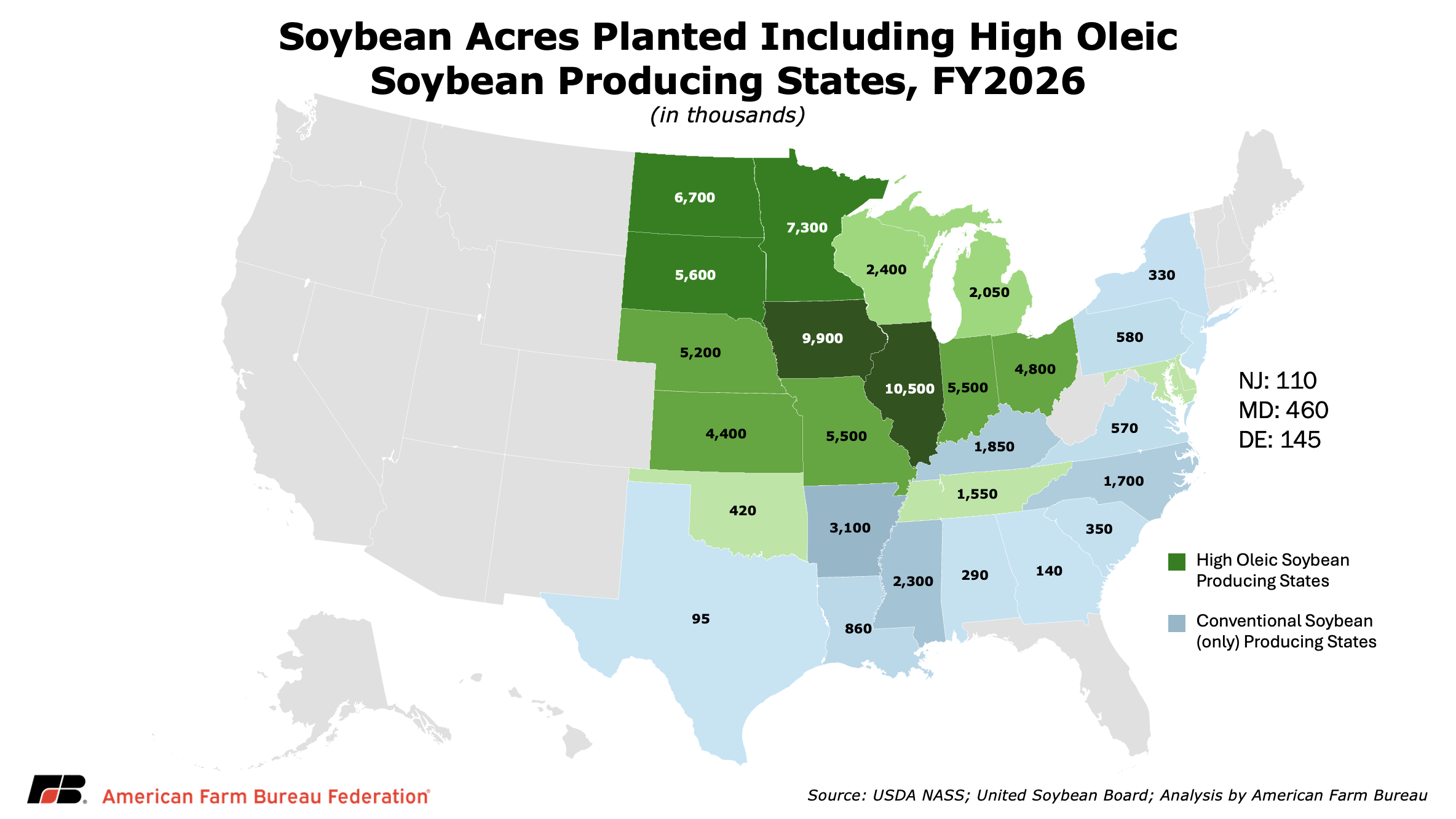
High oleic soybeans have been grown in the U.S. since 2012, but acreage planted has recently expanded due to an uptick in HOSB usage for dairy cattle feed. Farmers in 16 states currently grow HOSBs (mainly Midwestern), with the highest concentration of acres in Ohio and Indiana. While production data is limited, the United Soybean Board has estimated that nearly 1 million acres of HOSBs were planted in 2025, with future expansion reaching 5 million-7 million acres in the next decade, underscoring the market’s growth potential.
Soybean harvested area for 2025 was 80.4 million acres, meaning HOSBs accounted for roughly 1.24% of total production last year. Soybean planted area for 2026 is estimated at 84.7 million acres, up 4% from last year. With greater demand, the percentage of HOSB production compared to total soybean acreage harvested is forecasted to increase anywhere from 4.66% to 7.02% within the next decade.
HOSBs are gaining traction as farm costs are increasing. USDA’s most recent production costs forecast for major field crops includes a record-high $683.89 per acre for soybeans this year and $701.48 per acre in 2027, potentially making the premiums for HOSBs an appealing option. is moving in conjunction with HOSB demand. Producers are searching for avenues to capture premium pricing for their crops while maintaining or reducing production costs.
HOSBs are generally not more costly to grow than traditional varieties. They offer comparable production costs, with the main difference being additional market access.
To date, adoption of HOSBs is seed availability; in fact, Michigan seed suppliers ran out of HOSB seed last year. There are currently 21 specialty varieties of soybeans available that produce oil with higher oleic acid, including Plenish® from Corteva, Vistive Gold® from Bayer and SOYLEIC® from Beck’s.
For soybean farmers it is important to consider potential implications when switching to a new variety. Producing clean, high-quality beans is essential for staying within the premium pool. HOSBs must fit into your farm operation based on personal needs, constraints, and goals.
The High Oleic Advantage: Dairy Feed Applications
Companies including Nestlé and Frito-Lay continue to demand HOSBs for their unique fatty acid profile and oil longevity. On the industrial side, HOSBs serve as a lower-cost alternative for biobased products as the oil provides excellent stability and high-heat performance. However, the latest and most unique application of HOSBs is in dairy cattle nutrition.
Research led by land-grant universities shows HOSBs provide high-quality fat and protein sources for cattle at a reduced cost. According to the research, HOSBs did not impact milk production, but did show slight increases in milk fat concentration.
Traditional roasted soybeans have been a common source of fat (15%-22%) and protein (33%-40%) in dairy cattle’s total mixed rations. However, traditional soy is high in certain fatty acids that cause milk fat reduction, limiting its use in dairy rations.
HOSBs contain a rumen-bypass protein that allows cattle to absorb the energy and nutrients without disrupting normal fermentation and beneficial fatty acids. Rumen-bypass proteins are energy dense, so adding these sources to cattle diets can increase milk yield without increasing feed volume. Farmers can increase milk fat content and yield, while reducing feed costs and maintaining rumen health.
When substituting HOSBs for traditional roasted soybeans, high oleic soybeans resulted in 0.17 units higher milk fat concentration and 0.2 pounds higher milk fat yield, according to a Penn State University study. HOSBs contribute more fat and protein to dairy rations, directly translating to stronger milk components and increased profitability for farmers.
Replacing purchased protein and fat supplements with roasted HOSBs can significantly improve margins. Research trials have fed diets containing 5% to 24% HOSB (on a dry matter basis) to lactating cows and reported positive outcomes in feed intake and milk fat yields. For an industry paid based on the components in their milk, finding a feed source that can increase milk fat yield and improve feed efficiency without negatively affecting intake is a huge win for dairy farmers.
Research showed promise that dairy producers could decrease their feeding cost when planting soybeans themselves or purchasing from local growers. The income-over-feed-cost advantage is 65 cents per cow per lactating day for farms producing and roasting their own HOSBs and about 27 cents per cow per lactating day for farms buying roasted beans and paying transport, according to Michigan State University research. Income-over-feed is a metric used to calculate the money left over from selling an animal’s output (milk in this case) after subtracting the cost of the feed. It highlights farm efficiency as producers balance feeding high-quality rations and maximizing profitable output.
The overall profit advantage of producing and roasting the beans on-site is where the margins positively shift. On a 1,000-cow dairy, producing, roasting and feeding HOSBs could be a difference of $50,000-$60,000 a year in profit given typical butterfat prices for 2025.
Farm Margins
High oleic soybeans have returned $396 million in premium payments to farmers to date, providing an opportunity for producers in the Midwest to capture market premiums. HOSBs offer improved dairy feed performance, enhanced oil stability and greater industrial applications. Expanding into three new major markets has allowed HOSB producers to earn a 75 cents–$1.25 per bushel premium above traditional varieties. While HOSBs offer increased profit potential, it doesn’t take away demand from commodity soybean oil, which still meets the needs of many food and nonfood customers.
HOSBs unique fatty acid profile expands the market and uses for soybeans with the same agronomic performance as traditional varieties. The United Soybean Board has funded $139 million through its checkoff to advance research on HOSBs, including investments in improving seed genetics. Discoveries are leading to stronger HOSB genetics that are on par with or better in yield, have more resistance to diseases, and have better quality oil than traditional varieties.
Conclusion
HOSBs improve dairy milk fat yields, lower feed costs and improve dairy profit potential, while offering premium prices to soybean farmers. HOSBs create a unique opportunity for dairy farmers but more research is needed to determine the best-fit use in dairy feed regimes. There are several factors to consider such as optimal grind size, amount to feed, potential need for other fatty acids in feed rations, and costs. While high oleic soybeans present clear economic and nutritional benefits for both dairy producers and soybean farmers, further research is essential to fully optimize their value in dairy feeding systems.