Reviewing 2026 Crop Insurance Price Discovery

Faith Parum, Ph.D.
Deputy Chief Economist
- Harvest prices rose across all four major crops in 2026, increasing revenue guarantees for farmers with Revenue Protection policies that include the harvest price option. This is only the second time since 2011 that all four crops finished above their spring prices.
- Higher insurance guarantees do not eliminate financial pressures farmers face.
- Prices remain below estimated break-even levels, underscoring the importance of crop insurance as farmers manage elevated production costs and tight margins heading into 2027.
Crop insurance is one of the primary tools farmers use to manage risk. In 2026, harvest prices for corn, soybeans, cotton and wheat all finished above their spring crop insurance prices, increasing revenue guarantees for farmers with Revenue Protection (RP) policies that include the harvest price option. This marks a departure from recent years, when declining prices contributed to insured revenue losses.
According to USDA's Risk Management Agency (RMA), approximately 88.8 million acres of corn, 80.4 million acres of soybeans, 10.1 million acres of cotton, and 33.6 million acres of wheat were insured in 2026. RP policies covered approximately 95% of insured acreage across these four crops. Nationwide, farmers paid approximately $5.8 billion in crop insurance premiums across all insured commodities, as of Nov. 2.
Harvest Prices Rise Across Major Crops
RP protects against both yield and price risk. Under standard RP, revenue guarantees are calculated using the higher of the projected spring price or the harvest price, allowing coverage to adjust when market prices increase. Producers who choose RP with the Harvest Price Exclusion (RP-HPE) pay lower premiums but have guarantees fixed at the projected price, so they would not see this upward adjustment.
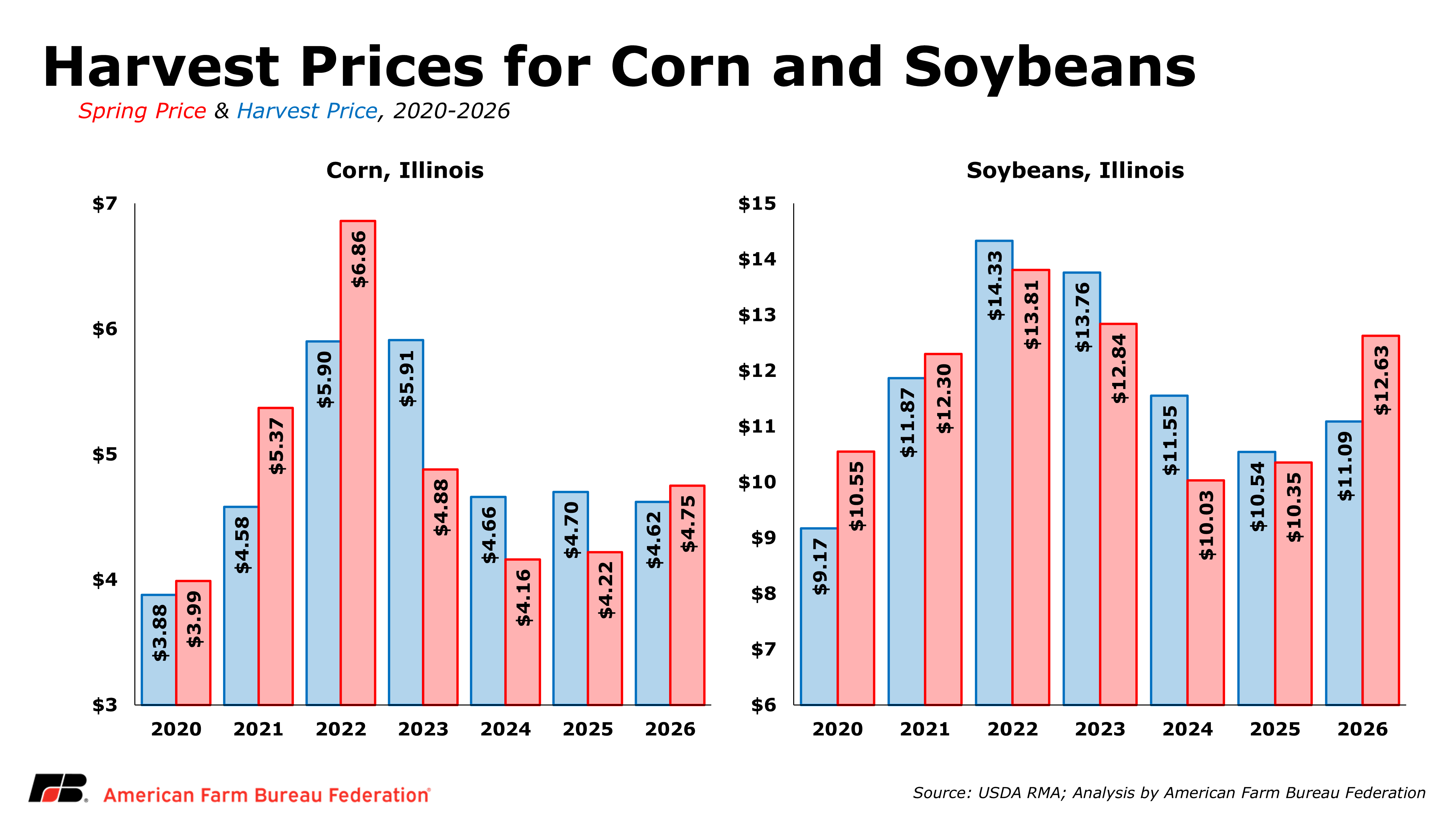
For 2026, corn's harvest price rose 2.8% above its spring price, the first increase since 2022 and the end of three consecutive years of lower harvest prices. Soybean harvest prices increased 13.9%, marking their first increase since 2021. Compared to 2025, harvest prices are 12.6% higher for corn and 22% higher for soybeans.
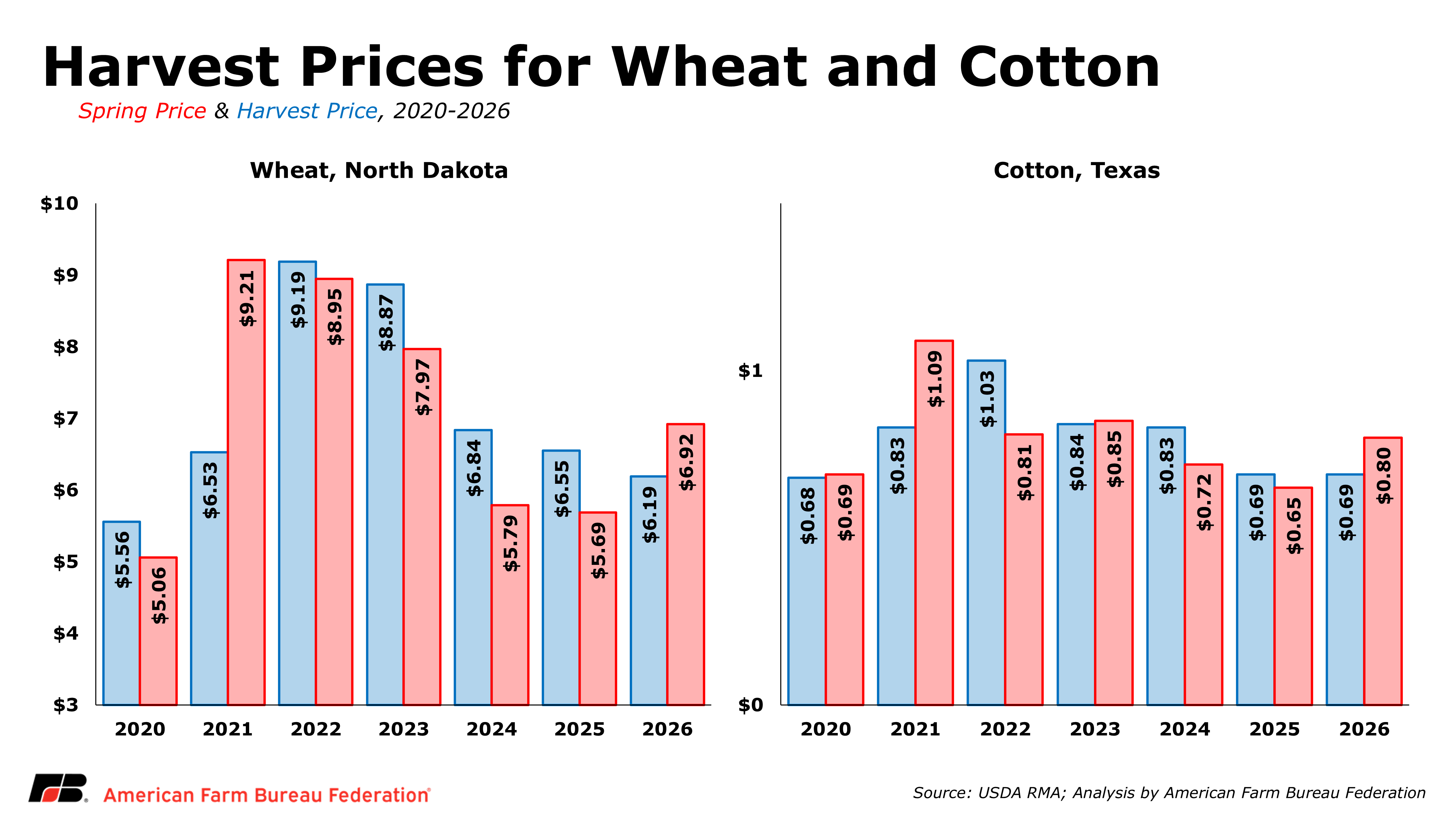
Wheat and cotton also recorded higher harvest prices in 2026, increasing 11.8% and 15.9% above their respective spring prices. The wheat insurance price series examined recorded its first increase since 2021, while cotton reversed declines in 2024 and 2025. Compared to last year, 2026 harvest prices are 21.6% higher for wheat and 23.1% higher for cotton.
A Year Outside the Norm
Higher harvest prices have been relatively uncommon. From 2011 through 2026, corn's harvest price exceeded its spring price in six of 16 years, soybeans in five, cotton in six and the wheat price series examined in four. Only in 2021 and 2026 were higher harvest prices recorded across all four series.
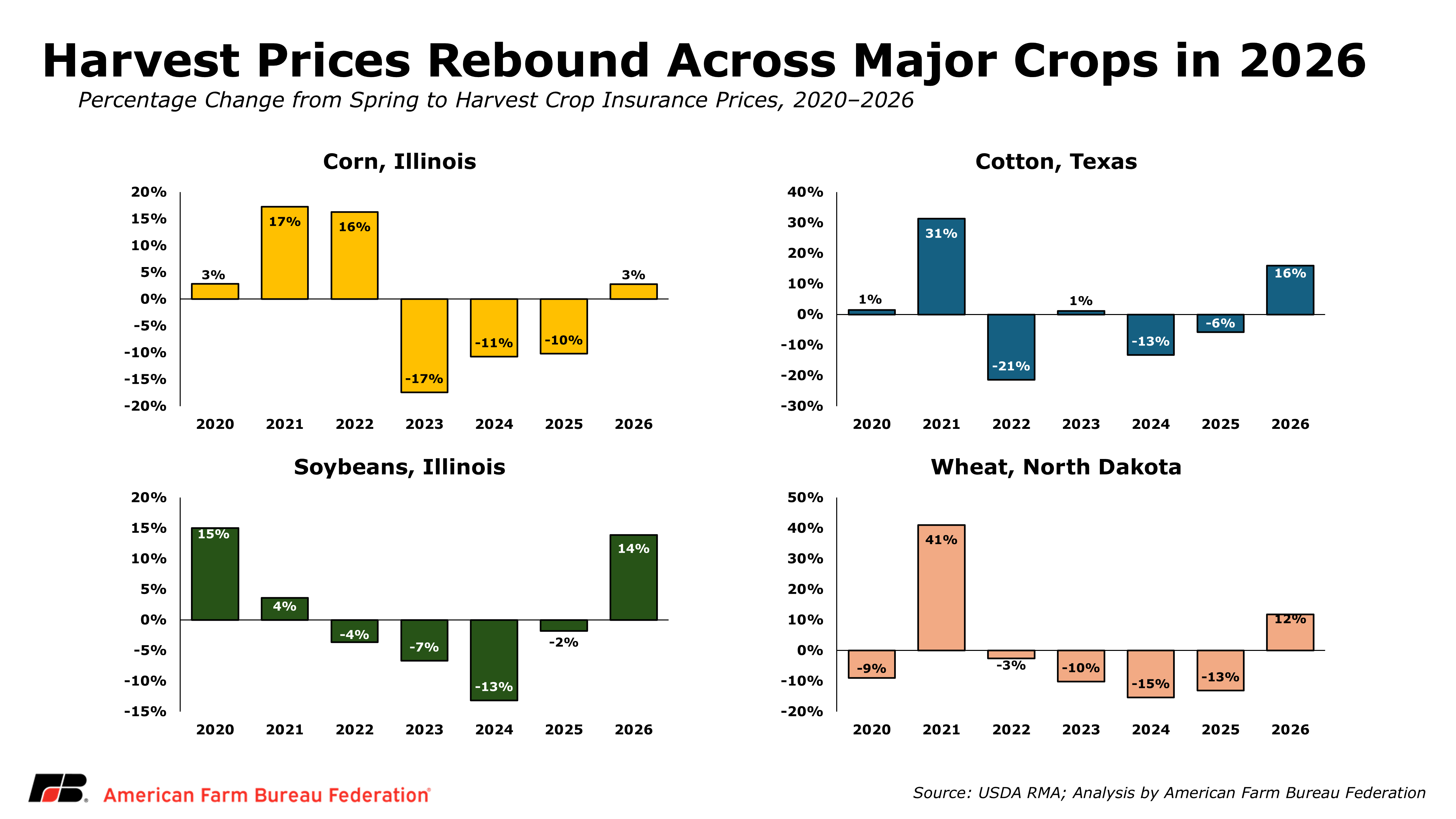
2026 marks a reversal from recent years. Corn recorded its first increase since 2022, following three consecutive years of declines. Soybeans and wheat reversed four consecutive years of lower harvest prices, while cotton rebounded after declines in 2024 and 2025. Although all four crops recorded increases, the gains varied considerably, ranging from just 3% for corn to 16% for cotton.
Higher Guarantees Do Not Eliminate Financial Pressures
Although higher harvest prices increase insurance protection, they do not necessarily improve farm profitability. Total production costs are projected to be $935.79 per planted acre for corn and $683.89 for soybeans in 2026, increasing to $952.09 and $701.48, respectively, in 2027.
Using these costs and USDA's October Crop Production yield projections, 2026 total-cost break-even prices are approximately $5.65 per bushel for corn, $13.03 for soybeans, $11.62 for wheat and $1.58 per pound for cotton. As shown in the chart, all four exceed USDA’s October World Agricultural Supply and Demand Estimates (WASDE) price forecasts of $4.70, $12.00, $6.30 and 77 cents, respectively. Operating-cost breakevens are lower, at $2.86 for corn, $4.90 for soybeans and $4.68 for wheat, so expected prices for those crops would cover out-of-pocket expenses but not land, equipment and other fixed costs. Cotton is the exception: its operating-cost breakeven of 95 cents per pound exceeds the projected price, leaving growers short of covering even their variable costs. These comparisons highlight the continued gap between production costs and expected market returns.
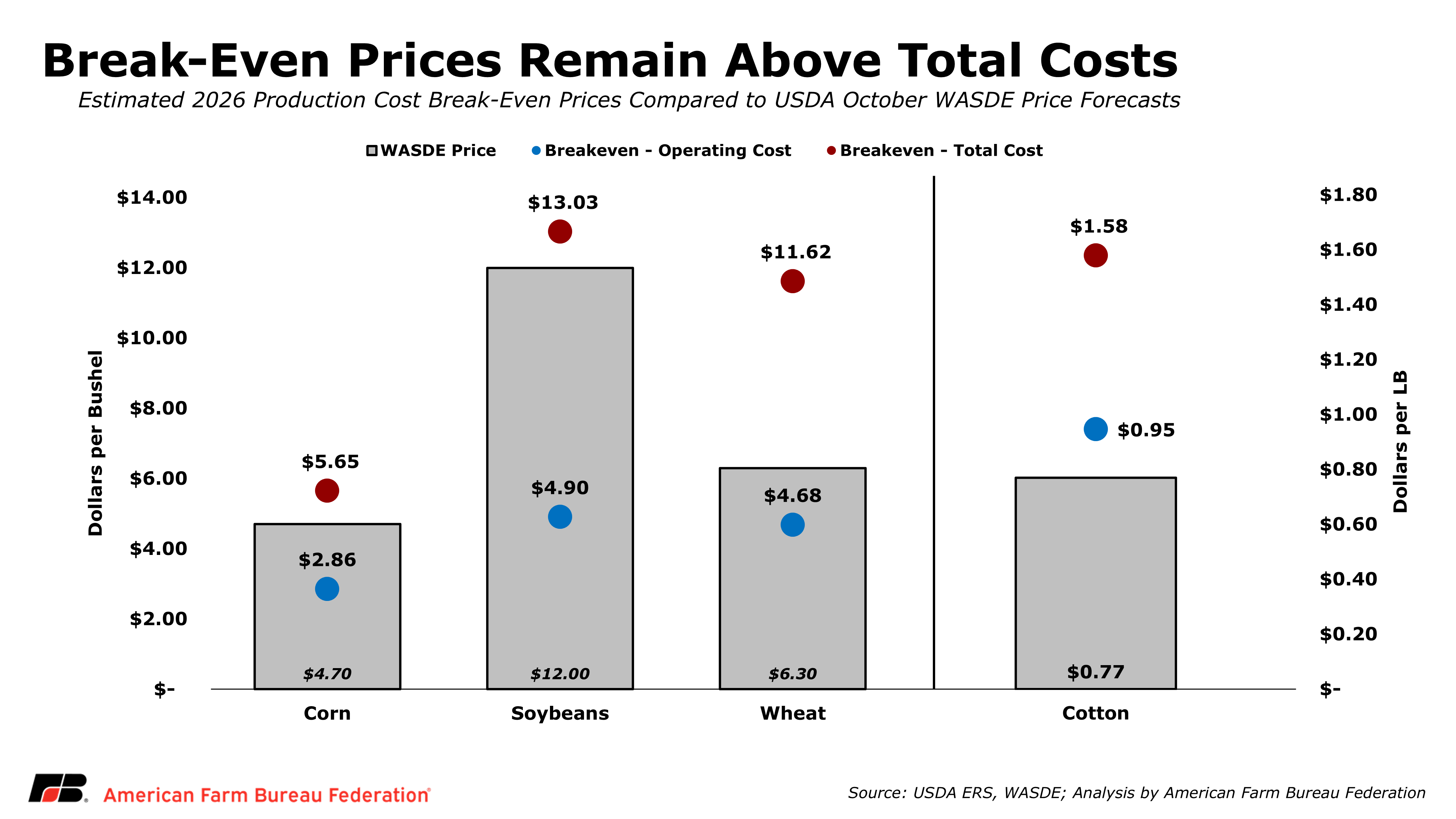
Crop insurance harvest prices differ from the marketing year prices farmers receive. Higher insurance guarantees protect against losses but do not ensure that market revenue covers production expenses. Crop insurance remains a key tool in a farmer’s toolbox.
With production costs expected to rise further in 2027 and farm margins remaining tight, the 2026 price discovery results reinforce the importance of maintaining affordable, flexible crop insurance that helps farmers manage both market uncertainty and unexpected production losses.