The $30 Billion Problem: Farm Bill Funding Meets its Limit

John Newton, Ph.D.
Vice President of Public Policy and Economic Analysis
- Driven by H.R. 1’s farm bill program and conservation investments, as well as assumptions on USDA’s use of Section 5 authority, the Congressional Budget Office (CBO) projects the Commodity Credit Corporation (CCC) will hit its $30 billion borrowing cap every year for the next decade.
- Hitting the $30 billion cap threatens USDA's ability to respond to emergencies via Section 5 discretionary authority. That authority — used for things like COVID-19 relief and the 2026 Farmer Bridge Assistance Program — only works if borrowing liquidity exists.
- The $30 billion cap hasn't been adjusted since 1987, raising the policy question of whether Congress should raise the borrowing limit. CBO's current scoring approach makes doing so a costly one-to-one budget increase, complicating the path forward.
Understanding the Commodity Credit Corporation
Since 1933, USDA has used Commodity Credit Corporation funds to implement select congressionally established programs. Today, the primary programs funded by the CCC include those related to commodity support, livestock, disasters, conservation, trade promotion and marketing assistance loans.
Since 1987, the CCC has held authority to borrow up to $30 billion at any one time to implement USDA commodity support and conservation programs, e.g., deliver Price Loss Coverage program payments or provide financial assistance for the Environmental Quality Incentives Program. By law, the CCC is replenished annually through the appropriations process.
At times, when funding is available, the Secretary of Agriculture may use the broad authority of the CCC under Section 5 of the Charter Act to provide additional and discretionary support to farmers and ranchers.
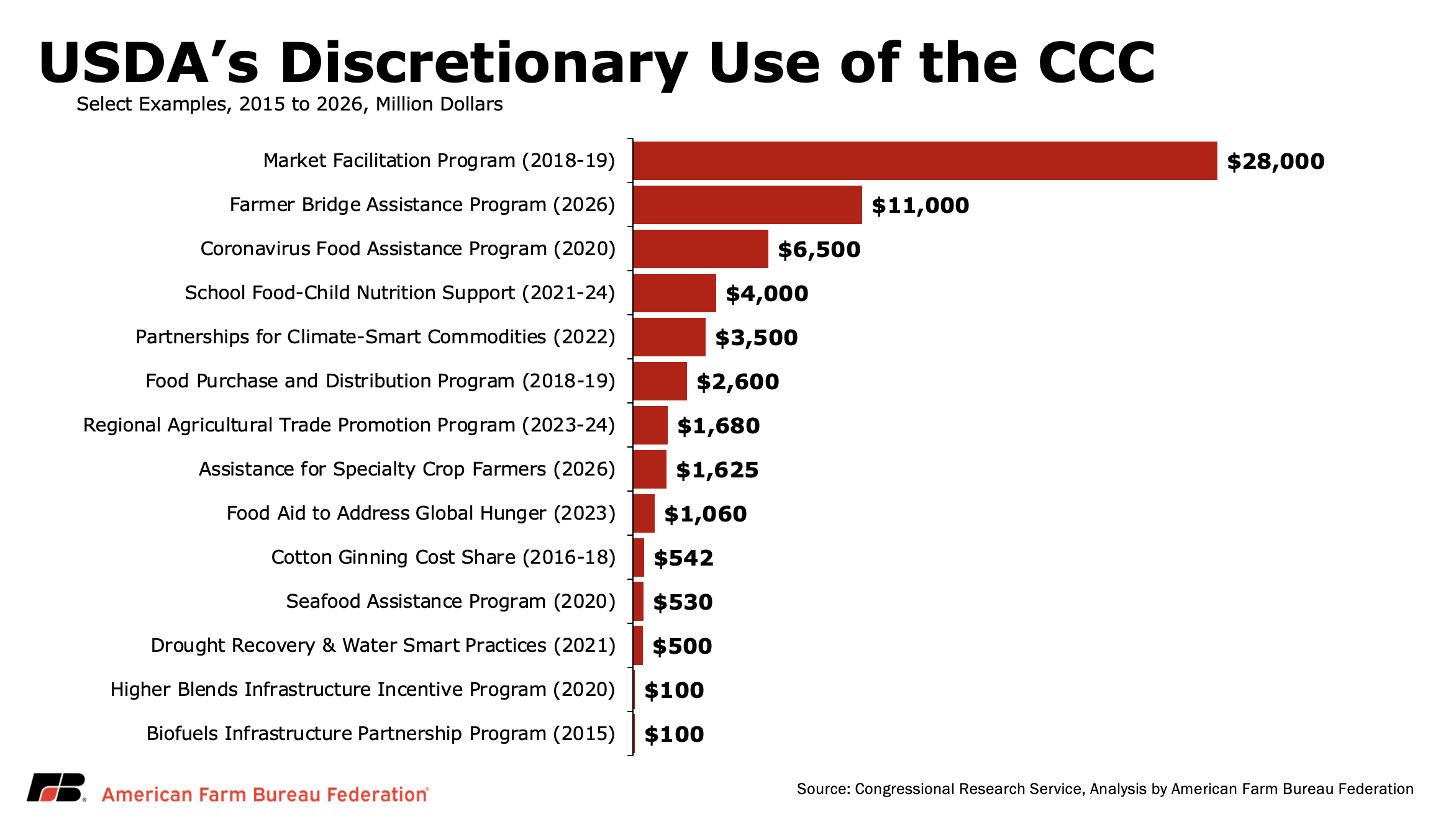
Historically, the CCC’s Section 5 discretionary authority has been used for administrative priorities or responses to emergency economic conditions. Examples of USDA’s recent use of Section 5 discretionary authority include:
- 2026’s Farmer Bridge Assistance Program, which helped to offset low crop prices and high input costs experienced since 2023;
- 2022’s Partnerships for Climate-Smart Commodities, which provided financial and technical assistance to implement on-farm climate-smart agricultural production practices; and
- 2020’s Coronavirus Food Assistance Program, which helped farmers and ranchers affected by COVID-19 supply chain disruptions.
CCC Section 5 Discretionary Authority Will Soon be Limited
Importantly, the ability to utilize Section 5 authority is conditional on the availability of borrowing authority (liquidity) under the $30 billion cap. Moving forward, if outlays related to the implementation of key farm bill income support and conservation programs are near the $30 billion cap, there would be limited financial resources available to respond to emergency needs, e.g., geopolitical disruptions or large-scale animal disease outbreaks.
Congress could still authorize and appropriate additional disaster assistance outside the CCC’s existing borrowing authority, but that process can take months and depends on lawmakers reaching agreement on a separate legislative package. The central concern is therefore not whether Congress retains the authority to respond, but whether USDA has enough CCC liquidity to act immediately when an emergency occurs rather than waiting for Congress to do so.
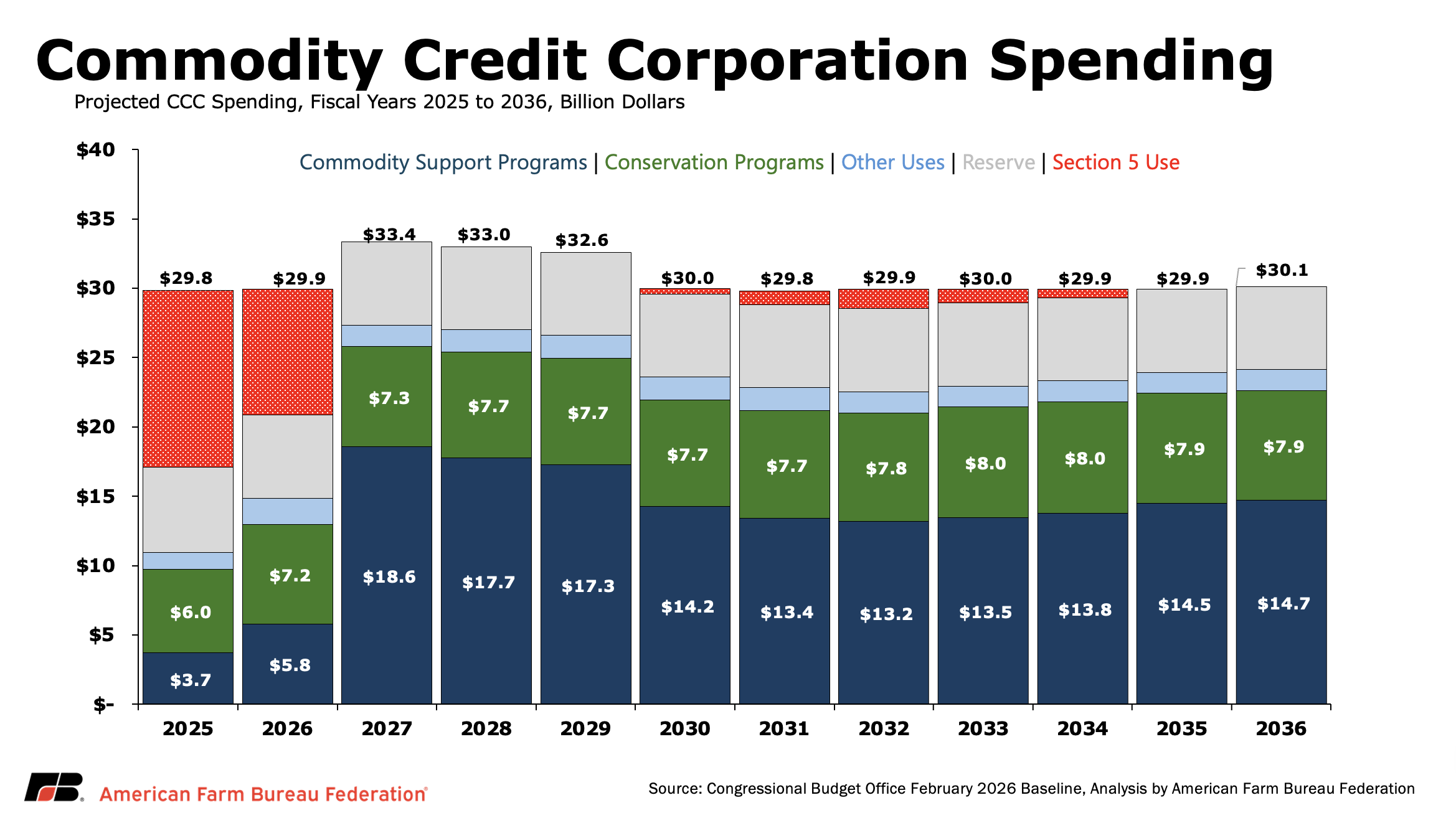
The Congressional Budget Office’s latest projections suggest that little, if any, liquidity will remain. Given the significant improvements and investments made to farm bill risk management and conservation programs in 2025 as part of H.R.1, the CBO now projects the CCC to expend its $30 billion borrowing authority each year over the next decade, either through traditional farm bill program outlays or the discretionary use of Section 5 authorities.
According to the February 2026 CBO Baseline for Mandatory Farm Programs, projected outlays for farm bill programs supported by the CCC are $10.9 billion for fiscal year 2025 but are expected to approach or exceed $27 billion from fiscal year 2027 to fiscal year 2029. The increase in projected outlays is driven by expectations for higher program payments related to continued low crop prices or revenue, as well as additional spending on conservation programs enacted in H.R. 1.
After taking into consideration CBO’s estimates for the use of Section 5 authority of $12.75 billion in fiscal year 2025 and $9.1 billion in fiscal year 2026, as well as the funds needed to be held in reserve until the annual replenishment occurs, CBO projects CCC outlays to exceed or approach the statutory limit of $30 billion going back to 2025 through 2029, with CCC needs exceeding borrowing authority by approximately $3 billion per year for fiscal years 2027 through 2029.* Given these projections, a policy question emerges: should Congress increase the CCC’s borrowing authority to ensure the necessary liquidity is available to respond to emergencies?
Is it Time to Raise the CCC Borrowing Authority?
This is not the first time raising the CCC borrowing authority has been considered. A 2020 Farm Bureau analysis reviewed how the CCC provided timely support to farmers and ranchers following the COVID-19 pandemic and estimated that, if indexed for inflation, the borrowing authority for the CCC should be more than double the $30 billion borrowing authority set in 1987. If adjusted for inflation to 2026, the CCC borrowing authority would approach $90 billion.
Increasing the CCC’s borrowing authority above $30 billion would provide USDA flexibility to utilize the Section 5 authority to respond quickly to emergency needs without having to go through annual funding packages for ad hoc assistance or other authorities.
What Happens if the Borrowing Authority is not Increased?
If the borrowing authority is not increased and CBO projections for farm program outlays are realized or climb even higher because of lower prices or revenues than currently projected, USDA could expend its borrowing authority under the CCC. In such a scenario, Congress would need to provide an exception, or “anomaly,” to alter the timing of CCC reimbursement. Recent years in which an anomaly was needed include fiscal years 2017, 2020 and 2021, when CCC expenditures approached the $30 billion borrowing authority.
Absent an anomaly, i.e., early replenishment, USDA would need to prioritize or prorate program payment delivery. This could result in farmers and ranchers receiving less than the full amount of commodity program or conservation program payments or even delaying the delivery of these program payments until after a replenishment has occurred.
CBO Math is a Head Scratcher
One potential challenge for raising the CCC borrowing authority is the current scoring methodology. Over the years CBO has altered its scoring methodology for the CCC Section 5 authority – going from a flat $1 billion per year assumption as recently as 2023, to variable outlays in 2024, and now to an assumption that USDA will definitively exhaust any additional CCC liquidity in each fiscal year. As a result, every additional dollar of CCC borrowing authority is treated as an additional dollar of federal spending, creating a one-to-one increase in the budget baseline even though a higher cap would only provide USDA the option (not the obligation) to spend those funds. This makes raising the limit appear significantly more costly and could make it more difficult for Congress to approve.
With a one-to-one score on the baseline, raising the CCC borrowing authority may not be the best use of baseline resources as those dollars are not guaranteed to flow to farmers and ranchers in emergency scenarios. However, if CBO used historical data to revisit the assumption that USDA will automatically utilize its Section 5 authority to expend all borrowing authority, it could result in an increase in the CCC borrowing authority without a direct one-to-one increase in the score.
Summary
Given the substantial enhancements and investments made to farm bill risk management and conservation programs under H.R.1 in 2025, CBO now projects that the CCC will exhaust its $30 billion borrowing authority annually over the next decade, whether through traditional farm bill program outlays or discretionary use of Section 5 authorities.
Without Congress raising the CCC’s borrowing authority, USDA will be unable to respond to emergency needs, and instead, stakeholders would continue to rely on annual appropriations or supplemental packages to fund emergency and ad hoc assistance efforts.
*CBO identifies known transfers of $12.5 billion in fiscal year 2025 and $3 billion in known transfers in fiscal year 2026 and assumes additional transfers to reach a total of $6 billion in fiscal year 2026.