Farmers Receive Less Than 6 Cents of the Food Dollar

Faith Parum, Ph.D.
Economist
Key Takeaways
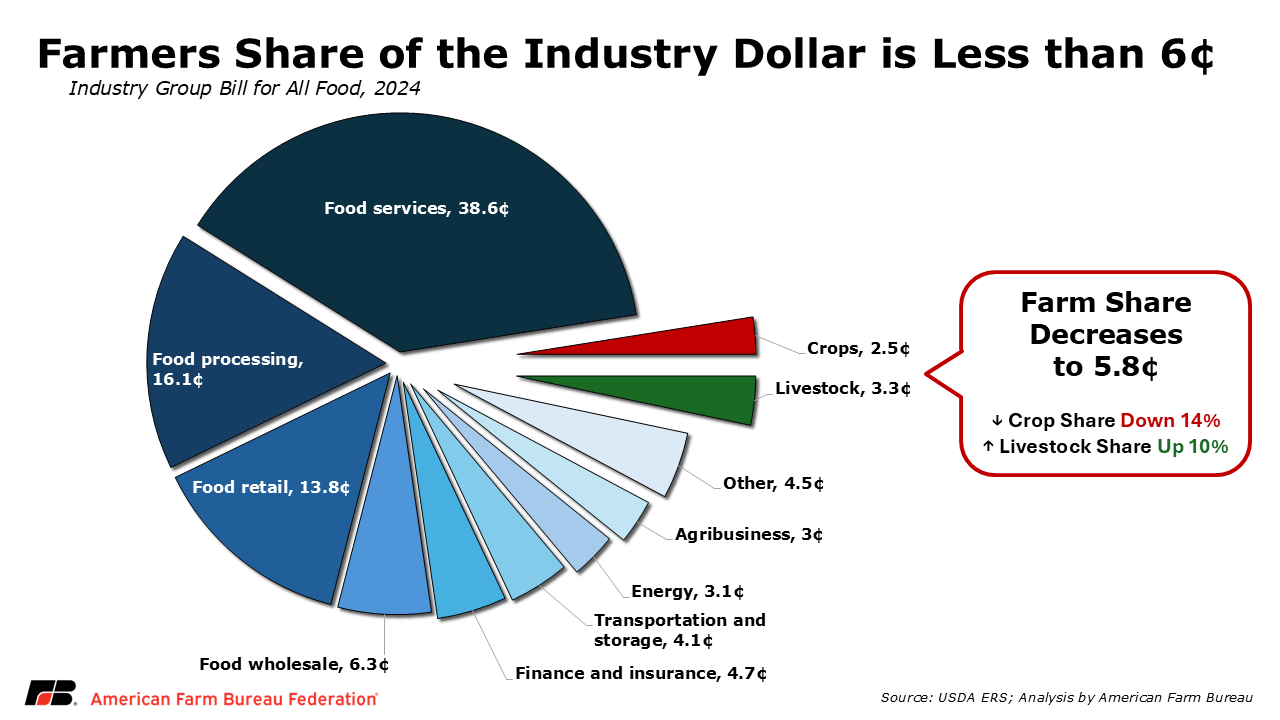
- In 2024, USDA estimates that farmers and ranchers received a combined 5.8 cents of every food dollar, down slightly from 5.9 cents in 2023, meaning less than 6 cents reaches the farm after accounting for production expenses.
- Within that total, crop producers saw their share decline from 2.9 to 2.5 cents, while livestock producers experienced a modest increase from 3 to 3.3 cents, highlighting divergent trends across sectors.
- With farmers capturing only a small share of the food dollar, even modest swings in commodity prices or increases in input costs can quickly strain farm finances.
The latest data from the USDA Economic Research Service Food Dollar Series provide a clear picture of how consumer food spending is distributed across the U.S. food supply chain. While farmers and ranchers produce the raw commodities that make food production possible, most of the economic value associated with food spending – the price at the grocery store or restaurant – is tied to what happens after those products leave the farm.
The Food Dollar Series tracks how each dollar spent by consumers on food is divided among the industries that contribute value along the supply chain. These industries include farming, food processing, transportation, packaging, wholesaling, retail and food service. As food moves through these stages, additional services, labor and infrastructure add value, and increase costs, to the final product.
Industry Bill: Farmers Receive Less Than 6 Cents of the Food Dollar
One of the clearest insights from the industry group breakdown is how small the farm share of consumer food spending is, and how it is shifting year over year. According to the latest estimates, crop producers capture about 2.5 cents of every food dollar, down from 2.9 cents in 2023, while livestock producers receive roughly 3.3 cents, up from 3 cents a year earlier. Importantly, these shares are averages across all food purchases; a given dollar spent goes toward either a crop- or animal-based product, but when aggregated across all food spending, both categories are reflected in the same “food dollar.” Combined, farmers and ranchers account for about 5.8 cents of total value added in the food system, down from 5.9 cents in 2023. While agricultural production remains essential to the entire supply chain, these year-over-year shifts highlight both continued pressure on the crop sector and modest gains in livestock, reinforcing that farm-level value capture remains a small and evolving share of overall food system spending.
Marketing Bill
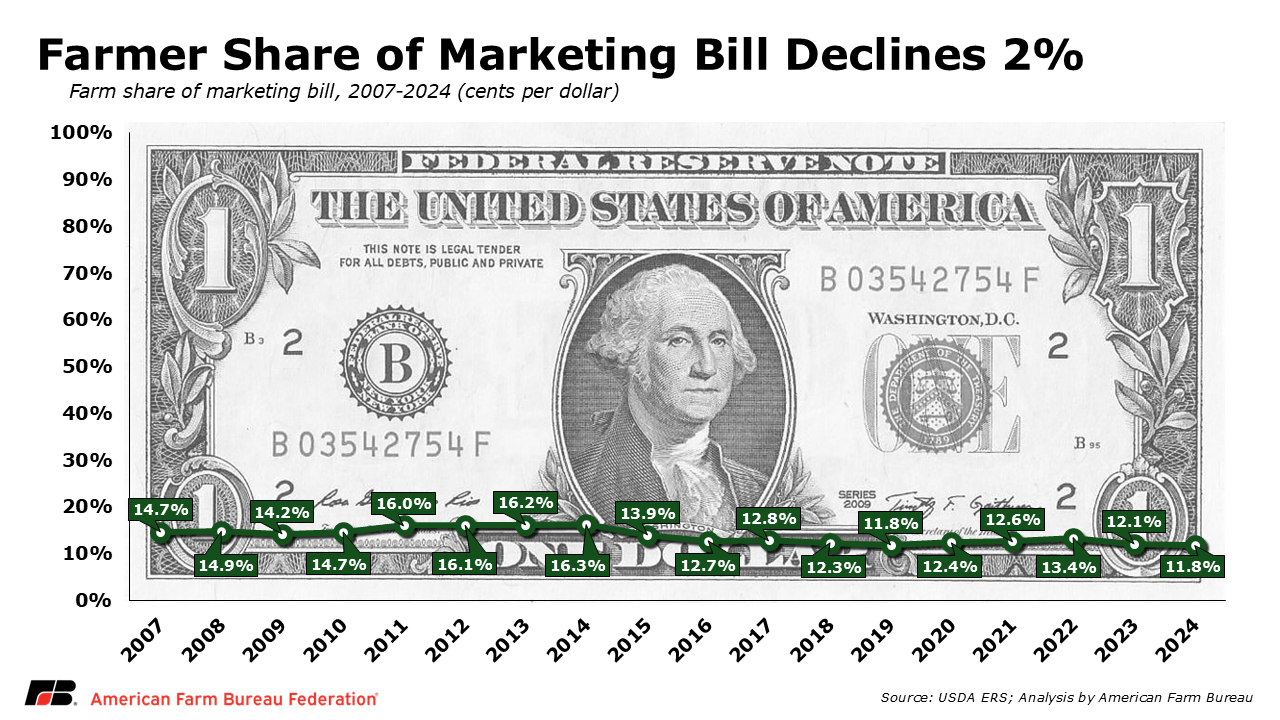
USDA’s Economic Research Service Food Dollar Series shows that the share of the consumer food dollar returning to farmers remains relatively small and continues to decline over time. In 2024, farmers received 11.8 cents of every dollar spent on domestically produced food, down from 12.1 cents in 2023, a 2.5% decrease year over year. The remaining 88.2 cents of the food dollar went toward the marketing bill, which includes costs associated with food processing, transportation, packaging, wholesaling, retailing and food service. The farmers’ share represents the portion of consumer spending tied directly to the value of raw agricultural commodities, while the marketing bill reflects the growing costs and value added beyond the farm gate. Over time, this shift illustrates how an increasing share of food spending is driven by services and supply chain activities rather than farm production itself.
Food at Home
USDA’s Food Dollar data show that farmers receive a relatively small share of consumer food spending, and that share varies widely depending on the type of food purchased. In 2024, the farm share of the food-at-home dollar was 18.5 cents, up slightly from 18.4 cents in 2023, a 0.5% increase year over year. This means less than one-fifth of what consumers spend on groceries goes back to farmers.
Products with minimal processing return a much larger portion of the food dollar to producers. Fresh eggs returned 69.1 cents per dollar to farmers in 2024, up from 65.2 cents in 2023 (+6%). Beef rose from 49.8 cents to 52.2 cents (+4.8%), fresh milk increased from 48.1 cents to 50.8 cents (+5.6%), and pork rose from 22.1 cents to 23.7 cents (+7.2%). Poultry and fish also saw modest gains, increasing 3.1% and 2.8%, respectively. Tree nuts and peanuts declined slightly from 51.9 cents to 51 cents (-1.7%), while fresh fruits and vegetables were unchanged.
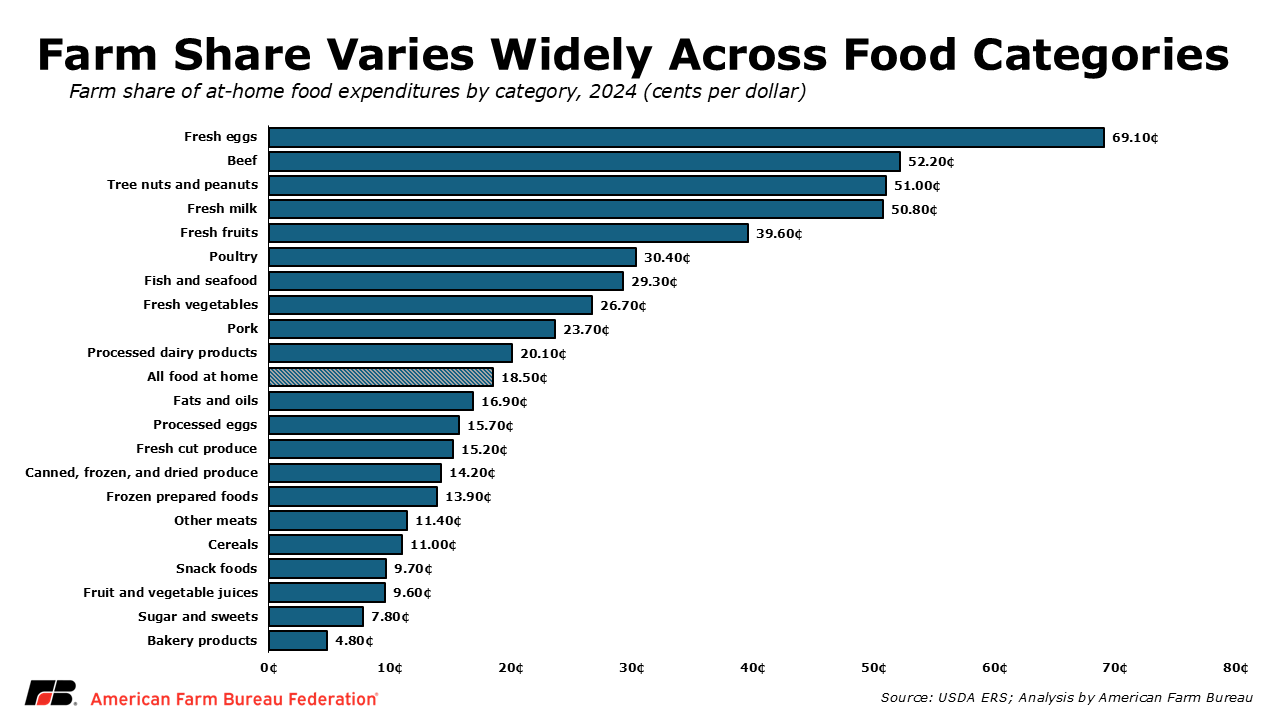
By contrast, foods that undergo significant processing or preparation return far less of the consumer dollar to farmers, as more value is added beyond the farm gate through processing, packaging, transportation, marketing and retail. In many of these categories, the farm share declined in 2024. Bakery products fell from 5.3 cents to 4.8 cents (-9.4%), snack foods declined from 10.4 cents to 9.7 cents (-6.7%), and soft drinks and bottled water slipped from 1.4 cents to 1.3 cents (-7.1%). These differences highlight that the majority of consumer food spending supports the broader food supply chain rather than the raw agricultural commodity itself.
Conclusion
Taken together, the Food Dollar data highlight a fundamental reality of the modern food system: while farmers and ranchers are the foundation of food production, most of the economic value is created after products leave the farm. With crop producers receiving about 2.5 cents and livestock producers about 3.3 cents of every consumer food dollar, less than 6 cents of total value added occurs at the farm level, while the other sectors continue to expand as consumer spending increasingly reflects processing, transportation, retail and food service. At the same time, this dynamic underscores how value creation has shifted beyond raw production, as demand for convenience, innovation and product differentiation grows, alongside expanding industrial uses for agricultural commodities such as fuels, bioplastics and other materials. These trends present opportunities for farmers and ranchers to capture a greater share of the food dollar through value-added production, direct marketing and deeper participation across the supply chain.