EPA Sets Record Renewable Fuel Volumes for 2026-2027

Faith Parum, Ph.D.
Economist
Key Takeaways
- EPA sets record Renewable Volume Obligations (RVOs) for 2026–2027, with growth concentrated in biomass-based diesel and advanced fuels while conventional ethanol remains at 15 billion gallons. Nationwide year-round E15 would help support higher levels of ethanol demand.
- Small refinery exemption (SRE) reforms redistribute previously waived gallons into future obligations, preserving overall renewable fuel demand and reducing long-standing uncertainty in biofuel and agricultural markets.
- EPA did not finalize proposed import-related Renewable Identification Number (RIN) restrictions, signaling a more incremental policy approach that leaves room for future adjustments.
EPA’s final Renewable Fuel Standard rule establishing Renewable Volume Obligations (RVOs) for 2026 and 2027 sets higher overall renewable fuel volumes, with particular growth in advanced biofuels like biomass-based diesel and cellulosic fuels. Renewable fuels are produced from feedstocks such as corn, soybeans, used cooking oil and animal fats.
The proposed rule included provisions aimed at limiting the role of imported fuels and feedstocks in generating Renewable Identification Numbers (RINs), a change intended to better align the program with domestic production and support U.S.-grown commodities. However, the final rule did not adopt the import RIN reduction Instead EPA intends to establish import RIN reduction provisions that will take effect beginning in the 2028 compliance year or shortly thereafter. Additionally, the rule includes a partial waiver of the 2025 cellulosic biofuel requirement due to lower-than-expected production and finalizes changes to how small refinery exemptions are accounted for, redistributing previously exempted volumes into future obligations to maintain overall demand.
Overall, the final rule reinforces demand for American-grown feedstocks while providing more certainty for farmers, biofuel producers and fuel markets. This Market Intel outlines the final RFS volumes and examines their potential impact on agriculture.
New Renewable Volumes
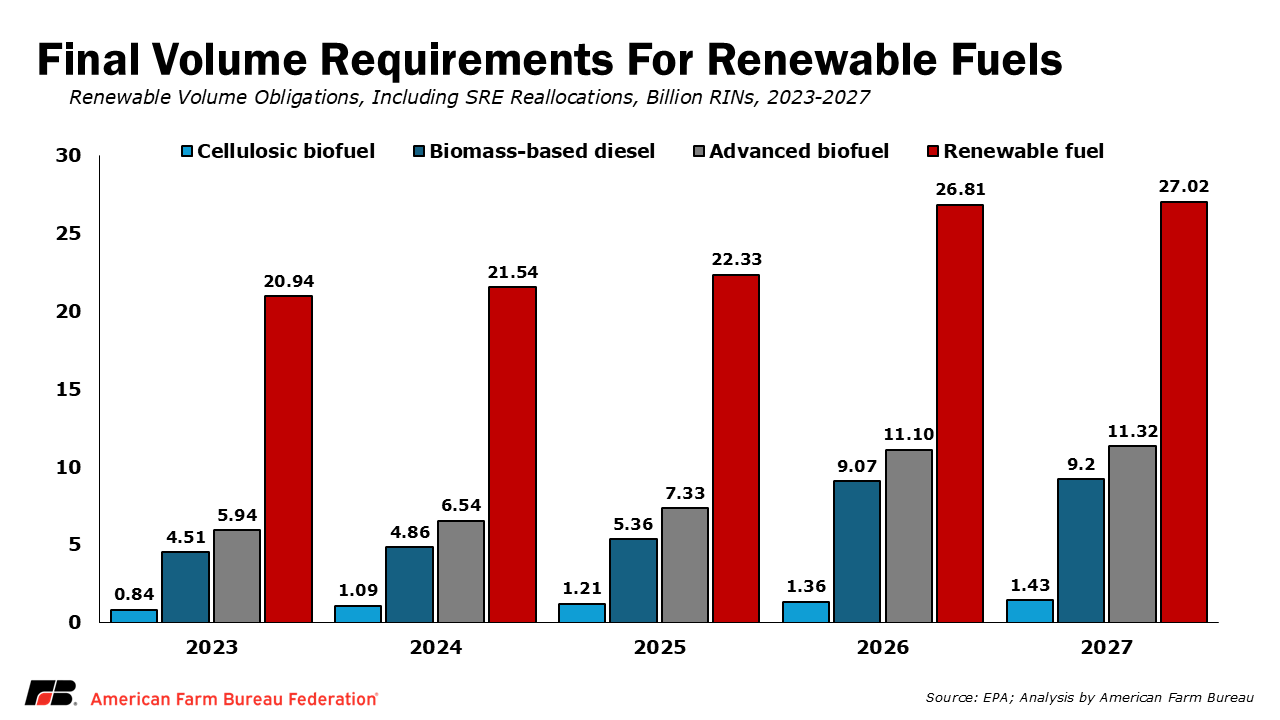
EPA sets these RVOs across four categories: total renewable fuel, advanced biofuel, cellulosic biofuel and biomass-based diesel. EPA finalized total renewable fuel volumes at 26.81 billion gallons in 2026 and 27.02 billion gallons in 2027, the highest levels set under the program. These increases reflect continued growth in renewable fuel production and stronger demand for feedstocks. See this Market Intel for a detailed look at each type of renewable fuel.
Cellulosic biofuel volumes were finalized at 1.36 billion gallons in 2026 and 1.43 billion gallons in 2027, reflecting a more conservative outlook based on expected production. In addition, EPA issued a partial waiver for the 2025 cellulosic requirement, lowering the obligation to align with actual supply. Cellulosic biofuels remain an emerging sector, and EPA continues to adjust targets when projected production falls short.
Biomass-based diesel volumes were finalized at 8.86 billion gallons in 2026 and 8.95 billion gallons in 2027, increasing to 9.07 billion and 9.20 billion gallons, respectively, when accounting for small refinery exemption (SRE) reallocations. Advanced biofuel volumes were set at 10.82 billion gallons in 2026 and 10.98 billion gallons in 2027, rising to 11.10 billion and 11.32 billion gallons after SRE adjustments. Growth in these categories reflects expanding renewable diesel capacity and strong demand for low-carbon fuels, particularly those derived from soybean oil and other fats and oils.
EPA also finalized a provision to account for previously exempted small refinery volumes by redistributing 0.99 billion gallons in 2026 and 1.04 billion gallons in 2027 into future obligations. This change is intended to ensure that exemptions do not reduce overall renewable fuel demand over time.
Small Refinery Exemptions
Small refinery exemptions (SREs) have been a key point of debate within the Renewable Fuel Standard, as they allow qualifying small refineries to be temporarily exempted from their renewable fuel blending obligations due to demonstrated economic hardship. In past years, these exemptions reduced overall biofuel demand by lowering the number of gallons obligated parties were required to blend, creating uncertainty for farmers and biofuel producers. In the final 2026–2027 rule, EPA redistributed a portion of previously exempted volumes, 0.99 billion gallons in 2026 and 1.04 billion gallons in 2027, into future Renewable Volume Obligations. This ensures that waived volumes are effectively made up in subsequent years, helping maintain consistent demand for renewable fuels and the agricultural feedstocks used to produce them.
Impacts on Corn, Soybeans and Soybean Oil
The final rule maintains the conventional renewable fuel requirement at 15 billion gallons, preserving a key source of demand for corn used in ethanol production. Ethanol remains one of the largest end uses for U.S. corn and continues to anchor demand in the sector. Expanding access to year-round E15 would further strengthen this demand by allowing higher ethanol blends to be sold consistently throughout the year, reducing regulatory uncertainty and supporting additional corn use.
In contrast, biomass-based diesel requirements increase significantly, supporting continued expansion in renewable diesel and biodiesel production. These fuels rely heavily on soybean oil as a primary feedstock, and higher volume obligations are expected to strengthen demand for soybeans and soybean oil.
In recent years, soybean oil use for biofuel production has grown rapidly, driven by expanding renewable diesel capacity. Higher RVOs for biomass-based diesel align more closely with current production trends and industry investment, helping support prices and market opportunities for soybean producers.
Advanced biofuel growth also supports demand for a range of feedstocks, including waste oils, animal fats and crop-based inputs. Together, these increases reinforce agriculture’s central role in supplying the renewable fuels market.
Conclusion
Renewable fuels continue to play a critical role in supporting demand for U.S. agricultural commodities. By setting record-high RVOs and maintaining strong targets for biomass-based diesel and advanced fuels, EPA’s final rule reflects the growth and capacity of the domestic biofuels industry. The rule also commits to revisiting how imported fuels and feedstocks are treated in the RIN system for 2028, a potential change that could further strengthen demand for domestically produced feedstocks.
For farmers, the outcome provides continued demand certainty for key crops like corn and soybeans while expanding market opportunities tied to renewable diesel and other advanced fuels.

