More Than Food: Agriculture’s Economic Footprint

Daniel Munch
Former AFBF Economist
Key Takeaways
- Food and agriculture supports $10.4 trillion in total U.S. economic output, representing about 20% of all economic activity.
- The sector supports nearly 49 million jobs, or roughly 30% of total U.S. employment, even though on-farm jobs account for less than 2%.
- Food and agriculture generates more than $1.3 trillion in tax revenue, reinforcing its role as a foundation of local, state and federal economies.
- Maintaining domestic food and agriculture production helps anchor jobs, income and economic activity within the United States.
Each year, the Feeding the Economy report provides one of the most comprehensive looks at the full economic footprint of U.S. food and agriculture. While often discussed in terms of farm receipts or commodity production, the report highlights a much broader reality: agriculture is not just a sector, it is a foundational driver of economic activity that supports millions of jobs, trillions in output and significant tax revenue across every state.
The 2026 Feeding the Economy report estimates $10.4 trillion in economic output tied to food and agriculture, accounting for roughly one-fifth of all U.S. economic activity, while supporting nearly 49 million jobs across the economy. At the center of that system are farmers and ranchers, whose production underpins economic stability by supplying the raw goods that feed families, sustain industries, support jobs, keep supply chains functioning nationwide and help ensure that the economic value tied to food production remains in the United States.
Looking Beyond the Farm Gate
The Feeding the Economy report uses an input-output modeling framework to measure how agricultural production moves through and supports the broader economy. Rather than focusing only on activity at the farm level, it captures three layers of economic impact.
First is the direct activity, which includes farms, ranches and food-related industries, including manufacturing, wholesaling and retail, where agricultural products are processed, distributed and sold. Second is the indirect activity, capturing the industries that supply inputs, such as equipment manufacturers, fertilizer producers, transportation providers and financial services. Finally, the report measures induced activity, reflecting how wages earned throughout the supply chain are spent in local economies, supporting restaurants, health care, housing and other services.
By combining these effects, the report provides a measure of total economic output, employment and tax revenue supported by the food and agriculture system. This “full footprint” approach is why the figures reported are substantially larger than traditional farm income or gross domestic product measures and why they are particularly useful for understanding agriculture’s broader economic impact.
Food and Agriculture Across State Economies
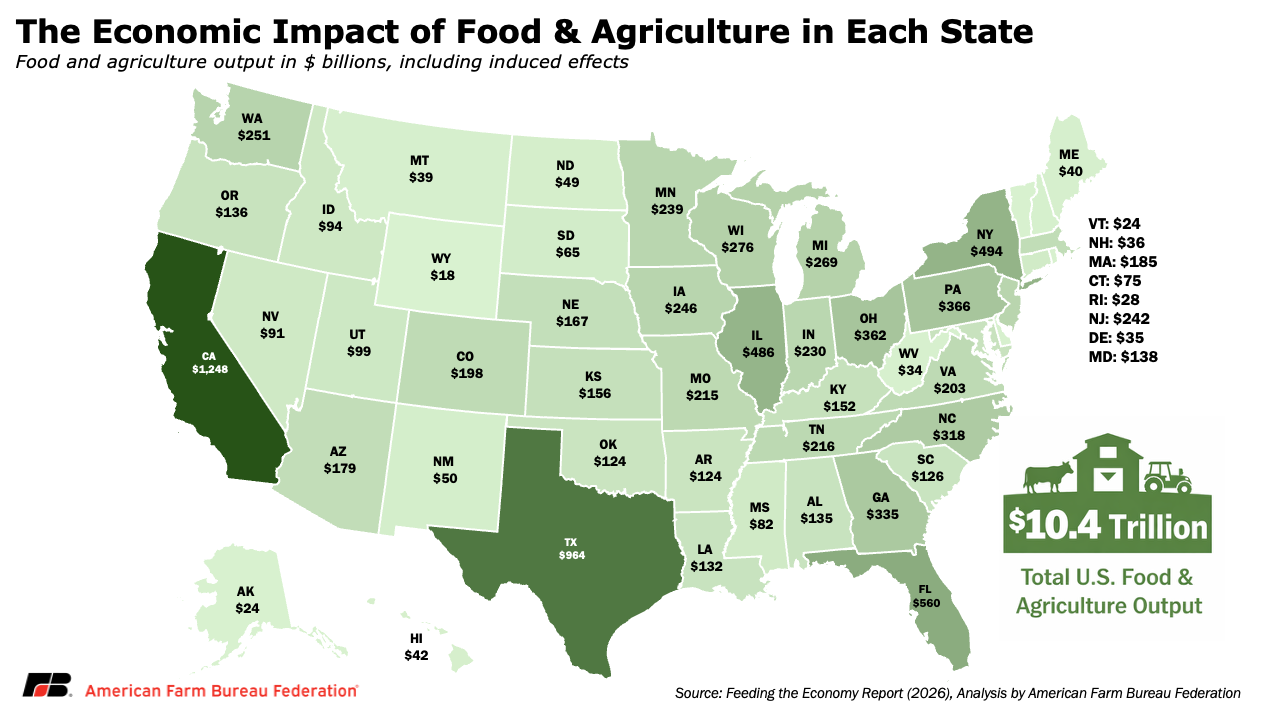
The economic role of food and agriculture varies widely across states, reflecting differences in production, population and the structure of local economies. In total dollars, the largest food and agriculture economies tend to be states with a combination of strong production and large consumer bases. California leads the nation with more than $1.2 trillion in food and agriculture output, followed by Texas at $964 billion, Florida at $560 billion and New York at $494 billion. In these states, the sector’s footprint is amplified by food manufacturing, distribution networks and retail activity that extend well beyond the farm.
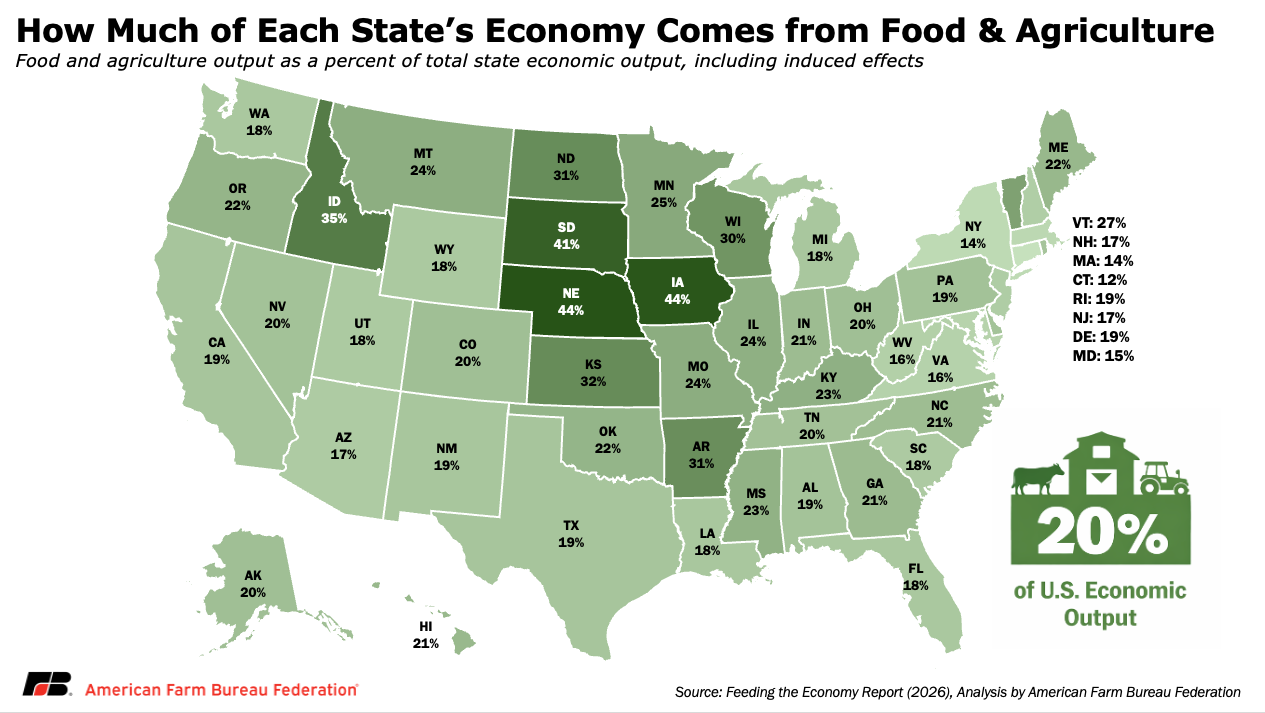
A different picture emerges when food and agriculture are measured as a share of total state economic output. In states such as Iowa and Nebraska, the sector accounts for roughly 44% of all economic activity. South Dakota follows at 41%, with Idaho at 35% and Kansas at 32%. In these states, agriculture represents a larger share of overall economic activity, meaning shifts in farm income, production costs or commodity markets tend to have more concentrated effects on jobs, tax revenue and local businesses. In more diversified economies, those impacts remain significant in absolute terms but are spread across a broader economic base. Even in the least agriculture-dependent states, food and agriculture account for 12% or more of economic activity, highlighting how deeply the sector is embedded across the entire U.S. economy.
Jobs and Wages Across the Food and Agriculture System
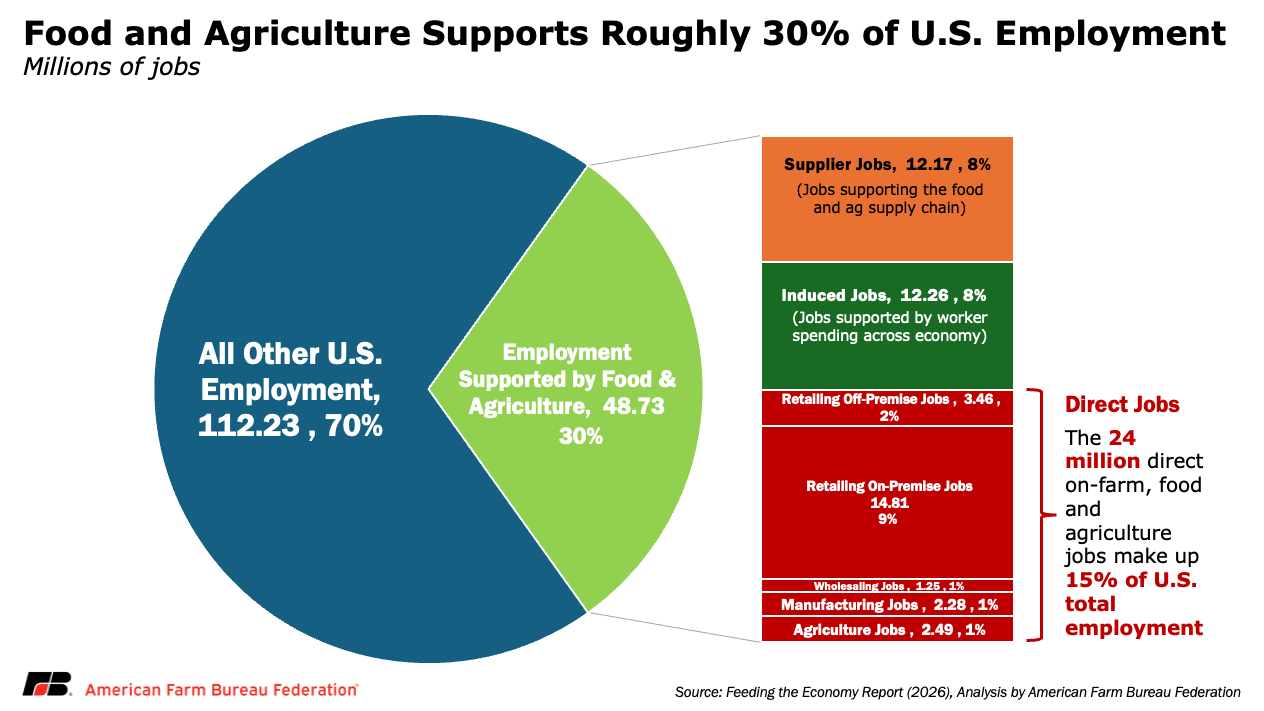
The economic reach of food and agriculture is especially evident in the jobs and income it supports across the broader economy. The 2026 Feeding the Economy report estimates the sector supports nearly 49 million jobs, accounting for roughly 30% of total U.S. employment, or about one in every three jobs nationwide.
That scale stands in contrast to the size of the farm workforce. Direct agricultural employment totaled about 2.5 million jobs, or less than 2% of U.S. employment. But when food manufacturing, wholesaling and retailing are included, direct employment rises to more than 24 million jobs, or about 15% of the workforce. This reflects how much of the system operates beyond production, in sectors that process, move and sell food.
Another roughly 24 million jobs are supported through supplier industries and broader economic spending. These include jobs in transportation, construction, finance, energy and other sectors that provide inputs and services, along with jobs supported by household spending across the economy.
The income generated across this system is equally significant. Direct food and agriculture activity generated just over $1 trillion in wages in 2026, with supplier industries contributing another $1 trillion and induced activity adding roughly $900 billion. Altogether, the sector supported more than $3 trillion in wages and salaries.
With total U.S. wages at approximately $11.7 trillion, this means food and agriculture account for more than one-quarter of all earnings nationwide. While farmers and ranchers are the foundation, most jobs and income tied to agriculture are generated beyond the farm gate, reinforcing how production supports a much larger economic system.
Tax Revenue
The economic footprint of food and agriculture also extends to public finances at every level of government. The 2026 Feeding the Economy report estimates the sector supports more than $1.3 trillion in total tax revenue, including $788 billion in federal taxes and $559 billion in state and local taxes. For context, total federal and state tax collections in the U.S. are roughly $6.5 trillion –$7 trillion annually, meaning food and agriculture activity supports about one-fifth of all tax revenue nationwide.
This revenue is generated across the full supply chain, from production and processing to transportation, retail and food service. As a result, the tax impact is not confined to traditionally agricultural states. Populated, diversified economies generate the highest total tax contributions, with California alone accounting for over $205 billion, followed by Texas at $109 billion, Florida at $80 billion and New York at nearly $79 billion. At the same time, food and agriculture remain an important source of tax revenue in every state, supporting funding for infrastructure, education, health care and other public services.
More Than Food: Where the Value Stays
The economic contribution of food and agriculture, and critically its domestic presence within the United States, is essential to food security and economic stability.
The data show a system that supports nearly one in three jobs, generates one-fifth of economic output and contributes a similar share of total tax revenue. But those benefits are not guaranteed to remain. As production faces sustained economic pressure, we risk shifting more of that value, from jobs and wages to processing and supply chains, beyond U.S. borders.
That dynamic is already visible in certain sectors. U.S. vegetable production has declined by roughly 39% and fruit production by 24% since 2000, reflecting some of the most exposed industries where labor costs, regulatory burdens and global competition intersect.
At its core, this is not just about food. It is about whether the economic engine tied to feeding, fueling and clothing a nation remains rooted at home or gradually shifts beyond U.S. borders.