Reviewing U.S. Agricultural Trade With China

Faith Parum, Ph.D.
Economist
Key Takeaways
- China remains a critical export market for U.S. agriculture. U.S. agricultural exports to China reached a record $40.9 billion in 2022 before falling sharply as trade tensions and shifting sourcing patterns disrupted flows.
- Soybeans accounted for 47% of all U.S. agricultural exports to China in 2024, underscoring how concentrated the relationship remains in a single commodity.
- Stable trade relationships matter in a depressed farm economy. With farmers facing continued margin pressure, reliable export demand is essential to supporting farm income.
China remains a critical export market for U.S. farmers and ranchers, particularly for soybeans, cotton, sorghum and pork. Recent years have demonstrated both the opportunity this market provides and the risks that come with trade disruption. As policymakers revisit the broader U.S.-China economic relationship, agriculture is one of the key points in the negotiation. Ahead of this week’s discussions, attention has focused on whether renewed trade talks could yield concrete commercial commitments, particularly for U.S. agricultural exports including soybeans and beef.
A Snapshot of the Broader Trade Relationship
The United States and China are still major trading partners, though the relationship narrowed significantly in 2025 as trade tensions disrupted flows in both directions.
In 2025, the United States exported $106.3 billion in goods to China while importing $308.4 billion, resulting in a goods trade deficit of approximately $202.1 billion. This is a decrease from prior years, reflecting the impact of tariff escalation. In 2024, the United States had a trade deficit of roughly $295 billion with China.
Even with the pullback, China remains a major supplier of manufactured goods to the U.S. market, particularly electronics, machinery, consumer products, furniture and industrial inputs. In many of these categories, supply chains are deeply integrated, making rapid diversification difficult.
On the export side, U.S. shipments to China are concentrated in sectors where the United States holds a competitive advantage, including agriculture, energy, aerospace and industrial equipment. Agriculture stands apart because China’s demand is driven by structural necessity. Limited arable land, rising protein consumption and feed demand continue to make imported agricultural commodities an important part of China’s food supply strategy.
Reviewing U.S. Agricultural Trade With China
China has long been one of the most consequential export markets for U.S. agriculture. U.S. agricultural exports to China reached a record $41 billion in 2022, accounting for 21% of total U.S. agricultural exports, supported by strong commodity demand and trade agreement purchase commitments. Since then, exports have moved lower as China diversified sourcing toward South America, particularly Brazil and Argentina, while also investing in port infrastructure, logistics networks and supply chain partnerships across the region to strengthen those trade relationships and improve export flows. By 2024, U.S. agricultural exports to China had fallen to approximately $27 billion, representing about 15% of total U.S. agricultural exports.
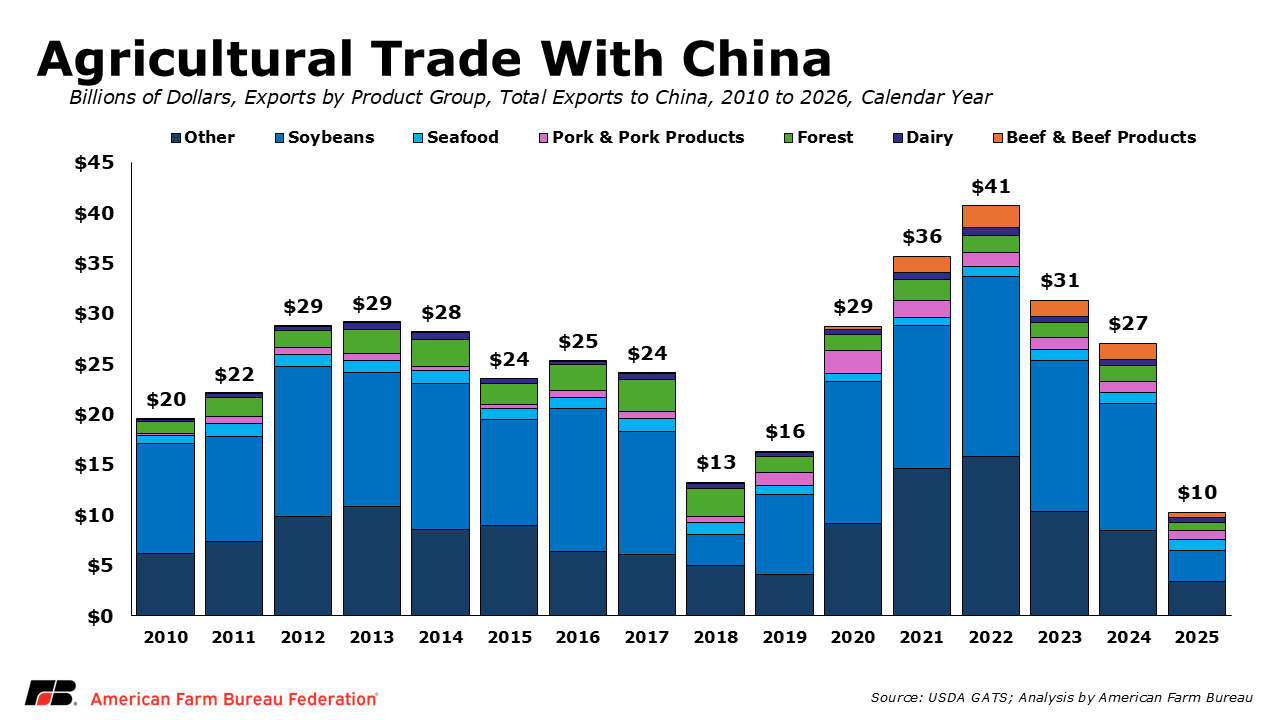
No commodity better illustrates that shift than soybeans. In 2024, soybeans accounted for 47% of all U.S. agricultural exports to China, making them the largest driver of the bilateral agricultural relationship. China’s soybean sourcing has shifted dramatically toward Brazil over the past decade. In 2010, China’s soybean purchases were more evenly split, with the U.S. exporting 24 MMT and capturing 45% of the market, compared to Brazil’s 19 MMT and 32% share. By 2024, that balance had shifted sharply. Brazil expanded shipments to 73 MMT, accounting for 70% of China’s soybean imports, while U.S. exports totaled 27 MMT, representing just 23% of the market.
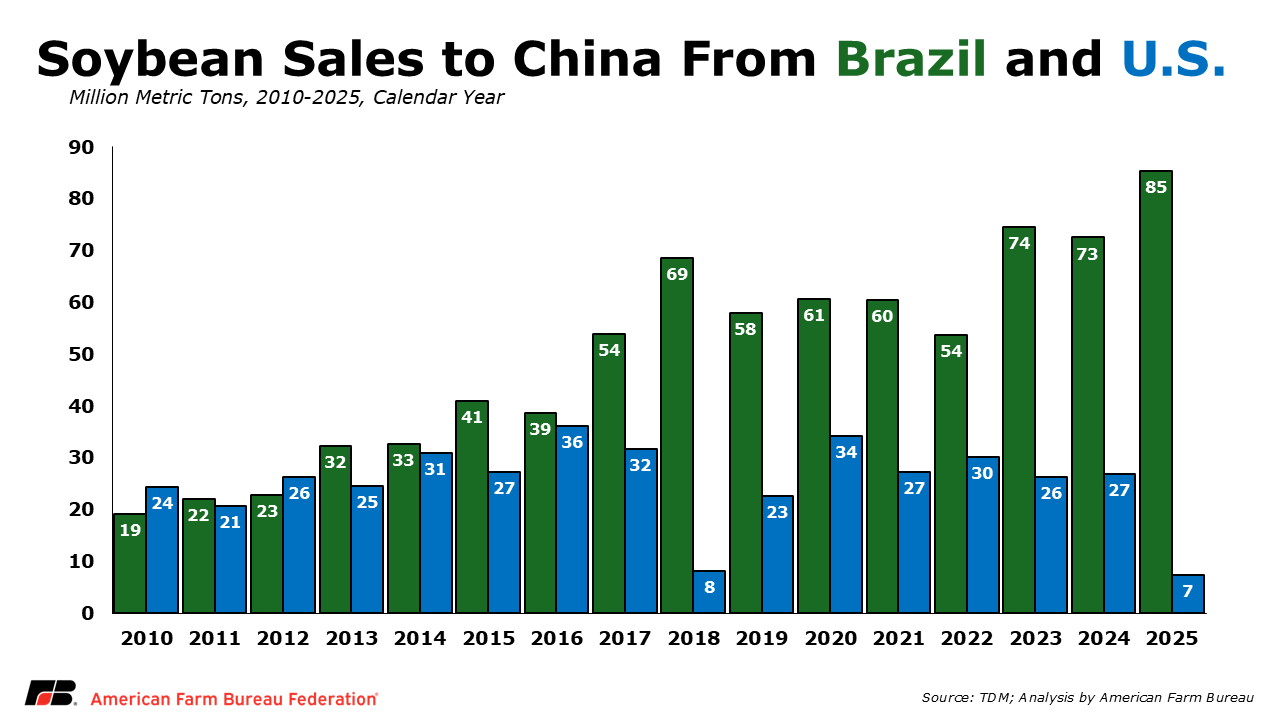
The turning point came after the 2018 trade dispute, when U.S. soybean exports to China fell sharply and Brazil stepped in to capture additional demand. While U.S. exports have partially recovered in some years, Brazil has continued to expand both production and its foothold in the Chinese market. For U.S. farmers, that shift matters because weaker access to a key export market can translate directly into lower demand, added price pressure and tighter margins.
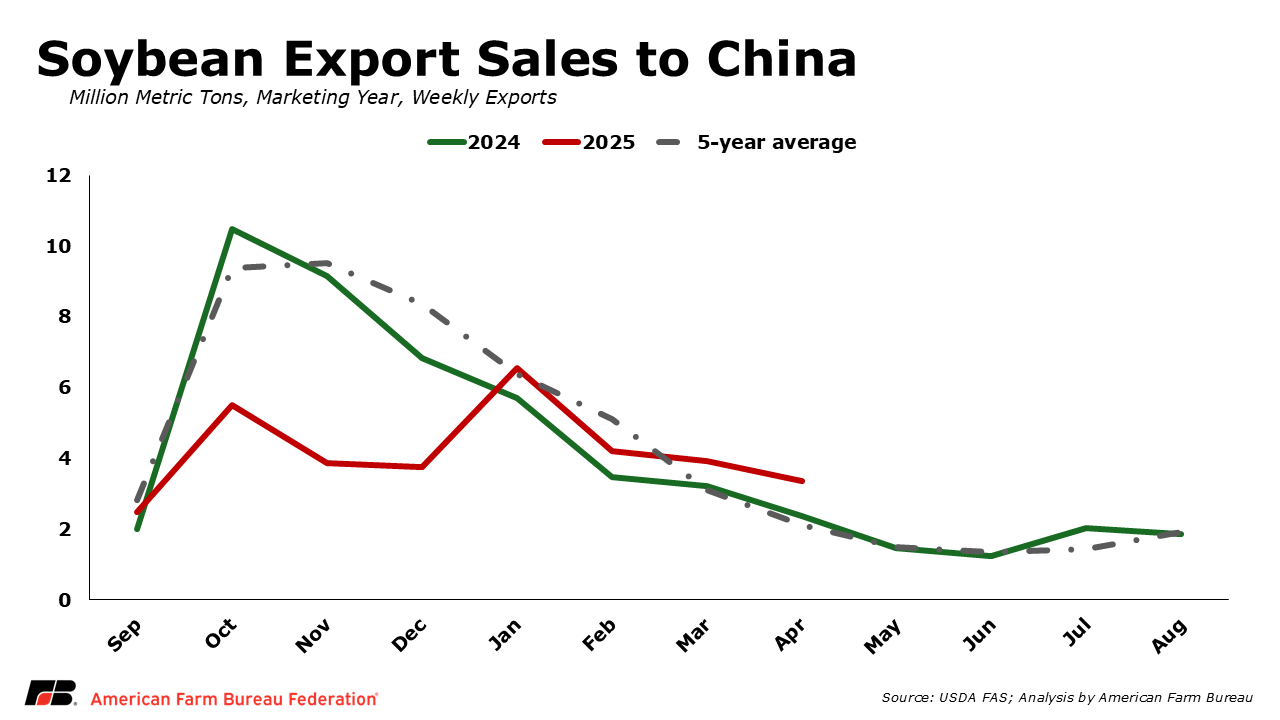
Recent export sales data suggest some renewed momentum. Through the first four months of 2026, weekly soybean export sales to China are running ahead of 2025 levels and generally above the five-year average, signaling stronger near-term purchasing activity. That improvement follows the China Phase Two trade framework announced in late 2025, which included a commitment for China to purchase 12 MMT of U.S. soybeans in 2025, followed by 25 MMT annually for the next three years.
Still, commitments on paper do not always translate into sustained buying behavior. Soybean trade remains highly seasonal, and China increasingly sources soybeans from Brazil during key portions of the marketing year. Early export sales strength is encouraging, but consistent follow-through will determine whether improved sentiment translates into meaningful support for farm income.
The Bottom Line
As U.S.-China trade discussions continue, agriculture remains both a strategic strength for the United States and a sector highly vulnerable to policy disruptions. This week’s meeting between President Trump and President Xi has renewed hope for stronger trade ties and potential agricultural purchase commitments. For farmers and ranchers facing continued economic pressure, the key will be whether renewed dialogue translates into consistent export sales and improved market certainty.

