Declining Egg Prices Squeeze Farmers

Bernt Nelson
Economist
Key Takeaways
- After nearly 21 million birds were affected by Highly Pathogenic Avian Influenza (HPAI) between January and March 2026, detections have fallen, with less than 10,000 birds affected so far in May. The resulting increase in egg supply comes during a time of softened demand.
- Retail prices for shell eggs are currently 62% below last year, while prices paid to farmers for shell eggs are down 93%. Prices for breaker eggs, used for the liquid egg market, have fallen to just 8 cents per dozen, 96% below last year and well below break-even levels.
- Prolonged periods of below break-even prices could force farms out of the market and contribute to continued consolidation in the egg industry.
Egg markets have encountered massive volatility since outbreaks of HPAI began in 2022. Retail shell egg prices hit a record level in 2025 but are now nearly 60% lower than a year ago as supplies have strengthened and HPAI cases declined. This demonstrates growing resilience in the poultry industry, but as egg supplies rebound, prices are now falling while expenses remain elevated, threatening farm profitability.
U.S. Egg Market Structure
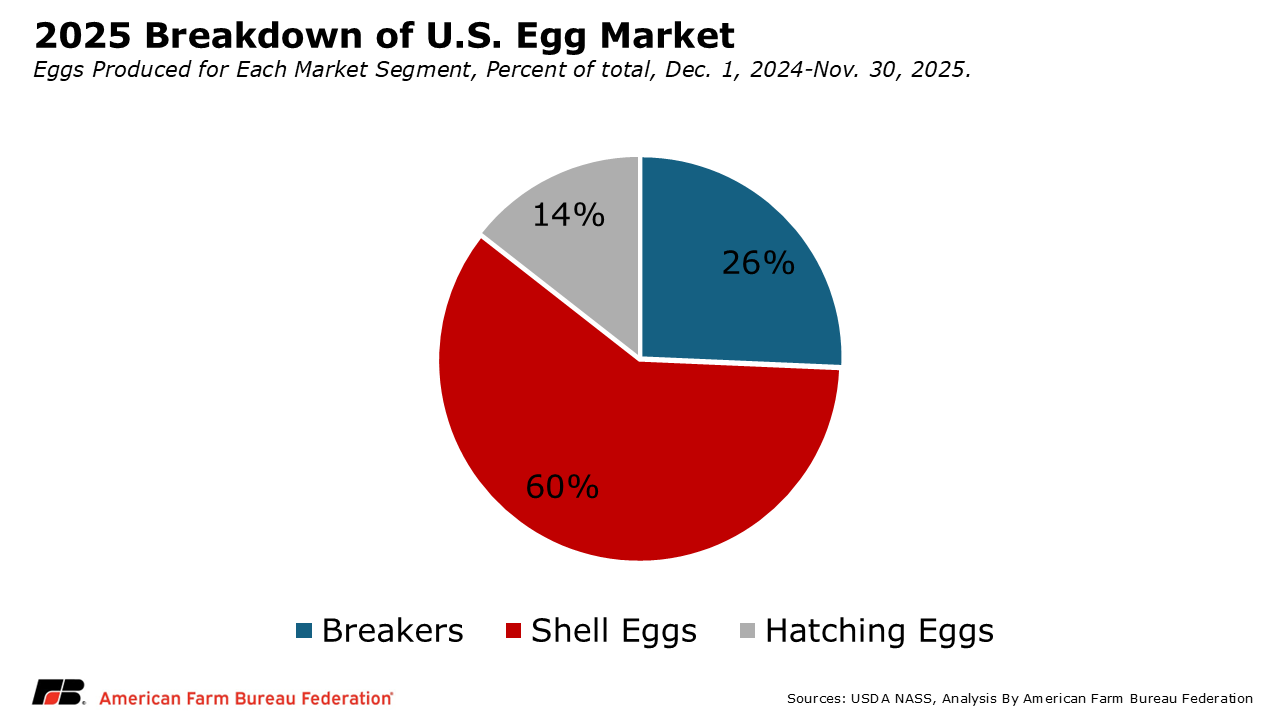
According to USDA’s 2025 Chickens and Eggs Summary, a total of 105.25 billion eggs were produced in the United States in 2025, down about 3.9 billion eggs or 4% from 2024 — reflecting impacts from HPAI. All eggs produced for human consumption are called table eggs. About 90.2 billion eggs, or 86% of all eggs produced in 2025, were table eggs, while 15.2 billion, or about 14%, were hatching eggs used for producing chickens. Out of the table eggs produced for human consumption, about 30%, or 31.6 billion, commonly called breaker eggs, went to specialized breaking facilities for the liquid egg market. The liquid eggs are then converted into ingredients for industrial bakers, the food service industry or other food manufacturers. The remaining unbroken table eggs, sold in cartons at the grocery store, are called shell eggs. About 60% of all eggs produced in the U.S. in 2025, or about 63.2 billion eggs, were shell eggs.
Prices and Volatility
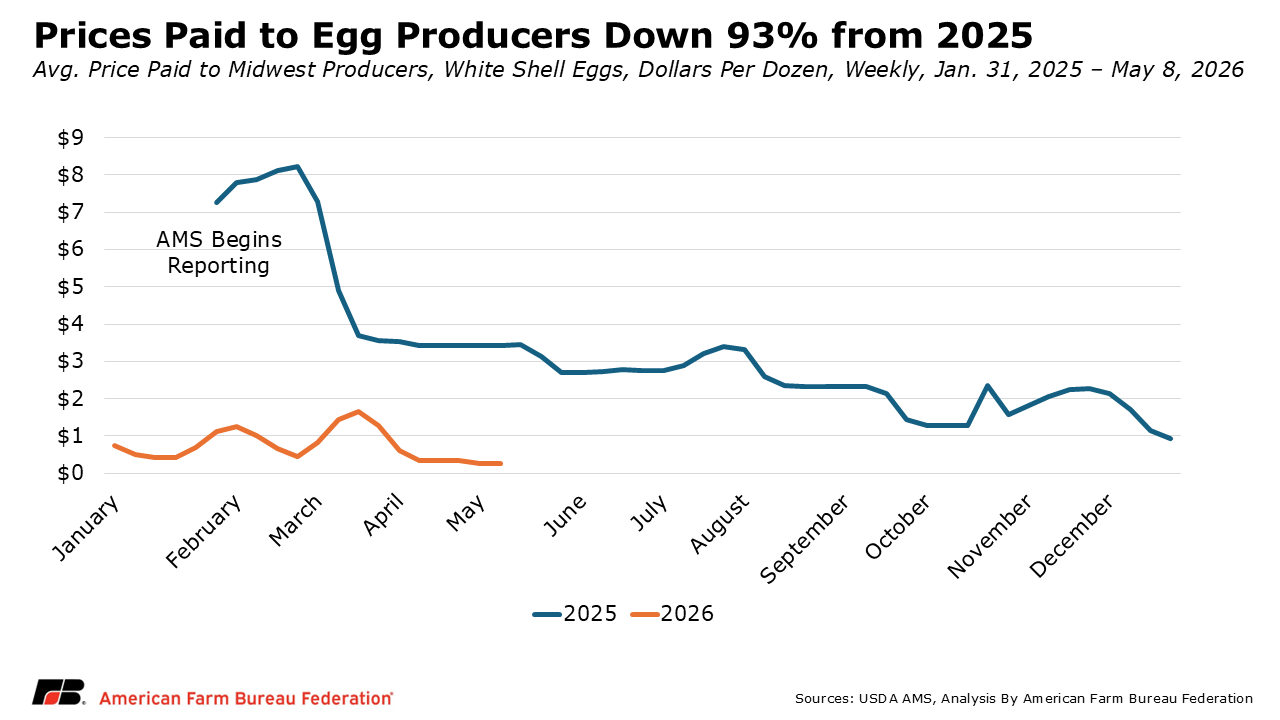
Farmgate prices for eggs have fallen sharply in 2026. USDA’s Agricultural Marketing Service (AMS) began reporting weekly data for the average price paid to egg producers in the Midwest region for large white shell eggs in January 2025. AMS reports the average price paid to Midwestern egg producers for white shell eggs for the week of May 8, 2026, was 25 cents per dozen, down $3.19 per dozen or 93%, from the same week in 2025.
Prices for breaker eggs have fallen even more. According to AMS, the average national price paid for a dozen breaking stock eggs in April was just 8.73 cents per dozen, 96% lower than $2.48 per dozen in April 2025.
In general, the market for table eggs is considered more profitable than the market for breaker eggs. This is because table eggs are sold more directly to consumers with minimal processing. This returns a larger share of every consumer’s dollar spent on food to the farmer.
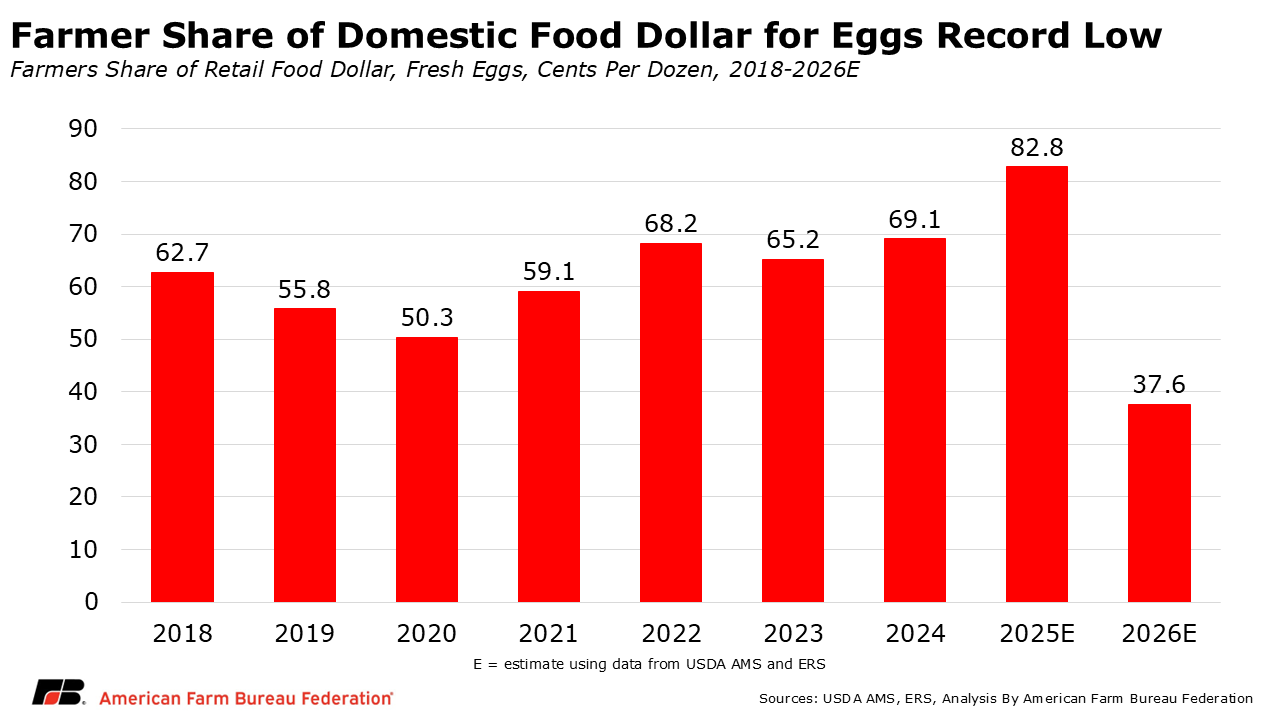
According to USDA-Economic Research Service’s (ERS) latest Food Dollar Series, fresh eggs returned 69.1 cents per dollar to the farmer in 2024. Using combined data from USDA AMS and ERS, the estimated farmer’s share of the retail dollar for fresh eggs was a record high 82.8 cents in 2025, up 19 cents from 2024. Using the same method, the estimated farmer’s share of the U.S. retail food dollar for fresh eggs for January-March 2026 is a record low at 37.6 cents, down 45.2 cents or 55% from the 2025 estimate. This underscores the high level of volatility egg farmers are experiencing in today’s markets.
Price Discovery
Price discovery is the process of determining the spot price for a commodity or asset. One of the primary mechanisms for egg price discovery is egg price clearing houses. Egg clearing houses act as centralized trading platforms to determine prices through transparent, live electronic auction-style bids to buy and sell eggs. Egg Clearinghouse Inc. (ECI), for example, traded 2.6 billion eggs and 39 million pounds of egg products with a value exceeding $600 million in 2024. ECI charges a commission of 1 cent per dozen eggs traded on its platform regardless of market conditions. When prices for eggs are high, the commission is a small percentage of the farmer’s overall price received. But when prices are low, like they currently are for the breaker market, 1 cent is a larger percentage of farmgate revenue.
Cost of Egg Production
The market a farmer participates in and other factors such as a farm’s distance from market heavily influence the cost of producing eggs. Smaller farms often operate with higher per-unit costs that make them more vulnerable to sharp price swings than larger farms. For example, pullet (young chicken) costs may be different for a farmer in the breaker market than for a farmer purchasing pullets for the shell egg market. The cost of growing those pullets to laying age may also vary, as would regional labor, transportation and utilities costs. Participating in the shell egg market also requires higher infrastructure investments in grading and packaging equipment, which can be difficult for smaller farms to afford. A grader alone can cost tens of thousands of dollars, with larger farms requiring multiple graders. Smaller farms that do not own or cannot afford a grader are limited to participating in the breaker market.
According to data from the Egg Industry Center located at Iowa State University, the combined four-region monthly cost to produce conventional eggs in April 2026 was about 79 cents per dozen. According to AMS, the average price paid to Midwestern egg producers for large white shell eggs was 35 cents per dozen, 44 cents per dozen below cost of production for the month of April. AMS reports that the price paid to producers for the week of May 8, 2026, was 25 cents per dozen. If current costs are near the same level reported in February, those costs would be three times higher than the average price paid to Midwestern producers for shell eggs for the week of May 8, 2026.
Conclusion
The steep drop in egg prices in 2026 has exposed just how vulnerable many egg farmers have become. Even as the egg industry shows signs of resilience in the wake of declining HPAI detections, the financial picture on the farm is far less stable. Farmgate prices have fallen faster than production costs, leaving many farmers operating well below break-even levels.
These challenges are not just temporary market fluctuations; they are structural vulnerabilities that will shape the future of the industry. With no futures markets, insurance programs or other risk management tools to cushion these shocks, egg farmers are fully exposed to market volatility at a time when margins are negative or razor thin.