Senate Testimony: “Perspectives on the Fertilizer Industry: Ensuring a Stable and Affordable Supply for American Producers”
Testimony as Prepared by KY Farm Bureau President Eddie Melton
TOPICS
fertilizerAFBF Staff

photo credit: AFBF Photo
Testimony as Prepared by Eddie Melton
President, Kentucky Farm Bureau
To the United States Senate Committee on Agriculture, Nutrition, & Forestry
May 12, 2026
Chairman Boozman, Ranking Member Klobuchar, and Members of the Senate Agriculture Committee, my name is Eddie Melton. I am a fifth-generation row crop and beef cattle farmer from Webster County, Kentucky, and I currently serve as president of Kentucky Farm Bureau. It is an honor to be with you today to speak on behalf of the farmers of Kentucky, as well as the more than 470,000 Kentucky Farm Bureau member families.
My family has been farming in Webster County since 1900 when my great-great-grandfather purchased our farm. I graduated from Murray State University in 1980 with a Bachelor of Science in agriculture. During my college years, I had to take a break from my studies to help run our farm when my father’s health began to decline. In 1990, the entire operation became my responsibility.
During my lifetime, I have helped bring in more than 50 years of crops. We typically raise corn, soybeans, canola, wheat, and beef cattle. This year, due to fertilizer prices, we made the decision not to plant wheat and canola. This is the kind of decision farmers across the country have had to make this crop year.
This hearing comes at a critical time as we assess the current state of the farm economy and the ongoing challenges facing American agriculture. Against this backdrop, I want to focus on one of the most pressing and persistent issues confronting producers: the sustained rise in fertilizer and input costs, and the broader financial strain it is placing on the agricultural sector.
A Crisis Years in the Making
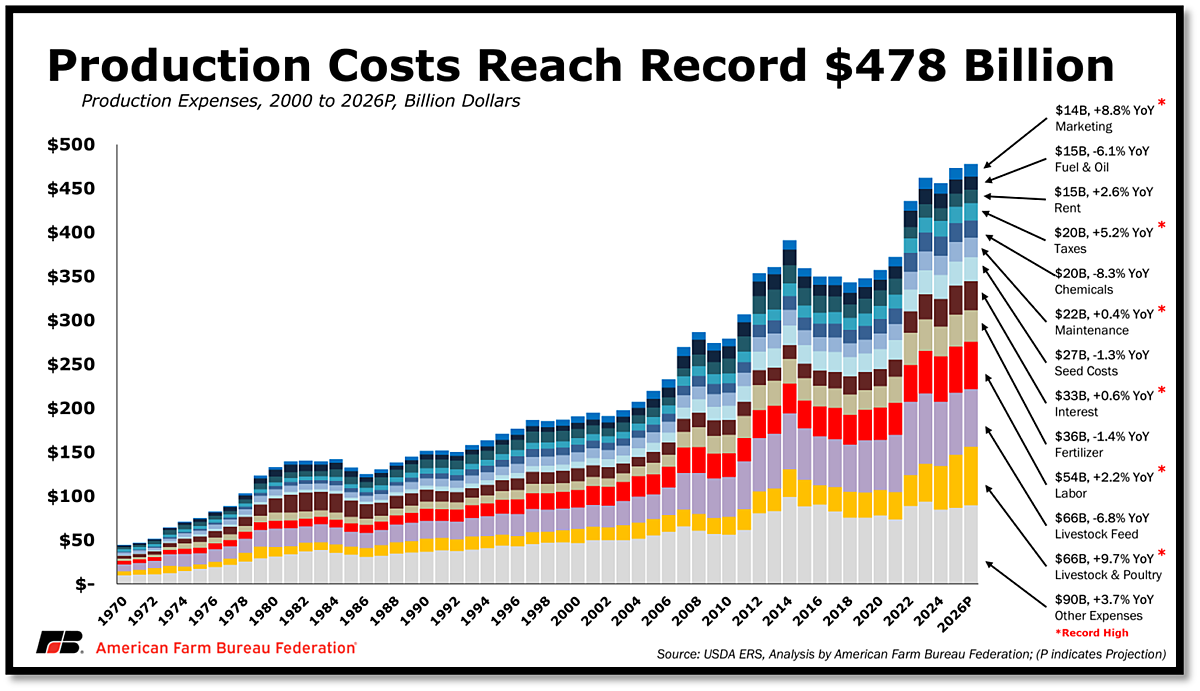
One point that must be clearly understood is that today’s fertilizer price challenges did not begin with the recent conflict in Iran. While global tensions often draw attention to input markets, prices for inputs like fertilizer and fuel have been elevated for several years. USDA forecasts that production expenses will reach a record $478 billion in 2026, and that was before the surge in fuel and fertilizer prices.[1]
The current situation is not a temporary disruption, it is the continuation of a longer trend that has steadily increased the cost of doing business in agriculture.
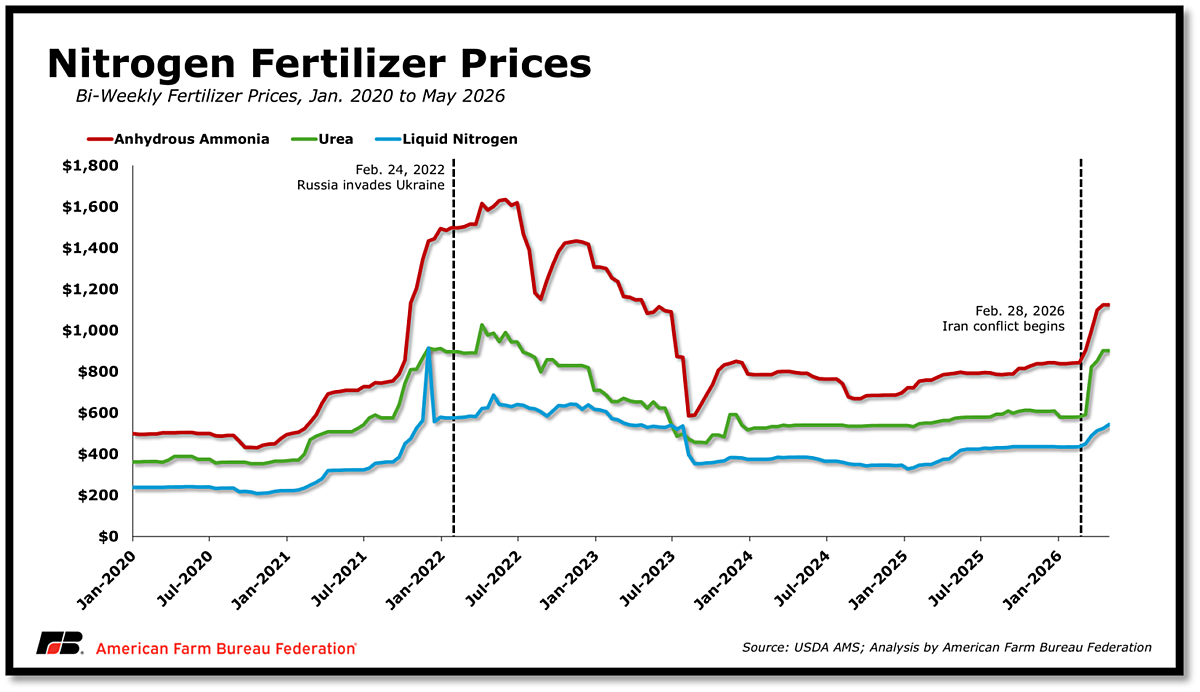
While the current crisis is not new, disruptions at the Strait of Hormuz have beyond a doubt exacerbated the problem. The University of Kentucky’s Department of Agricultural Economics recently published an article on this very issue. According to their data, prior to the closure, more than 20 million barrels of oil moved through the Strait daily, along with most of the liquefied natural gas from Qatar and the UAE.[2] The shipping disruptions contributed to an increase in the price of nitrogen fertilizer, which has natural gas as its primary feedstock. The analysis also points out that one-third of fertilizer carried by cargo ships, particularly urea and phosphate, must pass through the Strait. The unpredictability in the region has led to concerns about availability for not just the current crop year, but for next year as well. The chart below shows nitrogen fertilizer prices since January 2020 along with the accompanying spikes.
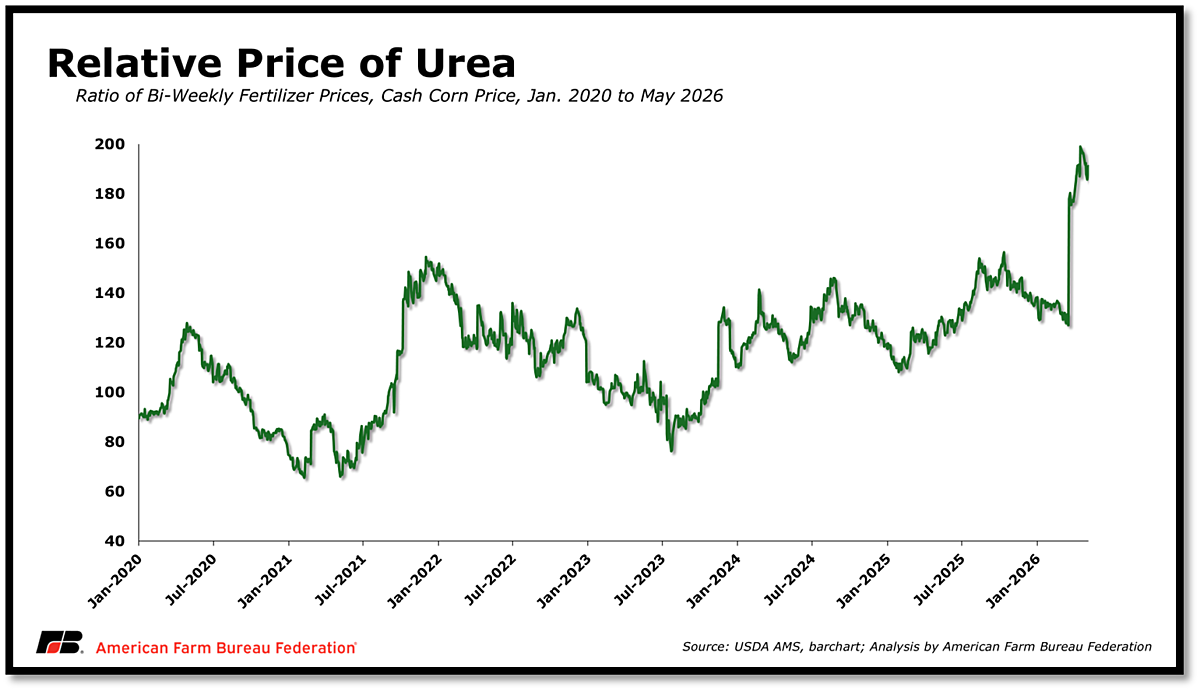
One common way to measure fertilizer affordability is to compare how many bushels of corn are required to purchase a ton of fertilizer. In 2022, farmers saw record-high grain prices, with corn averaging approximately $6.50 to $7.00 per bushel. Today, USDA’s latest WASDE places corn closer to $4.15 per bushel. As prices have declined, the number of bushels required to purchase a ton of fertilizer has increased significantly, meaning fertilizer is effectively more expensive in real terms. For example, the current cost of urea is near the record high seen in 2022 during the peak of the conflict between Russia and Ukraine.[3]
Sustained Economic Pressure’s Impact on the Farm
At the same time fertilizer prices are rising, the broader farm economy has been under sustained pressure. This year marks the fourth consecutive year of decline, driven by a combination of persistently low commodity prices and elevated fertilizer costs, as evidenced in the chart “Production Costs Reach Record $478 Billion.” Unlike previous cycles, producers are not benefiting from strong crop prices to offset higher expenses. Instead, they are being squeezed from both sides.
That margin compression is having real consequences on the ground. Many farmers are operating with little to no working capital, limiting their ability to manage risk or invest in future production. Over time, that kind of financial strain compounds. It is reflected in rising farm bankruptcies and reinforced by producer surveys showing that input costs are directly influencing planting decisions. In the first quarter of 2026, 86 farms have already filed for Chapter 12 bankruptcy, including 25 in the Southeastern region.[4]
To better understand how global fertilizer market disruptions are affecting producers during spring planting, the American Farm Bureau Federation (AFBF) conducted a Fertilizer Availability Survey of more than 5,700 farmers and ranchers nationwide between April 3 and April 11.[5] The results highlight significant challenges in fertilizer access, with just 19% of Southern producers reporting that they had pre-booked fertilizer, compared to 30% in the Northeast, 31% in the West, and 67% in the Midwest—reflecting variations in planting timelines and exposure to recent price increases.
Affordability challenges are especially acute in the South with roughly 78% of respondents indicating they were unable to afford all the fertilizer they need. In my home state of Kentucky, just 29% of farmers reported being able to pre-book fertilizer with almost 72% stating they could not afford all the fertilizer they needed for this growing season. Roughly 90% of Kentucky farmers who responded to the survey said they were financially in the same or a worse position than they were last year, while nationwide roughly 60% reported being in a worse position. We know this is a direct result of rising fertilizer costs.
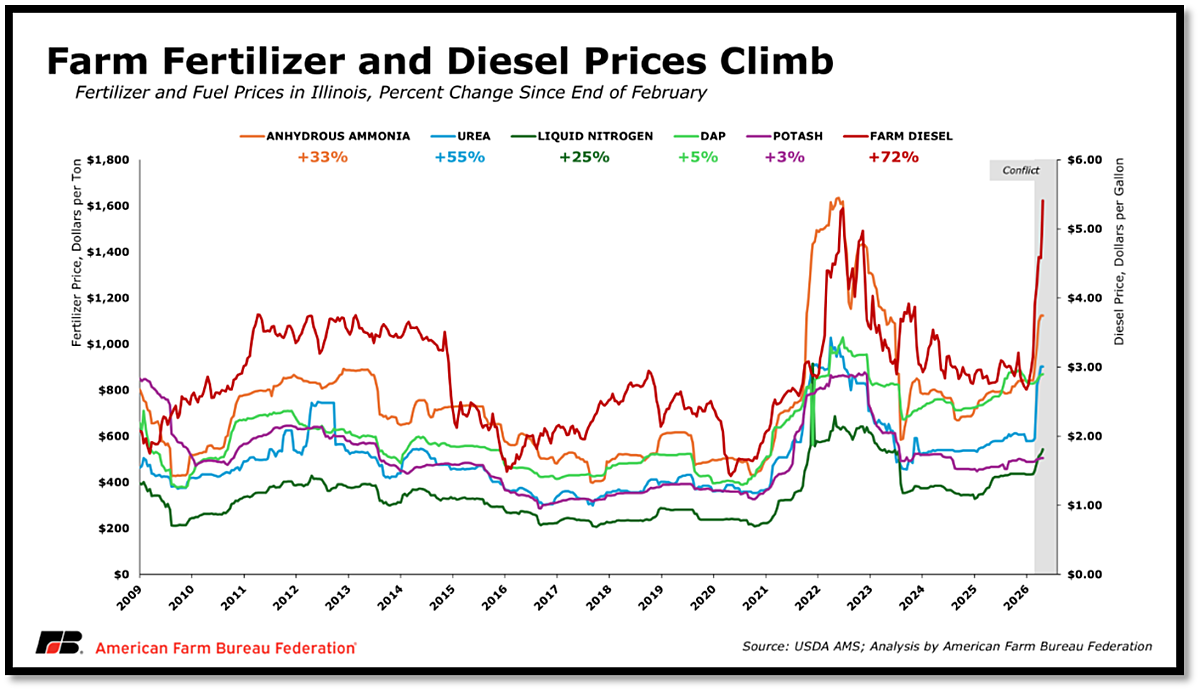
Since February, we have seen a 33% rise in anhydrous prices, a 55% rise in urea prices, a 25% increase in liquid nitrogen, a 5% increase in DAP, and a 3% increase in potash. At the same time, farm diesel prices have surged 72% since the end of February, increasing the cost of fieldwork, fertilizer transportation, and irrigation. Taken together, these pressures are weighing heavily on farm finances, with nearly six in ten farmers reporting worsening financial conditions, underscoring the urgent need for near-term economic relief to keep farm operations viable.
Policy Solutions
Addressing these challenges requires both immediate and long-term action. In the near term, greater transparency in the fertilizer market and ensuring farmers have access to the fertilizer they need to get through this growing season is essential. This includes the temporary suspension of the countervailing duties on imported fertilizer products to moderate price increases. AFBF sent a letter to President Trump on March 9, 2026, shortly after the impacts of the disruptions in maritime travel in the Strait of Hormuz were felt in the global fertilizer market.[6] We appreciate the efforts by the Administration so far, including the suspension of the Jones Act and increased resources to build domestic capacity. We continue, however, to call on the President and Congress to do everything in their power to increase availability of fertilizer and ease the price burden on farmers this growing season. In an October 2025 letter to the President and Congressional leadership, AFBF highlighted the need for fairness and transparency in input markets.[7] Agriculture depends on well-functioning markets, but when pricing is opaque and options are limited, producers are left without the ability to respond effectively. Improving research into pricing would provide farmers with more certainty as they make critical input decisions.
Over the longer term, the United States must strengthen its domestic fertilizer production capacity. We are grateful to the Administration, especially Secretary Rollins and the team at USDA, for their work on this issue. Reliance on global supply chains for such a vital input leaves producers vulnerable to disruptions well beyond their control. Expanding domestic production would improve supply reliability and help moderate price volatility over time. Achieving that goal will require a regulatory environment that allows investment and development to move forward in a timely and predictable manner. Additionally, the U.S. must continue research and development of agricultural biologicals that can help improve plant growth and nutrition. These tools can help provide additional fertilizer options to farmers.
Call to Action
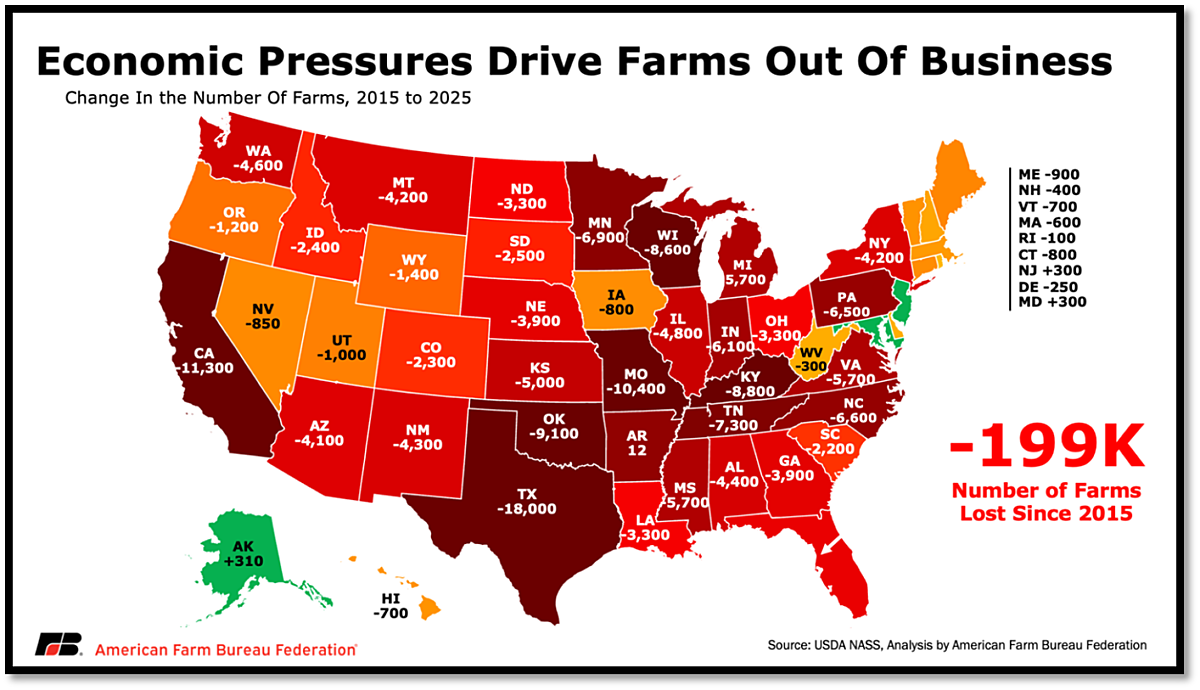
The challenges facing agriculture today are the result of sustained economic pressure that is reshaping the farm economy. According to USDA, we lost more than 20 million acres of farmland between 2017 and 2022, along with more than 199,000 farms since 2017.[8] If farm closures, farmland loss, and consolidation continue, the long-term structure of American agriculture will begin to change. That change poses a risk to our national security by weakening domestic food production capacity and increasing reliance on foreign, less resilient supply chains. Ensuring that producers have access to affordable inputs and fair, transparent markets is critical, not only for their operations, but for the long-term stability of American agriculture and national food security.
For producers operating on thin margins, there is no flexibility to wait for longer-term solutions. That is why near-term support matters. Congress should act now with additional economic assistance to help farmers manage today’s cost pressures, prevent further financial strain, and stabilize operations while longer-term fixes are put in place.
Chairman Boozman, Ranking Member Klobuchar, and members of the Committee, thank you for the opportunity to speak today as both a farmer and as president of the Kentucky Farm Bureau.
This hearing is an important step toward advancing lasting solutions to the rising input cost challenges facing agriculture. I look forward to working with the Committee to strengthen the farm economy and ensure that America’s farmers and ranchers can continue to provide a safe, reliable supply of food, fiber, and fuel for generations to come.
Thank you.
[1] American Farm Bureau Federation, Market Intel, “USDA Cuts 2025 Farm Income as Weakness Persists into 2026,” available at: https://www.fb.org/market-intel/usda-cuts-2025-farm-income-as-weakness-persists-into-2026
[2] University of Kentucky Department of Agricultural Economics, “Global Shipping Disruptions and the Recent Increase in Nitrogen Fertilizer Prices,” available at: https://agecon.mgcafe.uky.edu/articles/global-shipping-disruptions-and-recent-increase-nitrogen-fertilizer-prices
[3] Federal Reserve Bank of Kansas City – Center for Agriculture and the Economy, “Disruptions in the Strait of Hormuz Pressure Fertilizer Prices Ahead of the U.S. Growing Season,” available at: https://www.kansascityfed.org/center-for-agriculture-and-the-economy/insights-on-agricultural-and-rural-economies/
[4] Administrative Office of the U.S. Courts, “Bankruptcy Filings Statistics,” available at: https://www.uscourts.gov/data-news/reports/statistical-reports/bankruptcy-filings-statistics
[5] American Farm Bureau Federation, Market Intel, “Farm Bureau Survey Reveals Real Impact of Fertilizer Availability and Price,” available at: https://www.fb.org/market-intel/farm-bureau-survey-reveals-real-impact-of-fertilizer-availability-and-price
[6] American Farm Bureau Federation. (2026). Letter to the President of the United States: Fertilizer. https://www.fb.org/files/AFBF-Letter-to-POTUS-Fertilizer.pdf
[7] American Farm Bureau Federation. (2026). AFBF letter to Congress: Farm economy. https://www.fb.org/files/backgrounder/AFBF-Letter-to-Congress-Farm-Economy.pdf
[8] American Farm Bureau Federation, Market Intel, “Farm Bankruptcies Continued to Climb in 2025,” available at: https://www.fb.org/market-intel/farm-bankruptcies-continued-to-climb-in-2025
Press Contacts
Mike Tomko
Director, Communications
(202) 406-3642
miket@fb.org
Bailey Corwine
Communications Manager
(202) 406-3643
baileyc@fb.org

