A Look at IRS Section 180 Tax Deductions

Cameron Castillo
Associate Economist
Key Takeaways:
- Section 180 tax deductions allow farmers and ranchers to deduct costs associated with the purchase, acquisition or application of critical inputs such as fertilizer and minerals in the year paid.
- For years, companies have advertised opportunities for farmers and ranchers to submit Section 180 deductions on the value of residual fertilizer and minerals in newly acquired farm or pastureland.
- While “residual fertility” deduction claims carry the allure of substantial per-acre savings, these claims are not backed by sound IRS guidance and could result in significant penalties for farmers and ranchers claiming these deductions.
Farmers buying land have long been able to take a tax deduction on the fertilizer they apply. However, a more aggressive idea has spread quickly over the past few years: claiming deductions on the fertilizer that was already in the soil when the land changed hands. Marketed under the banner of Section 180 of the Internal Revenue Code (IRC), the "residual fertility" deduction advertises to land buyers a first-year write-off of hundreds or thousands of dollars per acre. While the tax-savings benefits are attractive on the surface, residual fertility claims lack sound IRS guidance. Further, if projected per-acre deductions were to be realized, the cost would far exceed budgetary projections for all of Section 180. This Farm Bureau Intel walks through what the deduction is, how big the potential pool of claims could be, and what a farmer stands to lose if a claim is deemed inadmissible.
This analysis addresses claims made under the Section 180 election, which is taken in the year the land is acquired. Landowners who do not qualify for that election, such as those who cash-rent rather than farm the ground, or who bought in an earlier year, may instead capitalize residual fertility and recover it over several years under other provisions. Those claims fall outside this analysis.
What is Section 180?
Initially ratified by Congress in 1960, Section 180 lets a taxpayer engaged in farming elect to expense the cost of fertilizer, lime and similar soil amendments in the year paid rather than capitalize them. While data on the number of farmers across the country who use Section 180 claims is unavailable, the Congressional Joint Committee on Taxation (JCT) estimates that farmers save $150 million in taxes each year by using Section 180 tax deductions. estimates that farmers save $150 million in taxes each year by using Section 180 tax deductions.
Separate from the use of Section 180 to deduct the cost of applied fertilizer and similar related soil amendments is the concept of utilizing Section 180 to claim a deduction on unexhausted, residual fertilizer and similar minerals already present on newly purchased or inherited farmland. When farmland is purchased or inherited, the buyer allocates part of the purchase price (or stepped-up basis) to the unexhausted nutrients left by the prior owner and deducts that amount.
However, the precedent for Section 180 residual fertilizer deduction claims is, at best, unresolved. The only formal IRS guidance related to residual fertility claims comes from an early IRS memorandum, which denied a claimed deduction but outlined what a taxpayer would need to show:
- That residual fertilizer attributable to the prior owner is present and measurable;
- That it is being used up by the crops in the ground; and
- That the taxpayer holds beneficial ownership of the land.
No court decision, regulation or revenue ruling has endorsed the practice. Agricultural law commentary from Iowa State's Center for Agricultural Law and Taxation and Southern Ag Today describes a narrow, soil test-documented claim as reasonable with respect to approval for submitted deductions, while suggesting that claims based on total nutrient content, long-past purchases, or pasture and rangeland are vulnerable.
How Large Could the Pool of Claims Be?
There is no official count of residual fertility claims made under Section 180. However, what can be measured is the pool of land eligible to generate a claim.
USDA's 2024 Tenure, Ownership, and Transition of Agricultural Land (TOTAL) survey, released in March 2026, asked landowners what they expect to do with their land over the next five years (2025 through 2029). Owners reported plans to sell 22.8 million acres to nonrelatives and 12.8 million acres to relatives, with another 7.4 million acres to be gifted or donated. Gifts fall outside this analysis, because gifted land carries over the donor's basis and leaves the new owner no fresh purchase price to allocate to soil fertility. That leaves 35.6 million acres of farmland sales. Applying the national cropland share from the 2022 Census of Agriculture (43% out of 880 million farm acres) narrows the base to 15.5 million cropland acres, which this analysis uses to estimate annual transfers of cropland at 3.1 million acres per year for 2025-2029.
Multiplying those acres by the values in circulation produces a revealing pattern. A conservatively documented claim of $150 an acre (about two years of applied phosphorus and potassium at current prices) would cost the Treasury about $111 million a year at a 24% marginal tax rate. That is below what JCT already scores for all of Section 180, which is what one would expect: a modest, defensible deduction taken by a subset of land buyers should fit inside the existing estimate.
However, if the advertised values were realized, the cost to Treasury would be significantly more. At a deduction level of $300 per acre, the implied cost to the government is $223 million a year. Some companies advertise per-acre deductions significantly higher than $300 per acre, with one promoter quoted in a Oklahoma State University Extension webinar telling farmers their clients' nutrient loads run "over $1,300 per acre," which implies $964 million a year, or $4.8 billion across the five-year window (over 6 times the estimated impact by JCT). the estimated impact by JCT).
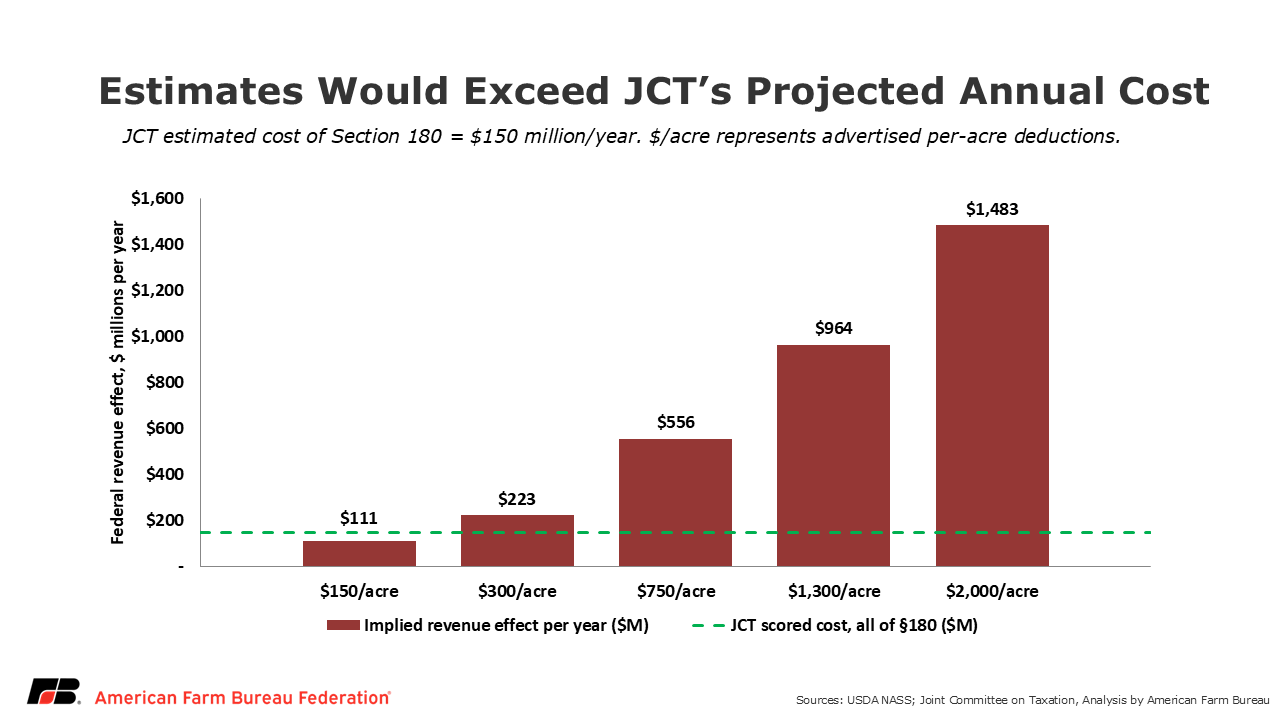
These estimates are ceilings, not precise forecasts of potential deduction savings. They assume every eligible acre generates a claim, which certainly is not happening. But the gap between the ceiling and JCT’s score of $150 million per year (for all of Section 180, not just residual fertility claims) is the crux of why some are skeptical about residual fertility claims under this section of the tax code.
Either uptake remains a small fraction of what the marketing implies or the tax return data JCT works from to score the budgetary impact of Section 180 (which lags by two to three years) has not yet caught up with a practice that has spread quickly. However, both readings describe a deduction growing faster than its official footprint.
What’s the Potential Downside?
The relevant question for an individual farmer is not the national total but the downside of a single claim. Consider a 500-acre cropland purchase at $6,020 an acre (the 2026 U.S. average reported by USDA) for a total of just over $3 million.
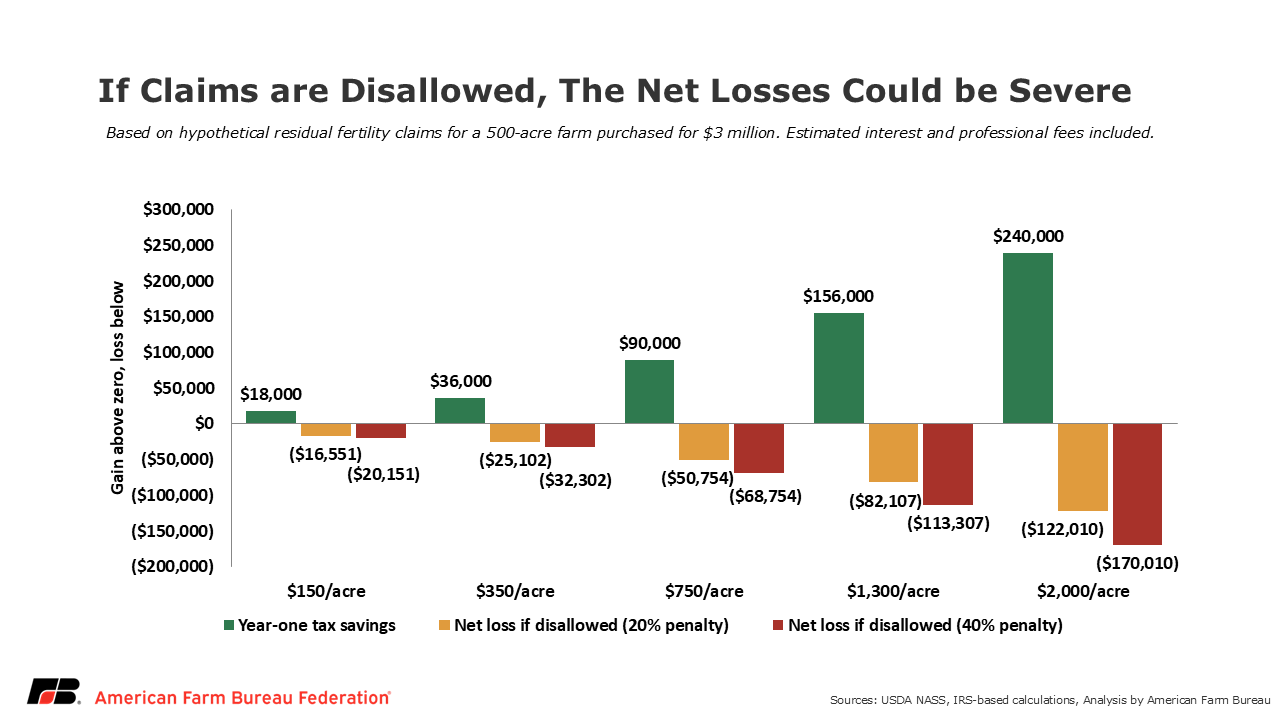
On 500 acres, a claimed deduction of $150 per acre is a $75,000 deduction and, at a 24% marginal rate, about $18,000 in first-year tax savings. At $750 an acre, the deduction is $375,000 and the savings $139,000; at $2,000 an acre, the deduction reaches $1 million and the savings $370,000.
These are all, in theory, pretty substantial savings. However, it is important to consider what those figures assert about the land itself. A $150 claim allocates 2.5% of the purchase price to soil fertility. A $2,000 claim allocates 33% ($1 million), which suggests that a third of what the buyer paid for was soil fertility.
If a claim is disallowed, the tax is repaid, which cancels the benefit. What the farmer pays on top of that is the penalty, underpayment of interest at the IRS' current 7% rate, and the cost of defending the position via retaining legal and/or tax professionals. Furthermore, accuracy-related penalties could increase from 20% to 40% when a claimed value is at least twice the correct amount. With a $ 150-per-acre claim, that loss could be roughly $16,000 to $20,000. For a $2,000 per acre claim, a disallowed residual fertility deduction could result in a net loss of nearly $170,000.
There is, however, a further wrinkle in the documented claim's favor: the Iowa State Center for Agricultural Law and Taxation notes that a technical advice memorandum can constitute substantial authority for a return position, which may shield a well-supported claim from the accuracy-related penalty altogether.
Two mechanical traps compound the risk on the aggressive end. The Section 180 election belongs on the return for the year the land was acquired, so promoters offering a 15- or 20-year lookback are implicitly relying on amended returns for years that may already be closed, while the six-year statute of limitations for substantial omissions keeps exposure open longer precisely on the largest claims. And a seven-figure first-year deduction can run into the excess business loss limitation, deferring the advertised savings into later years while the audit exposure begins immediately.
Bottom Line
Section 180 deductions are a useful tool for farmers and ranchers who seek to deduct their fertilizer and related minerals costs. However, utilizing Section 180 to make a claim based on residual fertility could lead farmers and ranchers into a sticky situation with the IRS. While advertised quotes show eye-popping tax savings by claiming residual fertility deductions, the reality is that residual fertility claims under Section 180 are supported by an IRS memorandum regarding a claim that was denied.
Farmers and ranchers should insist on soil test documentation they control, understand that a vendor's valuation is not IRS acceptance, and weigh the year-one savings against a penalty structure that grows with the claim. For policymakers, the situation calls for IRS guidance or statutory clarification of Section 180 to define what qualifies, thereby legitimizing deductions while removing the incentive for the aggressive version before enforcement does so retroactively.