Capturing the Feedlot Value of Beef-on-Dairy Cattle

Cydney Stables
AFBF Economics Intern
Daniel Munch
Former AFBF Economist
Key Takeaways
- With a historically small traditional beef herd and tight feeder cattle supplies, beef-on-dairy cattle, or dairy cows bred with beef cattle genetics, have become an increasingly important source of fed beef.
- Kansas State University research finds that placement weight is a major driver of beef-on-dairy performance. Their growth and feed-efficiency advantages are strongest when cattle enter feedlots at lighter weights.
- At a 400-pound placement weight, beef-on-dairy cattle gain about 0.70 pounds more per day than traditional beef cattle and convert feed at a similar rate.
- Beef-on-dairy cattle maintain lower mortality rates across the full 400- to 900-pound placement range, although that advantage narrows at heavier weights.
- Earlier placement could allow feedlots to capture more of the cattle’s efficient early growth, but doing so would require closer coordination among dairy farms, calf raisers, backgrounders and feedlots. Stronger downstream performance can help sustain demand and market value for beef-on-dairy calves.
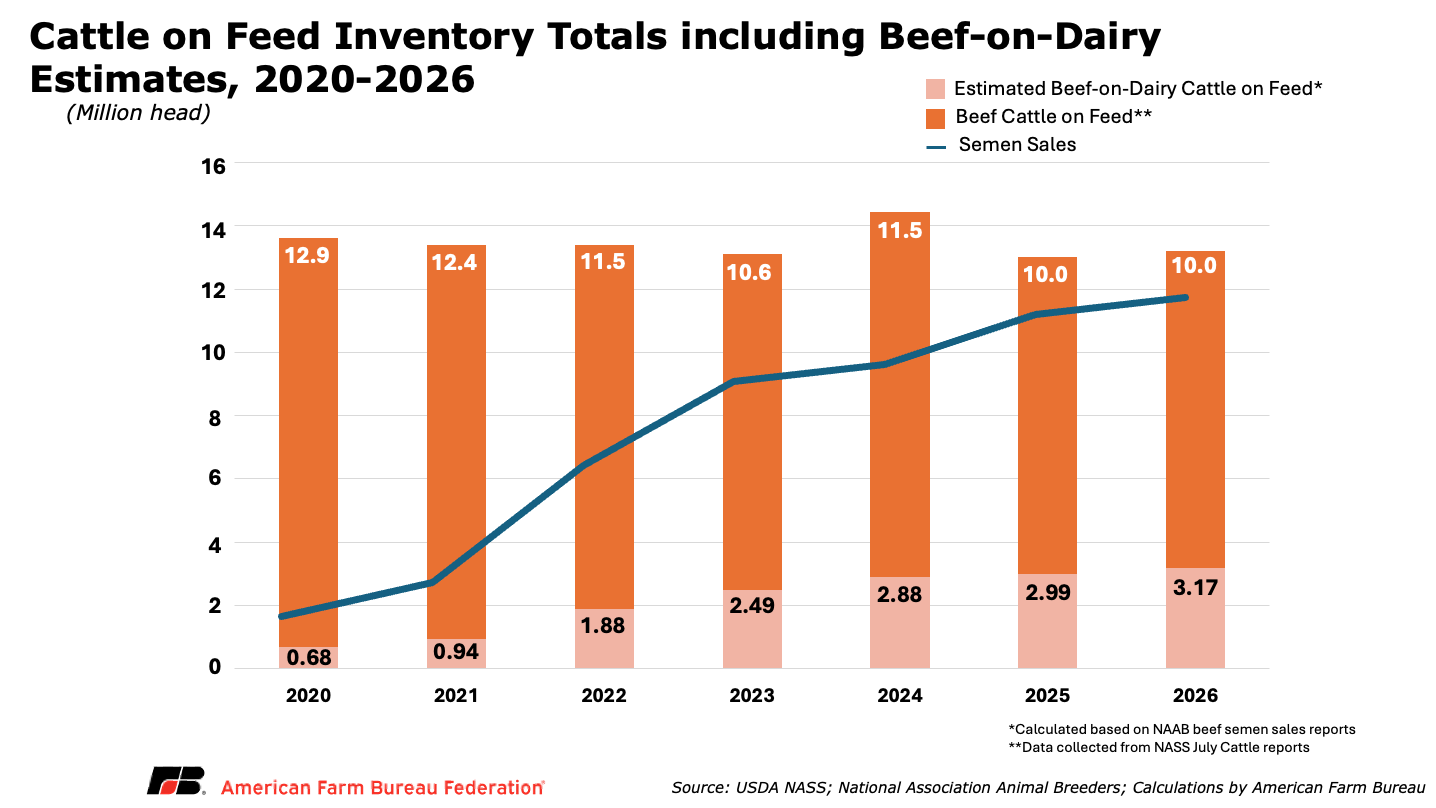
Beef-on-dairy breeding has become an increasingly important source of revenue for dairy farms. By using sexed semen to produce the dairy replacements they need and breeding other cows to beef genetics, dairy farmers can produce calves with greater market potential than traditional dairy calves. More than 72% of dairy farms now incorporate beef-on-dairy into their breeding programs and those crossbred animals account for more than 20% of cattle entering U.S. feedlots.
But producing a crossbred calf does not mean a farmer or rancher will make more money. The calf’s value depends on how well it performs for calf raisers, backgrounders, feedlots and, ultimately, beef processors. Growth rates, feed requirements, health outcomes and carcass characteristics all influence what downstream buyers are willing to pay, and therefore how much additional revenue beef-on-dairy can generate for the dairy farm.
New research using Kansas commercial feedlot data provides a clearer picture of how beef-on-dairy cattle perform relative to traditional beef cattle and how those outcomes change based on placement weight. The findings suggest beef-on-dairy cattle generally achieve stronger daily gains and lower mortality when entering feedlots at lighter weights, although their feed efficiency and growth advantage decline as placement weights increase. These results can help feedlot managers refine purchasing, placement and feeding decisions, while giving dairy farmers and calf raisers greater insight into the traits and management practices that support continued demand, and stronger market value, for beef-on-dairy calves.
Filling a Critical Supply Gap
With U.S. cattle inventory at its lowest level since 1951, beef-on-dairy cattle are becoming an increasingly important source of fed beef. USDA’s July 2026 cattle inventory report showed modest signs of stabilization, with total cattle inventory increasing for the first time since 2018. However, the beef cow herd declined to 28.5 million head, the lowest level recorded in a July inventory report, while lower calf inventories and feedlot placements point to continued constraints on feeder cattle supplies in the years ahead.
The dairy sector is helping offset some of that decline. Milk cow inventory increased this year by 200,000 head, dairy replacement heifers rose by 100,000, and cattle on feed had a 200,000 head increase (up 2% from 2025). Cattle on feed in all U.S. feedlots totaled 13.2 million head on July 1, 2026, up 2% from the previous year. However, declines in feedlot placements (the amount of cattle entering feedlots) and calf inventories point to fewer feeder cattle available in coming years. The recent expansion in dairy cow inventories underscores the dairy sector's growing role in counterbalancing declines elsewhere in the cattle industry.
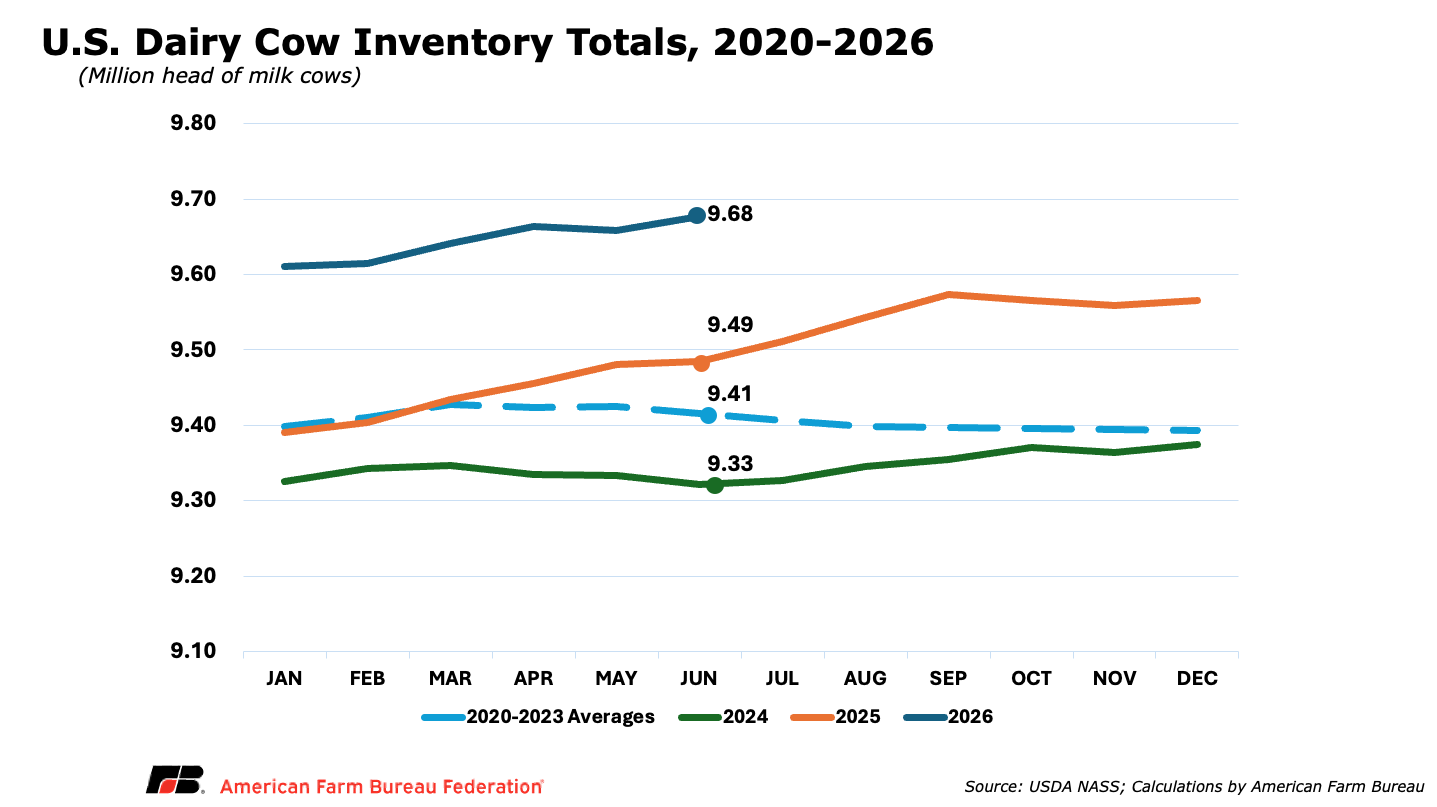
That combination of near-term stabilization and longer-term supply pressure increases the importance of dairy-origin cattle to the beef sector. With greater widespread adoption of beef-on-dairy crossbreeding and an increasing dairy cattle herd, it is likely that the beef industry will turn to dairy stock to continue to fill the inventory gaps. Currently, beef-on-dairy cattle account for roughly 20% of U.S. beef production, but given the rapid increase in crossbreeding and the consistently low cattle inventories, beef-on-dairy could account for over 25% in coming years.
Feedlot Management Indicators
Feedlots closely track cattle performance to improve efficiency and manage costs. Among the most important measures are average daily gain (ADG), average feed conversion (AFC) and mortality. Together, these measures show how quickly cattle gain weight, how much feed they require and how healthy they remain through the feeding period.
- Average daily gain (ADG) measures how many pounds of weight cattle gain per day while in the feedlot. It is one of the most important metrics to measure efficiency of a feedlot and directly correlates to farm income levels. ADG is also a key indicator of the health of the animal and is used as a benchmark for feedlot performance. A higher ADG allows cattle to reach market weight sooner, which means the feedlot can produce more beef in less time.
- Average feed conversion (AFC) is a measure of the feed fed per pound gained in cattle. Feed costs have a large impact on operational margins, so AFC helps managers determine cost-effectiveness for cattle rations. Feedlots regularly adjust rations based on prices and nutritional requirements, so maintaining a strong AFC and ADG ratio helps to keep feedlots in the green. When combined together, the ideal outcome is a pen of cattle with a low AFC and a high ADG.
- Mortality is a key health metric that feedlots use to measure herd health, animal welfare and overall operational performance. A lower percentage of cattle mortality leads to better execution of feedlot goals.
Feedlot managers use data such as ADG, AFC and mortality to consistently maximize the value of each animal from placement, identifying strategies to improve health and performance metrics and replicating them for future groups of cattle. While beef-on-dairy animals are not a new phenomenon, the ability to track their health and performance metrics could enhance efficiencies in the cattle sector.
One of the most important decisions farmers and ranchers make leading up to feedlot placement is placement weight. Cattle placed in feedlots at different ages and weights do not gain or convert feed at the same rate, affecting feed costs, health outcomes and the time needed to reach market weight.
As beef-on-dairy cattle make up a larger share of feedlot inventories, the key question is whether they can help fill the gap left by the shrinking beef herd while still delivering competitive performance and economic returns. Comparing ADG, AFC and mortality with traditional beef cattle helps answer that question and shows where beef-on-dairy cattle perform best.
The Beef-on-Dairy Advantage
Research conducted by Kansas State University has found that beef-on-dairy cattle performance is significantly impacted by placement weight, shown through factors of ADG, AFC and mortality. The study utilized pen-level data from three commercial feedlot companies across Kansas and surrounding states. Upon completing the analysis, general conclusions can be made that across all placement weight ranges (400 – 900 lbs.) beef-on-dairy cattle have a greater daily weight gain and experience lower mortality but require more feed per pound of gain when compared to traditional beef.
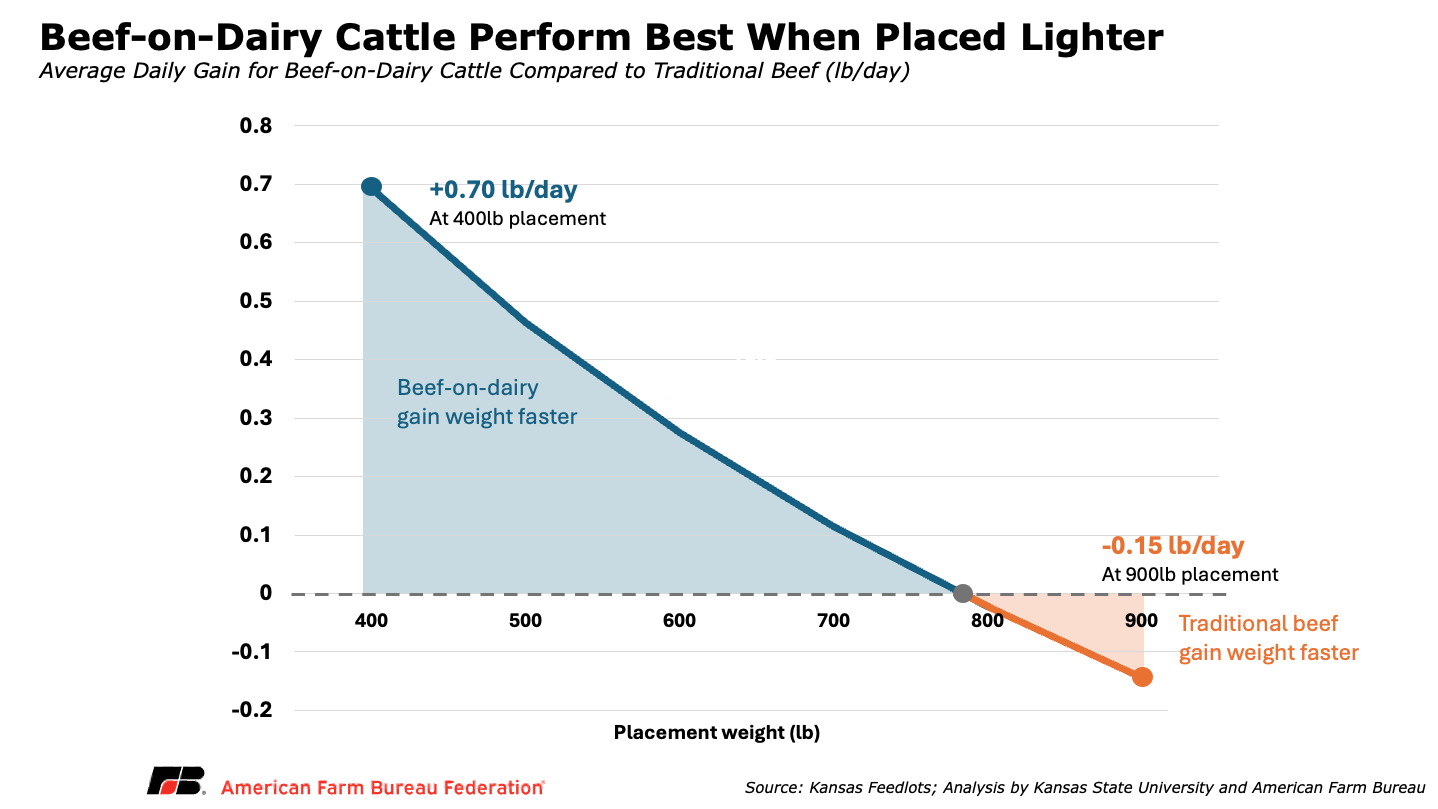
For ADG, the growth advantage of being a beef-on-dairy animal decreases as the placement weight increases compared to traditional beef. At a 400-pound placement, beef-on-dairy cattle have a 0.70 pound-per-day advantage over traditional beef cattle for their daily gain, but as the placement weight increases to 900 pounds, they experience a disadvantage of 0.15 pounds per day. Therefore, at heavier placement weights, traditional beef cattle outperform beef-on-dairy. The applicable conclusion for feedlot managers in terms of ADG is that beef-on-dairy cattle will gain weight faster when placed at lighter weights and will take longer to finish out when placed in the feedlot at heavier weights compared to traditional beef cattle.
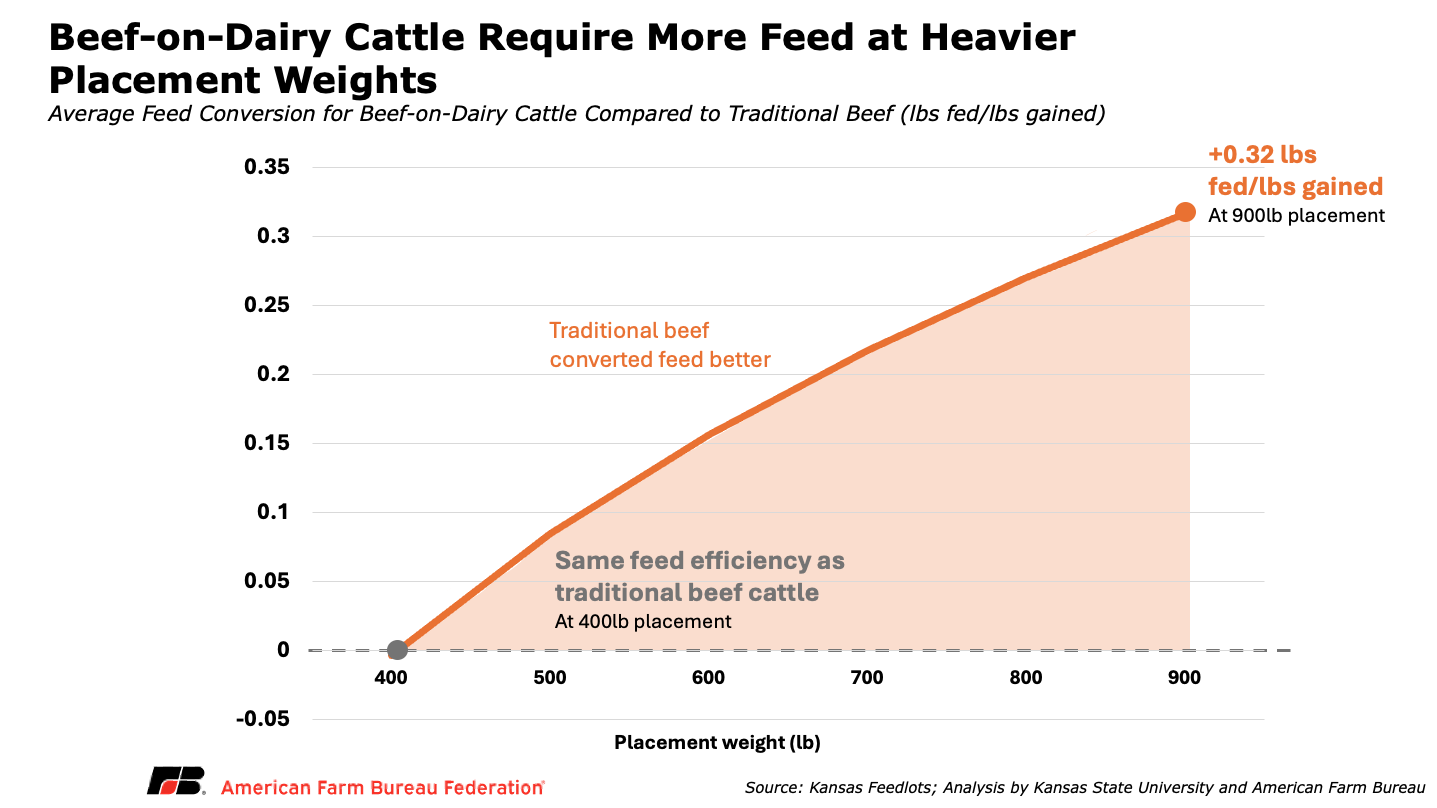
AFC resulted in beef-on-dairy cattle losing some feed efficiency as their placement weight increases. At 400 pounds, beef-on-dairy cattle converted feed at the exact same level as traditional beef, however when placed at 900 pounds, beef-on-dairy cattle require 0.32 more pounds fed per pound gained than traditional beef. Beef-on-dairy cattle, when placed at lighter placement weights, convert feed just as efficiently as traditional beef cattle, but when placed at heavier weights, beef-on-dairy cattle require more feed per pound gained, translating to longer finishing periods and greater inputs needed.
The data analyzed displayed a lower predicted death rate for beef-on-dairy cattle across the entire placement weight range (400 – 900 lbs.). As the placement weight of beef-on-dairy cattle increases, the mortality advantage of beef-on-dairy over traditional beef becomes smaller, but they still exhibit a lower mortality.
The study conducted an additional risk analysis to determine how placement weights impact the levels of risk for beef-on-dairy cattle compared to traditional beef for factors of ADG, AFC and mortality. Results indicate to feedlot managers that overall beef-on-dairy cattle do not exhibit greater production risk, although placement weights are an extremely influential factor in feedlot performance.
It is still important to consider that differing frame sizes, muscle composition, backgrounding protocols, placement weights and health treatments can result in varying performance. A strong need remains for continued research on best management practices for crossbred cattle, but baseline findings suggest that beef-on-dairy fed cattle perform best when placed in feedlots at lighter weights.
Industry Impacts
Feedlots continually look for ways to improve efficiency, and current beef-on-dairy placement practices may leave some performance gains uncaptured. Beef-on-dairy cattle enter feedlots at roughly 650 pounds on average and remain on feed about 70 days longer than traditional beef cattle. At that placement weight, much of their early growth advantage has already occurred before the cattle reach the feedlot. As a result, feedlots may be purchasing heavier cattle after some of their most efficient weight gain has already been captured by calf raisers or backgrounders.
Current calf-raising and backgrounding systems could place beef-on-dairy cattle into feedlots at lighter weights, allowing feedlots to capture more of the early growth advantage identified in the research. Doing so would require greater coordination among dairy farms, calf raisers, backgrounders and feedlots, particularly because earlier placement would shift more days on feed and associated costs to the feedlot. Better alignment of purchasing, placement and feeding decisions could help ensure that the value created by beef-on-dairy genetics is shared across the supply chain rather than lost through inefficient timing.
Conclusion
Improving cattle performance and feedlot efficiency can strengthen economic returns throughout the cattle supply chain. Feedlot profitability is tied to growth performance and carcass quality, though further research is needed to understand how specific production decisions affect carcass quality and grading for beef-on-dairy cattle compared with traditional beef cattle. By producing more pounds of beef per dollar spent on feed, improved efficiency can strengthen feedlot margins and returns to cattle suppliers. For dairy farmers, stronger and more predictable feedlot performance can help sustain buyer demand and support the long-term market value of beef-on-dairy calves.
Stronger returns across the cattle sector can also support longer-term efforts to rebuild the beef herd. In the meantime, beef-on-dairy cattle will remain an important source of fed cattle as traditional beef supplies stay tight. Improving how these cattle are raised, placed and fed can help the industry capture more of their value while supporting a more stable and resilient beef supply.
**For more information regarding this research, please contact Kansas State University agricultural economics professors Dr. Ted Schroeder and Dr. Joe Parcell or graduate research assistant Cydney Stables.