July Cattle Report Signals Stabilizing Cattle Herd

Bernt Nelson
Economist
Key Takeaways
- U.S. cattle herd shows signs of stabilization. Total cattle inventory increased slightly for the first time since 2018, but the beef cow herd fell to 28.5 million head, a record low for the July report, indicating herd rebuilding remains limited.
- Replacement heifer numbers improved, but the calf crop remains historically small. Beef replacement heifers increased 3%, suggesting farmers and ranchers are beginning to retain females for breeding. However, the 2026 calf crop is projected at a record-low 32.5 million head, marking the ninth consecutive annual decline and constraining future herd growth.
- Feeder cattle supplies are expected to remain tight through 2027. Lower calf numbers and declining feedlot placements point to fewer feeder cattle available in the coming years. While the reopening of the U.S.-Mexico border will gradually increase feeder cattle imports, supplies are still expected to remain historically tight.
- Market signals are mixed as supply constraints clash with softer demand indicators. Tight cattle supplies remain supportive for long-term cattle prices, but recent declines in boxed beef values and the reopening of cattle imports from Mexico have added bearish pressure. Cattle prices have fallen sharply in recent weeks, though improving packer margins may help support processing activity going forward.
USDA’s July Cattle Inventory report offers a critical midyear snapshot of the U.S. cattle herd, including an estimate of the year’s calf crop. Released in tandem with USDA’s monthly Cattle on Feed report, the two datasets together provide a more comprehensive view of supply trends and herd dynamics.
July Cattle Inventory
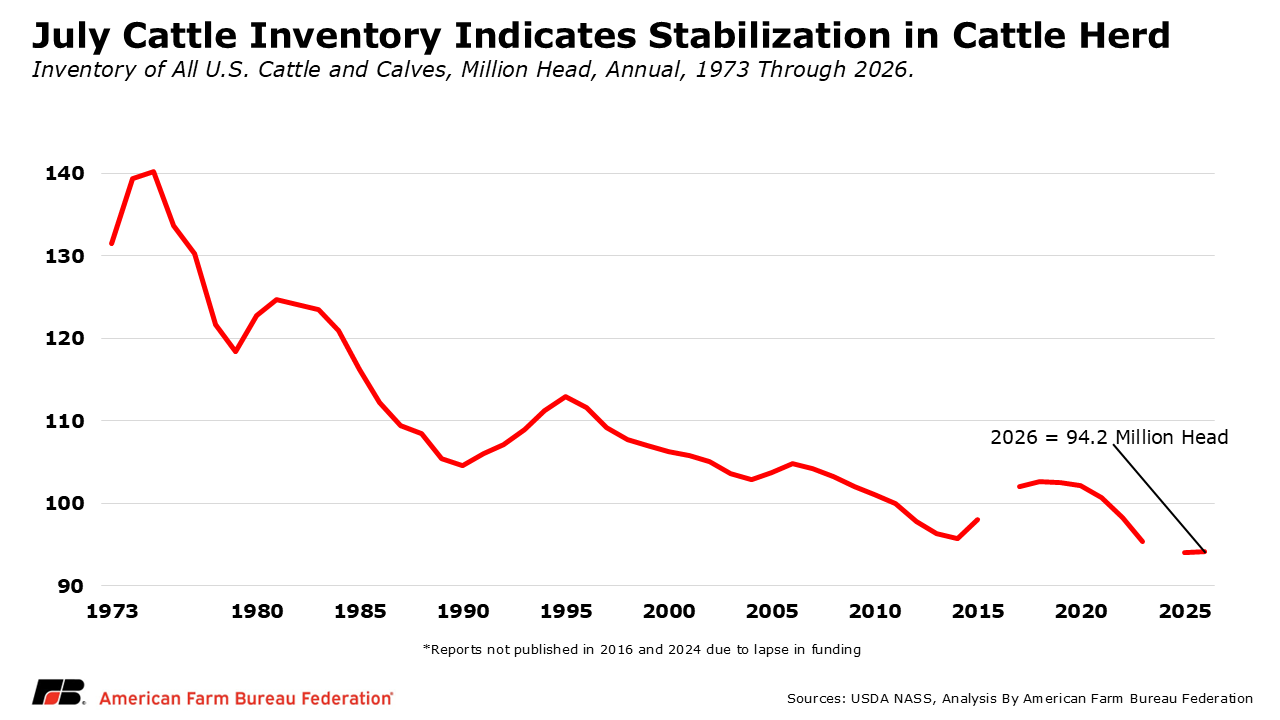
According to the July Cattle Inventory report, the inventory of all cattle and calves in the United States totaled 94.2 million head on July 1, 2026, up 200,000 head, or less than 1%, from 94.0 million head on July 1, 2025. This marks the first increase in the July cattle inventory since 2018.
Despite the slight increase in total inventory, indicators of herd expansion remain mixed. All cows and heifers that have calved were estimated at 38.1 million head, unchanged from a year ago. Within that total, beef cows were estimated at 28.5 million head, down 200,000 head, or 1%, from 2025 and the smallest July inventory on record (the data goes back to 1973). In contrast, milk cows were estimated at 9.65 million head, up 200,000 head, or 2%, from last year.
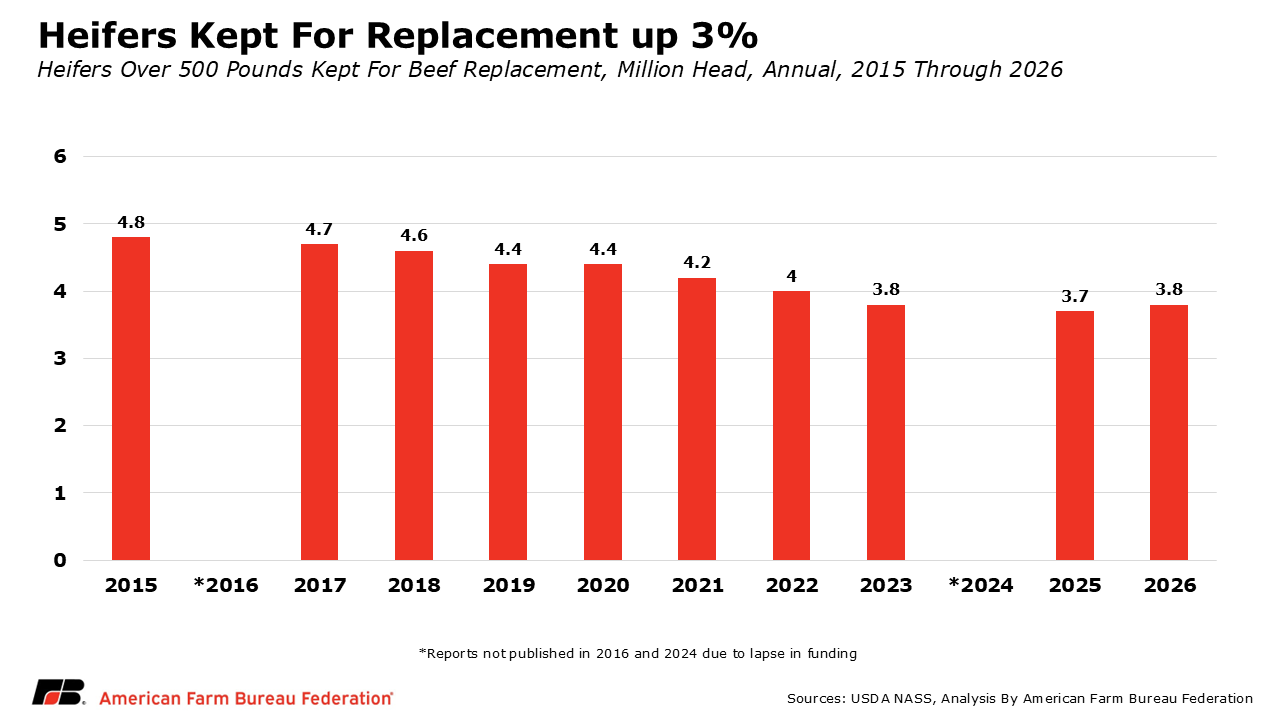
One of the most closely watched measures in the report is the inventory of beef replacement heifers weighing more than 500 pounds, which was estimated at 3.8 million head, up 100,000 head, or 3%, from 2025. This increase represents the first meaningful sign of heifer retention and potential herd rebuilding in nearly a decade. Meanwhile, other heifers totaled 7.3 million head, down 100,000 head, or 1%, from last year. These animals remain a potential source of future breeding stock.
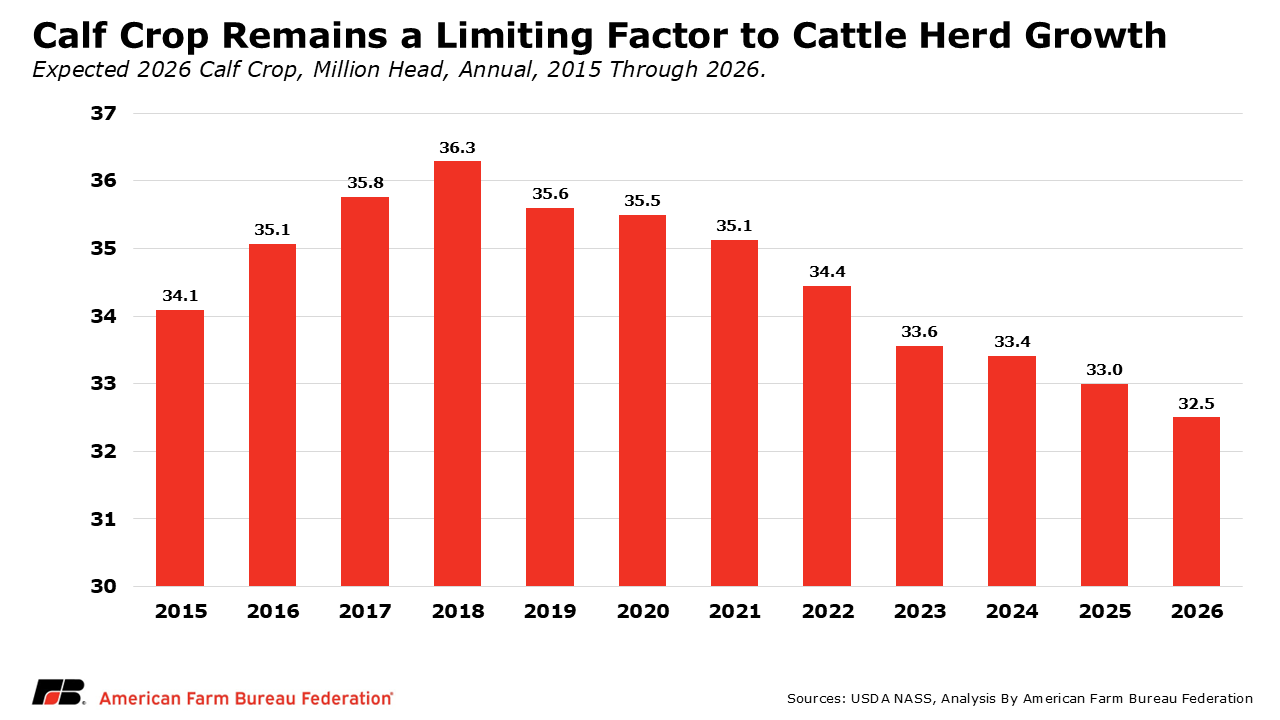
The report also estimated the 2026 calf crop at 32.5 million head, down 2% from 2025 and the smallest calf crop on record. This marks the ninth consecutive year of decline and remains a major constraint on future herd growth. These calves represent the pool of animals available either for breeding or for placement into feedlots in 2027 and 2028. As long as calf numbers continue to decline, producers face limitations in expanding the herd, regardless of retention decisions.
Overall, the report suggests stabilization rather than expansion of the U.S. cattle herd. The increase in beef replacement heifers is an encouraging sign and contributed to the modest rise in total cattle inventory. However, that gain was largely offset by a smaller beef cow herd, while growth in milk cow numbers accounted for much of the increase in total cattle inventory. A sustained increase in both the calf crop and total cattle inventory would provide a clearer indication that a broader expansion phase has begun.
Cattle on Feed
USDA releases a monthly Cattle on Feed report that tracks inventories in large commercial feedlots with capacities of 1,000 head or more. The July Cattle Inventory report complements that survey by providing a broader estimate of all cattle and calves on feed across U.S. feedlots of every size.
According to the July report, 13.2 million cattle and calves were on feed in all U.S. feedlots on July 1, 2026. Of that total, 11.37 million head were in feedlots with capacities of 1,000 head or more, up 2% from a year earlier and accounting for 86.2% of all cattle on feed, compared with 85.2% a year ago.
Within large feedlots, USDA estimated 7.12 million steers and steer calves on feed, up 236,000 head, or 3%, from last year. Heifers and heifer calves totaled 4.25 million head, up 10,000 head, or less than 1%. Steers and steer calves represented approximately 63% of cattle on feed, while heifers and heifer calves accounted for about 36%.
Recent placement and marketing activity highlights the increasingly tight supply. June placements totaled 1.40 million head, down 42,000 head, or 3%, from a year ago. This followed May placements that were down 10%, or 183,000 head, from May 2025. At the same time, June marketings were estimated at 1.66 million head, down 46,000 head, or 3%, from last year and the lowest June total on record.
The combination of declining placements and slower marketings suggests cattle are remaining in feedlots longer, contributing to heavier market weights. Slower slaughter rates have also allowed market-ready supplies to build in feedlots, while packers have reduced processing schedules amid tight cattle supplies and compressed margins. As a result, cattle are being fed to heavier weights before entering the packing sector, partially offsetting the impact of lower cattle inventories on beef production.
Feeder Cattle Supplies and Mexico
Mexico typically exports between 1.2 million and 1.5 million head of feeder cattle to the United States each year. These cattle are an important component of the U.S. beef supply chain, moving from border crossings into feedyards across the country before eventually entering packing plants.
This trade was disrupted in November 2024 when the United States closed the border to livestock imports following the detection of New World screwworm (NWS) in southern Mexico. The pest gradually spread northward and was eventually detected in the United States in June 2026. As of this article’s posting, there have been 42 confirmed NWS detections in the current U.S. outbreak: 41 cases in Texas and one in New Mexico.
The border closure has tightened feeder cattle supplies, particularly in border states such as Arizona, New Mexico and Texas, which depend heavily on Mexican cattle to support feedyards and maintain beef production. Reduced cattle imports have contributed to tighter supplies and higher beef prices.
Efforts to contain the pest have centered on the Sterile Insect Technique, a proven method for controlling NWS populations. A key milestone occurred on June 27, 2026, with the opening of a new sterile fly production facility in Metapa, Mexico. Prior to its opening, the only remaining production facility was located in Panama and produced approximately 100 million sterile flies per week. The Metapa facility is expected to produce 30 million flies per week by the end of August, with an increased capacity up to 100 million flies per week by the fall.
These advancements helped pave the way for the gradual reopening of cross-border cattle trade. On July 24, Secretary of Agriculture Brooke Rollins announced that imports would resume through the Douglas, Arizona, port of entry after a 30-day period, with two New Mexico ports scheduled to reopen thereafter. Reopening protocols include stringent treatment and inspection requirements. Imported cattle must pass through disinfectant dip vats and undergo additional inspections for open wounds or any additional signs of NWS. Animals showing evidence of NWS infestation or visible open wounds will be rejected and prohibited from entering the United States.
The phased reopening should help ease feeder cattle supply constraints over time while maintaining safeguards to prevent further spread of NWS.
Markets
The monthly reports and the announcement that the United States will reopen its border to livestock imports from Mexico were both released after markets closed on Friday, July 24. Overall, the reports provide mixed signals and are largely neutral for cattle markets, while the reopening of the border is viewed as bearish because it will increase cattle supplies over time.
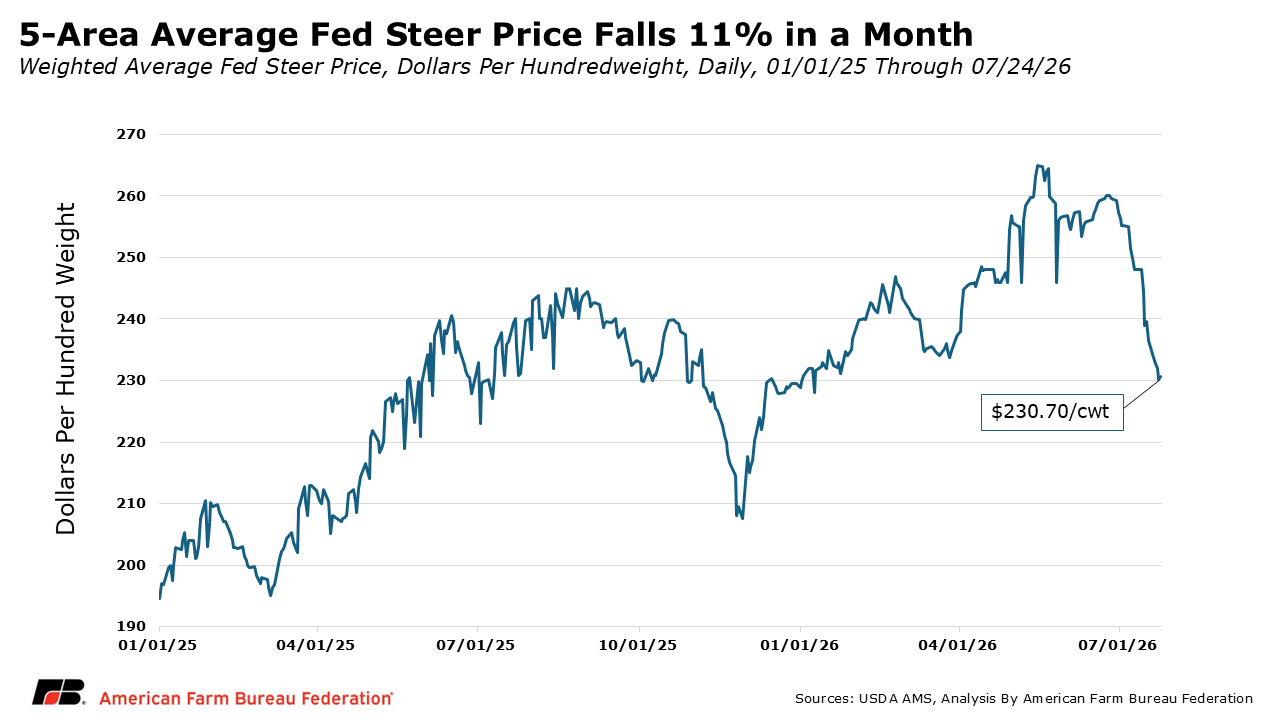
These developments follow a sharp decline in cattle prices over the past month. August 2026 live cattle futures recently recorded a historic streak of losses over 15 consecutive trading days. In the cash market, the 5-area daily weighted average fed cattle price has fallen $29/hundredweight (cwt), or 11%, since June 25, 2026.
From a supply perspective, the strongest bullish takeaway from the reports is found in the feeder cattle market. A record-small calf crop and lower June placements both point to a tighter supply of feeder cattle later in 2026 and throughout 2027. While the reopening of the border to Mexican cattle imports will gradually increase feeder cattle availability, supplies are still expected to remain historically tight. Reduced feeder cattle numbers ultimately imply limited future fed cattle supplies, which should provide some support to cattle prices.
Demand
Boxed beef prices have weakened since late June. U.S. beef demand typically peaks around the Fourth of July holiday as summer grilling season reaches its height. Since reaching a high of $400.31/cwt on June 23, the Choice beef cutout value has declined $39.07/cwt, or roughly 10%, to $361.24/cwt on July 24.
Although seasonal declines in beef prices following the peak grilling season are common, the recent weakness raises questions about whether consumer demand is beginning to soften after several years of exceptional strength. If consumer demand is slowing, beef cutout values could continue to decline. If demand remains resilient, however, boxed beef prices may find support.
Both scenarios have important implications for packer profitability. While fed cattle prices have recently declined faster than beef cutout values, resulting in a modest improvement in the live-to-cutout spread, packer margins remain firmly in negative territory and have been for several months.
Conclusion
USDA's July Cattle Inventory and Cattle on Feed reports suggest the U.S. cattle industry remains in a period of stabilization rather than meaningful expansion. While the increase in replacement heifers provides an early signal that some producers may be positioning for herd rebuilding, record-low beef cow numbers and the smallest calf crop on record continue to limit growth potential. At the same time, lower feedlot placements point to tight feeder cattle supplies extending into 2027, even as the gradual reopening of live cattle imports from Mexico provides some relief.
For markets, the outlook remains mixed. Tight long-term cattle supplies remain supportive, but softer boxed beef prices, questions surrounding consumer demand, and increased imports from Mexico have added near-term pressure. The coming months will be critical in determining whether early signs of herd rebuilding gain momentum or whether supply constraints continue to define the cattle market cycle.