Crop Costs Revised Higher, With Little Relief in Sight
Deputy Chief Economist

Faith Parum, Ph.D.
Deputy Chief Economist
Key Takeaways
- USDA revised production cost estimates higher for every major field crop in both 2026 and 2027.
- Fertilizer is the primary driver of the revisions, with USDA raising fertilizer cost estimates by about 10% for 2026 and 14% for 2027 compared to June estimates.
- USDA projects fertilizer costs will remain elevated in 2027, while increases in chemicals, seed, land rent and other expenses will push total production costs even higher.
- USDA’s newly announced $8 billion Harvest Fuel Relief Program (HFRP) will help to offset rising costs. Because diesel is essential to every type of farm, USDA is working with stakeholders to ensure it reaches all of agriculture, including specialty crops and producers outside traditional Title I commodity programs.
- With production costs reaching record highs and crop prices remaining low, farmers need certainty. Congress should act before the end of the year to pass a fully modernized farm bill including year-round E15 authorization and protections for interstate commerce.
Farmers are facing record-high production costs, and USDA's latest Commodity Costs and Returns forecast shows no signs of relief. The updated forecast projects record production costs for every major field crop in 2027, as ongoing pressure in global energy and fertilizer markets continues to drive expenses higher. Conflict involving Iran, Russia and Ukraine and threats to shipping through the Strait of Hormuz have added uncertainty to already volatile input markets. Compared to its June forecast, USDA raised estimated production costs for every major crop in both 2026 and 2027.
Costs Projected to Reach New Highs in 2027
USDA's updated 2027 forecast suggests few signs of relief. Production costs were already projected to reach record highs in USDA’s June forecast, and the latest revisions push those estimates even higher for every major field crop. Rice is projected to have the highest per-acre production costs at $1,472 in 2027, followed by peanuts ($1,276), cotton ($1,019) and corn ($984). Soybeans ($714), barley ($550), oats ($544), sorghum ($487) and wheat ($446) are also projected to reach new highs.
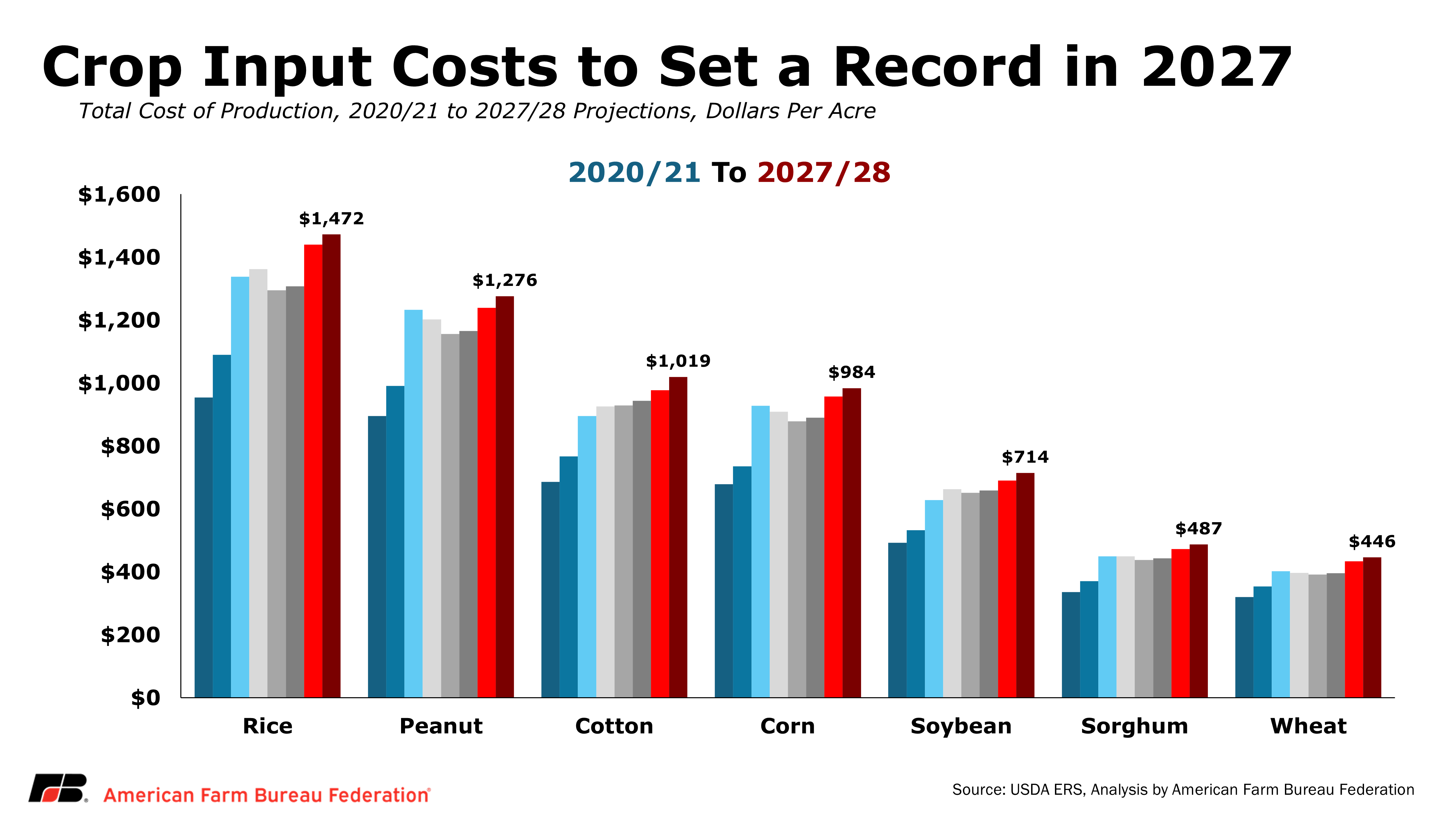
For all major crops, projected 2027 expenses exceed even the highs experienced during the supply chain disruptions and inflationary pressures of the early 2020s. While commodity prices fluctuate from year to year, production costs have trended steadily higher, leaving farmers increasingly vulnerable when market prices decline.
How 2027 Compares to 2026
While USDA revised fertilizer cost estimates higher for both 2026 and 2027 compared to its June forecast, those revisions do not reflect additional increases between the two years. Comparing 2026 to 2027, USDA projects lower costs for fuel and interest expenses, but higher costs are projected for seed, chemicals, repairs, labor, machinery and equipment, and taxes.
Chemical costs are projected to rise 10%, followed by land rent and repairs at approximately 4% each, machinery ownership at 4%, seed at 3.9%, custom work at 2.8% and labor at 2.7%. Interest expenses are one of the few categories expected to decline, falling between 1% and 4.5%, depending on the crop.
What Changed in this Report?
Compared to USDA's June projections, estimated 2026 production costs increased for every major field crop. Rice saw the largest dollar revision, rising nearly $28 per acre (2%), followed by corn at approximately $21 per acre (2%) and peanuts at $15 per acre (1%). Wheat experienced the largest percentage increase, rising about 3%, or nearly $14 per acre.
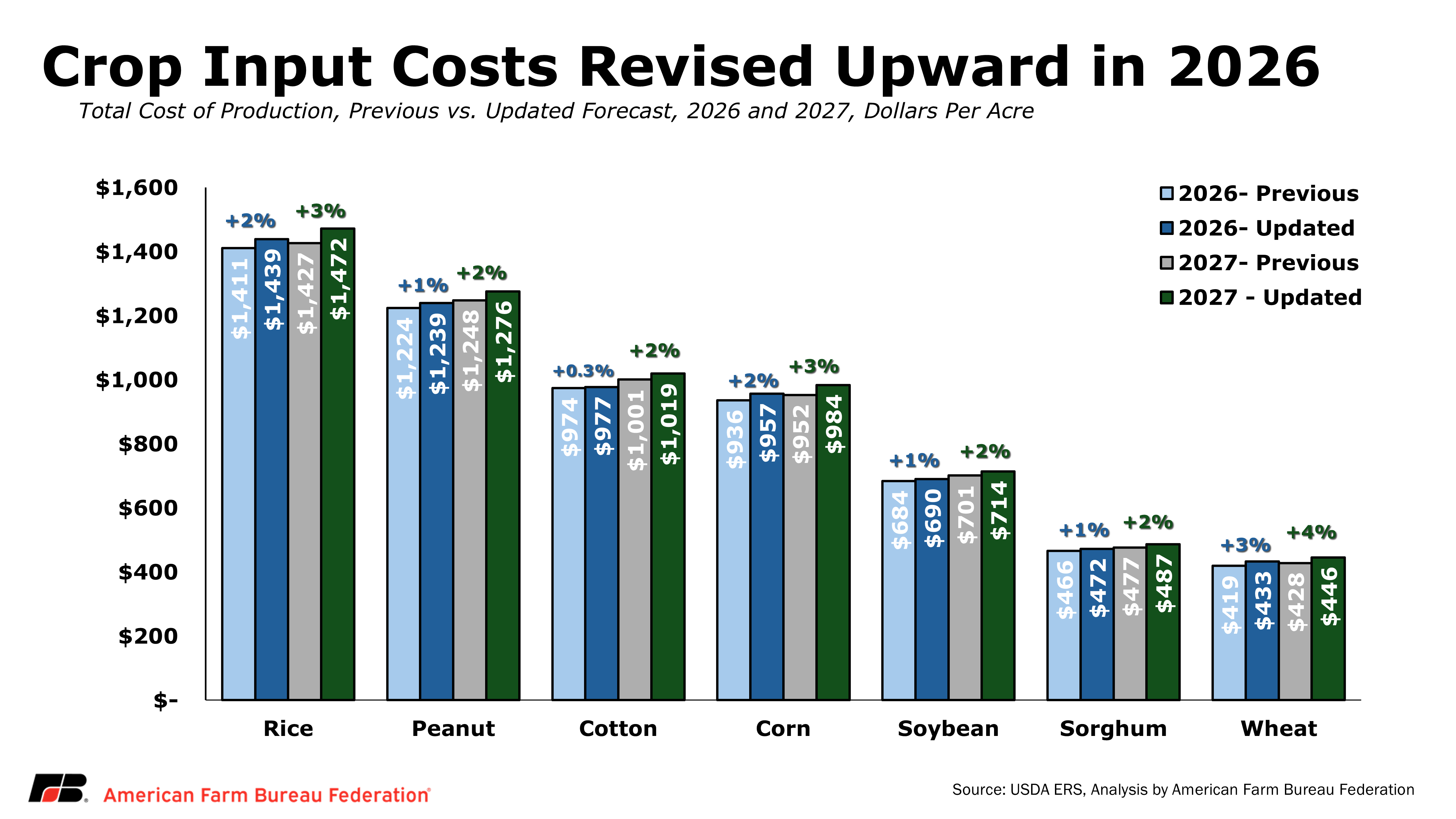
The revisions to 2027 were even larger. Projected costs increased approximately $45 per acre for rice (3%), $32 for corn (3%), $28 for peanuts (2%) and $18 each for cotton (1%) and wheat (4%). While the magnitude varies by crop, the updated forecast points to higher production expenses across the board.
Bottom Line
Farmers continue to face pressure from both sides of their balance sheets, with record production costs and commodity prices that remain too low to fully cover expenses for many major crops and for many farmers.
Compared to its June forecast, USDA raised estimated production costs for every major field crop in both 2026 and 2027, largely driven by upward revisions to fertilizer costs. While these estimates focus on field crops, specialty crop producers are also facing rising input, labor and transportation costs. Although fuel and energy expenses are projected to ease next year, production costs are expected to remain elevated across agriculture, leaving little room for already-tight farm margins to recover.
Recent economic assistance and improvements to the farm safety net under H.R. 1 have provided important support. This includes USDA’s recent announcement of relief on high fuel prices under the HFRP. Program details have yet to be announced, but the program is expected to alleviate some of the financial strain brought on by record-high diesel fuel prices. HFRP needs to address financial challenges facing all of agriculture, including specialty crops and producers not covered by traditional Title I commodity programs.* Congress must continue working to strengthen agricultural markets by authorizing year-round E15, expanding domestic demand and passing a modern five-year farm bill that gives farmers greater certainty in an increasingly challenging economic environment.
* According to USDA: “Producers of non-Title I commodities, including specialty crop growers and fishermen, are encouraged to provide data related to increased fuel costs to HarvestFuel@usda.gov for USDA’s consideration when determining payment rates.”