Diesel Costs Increase for Harvest

Faith Parum, Ph.D.
Deputy Chief Economist
Cameron Castillo
Associate Economist
Key Takeaways:
- America’s farmers and ranchers rely heavily upon diesel to plant, grow and harvest their crops, and to get them to market.
- Ongoing geopolitical conflicts have created supply chain bottlenecks, which have led to record-high diesel prices in recent weeks.
- Most farmers and ranchers use off-highway diesel, also known as red-dye diesel or farm diesel. This type of diesel fuel is exempt from state and federal highway taxes.
- Several states have recently taken steps to help farmers and ranchers suffering from the burden of high diesel prices by allowing for the temporary use of farm diesel on public roadways.
Diesel is used throughout agricultural production, powering tractors, combines, irrigation equipment and the trucks that move crops, livestock and farm inputs. With diesel prices rising sharply in recent weeks, fuel costs have become an even larger concern during one of the most fuel-intensive periods of the year.
A recent Farm Bureau analysis detailed the global supply disruptions and tight fuel markets behind the increase in diesel prices. For farmers, the effects show up directly in the cost of operating equipment and indirectly through higher transportation costs.
To illustrate the direct farm-level impact, Farm Bureau modeled fuel costs across several representative row crop and specialty crop farms. For each crop, the model combines average acres per farm from the 2022 Census of Agriculture with crop-specific diesel-use estimates drawn from university Extension budgets and production studies. That estimated seasonal fuel use is then multiplied by the change in the U.S. farm diesel price, which increased from $3.01 per gallon in September 2025 to $5.61 per gallon in September 2026, a gain of $2.60 per gallon. This analysis uses the Illinois farm diesel price reported by USDA AMS. Regional differences in fuel prices may result in higher costs for producers in other parts of the country.
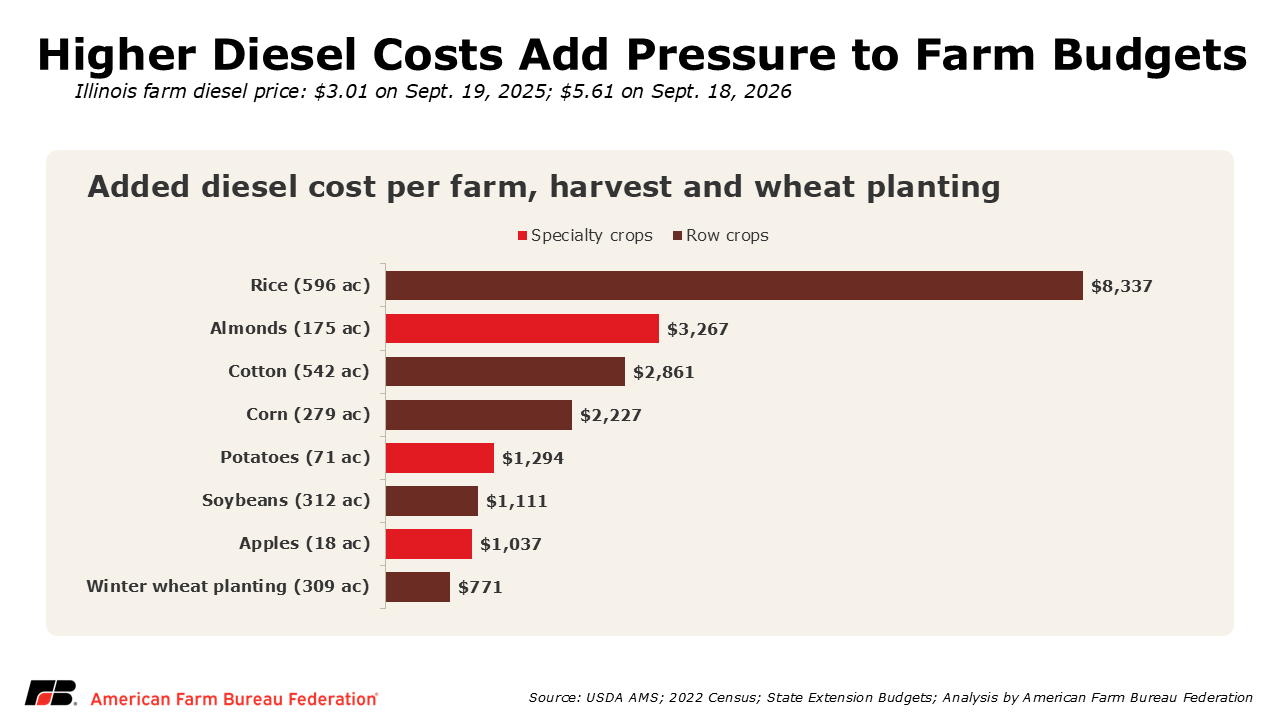
The results show how a diesel fuel price increase can impact farmers differently during harvest. Per our analysis, the average corn farm covers 279 acres and uses an estimated 3.07 gallons of diesel per acre (for all harvest-related activities), resulting in 857 gallons of diesel used over the fall harvest period. At the $2.60-per-gallon price increase, that adds roughly $2,227 to the farm’s diesel bill.
For cotton, the model uses 542 acres and 2.03 gallons of diesel per acre, producing an additional harvest cost of about $2,861. A model rice farm is even more fuel-intensive, with 596 acres and an estimated 5.38 gallons per acre, resulting in an eye-popping $8,337 increase in diesel costs at harvest.
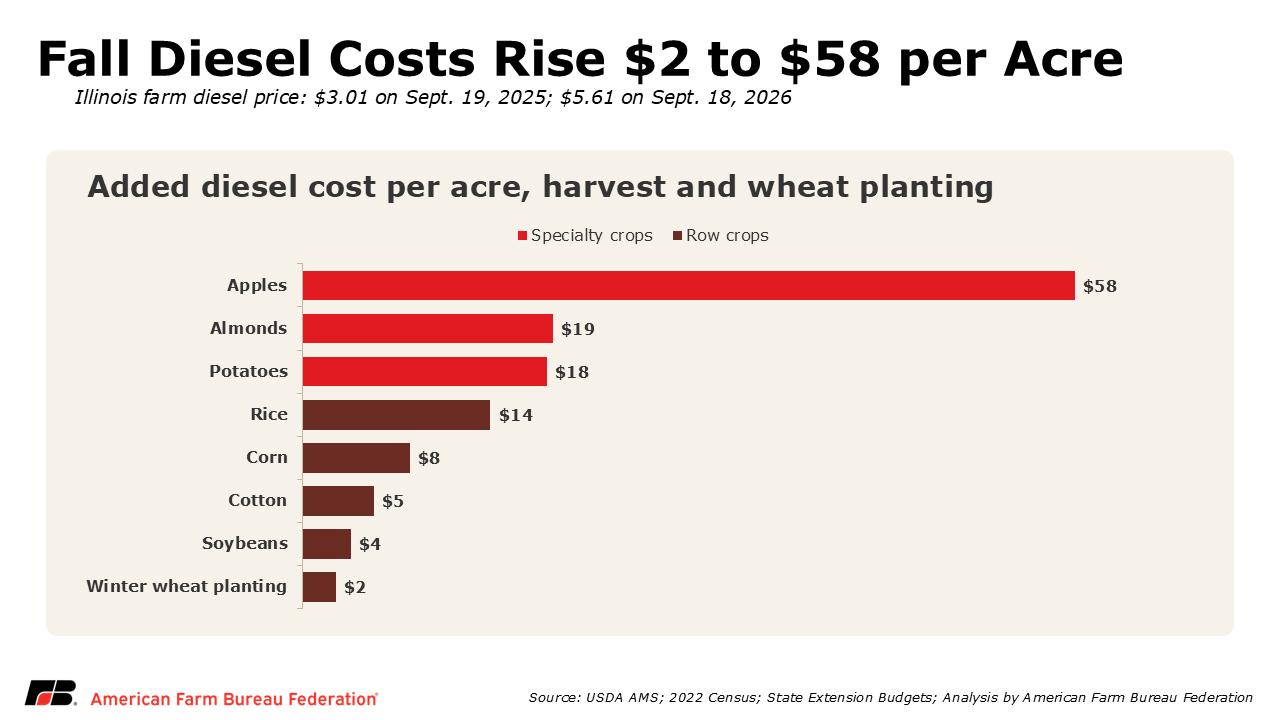
The impact also differs on a per-acre basis. With a $2.60-per-gallon increase in diesel prices, Farm Bureau estimates additional diesel costs of about $3.56 per acre for soybeans, $7.98 for corn, $5.28 for cotton, and $14 for rice. For farmers planting a winter wheat crop this fall, the model projects an additional $2.50 per acre in diesel costs.
Specialty crop farmers likewise face drastic price increases during harvest. Farm Bureau projects that a $2.60-per-gallon increase in diesel prices contributes to an estimated $18.23 per acre increase in harvest diesel costs for potatoes, $18.67 for almonds, and a staggering $57.59 per acre for apple growers. These harvest cost increases for 2026 arrive in the aftermath of historically high production costs for these three crops in 2025.
These estimates are intended to show the scale of the fuel price increase under representative production assumptions. Actual farm costs will vary with acreage, production practices, irrigation, equipment efficiency, tillage systems and how much work is custom hired. Higher diesel prices can also affect farmers beyond fuel used directly on the farm. Diesel is a major input in moving agricultural commodities and production inputs, meaning higher prices can increase rail fuel surcharges, barge transportation costs and trucking expenses, adding costs throughout the agricultural supply chain.
Why Farm Diesel is Different
One important feature of the diesel market is that fuel used on farms is often taxed differently from fuel used on public roadways. The federal government imposes 24.4 cents per gallon in taxes and fees on highway diesel. As of January 2026, state diesel taxes and fees averaged another 35.5 cents per gallon, bringing the combined federal and average state burden to nearly 60 cents per gallon. State taxes vary widely, and these figures do not include county or local taxes.
Diesel intended for qualifying tax-exempt uses, including farming, is dyed red and generally sold without the federal highway excise tax collected. Farmers commonly use dyed diesel in tractors, combines, irrigation pumps and other equipment operating off public roadways. If undyed diesel is instead used for a qualifying farm purpose, producers may also be eligible to claim a credit or refund.
That tax distinction can produce meaningful savings when multiplied across thousands of gallons of fuel, but it also comes with restrictions. Dyed diesel generally cannot be used in a truck traveling on public highways simply because that truck is being used for farm business. Federal tax and penalty provisions can apply when dyed fuel is knowingly used for a taxable purpose.
States Provide More Flexibility
Several states have recently taken emergency steps to give agricultural producers greater flexibility in using dyed diesel.
Louisiana acted on Sept. 23, temporarily suspending state penalties through Oct. 22 for qualifying farm and forest-product vehicles using dyed diesel on public roads. The order also directs the Louisiana Department of Revenue to request federal penalty relief from the IRS.
Alabama followed on Sept. 24, directing state law enforcement to halt enforcement of dyed-diesel restrictions for agricultural and timber operations for 120 days while also seeking federal relief.
Texas took similar action on Sept. 28, suspending state restrictions and associated penalties on the use of dyed diesel on Texas roads. The state also temporarily increased allowable weights for certain fuel, agricultural and timber loads.
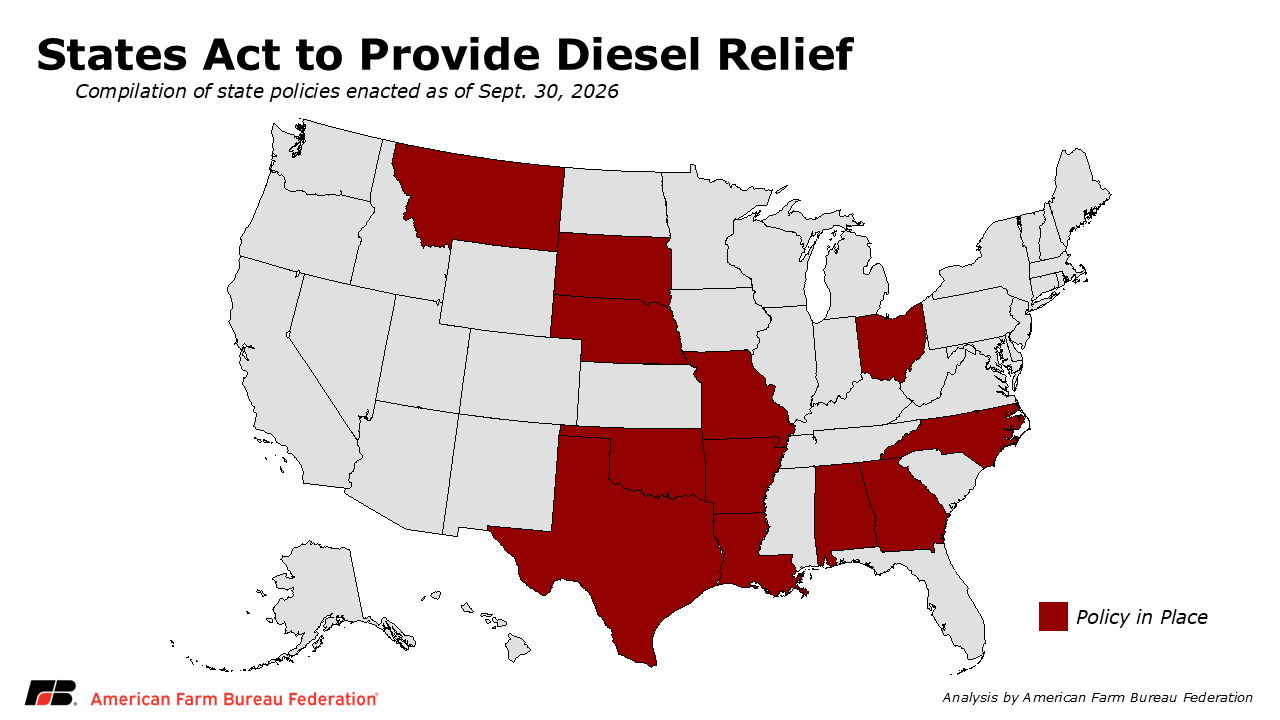
Arkansas, Georgia, Indiana, Missouri, Montana, North Carolina, Nebraska, Oklahoma, Ohio and South Dakota have taken similar actions so far with many states considering action. However, while states can change their own enforcement practices or penalties, federal fuel tax requirements remain under federal jurisdiction.
Flexibility During Harvest
For farmers and ranchers, diesel is essential input that cannot be skipped when crops are ready to harvest, livestock need to be moved, or products need to reach their intended market. Farm Bureau analysis shows that a $2.60-per-gallon increase can translate into thousands of dollars in additional harvest fuel costs alone depending on the crop and production system.
With those costs rising, policymakers are looking for ways to provide immediate relief by reducing the tax burden on diesel and giving states greater flexibility to respond to local conditions. Temporary dyed diesel exemptions are one tool, but broader flexibility around state and federal fuel taxes could provide more direct relief to farmers and ranchers during periods of unusually high fuel costs.