Hormuz Price Shocks Outpace Higher Crop Prices

John Newton, Ph.D.
Vice President of Public Policy and Economic Analysis
Key Takeaways
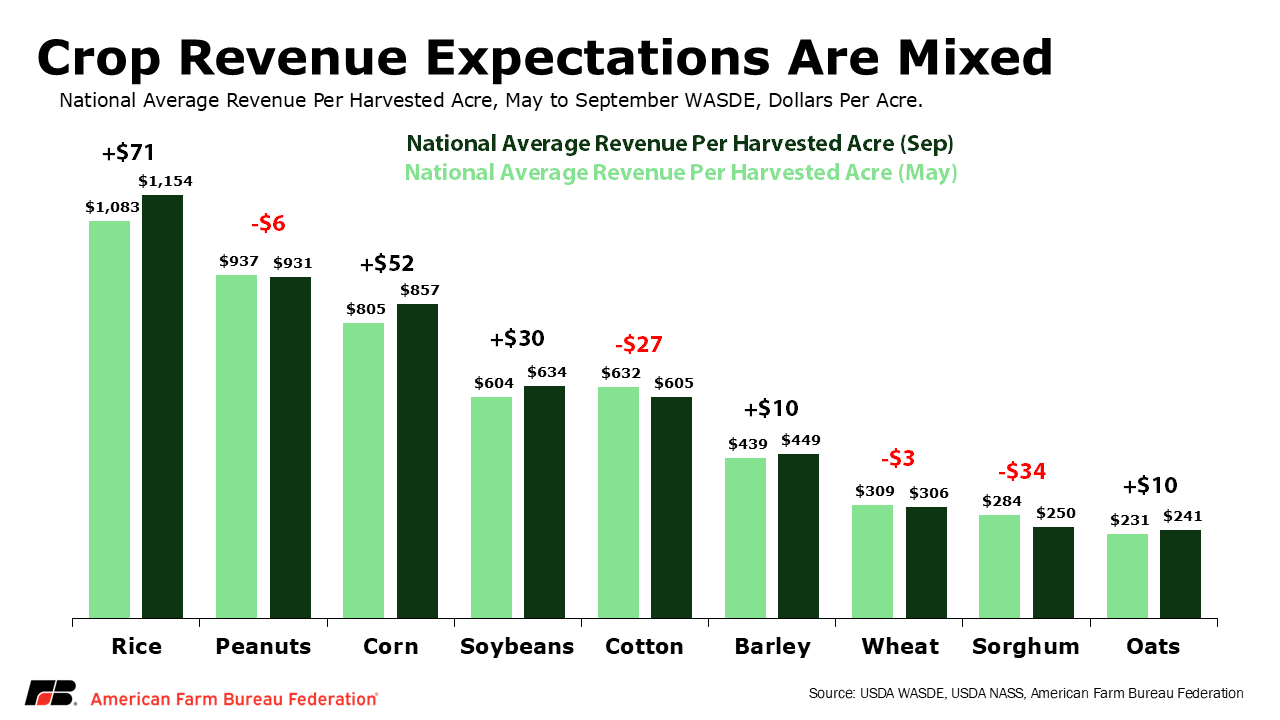
- Crop revenue projections are mixed but mostly improved. September's WASDE raised per-acre revenue estimates for corn and soybeans, along with rice, barley and oats. But peanuts, cotton, wheat and sorghum revenue projections fell from USDA’s May estimates.
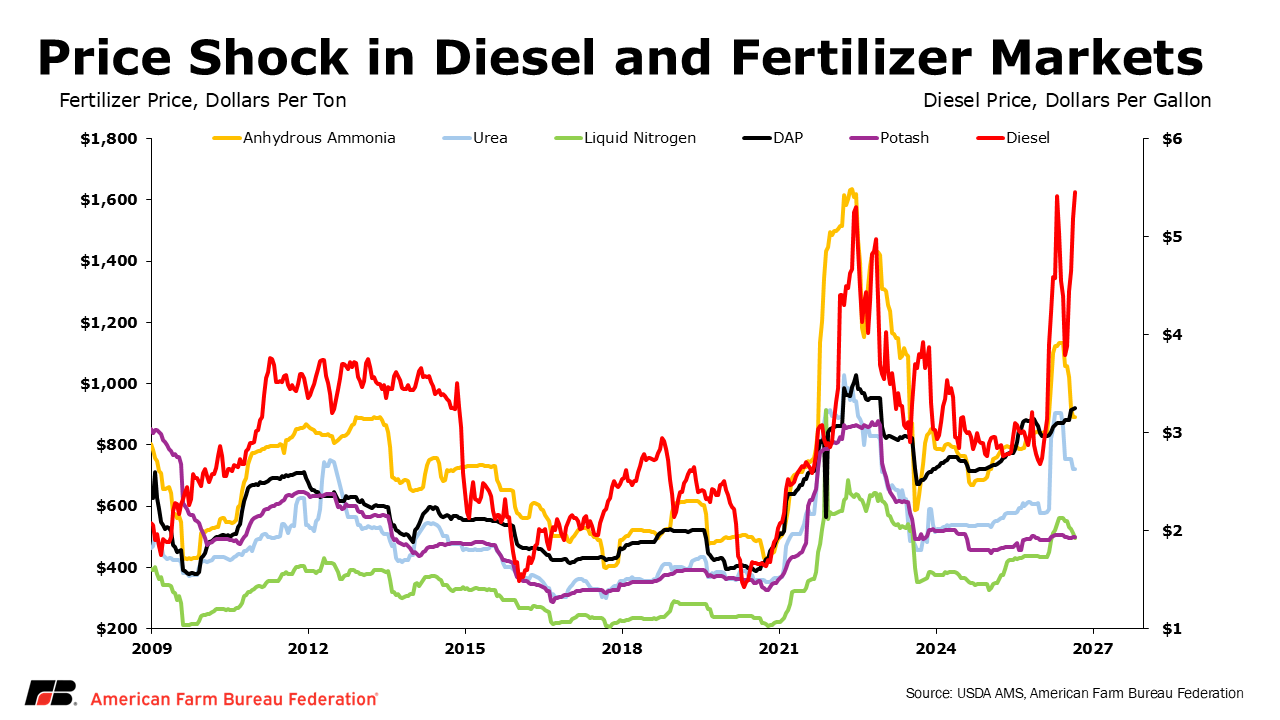
- Post-Hormuz input cost shocks for diesel and fertilizer are eating into any revenue gains. Since the Strait of Hormuz closure in early March, fertilizer and diesel costs have surged nationally. Diesel prices alone are up 45% since the spring and, absent a resolution of geopolitical risks, including recent disruptions in the Bab al-Mandeb Strait, input costs are expected to keep climbing as farmers enter into harvest.
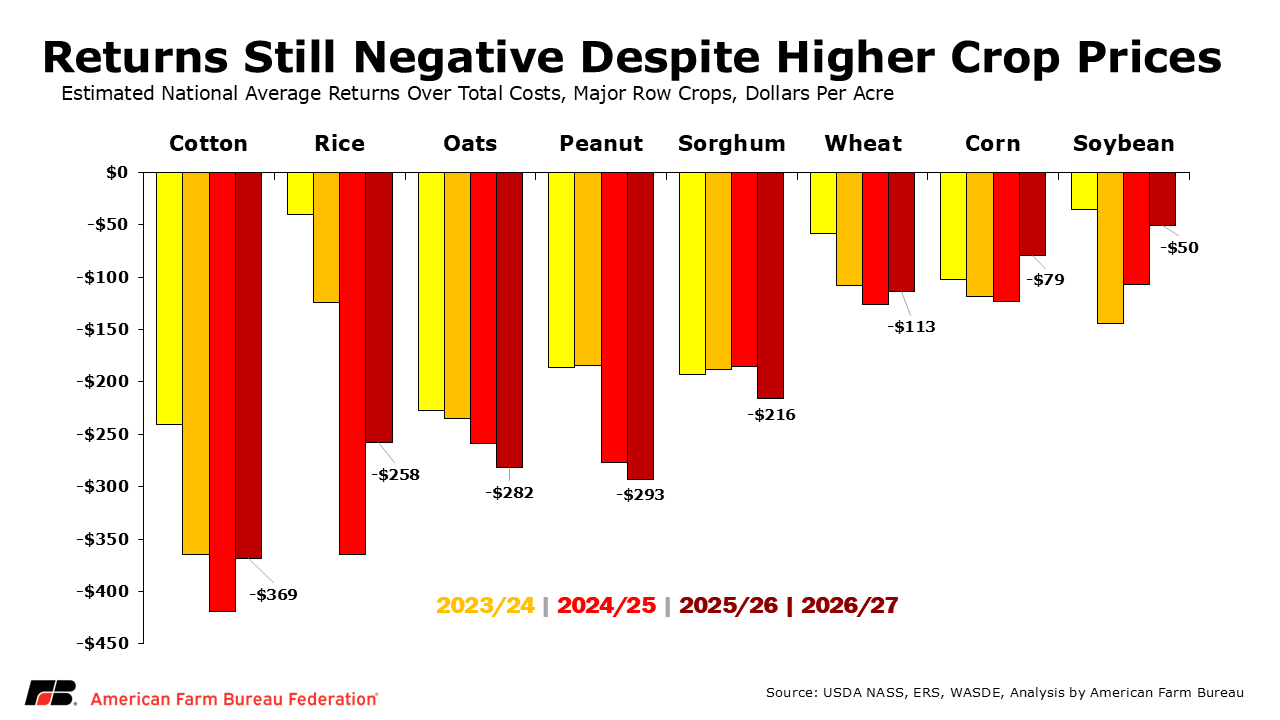
- Breakeven remains out of reach for all major row crops. Crops with falling revenue projections now face even deeper losses due to higher diesel and fertilizer expenses. Crops with rising revenue projections, like corn and soybeans, may offset some added costs, but across the board, the record-high –input cost environment means no major row crop is projected to clear breakeven for the 2026/27 marketing year.
Crop Revenue Expectations Are Mixed
USDA’s recent September World Agricultural Supply and Demand Estimates (WASDE) provided the first field-level observations and projections for planted acres, crop yields and the corresponding season average prices for major row crops for the 2026/27 marketing year. The national average revenue per harvested acre for corn is now projected at $857, up more than $50 from the May WASDE projections. For soybeans, the second-largest crop in the U.S., the national average revenue per harvested acre is projected at $634 and up $30 from the May forecast. Higher revenues, relative to the May estimates, are also projected for rice, barley and oats, while lower revenues are projected for peanuts, cotton, wheat and sorghum.
Higher Revenues May Not Offset Higher Diesel and Fertilizer Expenses
While season average corn prices approaching $5 per bushel and soybean prices near “beans in the teens” would normally be welcome news in farm country, since early March’s closure of the Strait of Hormuz, cost pressures in agriculture have only intensified – with total production expenses expected to reach nearly $500 billion in 2026.
Fertilizer expenses for 2026 are projected at a record $40 billion, up 15%, or $5 billion from the previous year. Similarly, fuel expenses, including diesel, are projected to reach a record $22 billion this year, up 29% or $5 billion from 2025. Meanwhile, persistent inflation is expected to result in another interest rate increase during the upcoming Federal Reserve Open Market Committee meeting – meaning interest expenses, which are currently projected at a record $34 billion, are likely to increase even further as farmers begin financing discussions with lenders in advance of the 2027 crop year.
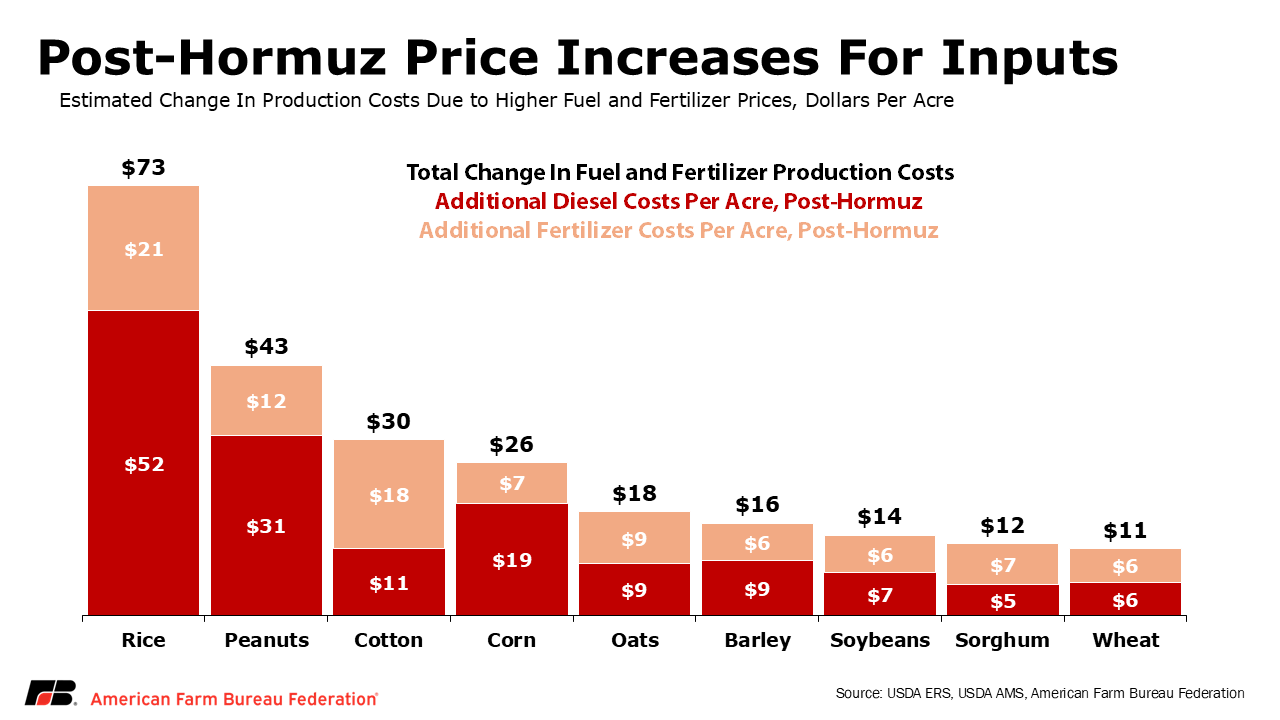
Based on USDA’s most recent cost-of-production estimates, and recent trends in diesel prices (up 45% on average from the spring), American Farm Bureau analysis indicates that as a result of fertilizer and diesel price shocks, productions costs are nearly $30 per acre higher for corn, $14 per acre higher for soybeans, $30 per acre higher for cotton and more than $70 per acre higher for rice compared to USDA’s pre-Hormuz input cost projections. For some crops, these higher per acre input cost projections more than offset any projected gains in crop revenues because of higher crop prices.
Higher Revenues, But Still Not Above Breakeven
For crops that have lower revenue projections compared to the spring (cotton, peanuts, wheat and sorghum), the higher input costs hit even harder and result in even deeper losses for the 2026/27 crop year than originally forecast.
For crops with higher revenue projections like corn and soybeans, higher prices – despite potentially lower crop yields – may potentially offset some of the higher input costs resulting from the closure of the Strait of Hormuz. Importantly, even with higher revenue projections for some crops, absent even higher crop prices, the record-high input cost environment means breakeven above total costs remains elusive for all major row crops for the 2026/27 marketing year – marking four consecutive years of returns below total costs.
Summary
Taken together, September’s WASDE reveals a farm economy caught between improving crop prices and an input cost environment that continues to be subject to inflationary pressures. While some crops may see some relief due to higher revenue projections, those gains are being significantly eroded by the surge in fertilizer and diesel expenses tied to the Strait of Hormuz closure and Bab al-Mandeb Strait disruptions. The net result is that despite recent price optimism, unless prices improve even further, no major row crop is projected to clear breakeven for the 2026/27 marketing year, further underscoring just how squeezed farm margins remain in this high-cost and geopolitically unstable economic environment.