USDA Revises Farm Income Higher, but Costs Still Bite

Faith Parum, Ph.D.
Deputy Chief Economist
Daniel Munch
Former AFBF Economist
Key Takeaways
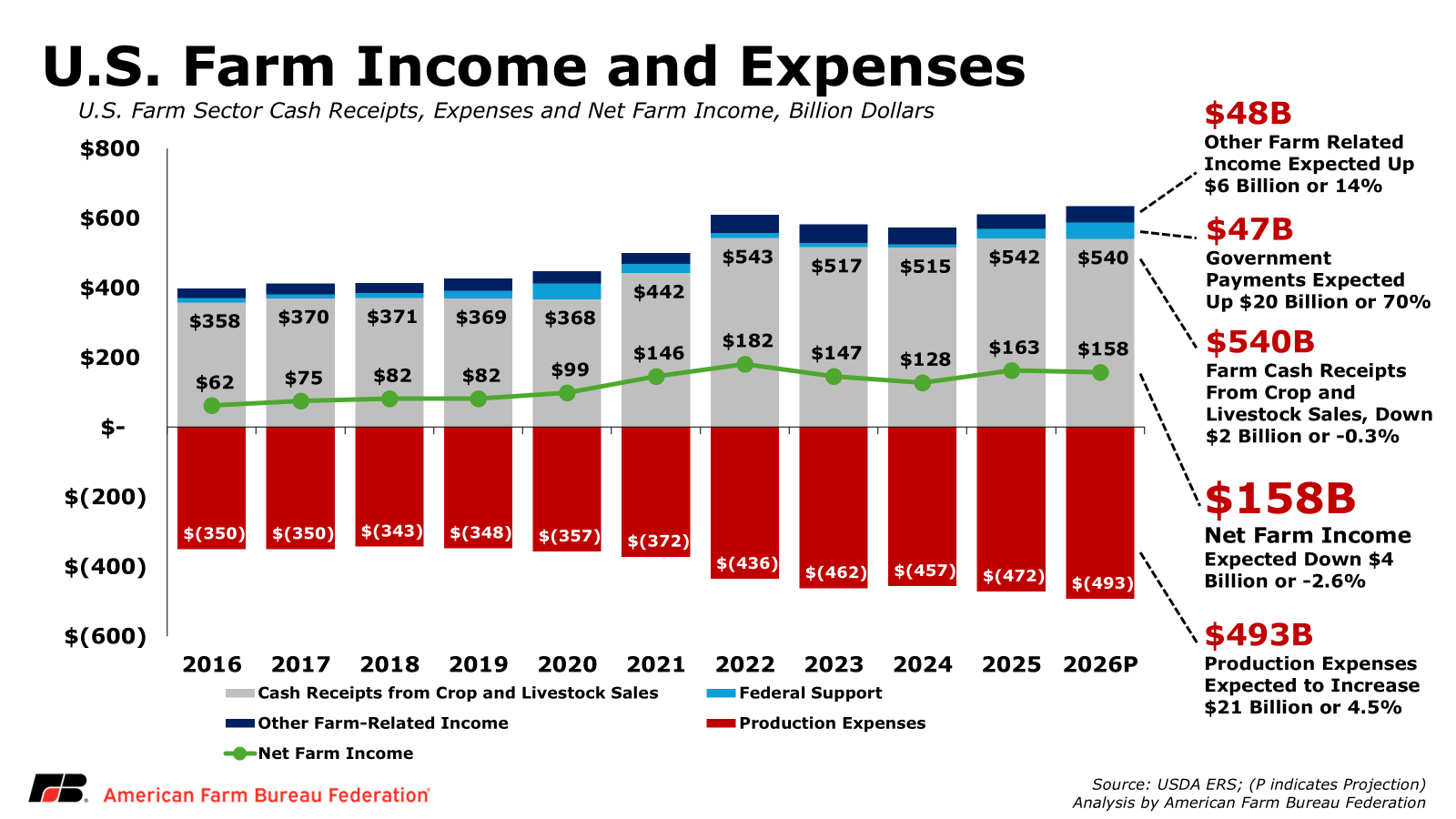
- USDA raised its 2026 net farm income forecast by $5 billion from February to $158.4 billion, and its estimate of 2025 income even more. As a result, net farm income is now expected to fall 2.6% in nominal terms and 5.5% after inflation in 2026.
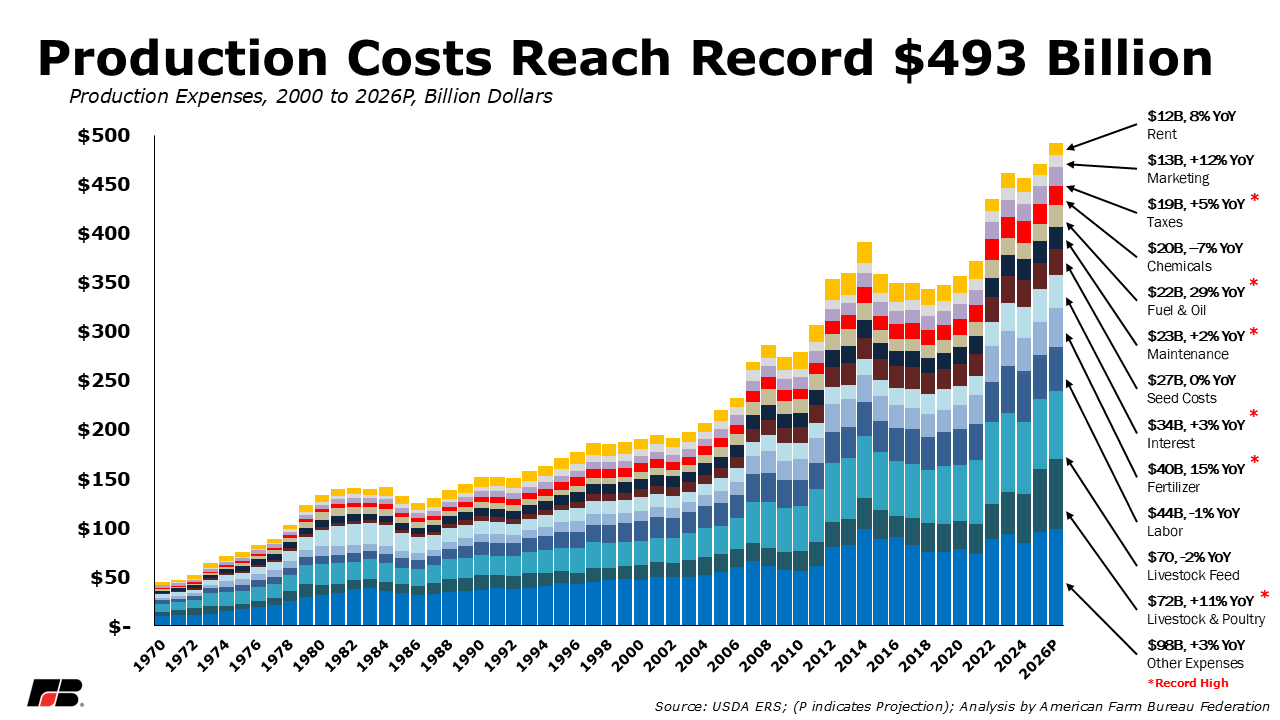
- The expense outlook has deteriorated significantly. USDA raised its 2026 production expense forecast by $15.1 billion since February to $492.8 billion. Fuel and oil expenses are now projected to jump 28.8%, fertilizer expenses are up 15.3% and livestock purchases are up 11.4% from their earlier forecast.
- Direct government payments, including ad hoc and traditional farm bill program payments, are forecast to reach $47.4 billion in 2026, up nearly 70% from 2025. Those payments provide critical support, but their size also illustrates the continued gap between market returns and the cost of producing food, fiber and fuel.
USDA’s September 2026 net farm income forecast, released Sept. 3, projects that net farm income, a broad measure of farm sector profitability, will decline to $158.4 billion in 2026. That is $4.3 billion, or 2.6%, below the newly revised 2025 estimate of approximately $162.7 billion. After adjusting for inflation, the decline becomes considerably larger at $9.1 billion, or 5.5%.
At first glance, the new forecast looks better than USDA’s February outlook, which placed 2026 net farm income at $153.4 billion. However, the comparison is more complicated. USDA also raised its estimate for 2025 by $8.1 billion, from $154.6 billion to $162.7 billion. Because the 2025 revision was larger than the $5 billion upward revision in the 2026 forecast, USDA now projects a steeper decline in farm income from 2025 to 2026. February's forecast anticipated only a 0.7% nominal decline in net farm income and a 2.6% inflation-adjusted decline; September now projects declines of 2.6% and 5.5%, respectively.
Overall, USDA’s September forecast puts farm income above its February estimate, but the revision does not signal broad financial relief. Federal support is projected to rise nearly 70%, from $28 billion in 2025 to $47 billion in 2026—$2.7 billion higher than February’s forecast. This is not all new assistance; USDA records payments when they are received, including support authorized for prior-year losses. Production expenses are now projected more than $15 billion higher, farm debt continues to rise and commodity conditions remain uneven, with stronger crop receipts offset by declines across much of the livestock sector. After inflation, net cash farm income (a slightly narrower measure of profits relative to net farm income) is still expected to fall 2.5% from 2025.
A Different Picture than February
USDA’s September update paints a stronger picture of 2025 than the February projection. For 2025, net farm income is now estimated at about $162.7 billion, up $8.1 billion from the February estimate, while net cash farm income was revised nearly $22 billion higher, from $153.9 billion to about $175.7 billion.
The largest change came from livestock markets. USDA now estimates 2025 animal and animal product receipts at roughly $303.6 billion, nearly $13 billion above its February estimate, while crop receipts changed little. Production expenses were revised slightly lower, from $473.1 billion to $471.6 billion, and direct government payments were revised down from $30.5 billion to $27.9 billion. Taken together, the revisions suggest that stronger realized market receipts, particularly from livestock, help explain much of the improvement in USDA’s estimate of 2025 farm income, rather than a broad easing in production costs or greater government support.
Crops
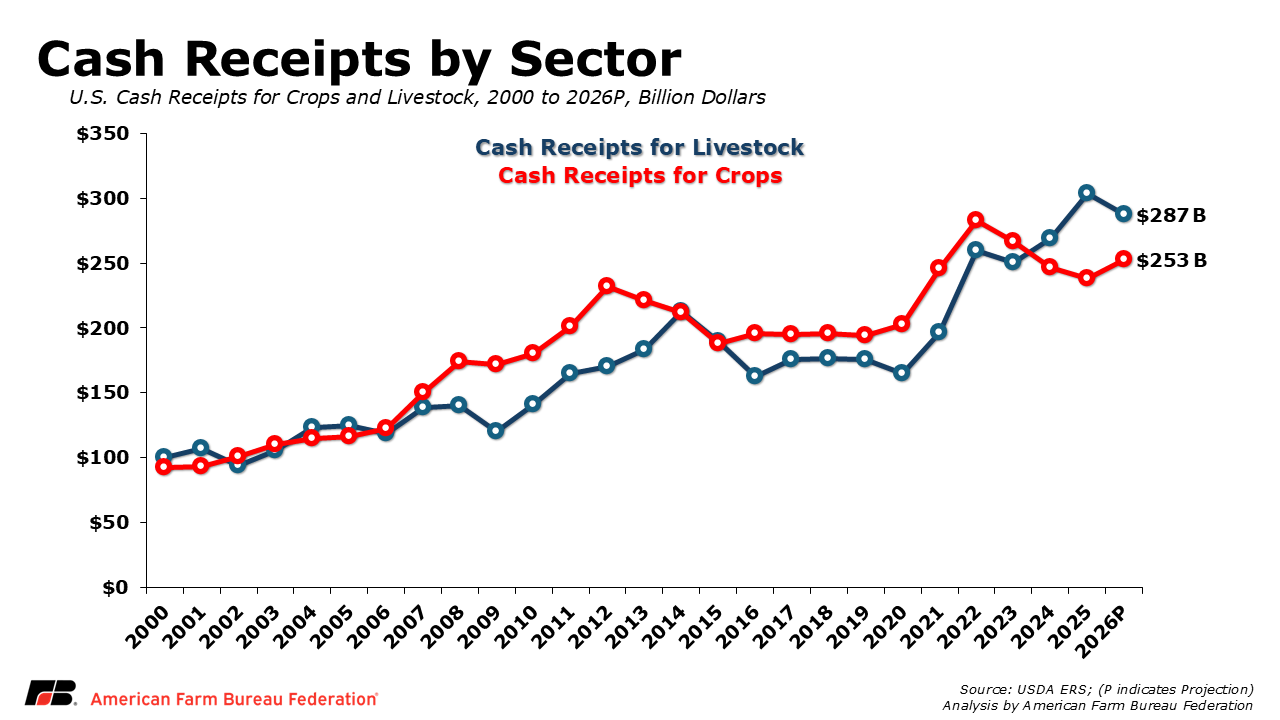
USDA’s September forecast shows a much stronger 2026 outlook for crop receipts than the February projection. Total crop cash receipts are now projected at $253 billion, up $14.6 billion, or 6.1%, from 2025 and more than $12 billion above USDA’s February forecast of $240.8 billion. After adjusting for inflation, crop receipts are still expected to increase 3.1%.
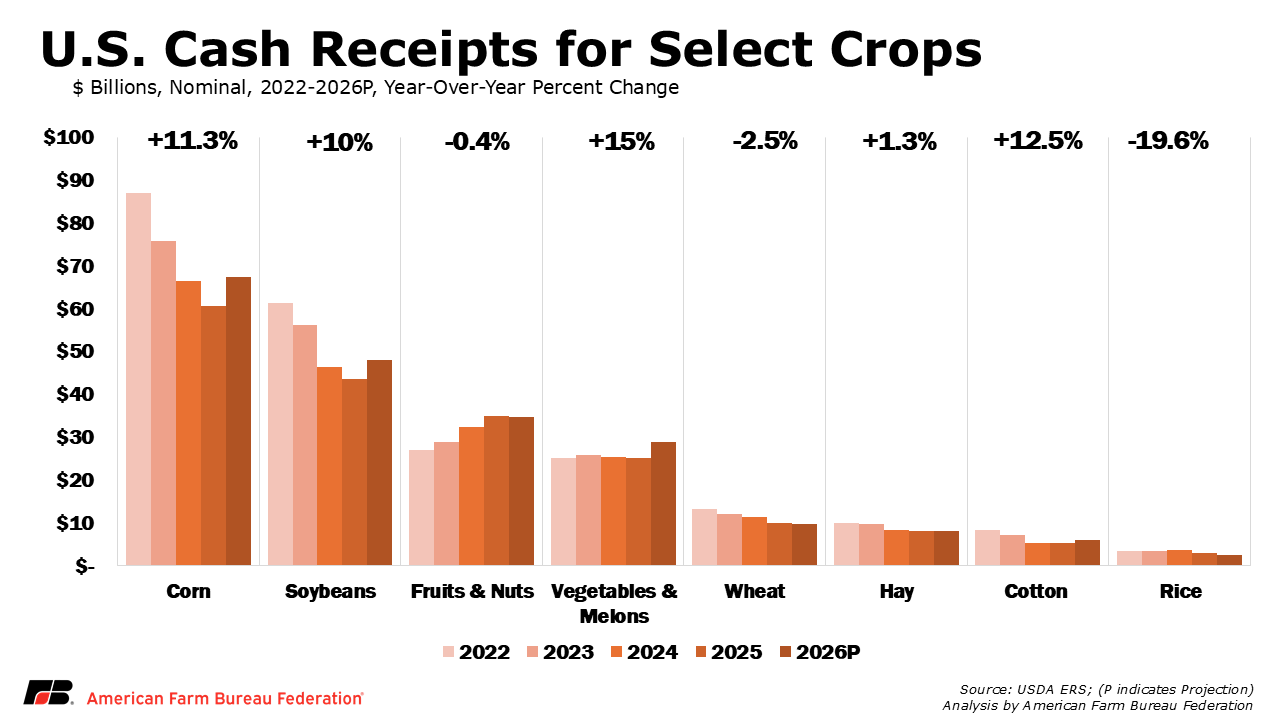
The largest revisions are concentrated in several major crops. Corn receipts are now expected to increase $6.8 billion, or 11.3%, to $67.3 billion, largely because of higher quantities sold; in February, USDA projected an increase of just $2 billion, or 3.3%. Soybean receipts are forecast to rise $4.3 billion, or 10%, to $47.9 billion, primarily on higher prices, compared with essentially no growth projected in February. Cotton receipts are now forecast to increase $651 million, or 12.5%, to $5.9 billion, after USDA previously expected receipts to remain near 2025 levels.
Other crops moved in the opposite direction. Rice receipts are projected to fall $571 million, or 19.6%, to $2.3 billion, a steeper decline than the 12.5% drop forecast in February. Hay receipts are now expected to increase only $104 million, or 1.3%, to $8 billion, compared with a $400 million, or 5.5%, increase projected earlier in the year, as persistent drought conditions have reduced forage and hay supplies across many livestock-producing regions.
Specialty crop receipts are also mixed. Vegetable and melon receipts are projected to increase $3.8 billion, or 15%, to $28.8 billion, a substantial upward revision from the 2.7% increase USDA projected in February. Fruit and nut receipts, however, are now expected to decline slightly, down about $140 million, or 0.4%, to $34.7 billion, reversing February’s forecast for a 1.2% increase.
Taken together, USDA’s September update points to stronger revenue expectations across much of the crop sector than earlier in the year, particularly for corn, soybeans, cotton and vegetables. But the gains remain uneven, and higher receipts come alongside sharply higher expectations for fertilizer, fuel and other production costs, limiting the extent to which stronger sales translate into improved farm margins.
Livestock
USDA’s September forecast also revised the livestock outlook higher than the February estimate, though receipts are still expected to retreat from a very strong 2025. Animal and animal product cash receipts are projected at $287.3 billion in 2026, about $13.4 billion above USDA’s February forecast, but down $16.4 billion, or 5.4%, from 2025. After adjusting for inflation, receipts are expected to decline 8.1%.
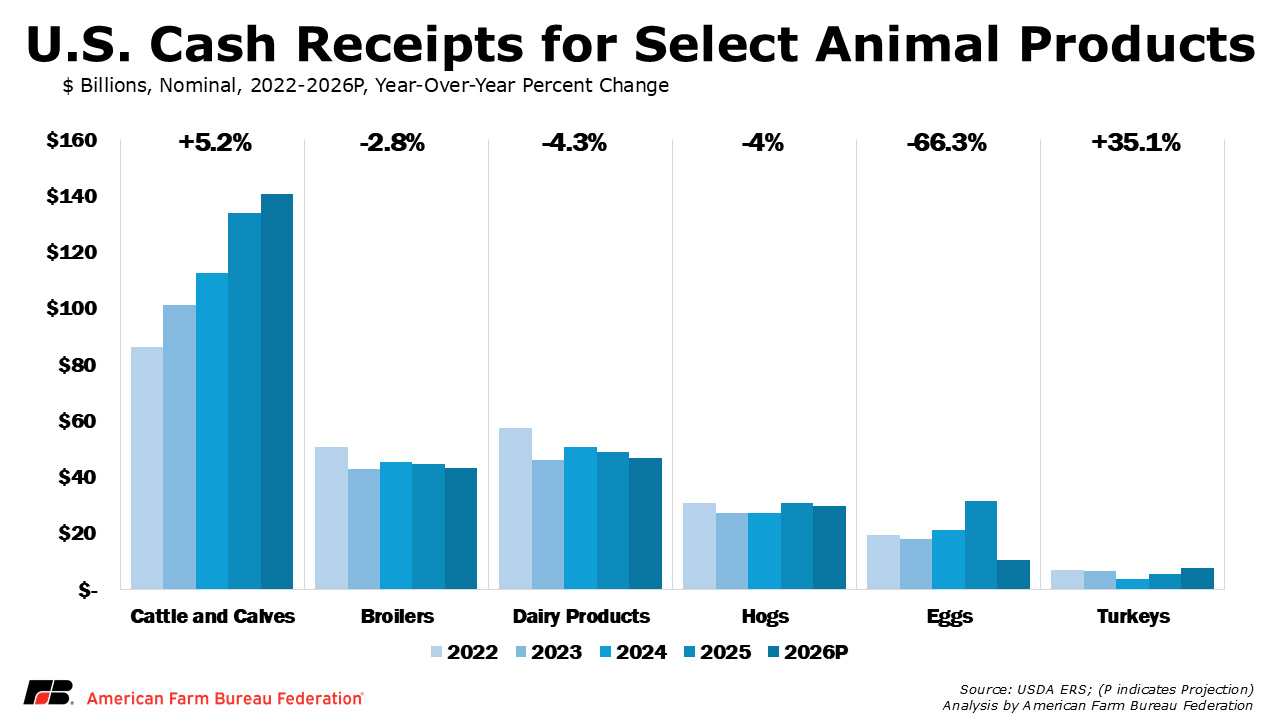
Cattle and calves remain the strongest part of the sector, with receipts forecast to rise $7 billion, or 5.2%, to $140.7 billion. However, higher receipts largely reflect historically tight cattle supplies rather than expanding production. Today’s strong cattle prices are a supply story years in the making, with the U.S. beef cow herd near historic lows following years of drought-driven liquidation and elevated production costs.
Importantly, the forecast may not fully capture the sharp decline in cattle prices that occurred following the administration’s recent proclamation to import 660 million pounds of beef. Cattle farmers and ranchers in many regions have seen cattle values fall, creating losses that could weigh on actual farm revenues beyond what is reflected in USDA’s current outlook.
Milk receipts are still expected to decline, but by a smaller amount than previously forecast, falling $2.1 billion, or 4.3%, to $46.8 billion, versus a 12.8% decline projected in February. Hog receipts are now expected to fall $1.2 billion, or 4%, compared with just a 0.7% decline in February.
Poultry markets are more mixed: egg receipts are expected to plunge $20.9 billion, or 66.3%, to $10.6 billion, broiler receipts fall $1.3 billion, or 2.8%, to $43.3 billion, while turkey receipts rise $2 billion, or 35.1%, to $7.5 billion.
Compared with February, USDA’s September outlook shows greater strength in cattle and a smaller expected decline in dairy receipts, but a weaker outlook for hogs and broilers. Overall livestock receipts are still projected to fall in 2026, with continued strength in cattle unable to fully offset sharp declines in egg receipts and softer returns across several other animal sectors.
Production Expenses
Production costs are one of the most significant changes in USDA’s September outlook. Total farm production expenses are now forecast at $492.8 billion in 2026, up $21.2 billion, or 4.5%, from 2025 and $15.1 billion above USDA’s February forecast. After adjusting for inflation, expenses are now expected to rise 1.5%; in February, USDA projected a 0.9% decline.
Several major categories are moving higher. Livestock and poultry purchases are projected to increase $7.4 billion, or 11.4%, to $71.9 billion, while fertilizer, lime and soil conditioner expenses rise $5.3 billion, or 15.3%, to $39.6 billion and fuel and oil costs increase $4.8 billion, or 28.8%, to $21.6 billion. Marketing, storage and transportation expenses are forecast to increase about $1.3 billion, or 12%, property taxes and fees by about $867 million, or 4.8%, and interest expenses by roughly $921 million, or 2.8%. Cash labor costs remain near $44.3 billion, down slightly from 2025, while feed expenses decline 2.1%.
The sharp increases now projected for fuel and fertilizer are particularly important given renewed conflict in the Middle East. Fighting involving Iran has again disrupted traffic through the Strait of Hormuz and pushed Brent crude above $96 per barrel, increasing the risk of further pressure on energy, transportation and fertilizer costs.
Taken together, USDA’s updated estimates suggest that meaningful expense relief remains limited. Even where individual costs ease, total production expenses remain elevated, leaving farm margins vulnerable to weaker commodity prices and renewed input-cost shocks.
Farm Finances
USDA’s September update shows some improvement in the farm balance sheet compared with February, but debt continues to climb. Total farm sector debt is forecast to reach a record $605.1 billion in 2026, up $26.4 billion, or 4.6%, from 2025. The sector’s debt-to-asset ratio is expected to inch up from 13.34% to 13.54%, meaning farmers will carry slightly more debt for every dollar of assets they own.
The revisions are somewhat less concerning than USDA’s February outlook, which projected debt at $624.7 billion and a 13.75% debt-to-asset ratio. Working capital (the cash and other short-term resources farms can use to pay bills) is now expected to increase 3.5% in 2026, after falling 15% in 2025. In February, USDA expected working capital to decline another 9.2%.
Conclusion
USDA’s September revisions show that 2025 farm income was stronger than previously estimated, largely because livestock receipts, particularly cattle, were better than USDA expected in February. That revision matters, but it does not erase the broader financial strain facing agriculture or necessarily mean conditions improved evenly across farms and commodities.
Looking ahead, USDA still expects real farm income to decline in 2026, production expenses to rise sharply, debt to increase and returns to remain uneven across sectors. Government payments via ad-hoc assistance and the farm safety net continue to provide an important bridge, but until market returns keep pace with production costs, many farmers and ranchers will continue to face tight margins and difficult financial decisions heading into 2027.