Imports Will Discourage America’s Beef Recovery

John Newton, Ph.D.
Vice President of Public Policy and Economic Analysis
Key Takeaways
- Today’s beef price challenges are a supply problem years in the making. Record ground beef prices are the result of the lowest beef cow inventory since 1971, driven by drought-forced liquidation and production costs that have jumped nearly 30% since 2020 — not a sudden or easily reversible shortage.
- Herd rebuilding is finally happening, but it's fragile. A 3% increase in beef heifers kept for replacement signals ranchers are starting to retain heifers rather than sell them, but this is happening alongside falling prices paid to farmers (down 14%) — a combination that could easily discourage the very rebuilding that's needed.
- Import timing could work against the herd-rebuilding goal. With roughly 70% of spring-born calves sold between September and November, the 90-day import window overlaps directly with this critical selling period, likely driving prices down further just as ranchers are weighing whether to expand their herds.
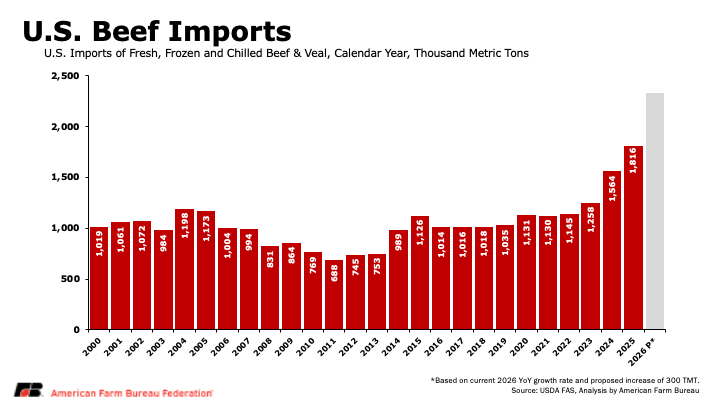
The administration recently revealed plans to allow up to 300,000 metric tons of beef – equivalent to more than 660 million pounds of beef – to be imported into the U.S. over a 90-day period in an attempt to reduce consumer prices for ground beef. This plan is being considered largely because Bureau of Labor Statistics data reveals that the average retail price for ground beef reached a record $6.90 per pound in April 2026 and remains near that level. Importantly, this announcement comes when beef imports into the U.S. are already record high and during the very window of time that many ranchers will be selling their cattle.
Historically Low Beef Cow Inventory and Plant Closures
One of the primary reasons beef, and in particular ground beef prices, reached a record high in 2026 is the historically low beef cow inventory. According to USDA’s July Cattle Inventory report the number of beef cows as of July 1 was 28.5 million head, the lowest level since the series first began in 1971. The calf crop also remains historically low at 32.5 million head but beef heifers kept for replacement was up 3% compared to prior year levels – signaling heifer retention has begun across the U.S.
Efforts to rebuild the U.S. cattle herd are fragile at best. Anecdotally, approximately 70% of the spring-born calves are sold during the months of September to November – months that overlap heavily with the 90-day import window announced by the administration.
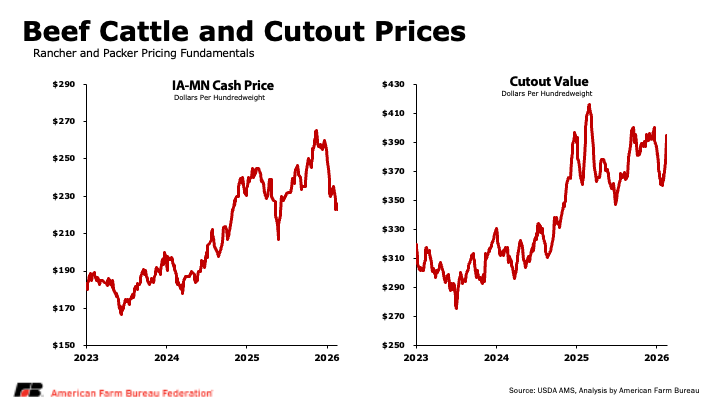
Despite the historically low cattle herd, due to a number of packing plant closures across the U.S., continued efforts to increase beef imports, and the phased reopening of the border with Mexico, cash cattle prices have fallen 14%, or nearly $40 per hundredweight, in recent months. Meanwhile, the beef cutout value, an approximation of the wholesale value of beef, has climbed to near historic highs, contributing to higher retail prices.
Record-High Production Expenses
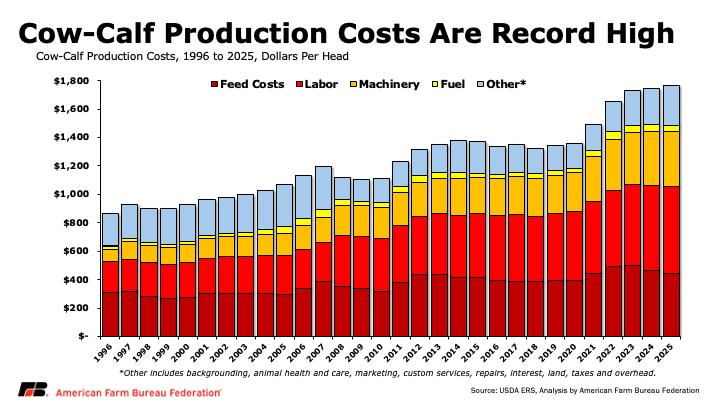
The reason for the historically small beef cow herd is multifaceted. First, drought conditions across much of the U.S. has forced ranchers to liquidate cattle or put cattle on feed because of the lack of homegrown forage. Second, according to USDA’s Economic Research Service’s cost and return data, input costs for cow-calf producers, i.e., ranchers who maintain a herd of beef cows for breeding purposes, reached a record high of $1,762 per head in 2025. Nearly every line item for cow-calf operators is more expensive today than ever before. Since 2020, prior to the most recent inflationary environment, production costs are up more than $400 per head, or nearly 30%.
Positive Returns for the First Time in a Long Time
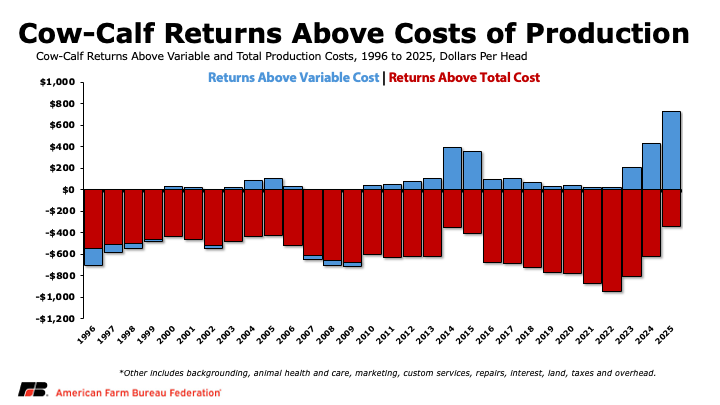
When evaluating total costs of production against revenue, there are two metrics to review: returns over variable costs and returns over total costs. If returns over variable costs are greater than zero, then the optimal business decision is to raise the livestock or crop and pay down the fixed expenses and debt. If the returns over total cost are positive, then the market returns exceed both the operating costs and the fixed costs. In the cow-calf space, and on average, that has never been the case, according to USDA data.
Recent years have been among some of the best economic years for cow-calf producers, allowing them to make reinvestments into their farm and ranch operations such as making capital purchases, updating equipment, and improving facilities such as fencing or barn roofs, among other investments. However, the positive returns are above variable costs only. When considering fixed costs such as land, taxes and machinery, returns above the total cost of production for cow-calf operations have been negative for 30 consecutive years. It is for these reasons that efforts to increase beef imports will further undermine the economic incentive for ranchers to make the investment to rebuild the herd.
Summary
The administration's plan to import up to 300,000 metric tons of beef is aimed at easing record-high ground beef prices, but it arrives at a moment when the underlying economics of the cattle industry are already fragile. The beef cow herd sits at its lowest level in over 50 years, not because ranchers lack incentive to rebuild, but because drought and record production costs have made expansion a financial risk.
Finally seeing the returns needed to justify reinvesting in their herds, cow-calf producers are beginning to hold on to their heifers and starting to rebuild. A surge of imports coinciding with the fall calf-selling season and the drop in cattle prices that would come with those imports would jeopardize that. The result could be a policy that offers short-term relief at the grocery store while working against the longer-term goal of a larger, more resilient American cattle herd.