Crop Report Revisions Highlight Importance of Accurate Estimates

Faith Parum, Ph.D.
Deputy Chief Economist
Key Takeaways
- Two recent USDA reports were followed by some of the largest single-day declines in December corn futures during 2026, emphasizing estimates’ impacts on commodity prices.
- USDA corrected its September corn production estimates after identifying a processing error that affected plant populations, ear counts, yields and production in Kansas and Nebraska.
- The correction raised September’s national production forecast by 28.4 million bushels, shrinking the reported September-to-October production increase by about 12%.
- Accurate, timely USDA estimates are essential to market transparency, price discovery and the marketing decisions farmers make throughout the year.
USDA's National Agricultural Statistics Service (NASS) announced corrections to its September 2026 Crop Production report on Oct. 23 following concerns about differences between its September and October corn estimates. In a follow-up notice on Oct. 24, NASS explained that incorrect acreage weights had been used to combine irrigated and non-irrigated corn observations in Kansas and Nebraska. The error affected September plant populations and ear counts, resulting in revisions to state-level yields and production, as well as national estimates and 10-state objective-yield averages. The agency corrected the affected September estimates, reviewed its October calculations and confirmed that October forecasts remain unchanged.
USDA production estimates give farmers, grain buyers and other market participants a common source of information used for price discovery, marketing and risk management. Unfortunately, revisions, especially market-moving revisions, undermine trust in the accuracy of the reported data and may discourage future participation in these critical surveys.
Market Surprises Heighten Concerns
Two recent USDA reports were followed by some of the largest single-day declines in December corn futures during 2026. On Sept. 30, December corn futures declined 21.25 cents per bushel after USDA reported Sept. 1 corn stocks of 2.095 billion bushels, above market expectations of approximately 1.924 billion bushels. On Oct. 9, futures declined another 20.5 cents after USDA raised its national corn yield forecast to 181.2 bushels per acre, compared with market expectations near 177.7 bushels.
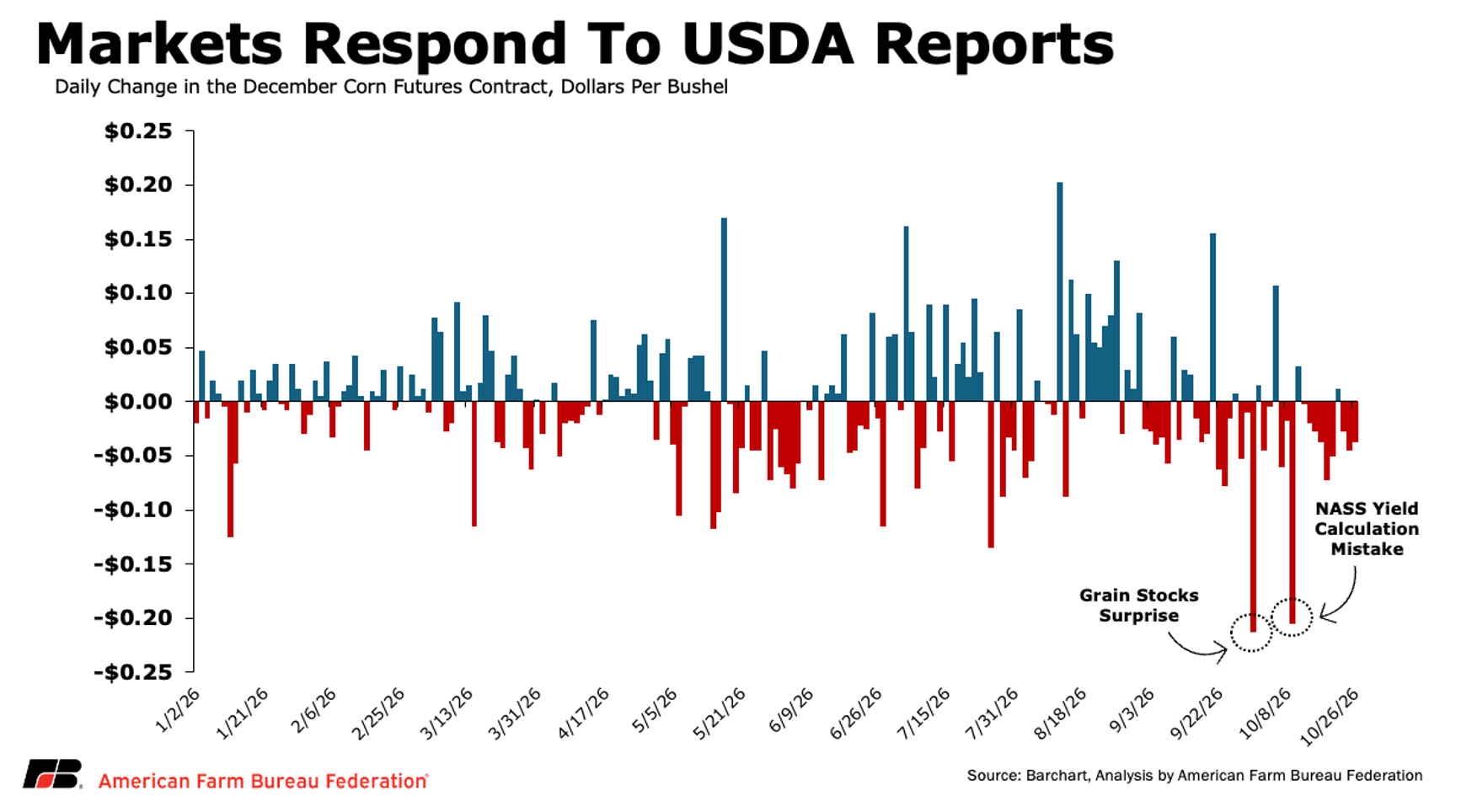
Together, these two trading sessions represented a decline of 41.75 cents per bushel. Actual farm revenue impacts depend on marketing arrangements, hedging decisions, basis, and the portion of production remaining unpriced. These price movements also reflected broader market expectations and are not all a result of the changes to the September report.
These developments are more significant for farmers already facing tight or negative margins. Lower commodity prices, combined with elevated fertilizer, fuel, interest and other expenses, continue to pressure farm viability. The September Grain Stocks report and October production estimates both exceeded market expectations, contributing to sharp price reactions. The subsequent correction to September's production data has added concern about the reliability of the information farmers use to evaluate supplies and make marketing decisions.
What Changed in the September Report?
NASS identified a processing error involving acreage weights used to combine irrigated and non-irrigated objective-yield observations in Kansas and Nebraska. The correction increased Nebraska's September corn yield estimate by 5 bushels per acre to 182 bushels and lowered Kansas' estimate by 3 bushels to 118 bushels per acre. Nationally, September's yield estimate increased from 178.5 to 178.8 bushels per acre. These revisions added approximately 48 million bushels to Nebraska's production forecast and reduced Kansas' by nearly 20 million bushels, resulting in a net increase of 28.4 million bushels in estimated U.S. production.
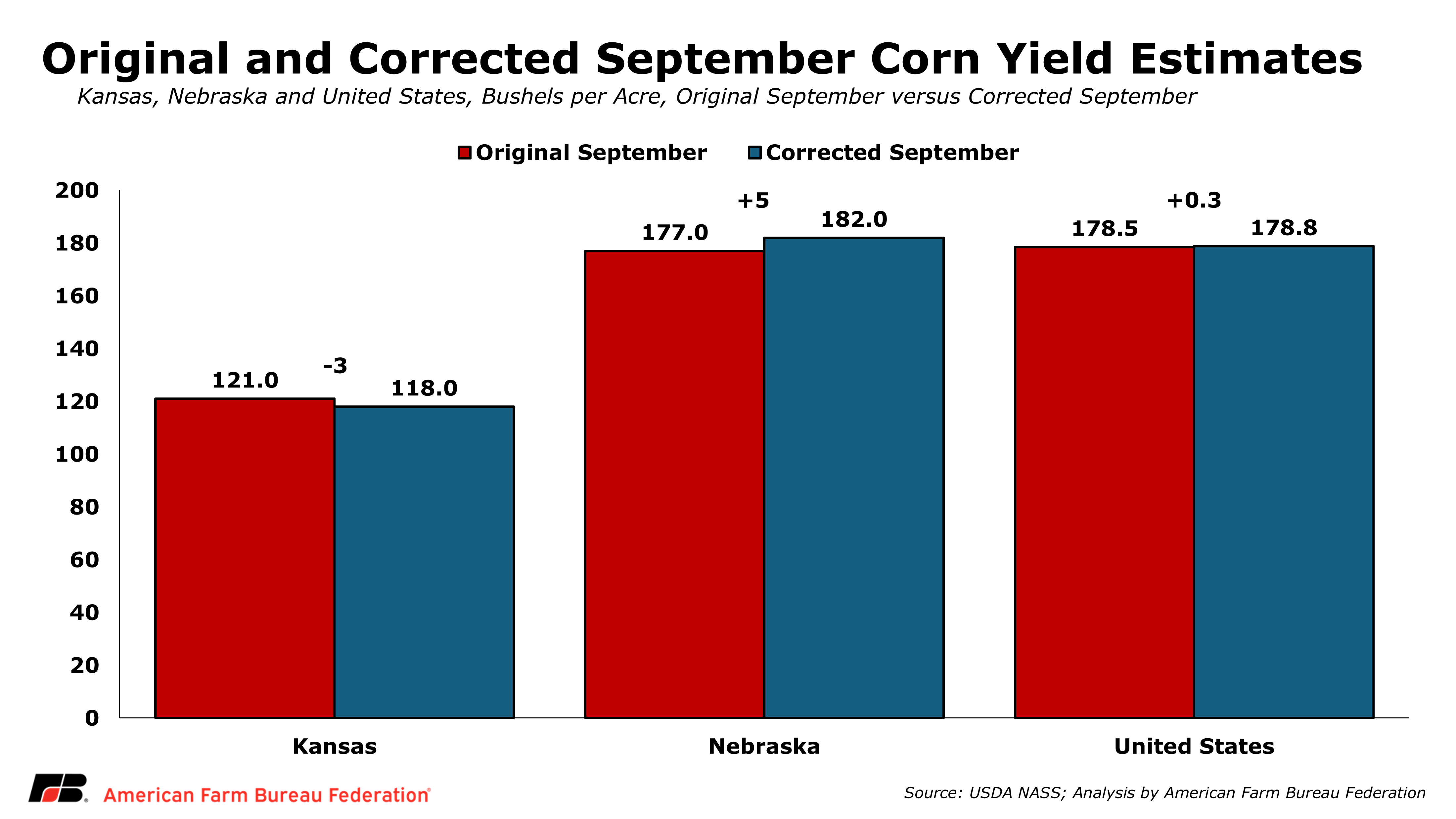
While the national production adjustment was relatively small at approximately 0.2%, the state-level changes were more substantial. Nebraska's September production forecast increased nearly 3%, while Kansas' decreased approximately 2.5%. These offsetting adjustments demonstrate how errors in individual state estimates can affect the national production outlook and the information available to market participants.
How do the Corrections Affect the October Comparison?
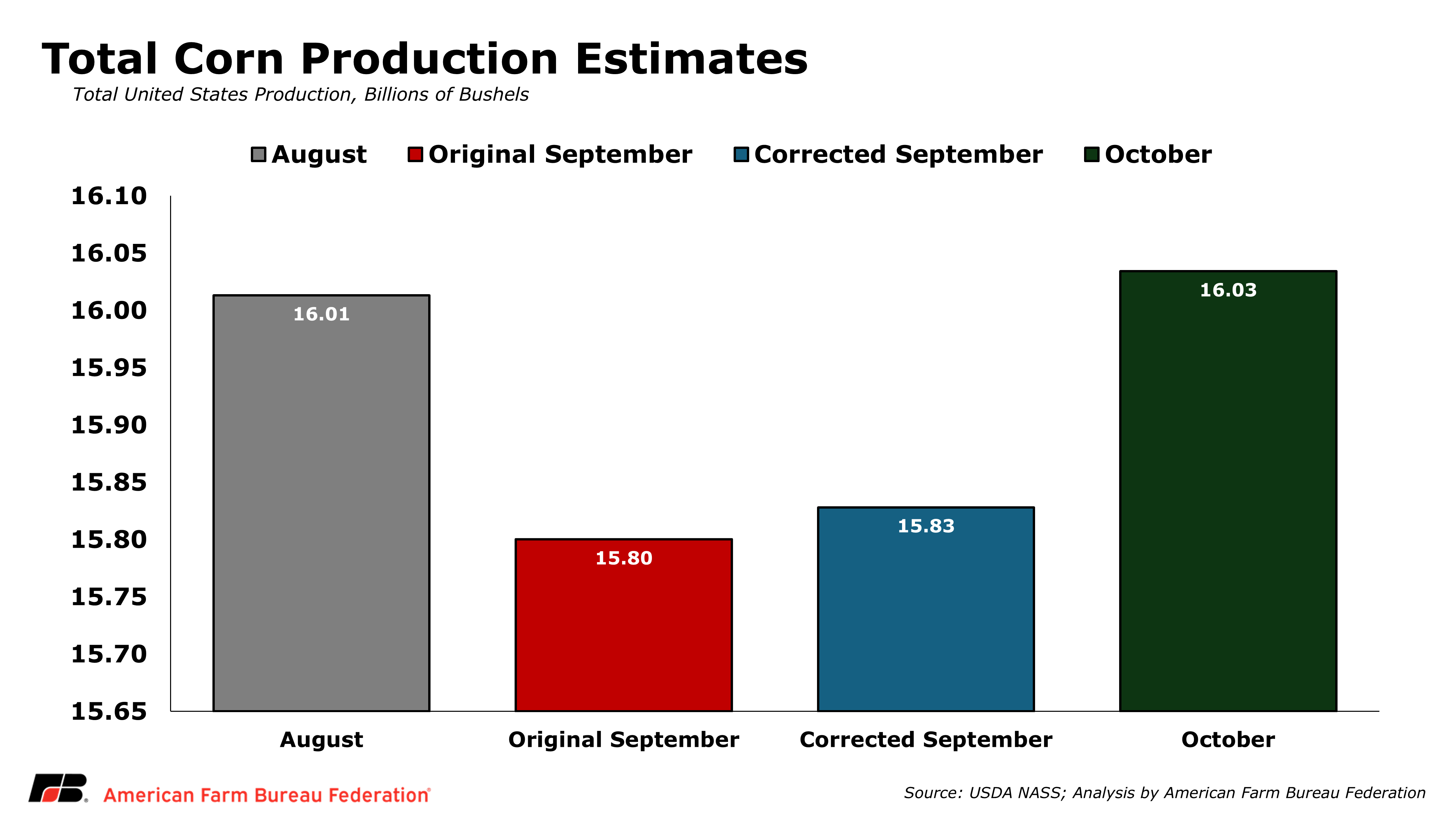
When USDA released its October Crop Production report on Oct. 9, the national corn production forecast increased by approximately 234 million bushels to 16.03 billion bushels. Part of that increase, however, reflected the September error, which the market forecasted at a lower production estimate.
The revised September production estimate increased from approximately 15.80 billion to 15.83 billion bushels. As a result, the September-to-October production increase narrowed from approximately 234 million bushels to 206 million bushels.
Looking back to August, USDA initially forecasted national corn production at 16.01 billion bushels before lowering its estimate to 15.83 billion bushels in corrected September figures. By October, production was forecast at 16.03 billion bushels, approximately 21 million bushels, or 0.13%, above August's estimate.
The correction also changes the comparison of corn yields between the two months. Nationally, the reported yield increase narrowed from 2.7 to 2.4 bushels per acre. The difference is especially noticeable in Nebraska, where the September error made October's yield increase appear to be 11 bushels per acre. With the corrected September estimate, that increase is 6 bushels per acre. In Kansas, the reported increase grows from 4 to 7 bushels per acre.
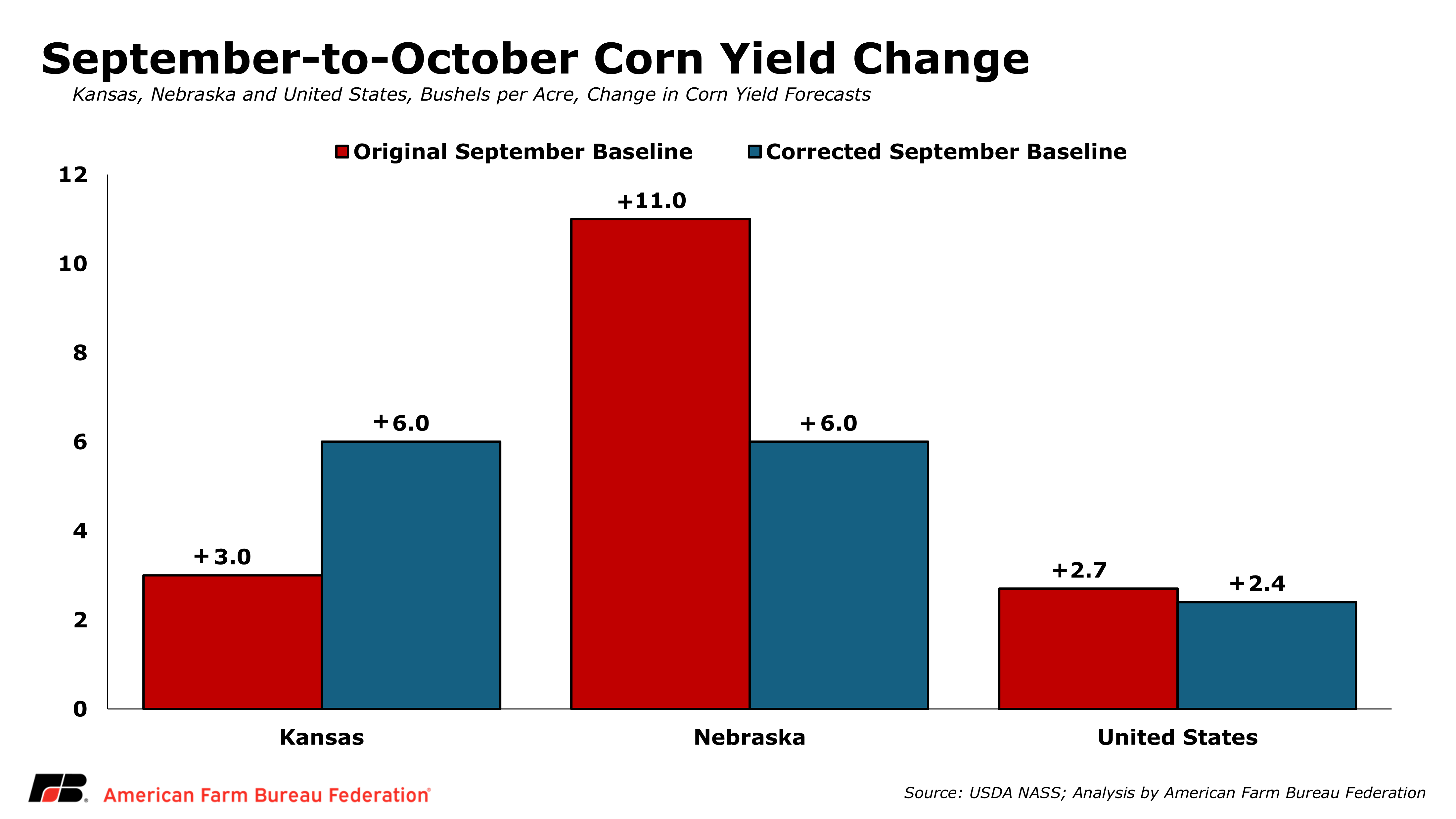
The broader comparison shows how September's lower production forecast influenced the apparent size of October's increase. USDA’s corrections narrowed the month-to-month change, although it still represents a large increase in production estimates from September to October.
Maintaining Confidence in Agricultural Statistics
USDA's decision to correct the September report and provide additional information about the error is an important step in maintaining confidence in its estimates. NASS has confirmed its October forecasts are accurate and announced additional checks of acreage weights and objective-yield calculations before future reports are published.
The September revisions demonstrate how errors in earlier estimates can affect markets and the interpretation of subsequent reports. Continued improvements to data processing, verification and quality-control procedures can help strengthen the accuracy and consistency of future estimates. USDA is also pursuing broader data modernization efforts, including an Oct. 24 agreement with NASA to explore how satellite observations, geospatial analysis and improved statistical methods can strengthen agricultural estimates.
Agricultural markets depend on reliable information to support transparent price discovery. Farmers make production, financing and marketing decisions based in part on the supply expectations reflected in USDA reports. As financial pressures across agriculture continue, maintaining accurate and timely agricultural statistics remains essential to allowing markets to function efficiently and helping farmers make informed business decisions.