Reviewing Trends in Conservation Reserve Program Enrollment

Cameron Castillo
Associate Economist
Cydney Stables
AFBF Economics Intern
Key Takeaways
- USDA voluntary and incentive-based conservation practices are widely used by America’s farmers and ranchers. They have proven to be an effective tool for contributing long-lasting benefits to soil, water and wildlife habitat resources while helping farmers and ranchers diversify their income streams.
- CRP has an annual enrollment cap of 27 million acres, as established in the 2018 farm bill. USDA accepted 2.2 million acres in Conservation Reserve Program enrollment for 2026, expanding the reach of this voluntary land retirement conservation program in its 41st year.
- Grasslands CRP, which allows haying and grazing on CRP land, has become the most widely used CRP contract category within recent years.
- Farmers have employed conservation practices (now widely recognized as part of regenerative agriculture) for decades. In 2023 alone, farmers and ranchers enrolled nearly 70 million acres in conservation practices now categorized as regenerative.
USDA’s Largest Conservation Program
For more than 40 years, thenConservation Reserve Program (CRP) has remained the largest voluntary private lands conservation program in the U.S. Administered by USDA’s Farm Service Agency (FSA) under the guidelines set forth in Title II of the farm bill, CRP aims to protect natural resources while providing economic benefits to farmers and ranchers. Through annual rental payments, the program encourages farmers to idle agricultural lands from production. Additionally, the program incentivizes the use of plant vegetation practices (intentionally planting or restoring native plant communities on land that has been taken out of crop production) to improve water quality, prevent erosion and restore natural wildlife habitat. CRP offers contracts between 10 to 15 years in length, paying landowners annually. The use of CRP contracts provides a diversified income stream for farmers and ranchers.
FSA offers three variations of CRP contracts: General, Grasslands and Continuous CRP. Each contract category focuses on various practices, including but not limited to establishing native grasses, implementing riparian buffers, wetland restoration and the development of sustainable grazing methods. Key differences across these contracts include enrollment period, land focus and required conservation practices.
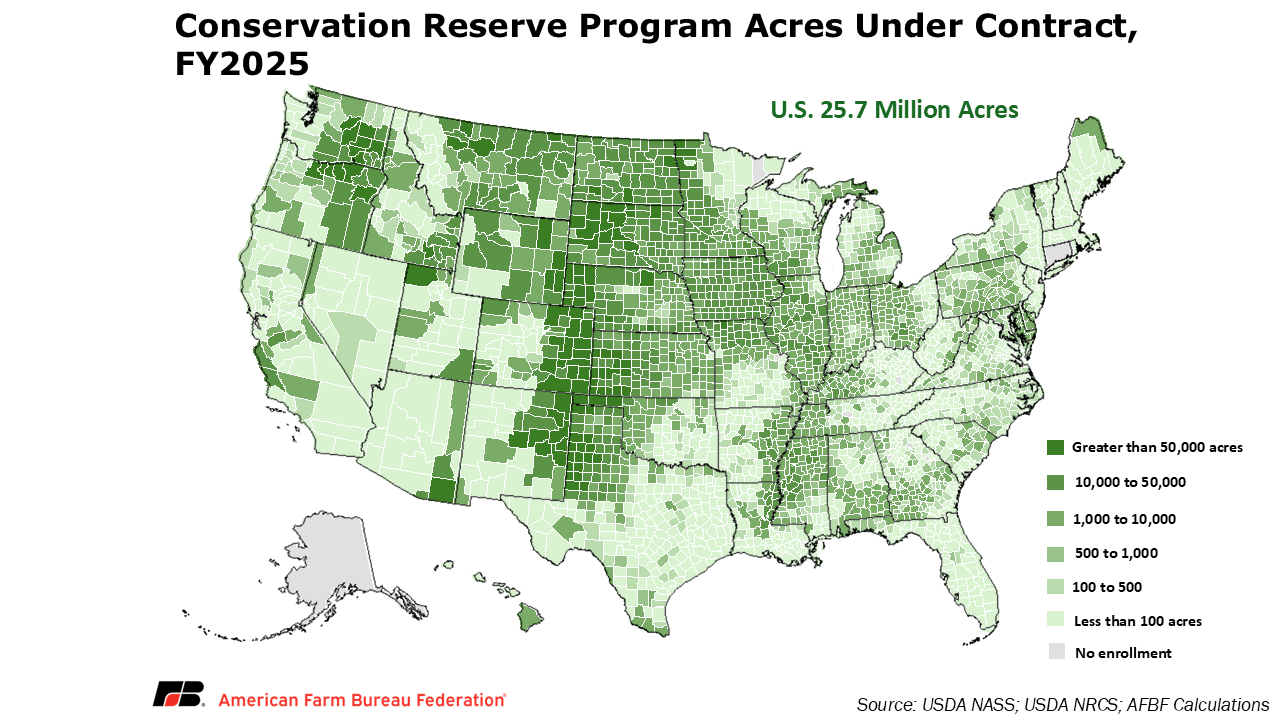
USDA recently announced new CRP enrollment figures for 2026 at 2.2 million acres. Federal law caps total CRP acreage contracts at 27 million acres, an area similar in size to the state of Tennessee. In fiscal year 2025 (the latest full year of available data), Colorado held the largest acreage, followed by South Dakota and Nebraska at 2.96 million, 2.63 million and 2.4 million acres, respectively. While we don't have official state-by-state enrollment totals for 2026, FSA has indicated that the top three states remain unchanged.
CRP Contract Differences
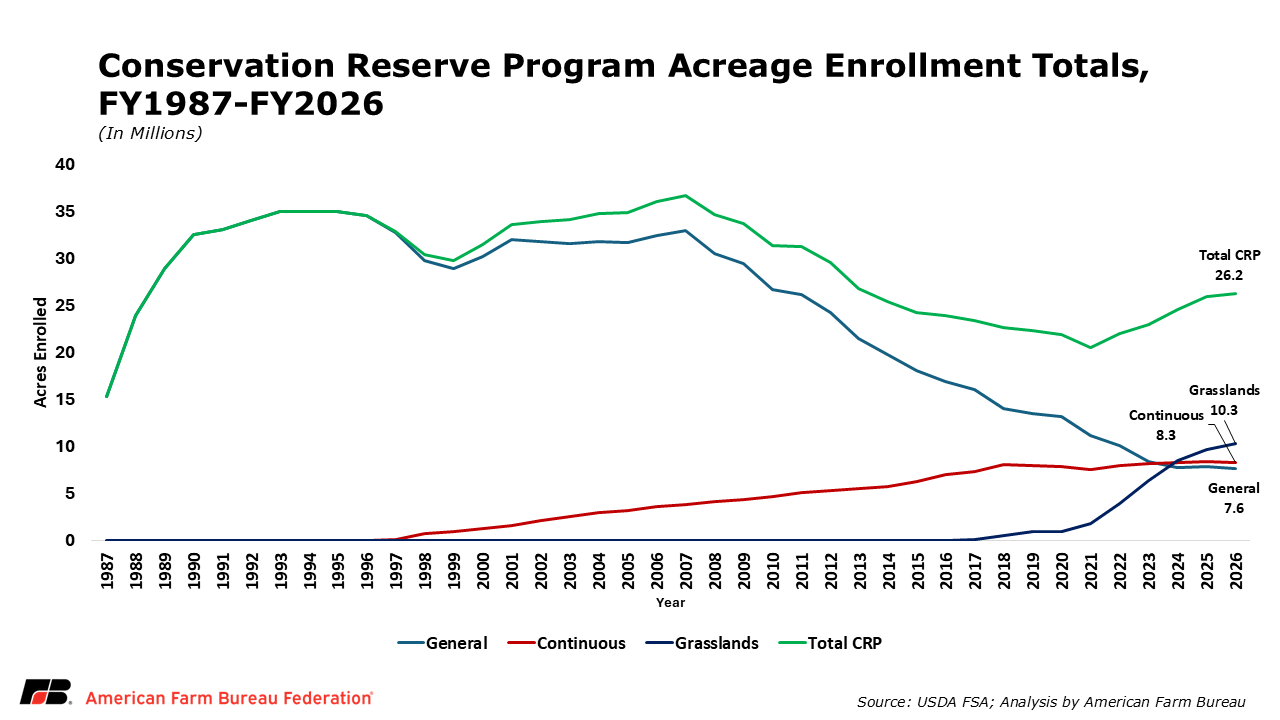
To enroll farmland into the CRP General program, farmers and ranchers submit an offer that includes their requested rental rate and FSA soil assessment scores. Each offer uses the Environmental Benefits Index (EBI), a six-factor national ranking system with five factors that quantify environmental value such as wildlife habitat, water quality, soil erosion, air quality, carbon sequestration and long-term (post contract period) benefits and one factor that scores cost-competitiveness. From there, FSA accepts offers top-to-bottom based on the land’s total EBI score until the acreage available under the statutorily imposed cap is filled. General CRP contracts accounted for just over 29% of the acres enrolled in CRP in April 2026, representing nearly 7.6 million acres.
Grasslands CRP, widely used by ranchers in Western states, uses a similar structure, awarding contracts based on factors that include conservation priority, contract structure and rental rates. Grasslands CRP contracts accounted for nearly 39% of the acres enrolled in CRP in April 2026, a total of nearly 10.3 million acres. Enrolled Grasslands CRP acres have increased each year since the program’s inception following the 2018 farm bill. It is the most popular of the three contract categories beginning in fiscal year 2024.
Unlike General and Grasslands CRP, Continuous CRP contracts are not competitively bid. Land is enrolled automatically, on a rolling basis, so long as it meets the eligibility criteria for an approved conservation practice. Continuous CRP contracts accounted for roughly 32% of the acres enrolled in CRP in April 2026, or roughly 8.3 million acres.
Rental Rates
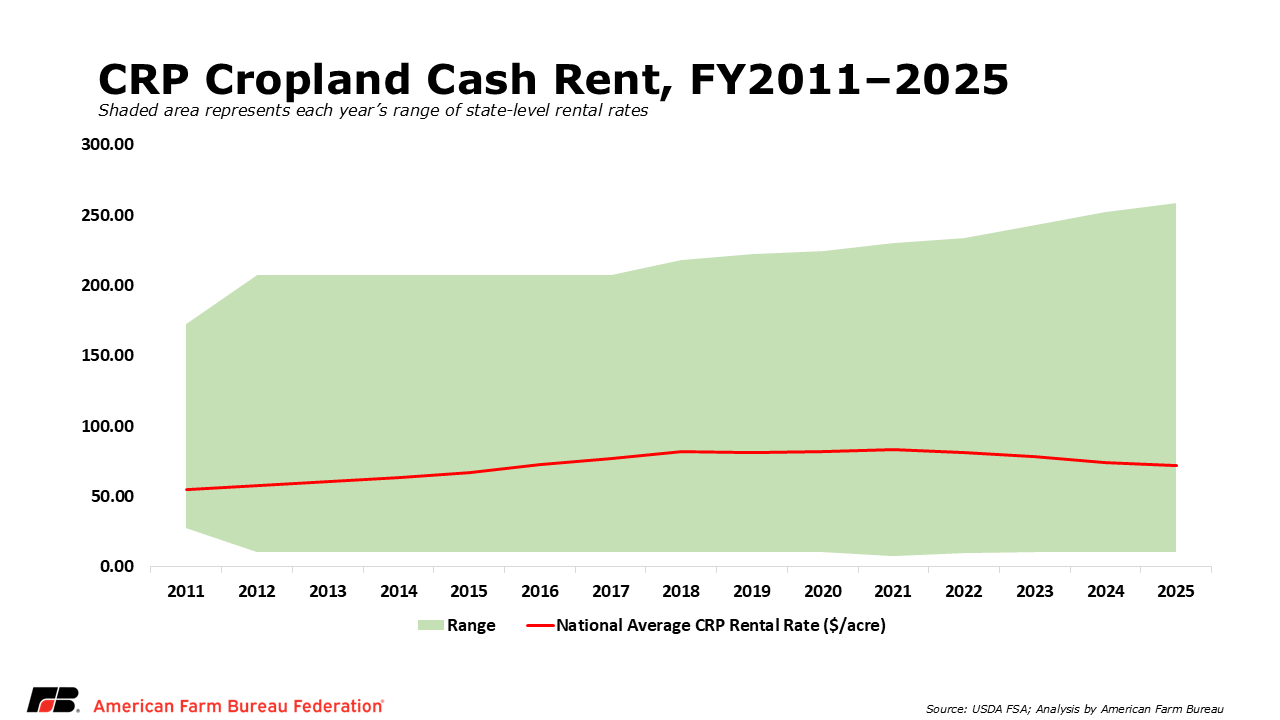
For General CRP, FSA sets a maximum Soil Rental Rate (SRR) using the productivity of the soils within each county. This number is measured against the average cash rental rates per acre for non-irrigated cropland (using a three-year average of National Agricultural Statistics Service (NASS) data adjusted for inflation) for the predominant crop of each soil type within a soil survey area. That county baseline is then adjusted by a Soil Productivity Index (SPI) specific to each soil map unit, weighted across the predominant soil types on the offered tract, and subject to an 85% proration for general signup. Continuous CRP rental rates are similarly calculated; however, rental rates under this contract category are subject to a 90% proration. Notably, the range of CRP rental is quite large, with Iowa maintaining average CRP rental rates near $260/acre within the last five years, while states such as Wyoming maintaining average CRP rental payments of less than $16/acre.
Unlike General and Continuous CRP, the Grasslands CRP program is not inherently a land retirement program. Under Grasslands CRP, ranchers are allowed to keep land in production through livestock grazing or hay production. Baseline Grasslands CRP rental rates are calculated by taking 75% of the NASS annual pasture rental rate for the specific county, as long as the specific county rental rate is at or above the minimum contract level of $13 per acre per year. Notably, the CRP Grasslands average rental rate has eclipsed the NASS pastureland average rental rate several times in the last decade, largely due to factors such as the $13 per acre per year minimum contract rate and the presence of national priority zone bonuses (such as within the Yellowstone ecosystem) that receive an extra $5 per acre per year. For fiscal year 2026, Arizona had the lowest statewide average Grasslands CRP rate at $2.93 per acre, while Iowa had the highest average rate at $48.17 per acre.
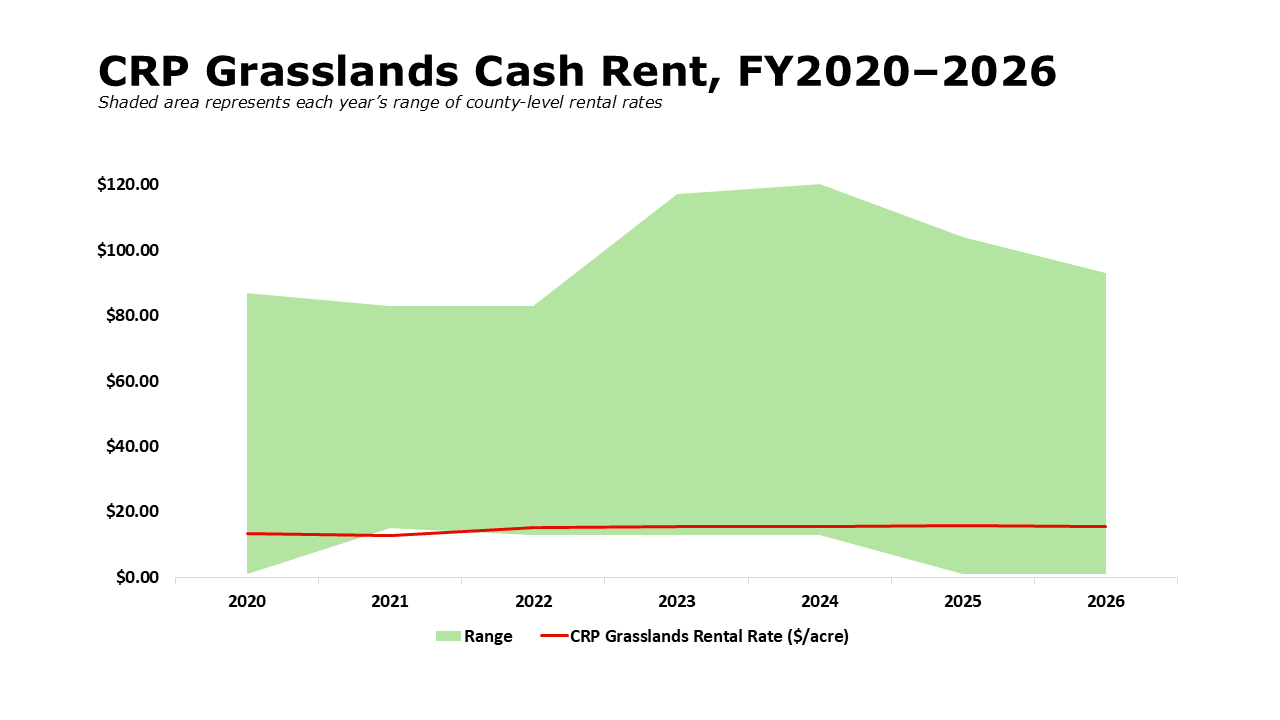
The FSA releases a monthly summary of the CRP rental rates to reflect current market rents. These rates are used to directly determine the foundation for annual per-acre rental payments that participants receive. Average CRP rental rates vary widely depending on the program and location. National averages for 2026 were $57 per acre for General, $148 per acre for Continuous, and nearly $16 per acre for Grasslands CRP.
CRP Enrollment Reflects a Commitment to Regenerative Agriculture
The growth in CRP enrollment is yet another example of the multigenerational dedication to conservation and land stewardship exhibited by America’s farm and ranch families. Regenerative agriculture has become a prominent focus among policymakers at all levels of government. USDA defines regenerative agriculture as “a conservation management approach that emphasizes natural resources through improved soil health, water management, and natural vitality for the productivity and prosperity of American agriculture and communities.” Through participation in CRP and other voluntary, incentive-based USDA conservation programs, farmers and ranchers are advancing conservation and maintaining the long-term health and productivity of their land, with recent investments expanding these efforts through the Regenerative (Agriculture) Pilot Program. As discussed in a recent Farm Bureau Intel, American farmers and ranchers enrolled nearly 70 million acres in federally supported conservation practices now classified as regenerative in 2023.
Aside from federal programs, many farmers and ranchers participate in state, local, private sector and even self-funded conservation initiatives that emphasize critical regenerative agriculture practices and applications. When it comes to protecting and preserving the land and environment through regenerative agriculture practices, America’s farmers and ranchers will continue to lead the way.
Conclusion
Land enrolled in the Conservation Reserve Program reduces soil erosion, improves water quality, increases soil health, and provides critical habitat for wildlife. These environmental improvements can create lasting value for agricultural operations by preserving natural resources that are essential for future production. By balancing economic stability with conservation stewardship, CRP enables farmers and ranchers to diversify their income while investing in the long-term health and productivity of their land, benefiting both rural communities and the environment.