Fix Our Forests Act: Why Active Stewardship Matters

Shelby Hagenauer
Senior Director, Government Affairs
Key Takeaways
- America’s forests need active management to maintain healthy, resilient ecosystems, reduce wildfire risk to communities, protect wildlife habitat and watersheds, and sustain multiple-use activities.
- Farmers, ranchers and foresters, the people who work on or among forestlands — both federally managed and privately owned — have the most at stake.
- Congress has the opportunity before the end of the year to provide more tools for land managers and improve the resiliency of America’s forests by passing the Fix Our Forests Act.
State of Play
For decades, federal policies and litigation have restricted timber harvest and other vegetation management activities on national forests. The scale of the problem is vast. The U.S. Forest Service (USFS) manages over 193 million acres of forests and grasslands across the country and estimates indicate that almost half of that land is in some combination of a high wildfire hazard area, suffering from above-normal levels of insect and disease impacts, and needing other restoration treatment.
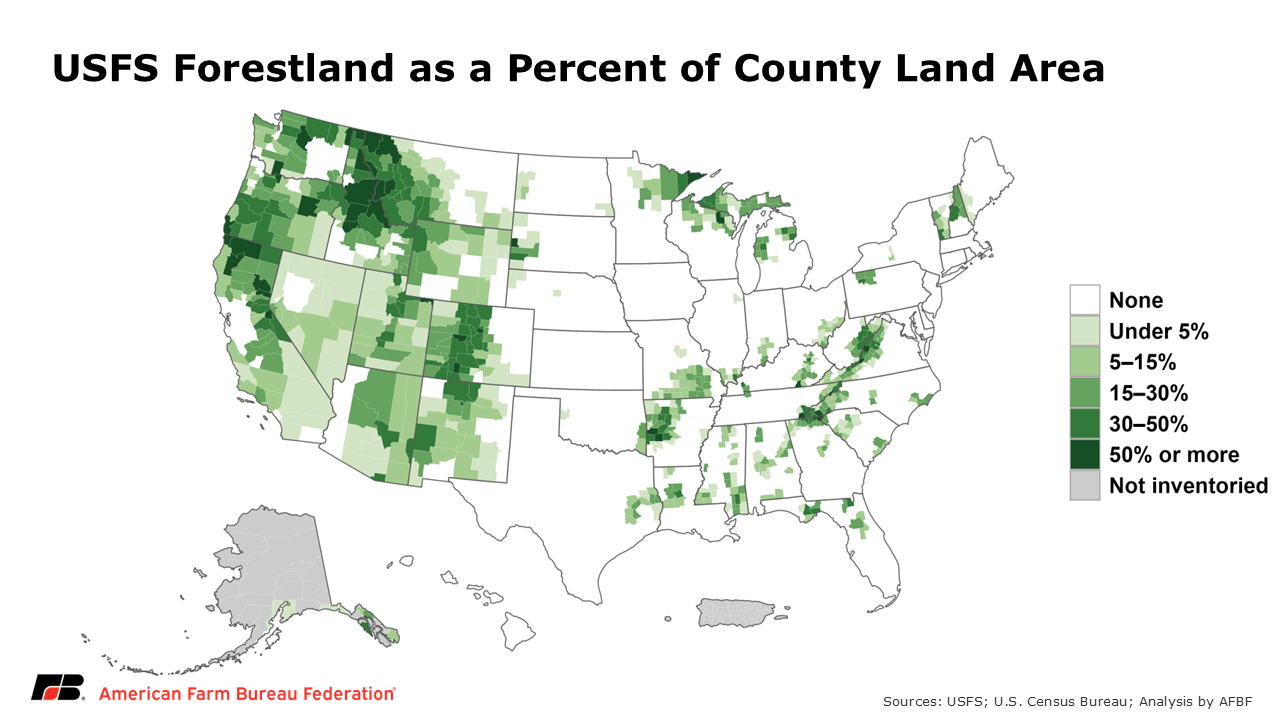
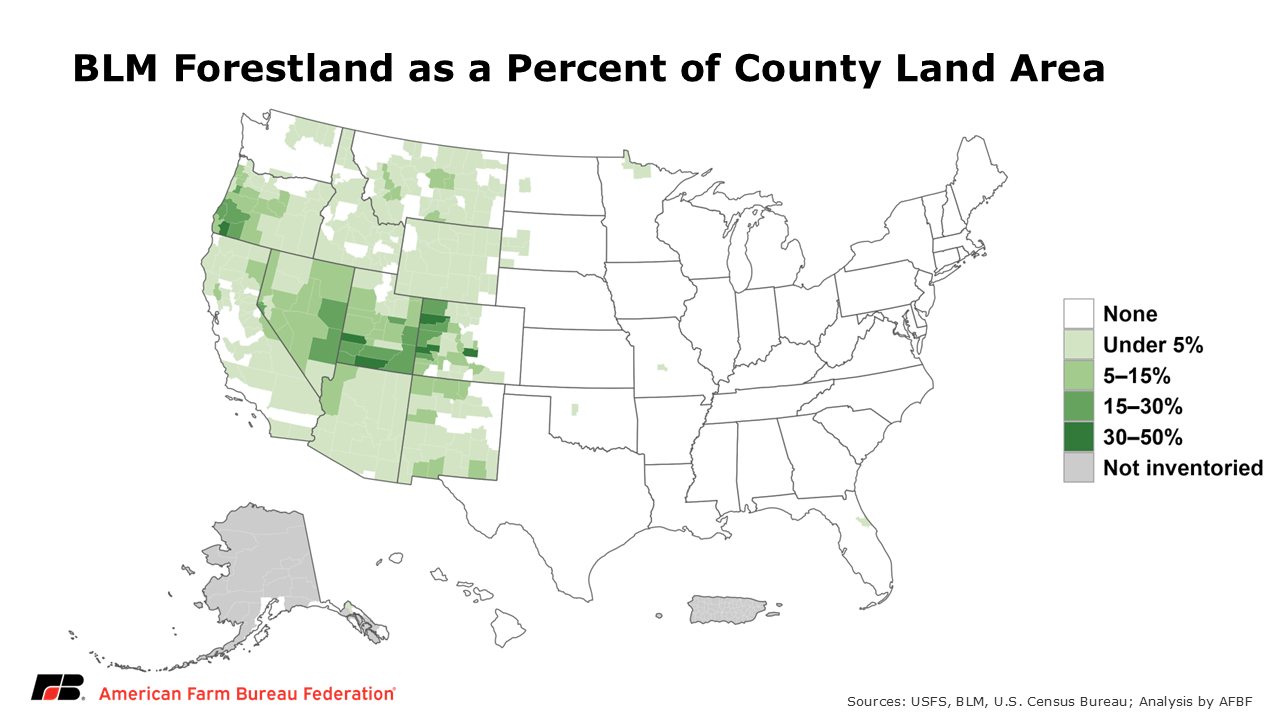
In addition to forestland maintained by the USFS, the Department of Interior’s Bureau of Land Management (BLM) manages nearly 60 million acres of forested land, primarily situated in the western United States.
The result is a landscape of densely overgrown forested federal lands with heavy fuel loads that in many parts of the West are also very dry due to ongoing drought and are at high risk for wildfires. When a fire starts on federal land, it spreads regardless of who owns neighboring property. Destruction of homes and grazing lands, loss of livestock and wildlife, destroyed recreation areas, damage to water infrastructure, and smoke drift all negatively impact rural communities. The damage results in income lost not just from the fire itself, but also from resulting barren landscapes that can take years or decades to recover when restoration activities are not prioritized.
Forest Fire Impacts
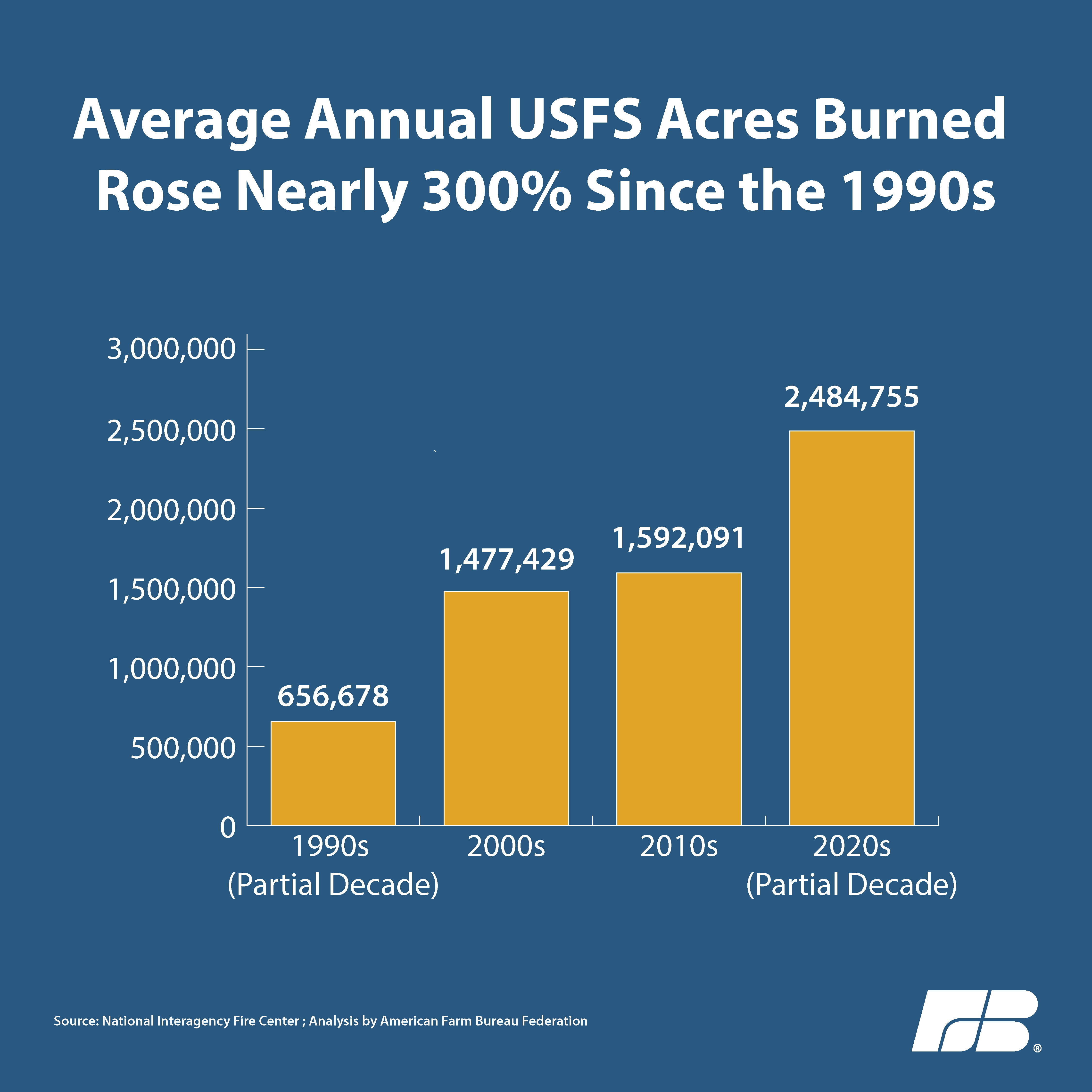
In the 2000s, annual acreage burned across the United States was nearly double than in the 1990s. Through late October, over 9 million acres have burned as a result of more than 65,000 fires. The Big Grass Fire along the Oregon-Idaho border burned nearly 580,000 acres, much of it grazing land. Fires in Utah impacted grazing lands for more than 22,000 head of livestock. And fires in Kansas, Nebraska, Texas and Oklahoma burned more than a million acres of private and public land, displacing tens of thousands of cattle. After a fire, ranchers face additional costs as they must find alternative feed or pasture for livestock, replace fences, and lose access to federal grazing allotments while they recover. Those impacts last well after a fire is suppressed and crews move on.
Research has brought more understanding of the impact wildfire has on watersheds, as forested watersheds protect water supplies for both irrigated agriculture and communities — sometimes hundreds or thousands of miles away from the forest. Fire behavior that includes extreme heat can scorch the soil and change how water moves through forests and into streams and rivers. Instead of soaking into the ground as it moves, water rushes over burned earth and creates dangerous and fast-moving floods. Debris from fires like downed logs, brush and ash are pushed into nearby waters. This can damage water management infrastructure by collecting in reservoirs and degrading water quality, increasing costs and reducing water availability for both agriculture and rural communities.
Flash floods through fire debris scars are incredibly dangerous. Extreme and deadly fires burned the USFS-owned mountains around Ruidoso, New Mexico, in 2024, with floods following. The worst flood activity, however, did not occur until a year later, when a June 2025 storm brought heavy rainfall that washed right over burn scars and ran into the rapidly rising Rio Ruidoso. Three people were killed and significant damage resulted from this flooding over a year after the fire.
Active Forest Management
Timber harvest is a critical part of forest management but has declined on federal lands in recent decades. A 2025 executive order and harvest goals included in federal legislation have resulted in the National Active Forest Management Strategy, “aiming to grow timber volume by 25% and reach 4 billion board feet annually by the 2028 fiscal year.” From 2014-2023, USFS timber sales were about 3 billion board feet annually, so this represents a 33% increase and a welcome goal for both forest management and the U.S. timber industry. However, this could be undermined by continued regulatory and legal hurdles that require congressional action.
Fix Our Forests Act
It is time to provide federal agencies with the authority to meaningfully increase the pace and scale of forest treatments, enhance local partnerships and cross-boundary tools, and improve post-fire rehabilitation. This includes reducing unnecessary delays for projects that address wildfire risks, hazardous fuels, insects and disease. Provisions in the House and Senate versions of the Fix Our Forests Act (FOFA) would address these issues.
The U.S. House of Representatives passed the Fix Our Forests Act (H.R. 471) on a bipartisan vote in January 2025, and the Senate Agriculture Committee approved its version of the bill (S. 1462) also on a bipartisan vote in October 2025. It now awaits action in the full Senate. While the bills have some differences, the fundamental approach is the same: reviewing wildfire prevention at a landscape scale, expediting environmental assessments and deterring frivolous litigation, and expanding and strengthening local cooperative tools like Good Neighbor Authority and Stewardship Contracting. These programs allow the federal government to partner with states, counties and tribes to conduct projects on federal lands and also enter into long-term contracts with public or private entities to achieve local land management goals. Other provisions in these bills recognize the importance of protecting watersheds on both government and private lands and provide additional resources for management in these areas.
FOFA’s Cost Estimates
In late October, the Congressional Budget Office (CBO) released its cost estimate for the Senate’s Fix Our Forests Act. CBO estimates that FOFA would cost $27 million over the next decade. Nearly all that direct spending comes from the new White Oak Initiative. Under the bill, USDA would use funds already available through the Natural Resources Conservation Service to help producers of white oak trees address wildfire risks through active forest management, hazardous fuels reduction and ecosystem restoration.
The larger budgetary effects, however, would be in spending subject to the appropriators:
- FOFA would authorize $80 million per year for the Collaborative Forest Landscape Restoration Program through 2034, accounting for $551 million, or 53%, of estimated outlays.
- The second-largest spending item subject to appropriations is the Joint Chiefs’ Landscape Restoration Partnership at $90 million per year through 2031, or $450 million.
- The Source Water Protection Program, at $10 million per year, accounts for the remaining $45 million.
For farmers, ranchers and rural communities facing wildfire risk, passing FOFA and its new forest management authorities and spending authorizations is the first and most critical step, to be followed with additional appropriations.
Forest Management Is Critical
Almost three hundred years ago, Benjamin Franklin warned the citizens of Philadelphia that when it comes to fire, “an ounce of prevention is worth a pound of cure.” As America celebrates its 250th anniversary, that statement remains true. Forest management is critical to protecting farms, ranches and communities from the devastating impacts of wildfire. Farmers, ranchers and foresters encourage the House and Senate to reconcile their versions of the Fix Our Forests Act and send a bill to the president’s desk.