Packers and Stockyards Act – Timeline of Failed Attempts at Competition Overhaul

R.J. Layher
Director, Government Affairs
Key Takeaways
- Passed by Congress in 1921 to police unfair practices, price manipulation and monopoly in livestock markets, the Packers and Stockyards Act has lost force as its authority has been moved repeatedly between agencies and its direct line to the Secretary of Agriculture has weakened.
- Since the 2008 farm bill, each administration has proposed or finalized rules that the next one withdrew or Congress defunded.
- The Biden-era rules survived repeated defunding attempts, but USDA proposed in March 2026 to push back the Biden-ear Poultry Grower Payment Systems & Capital Improvement rule to December 2027. AFBF opposed that delay because it would weaken protections for producers.
Background
Congress passed the Packers and Stockyards Act (PSA) in 1921. At that time, the cost of living post-World War I had significantly increased, and President Woodrow Wilson instructed the Federal Trade Commission (FTC) to investigate the meat packing industry from the “hoof to the table” to identify and prevent market manipulation.
When the PSA was implemented, it gave the secretary of agriculture the direct ability to regulate specified activities of businesses engaged in the marketing of livestock, meat and poultry through the Packers and Stockyards Administration. This included prohibiting packers from engaging in unfair practices, giving undue preferences, manipulating price and supply, and creating a monopoly.
Over time, the Packers and Stockyards Administration’s ability to directly report to the secretary was eroded. In 1927, the Packers and Stockyards Administration became part of the Bureau of Animal Industry, which in turn eventually became part of USDA’s Agricultural Marketing Service (AMS). Over the next few decades, the Packers and Stockyards Administration alternated between being its own entity or under the umbrella of another agency. This continued until 1994 when the administration became the Packers and Stockyards Division (PSD) and merged with the Federal Grain Inspection Service to become the Grain Inspection, Packers and Stockyards Administration (GIPSA). Most recently, PSD was swept into AMS’ Livestock and Poultry Division as part of the ongoing USDA reorganization.
Evolution of the PSA
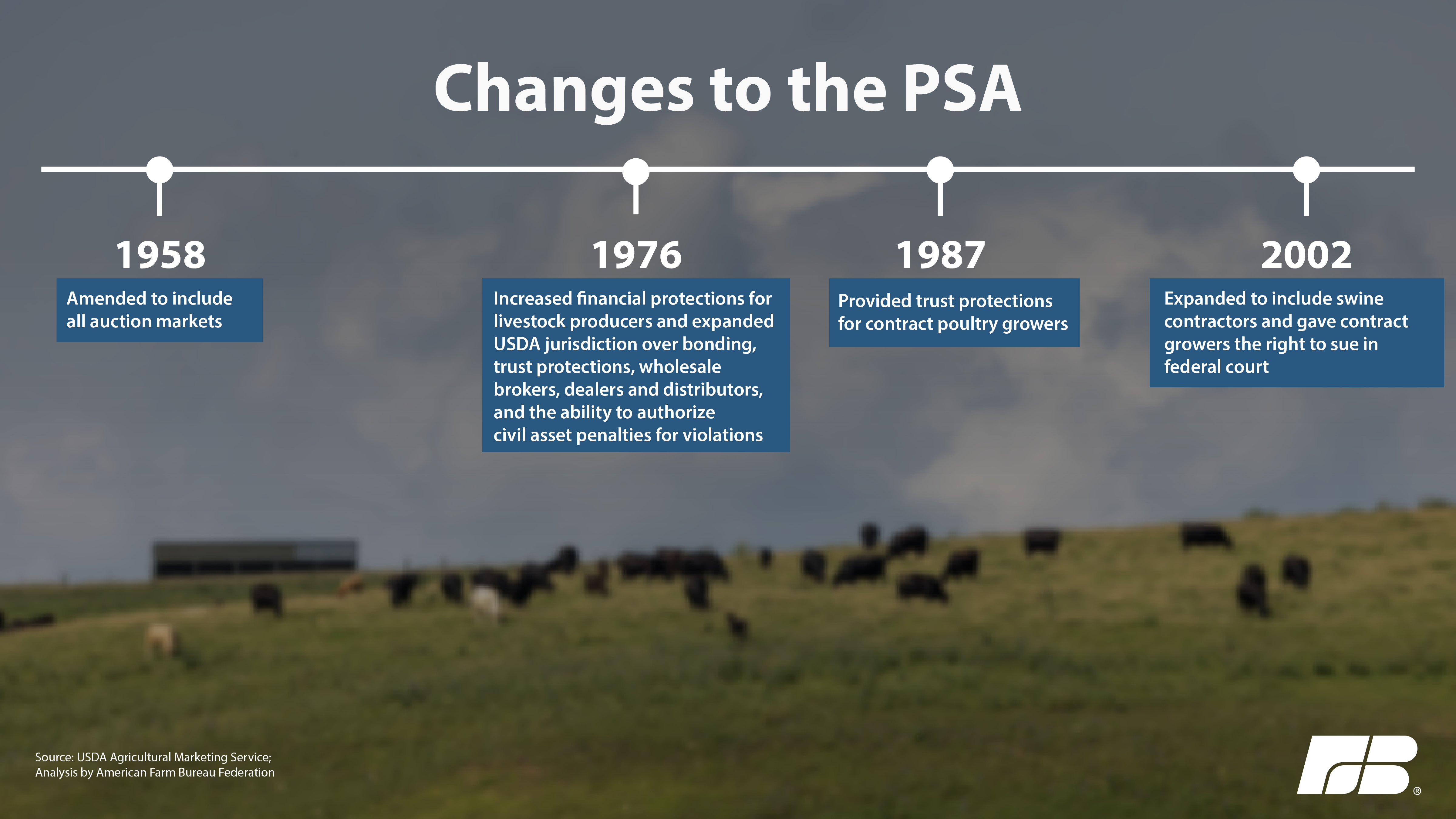
Over the last 105 years, the PSA has changed several times to adapt to changes in livestock production and marketing. The last meaningful changes to the PSA came in 2002, and since then, there have been multiple attempts to make changes through congressional appropriation and authorization authorities.
2008 Farm Bill
The 2008 farm bill expanded the PSA by adding provisions specific to swine and poultry growers. Several key provisions of this expansion were:
- A contract poultry grower or swine producer can cancel a contract within three days of the contract being executed;
- Integrators must provide growers information about facility upgrades (capital investment disclosures);
- Contract disputes must be carried out in the U.S. District Court where the alleged dispute occurred; and
- USDA was directed to enact regulations to establish criteria the secretary will consider in determining undue or unreasonable preference; reasonable notice to poultry growers of any suspension or delivery of birds under the contract; when a requirement of additional capital investments constitutes a violation of the act; and if a reasonable amount of time has been given for a producer or grower to remedy a breach of contract.
2010 Rulemaking
USDA’s subsequent proposed rule, released in 2010, was broadly opposed by industry stakeholders, including the National Cattlemen’s Beef Association, National Chicken Council,National Turkey Federation, National Pork Producers Council and the American Meat Institute. AFBF’s filed comments were neutral given the ambiguity surrounding several provisions dealing with undue or unreasonable preferences.
Parts of the rule were finalized in December 2011 with an effective date of Feb. 7, 2012. Due to industry pushback, Congress stepped in and defunded the most contentious parts of the rule regarding unfair or undue preferences in fiscal years 2012 through 2015.
Both the Obama and Trump administrations proposed new rules that were rescinded by their successors in the White House.
USDA Rulemaking and Congressional Actions 2021-2025
In 2021, President Biden signed an executive order launching a whole-of-government approach to promoting competition and reducing consolidation in the American economy. As part of the executive order implementation, USDA proposed and finalized three rules to promote fairness, transparency and competition within the livestock sector. Two of the three rules were specific to broiler production, while the third rule on market integrity is applicable to all species, e.g., cattle, hogs and poultry.
USDA withdrew a proposed fourth rule to address competition and unfair practices in the marketplace, or “harm to competition.”
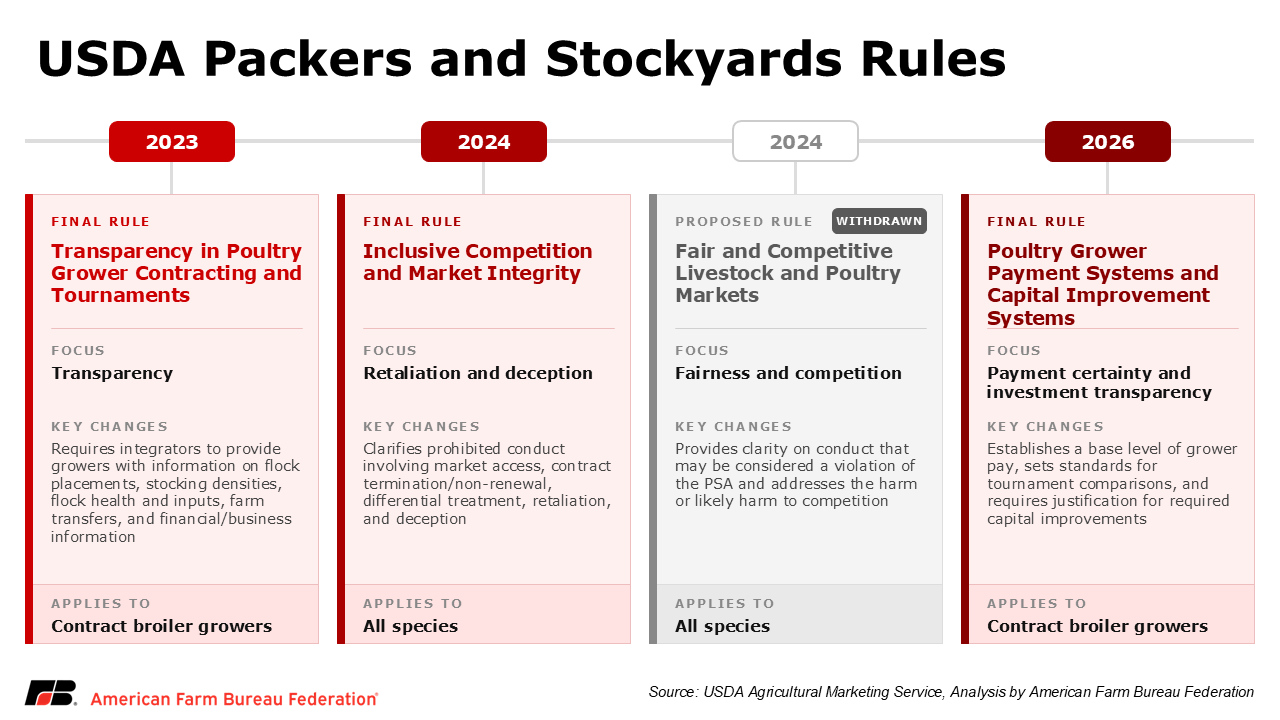
Attempts to defund these rules through the appropriations process in fiscal years 2023 through 2026 failed to result in any meaningful changes to USDA implementing and enforcing them..
However, in March 2026, USDA issued a proposed rule to delay the implementation date of the Poultry Grower & Capital Improvement Systems final rule from July 1, 2026, to Dec. 31, 2027. AFBF submitted comments in opposition.
Executive Order
On Sept. 4, 2026, President Trump issued Executive Order 14424 directing the secretary of agriculture to do a comprehensive policy and regulatory review and report within 60 days on “current enforcement actions, resources needs, and a plan for heightened enforcement for the coming year” and a “review of existing regulations, guidance, and enforcement policies under the Act, as appropriate and consistent with applicable law, revise them to strengthen protections for producers and ensure effective deterrence of prohibited conduct.”
The executive order was carefully crafted to give the maximum amount of regulatory flexibility to USDA to revise or terminate these regulations. This is due in part to Executive Order 14192. Signed by the president on Jan. 31, 2025, the order states that any time an agency “publicly proposes for notice and comment or otherwise promulgates a new regulation, it shall identify at least 10 existing regulations to be repealed.”
In July, USDA updated its Agency Rule List for 2026 to include rescissions of the three finalized PSA rules. By signing the executive order, the president sent a signal to the secretary of agriculture that necessary and needed reforms to the PSA are not an administration priority, a concern for Farm Bureau because of the increased regulatory and market uncertainty it creates for farmers and ranchers who are already up against so many challenges.
- USDA/AMS—Proposed Rule Stage—Inclusive Competition and Market Integrity under the Packers and Stockyards Act – Rescission (AMS-FTPP-25-0014)
- USDA/AMS—Proposed Rule Stage—Transparency in Poultry Grower Contracting and Tournaments – Rescission (AMS-FTPP-25-0015)
- USDA/AMS—Proposed Rule Stage Poultry Grower Payment Systems and Capital Improvement Systems – Rescission (AMS-FTPP-22-0046)
Conclusion
More than 100 years in, the Packers and Stockyards Act requires periodic changes to protect farmers and ranchers from unfair and anti-competitive practices in the marketplace as marketing practices for livestock change over time.
The repeal of recent Packers and Stockyards Act regulations creates policy uncertainty and continues the regulatory back and forth that hinders the promotion of fair competition in the livestock industry.