Farm Labor Bill Answers Agriculture’s Call for Reform

John Walt Boatright
Director, Government Affairs
KEY TAKEAWAYS:
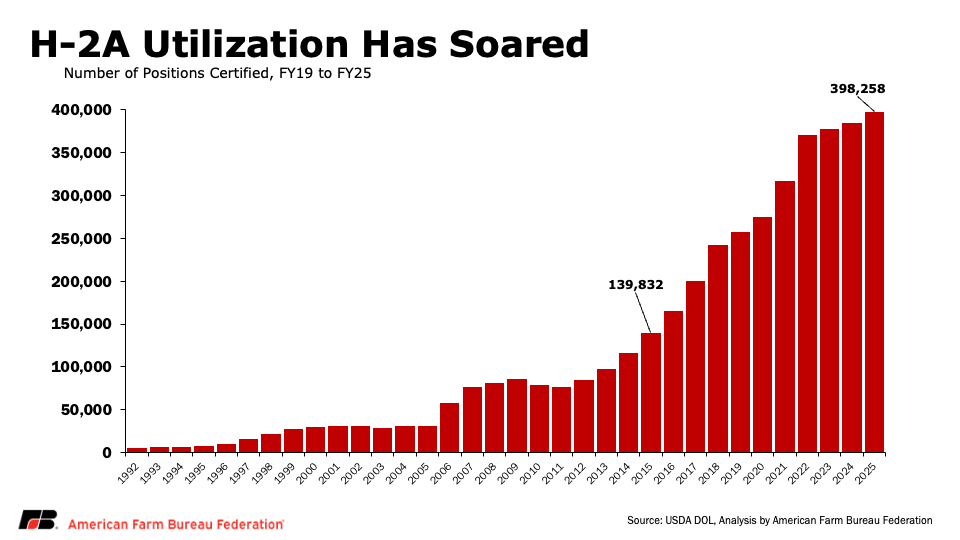
- Despite barriers to using the H-2A temporary agricultural visa program, farmers are increasingly turning to the program to meet their labor needs. In fiscal year 2026, H-2A use is already up 17% in volume, as fewer than 0.07% of those jobs received a domestic applicant.
- Rep. G.T. Thompson’s Securing Agriculture’s Workforce Act (SAWA) makes important strides in controlling unpredictable labor-related costs, modernizing an antiquated visa program, and enhancing access for agricultural sectors that previously could not participate in the program, like dairy.
Agriculture’s Labor Challenges
2026 is a year of important milestones for our country. Nearly all Americans will leave Fourth of July weekend with fresh memories of the America 250 celebrations. Many fewer will recognize that it has been 40 years since lawmakers last reformed our agricultural labor and immigration programs via the Immigration Reform and Control Act of 1986.
Why does that matter? For one, it was the last time Congress passed farm labor reforms into law, despite multiple attempts. It is also a reminder that farmers have been struggling with labor shortages for decades with little relief from policymakers.
Securing Agriculture’s Workforce Act
Enter Glenn “G.T.” Thompson, a nine-term Pennsylvania congressman and current chairman of the House Agriculture Committee. In 2023, he appointed a bipartisan group of lawmakers to deliberate and deliver solutions for the primary guestworker program for U.S. agriculture – the H-2A program. This group met with a broad cross-section of stakeholders, including farmers and ranchers who struggle to secure a reliable workforce regardless of commodity or region. The product of that work serves as the foundation for his newly introduced Securing Agriculture’s Workforce Act (SAWA).
The proposal centers on three key H-2A reform: controlling costs, improving access, and modernizing and streamlining the program.
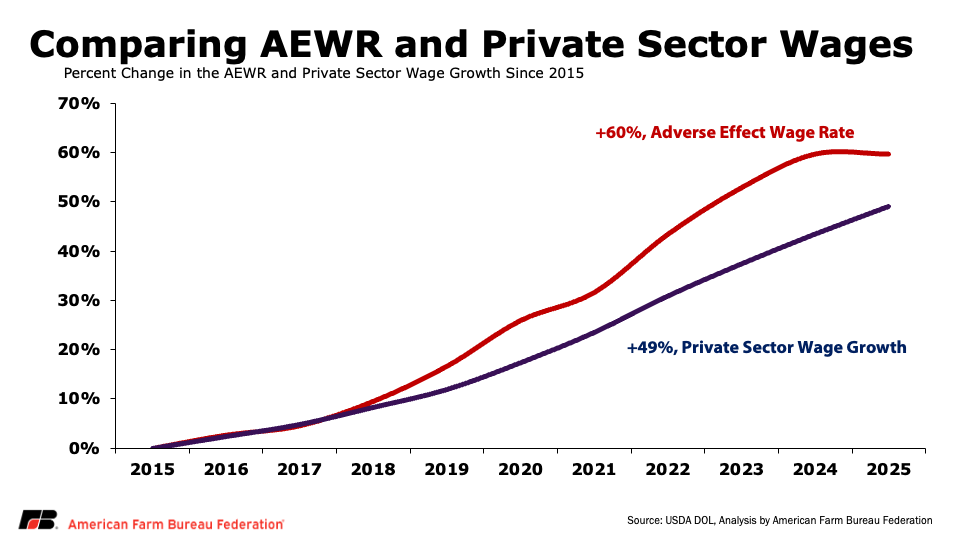
The costs of using the program are significant. Employers are required by law to pay housing, transportation and mandatory wage costs for H-2A employees, as well as cover the administrative costs of the program. The Adverse Effect Wage Rate (AEWR), the minimum hourly wage rate H-2A employees must be paid, has been the major and unpredictable cost driver for farmers. In the past decade alone, the AEWR has easily outpaced private sector wage growth, with the AEWR rising by 60% compared to a 49% increase in private sector wage growth. However, unlike most in the private sector, farmers cannot pay for increased labor costs by raising their prices; they are price takers not price makers.
SAWA restructures a flawed methodology by adopting reforms by the U.S. Department of Labor following the welcome discontinuation of the USDA Farm Labor Survey. The new rule also recognizes the extensive nonwage costs associated with the program and factors those costs in into the final AEWR determination. Along with codifying the Trump administration’s October 2025 AEWR reforms, which will save farmers hundreds of millions of dollars in inflated costs, SAWA adds sensible reforms to by capping year-over-year growth and eliminating mid-contract changes, thereby limiting the unpredictability that has long plagued the program.
The involvement of three Cabinet-level departments (Labor, Homeland Security, State) and various state agencies that poorly communicate with each other and the employers and employees they serve has long undermined the program’s efficiency. For example, delays, backlogs and other inefficiencies have become too common in the petitioning process, which results in lost time on the farm and reduced productivity, which hurts a farm’s preparedness and economic sustainability.
SAWA directs the agencies to create an online platform as a single point of access for growers and reinstitutes the in-person interview waiver for returning H-2A workers who have a proven history of vetting and reliability. Importantly, SAWA also designates H-2A workers as essential, which will keep government funding disruptions from halting the program’s functionality.
The current H-2A program only provides farmers with a seasonal and temporary workforce. This limited eligibility prevents the many sectors in production agriculture with year-round – and sometimes even hourly – labor needs from using the program. These sectors include, but are not limited to, operations like dairies with consistent milking needs, horticultural operations with plants at various stages, and livestock operations with varying animal husbandry needs.
SAWA strikes the seasonal requirement and clarifies the temporary designation for workers just under a year’s length. And the legislation ensures that many previously precluded sectors will be eligible for H-2A workers, including dairy and livestock occupations. Coupled with additional reforms, SAWA provides a long-desired option for farmers with year-round needs to secure a labor force where domestic interest in this work is absent.
The Time to Address Agricultural Labor Shortages is Now
Our agricultural workforce challenges are complex, multi-factored, and often misunderstood. Federal policymakers should seek to understand the labor needs of family farms and the direct implications for U.S. competitiveness in the global landscape. Struggling with this persistent and defining problem for decades, so many family farms – nearly 200,000 in the past decade, in fact – have closed down.
With the farm economy currently underwater in so many areas, Congress has an obligation to get the Securing Agriculture’s Workforce Act on the president’s desk. For the sake of family farm sustainability and national security, Farm Bureau urges lawmakers to pass this critical legislation as soon as possible.
AFBF Policy Supports:
- A visa program that is open to all segments of agriculture and flexible enough to provide for the differing needs of farmers and ranchers, including seasonal and year-round employers;
- A wage methodology that would cap year-over-year increases and is based on sound data.
- A visa program that is simplified and cost-competitive.