Time to Finish the Job: 2026 Farm Bill

Brian Glenn
Director, Government Affairs
Addy Donelson
Former AFBF Government Affairs Intern
Key Takeaways:
- The Senate Agriculture Committee's farm bill, the Agricultural Act of 2026, modernizes essential farm programs, authorizes year-round sales of E15 to strengthen markets for American agriculture, and includes measures to help reduce input cost volatility. As farmers and ranchers navigate one of the most challenging farm economies in a generation, this legislation provides much-needed certainty and support. The Senate Agriculture Committee should advance the bill in a bipartisan manner.
The farm bill is one of the most significant pieces of legislation affecting food and agriculture. While Congress reauthorizes the legislation every five years, the 2018 farm bill has been extended three times, and the current extension will expire on Sept. 30, 2026.
Through reconciliation in H.R. 1, the farm safety net and some conservation and research programs typically addressed in a farm bill received significant investment. Farmers and ranchers are thankful for the investments in risk management programs that will be felt on the farm this fall. However, hundreds of programs still must be updated in a full, 12-title farm bill. As farmers navigate one of the most challenging farm economies in a generation, they need the certainty that comes with a modern, comprehensive farm bill.
The Road to a New Farm Bill
In the 118th Congress, the House Agriculture Committee advanced the Farm, Food, and National Security Act of 2024 out of committee, but it was not taken up on the House floor. The Senate Agriculture Committee also released legislative text but did not hold a markup to consider it. In this current 119th Congress, Chairman G.T. Thompson released the Farm, Food, and National Security Act of 2026, which passed the House floor on a bipartisan vote of 224-200, marking the first time a farm bill passed the House floor since 2018.
Sen. John Boozman (R-Ark.), chairman of the Senate Agriculture Committee, released updated text on July 31 for his farm bill.
Aug. 6 Senate Ag Committee Farm Bill Markup
On Aug. 6, the Senate Ag Committee held a markup of the Agricultural Act of 2026, but the bill failed to advance. Various amendments were debated, voted on, and agreed to throughout the markup. A bipartisan en bloc package including 34 amendments was agreed to favorably via voice vote. These amendments included several Farm Bureau priorities of, including transferring the Food for Peace Program from the Department of State to USDA. Several standalone amendment votes were taken, including a favorable 17-6 vote for Leader Thune’s amendment to require USDA and USTR to determine a path forward to re-establish mandatory country of origin labeling requirements for beef in a manner compliant with the U.S.’s obligations under the World Trade Organization. Despite the bipartisan amendment process, the bill failed to advance out of committee during this markup due to partisan gridlock over the Supplemental Nutrition Assistance Program (SNAP) state cost share. Chairman Boozman recessed the committee allowing him to bring the members back to consider the legislation when the Senate is back in session in September.
The Time is Now for a 5-Year Farm Bill
Farm Bureau believes Chairman Boozman’s farm bill includes important support for farm families across the country, and the Senate Agriculture Committee should quickly advance this bill out of markup in a bipartisan manner. Farm Bureau is also calling on Congress to address priorities that are not currently included in the draft: protecting interstate commerce from a patchwork of state laws and providing economic assistance to farmers facing historic production costs and financial losses.
Agriculture is important to the nation's economy, energy security, environment, and national security, and must be treated as a strategic national resource in policy at every level. A comprehensive five-year bill is essential to providing certainty for farmers and ranchers, strengthening rural communities, and protecting the nation's food and agricultural security.
Below is an overview of key provisions within each title of the current Senate Agriculture Committee farm bill (note: this does not include amendments debated during the Aug. 6 markup). AFBF grassroots policy is also included below for reference.
Title I: Commodities
Strengthens assistance for producers:
- Upfront Tree Assistance Program payments for orchardists/nursery growers to plant alternative varieties, planting densities, and locations.
- A sales-based framework for timely assistance to specialty crop producers during market disruptions or economic crises.
- State block grants for uncovered livestock, poultry, crop, and tree disaster losses.
Supports a robust farm safety net:
- Continues marketing assistance and sugar loans during funding lapses.
- Reauthorization of key dairy programs through 2031, including the Dairy Forward Pricing Program, Dairy Indemnity Payment Program, and Dairy Promotion and Research Board.
- Codifies dairy processing cost reporting.
Improves producer flexibility and risk management for elevated input costs:
- Expands storage facility loans for propane, fertilizer, and related equipment.
- USDA evaluation of new safety net options for dry bean producers.
Title II: Conservation
Strengthens conservation programs:
- Reauthorizes the Conservation Reserve Program with reformed rental rates targeting marginal land.
- Drought-related updates across conservation programs.
Enhances land conservation efforts:
- Creates new programs supporting forest land and state/local conservation initiatives.
- Improves easement administration to protect working farms, grasslands, and wetlands.
Improves program delivery for farmers:
- Streamlines Technical Service Provider certification for broader access to conservation planning.
Title III: Trade
Helps expand markets for American farmers:
- Builds on H.R. 1 export promotion investments by directing the new funding to the Market Access program and the Foreign Market Development program.
Supports international food assistance efforts:
- Bolsters U.S. agricultural products through reauthorization and support of international food assistance efforts such as the McGovern-Dole Food for Education Program, Food for Progress, and the Bill Emerson Humanitarian Trust.
- Addresses trade barriers
- Prioritizes the protection of common food names in foreign markets and strengthens USDA’s support for specialty crop exports.
Title IV: Nutrition
Expands access to U.S. farm products:
- Reinforces buy American requirements, allows all forms of fruits and vegetables to be purchased by low-income families, enhances dairy incentives for SNAP purchases, and bolsters the commodity distribution program.
- Supports science-based dietary guideline review.
Strengthens local and regional food systems:
- Creates a USDA-state cooperative agreement program to boost local food purchasing.
Supports SNAP program integrity:
- 1-year delay in implementation of the SNAP state benefit cost-share passed in H.R. 1.
- Makes SNAP online purchasing permanent and supports enhanced cybersecurity efforts to prevent fraud.
- Supports staffing for SNAP administration.
Title V: Credit
Expands access to agricultural credit:
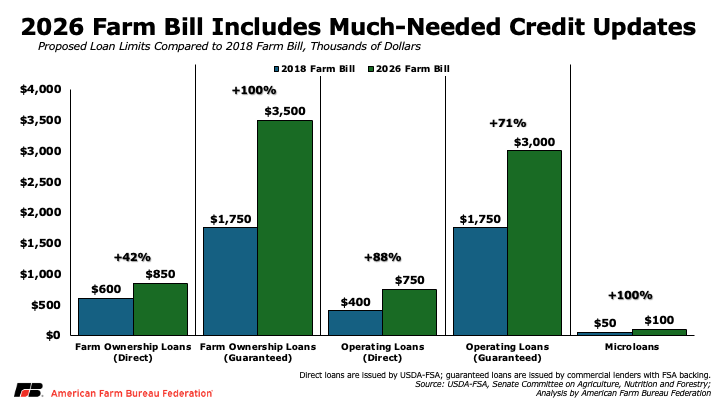
- Increases Farm Service Agency direct and guaranteed loan limits.
- Updates the guaranteed ownership loan inflation benchmark to reflect current land values.
- Improves financing for farmers, exporters, and commercial fishing operations.
Strengthens support for farmers:
- Makes it easier for beginning and distressed farmers to access financing.
- Expands the USDA Conservation Loan Program for precision agriculture equipment.
Modernizes rural lending:
- Accelerates USDA loan delivery.
- Allows Farm Credit institutions to partner with community lenders on rural and Tribal facility financing, including childcare, healthcare, and public safety.
Title VI: Rural Development
Expands rural broadband access:
- Codifies the ReConnect broadband program and prioritizes underserved areas to improve broadband speeds and expand connectivity for farms and ranches to support precision agriculture.
Strengthens rural communities and local economies:
- Increases support for rural healthcare, childcare, small meat and poultry processors, and rural entrepreneurs.
Invests in essential rural infrastructure:
- Improves drinking water and wastewater systems, emergency preparedness, and cybersecurity for rural water systems.
Title VII: Research
Strengthens agricultural research and innovation:
- Invests in specialty crop mechanization and automation research.
- Reauthorizes key USDA research programs like the Agriculture and Food Research Initiative (AFRI) and the Advanced Research and Development Authority (AgARDA).
- Advances research on emerging pests, diseases, aquaculture, and animal health.
Invests in the future agricultural workforce:
- Expands workforce training grants and supports community/junior colleges and 1890 land-grant institutions.
Increases services for farmers and rural communities:
- Expands resources for the Farm and Ranch Stress Assistance Network to improve access to mental health services.
Title VIII: Forestry
Improves forest management and wildfire resilience:
- Expands active forest management tools, streamlines environmental reviews, and updates forest restoration and watershed protection programs.
Modernizes forestry programs:
- Enhances forest inventory/data collection and wood innovation initiatives.
- Updates policies to better support sustainable forest management and the use of wood products.
Strengthens conservation and public land stewardship:
- Extends key restoration programs and strengthens state, local, and Tribal partnerships.
Title IX: Energy
Strengthens the bioeconomy and domestic manufacturing:
- Expands the BioPreferred program.
- Improves federal purchasing of biobased products and supports biorefineries.
Supports renewable energy in rural America:
- Improves the Rural Energy for America Program (REAP) with simplified applications and expanded technical assistance.
Accelerates biofuel and biobased innovation:
- Supports development and prioritization of sustainable aviation fuel as an important fuel and market for farmers.
Title X: Horticulture
Strengthens support for specialty crops and local markets:
- Reauthorizes market development and food safety programs.
- Maintains Local Agriculture Market Program (LAMP) funding while expanding food hub eligibility.
- Eliminates Specialty Crop Block Grant matching requirements and requires states to consult with producers when setting funding priorities.
Advances agricultural innovation:
- Expands support for urban and emerging agriculture through grants, technical assistance, and expanded access to USDA programs.
- Studies biostimulants as a tool to help support plant growth and inform a clearer federal regulatory framework.
- Establishes a USDA Office of Biotechnology Policy to coordinate biotechnology initiatives.
Improves science-based regulation and program integrity:
- Strengthens EPA-USDA pesticide regulation coordination and supports EPA’s robust risk-based registration review requirements.
- Modernizes organic oversight and inspections.
- Increases National Organic Program authorized funding and improves traceability for imported organic products.
Title XI: Crop Insurance
Strengthens risk management tools for specialty crop producers:
- Establishes a Specialty Crop Advisory Committee for greater Federal Crop Insurance Corporation (FCIC) board representation.
Expands and improves crop insurance:
- Enhances coverage for revenue losses beyond natural disasters.
- Increases premium support for veteran farmers and ranchers.
Modernizes agricultural risk management:
- Updates FCIC governance to better reflect the breadth of agriculture.
- Directs USDA to develop new risk management tools for livestock and crop commodities including lamb and oilseeds.
Title XII: Miscellaneous
Delivers year-round E15:
- Permanently authorizes nationwide year-round sales of E15 and includes small refinery exemption reform to provide long-term regulatory certainty.
Supports animal disease preparedness and response programs:
- Expands animal disease prevention and traceability funding, surveillance, biosecurity, and vaccine stockpiles.
- Advances livestock health programs like the National Poultry Improvement Plan and U.S. Swine Health Improvement Plan.
Supports livestock, poultry, and seafood producers:
- Supports small meat and poultry processors with scale-appropriate food safety guidance.
Improves agricultural security and market transparency:
- Modernizes foreign ownership reporting requirements for U.S. agricultural land by extending reporting to leases.
- Creates a crop input economist position at USDA with responsibility for reporting on prices, supply and demand, trade flows, and supply-chain risks across crop inputs.
- Creates a mandatory price reporting system for fertilizer.
Bottom Line
The Senate Agriculture Committee's farm bill is strong legislation that delivers much-needed certainty and support for America’s farmers and ranchers. We urge Senate Agriculture Committee members to advance the bill out of committee in a bipartisan manner and send it to the full Senate for consideration. Congress must still address remaining priorities not currently in this farm bill draft, including protecting interstate commerce from a patchwork of state laws and providing economic assistance to producers facing record-high production expenses and historic inflation. Together, these actions will strengthen the farm economy, support rural communities, and reinforce agriculture's role in the nation's food, energy, and national security.
AFBF Policy Supports:
- Strong, timely, and accessible risk management tools for farmers and ranchers during times of market disruption or natural disaster to support financial stability for producers.
- Conservation and environmental policies that balance agricultural productivity with natural resource stewardship through science-based, voluntary, and market-oriented approaches that respect private property rights and ensure timely program delivery and technical assistance for farmers and ranchers.
- U.S. policies that strengthen global food security and economic development by leveraging American agriculture and American-grown products, expanding market opportunities, and ensuring international policies protect the interests of U.S. farmers and ranchers.
- Science-based nutrition policies and food assistance programs that expand access to wholesome agricultural products, strengthen nutrition research and education, recognize the nutritional value of dairy and other farm products, and reduce food insecurity while creating new market opportunities for America's farmers and ranchers.
- Modernizing USDA farm loan programs by streamlining the application process, ensuring loan limits keep pace with rising production costs, and prioritizing access to credit for young, beginning, and financially distressed farmers and ranchers.
- Strengthening local economies by expanding processing and marketing opportunities, prioritizing broadband deployment in underserved communities, increasing access to essential services such as childcare, and updating infrastructure in rural communities.
- Strong, sustained investments in agricultural research, Extension, and education through public-private partnerships and coordinated federal, state, and university efforts to advance innovation, strengthen U.S. agricultural competitiveness, and deliver science-based solutions that benefit farmers, ranchers, and consumers.
- Sustainable forest management practices that recognize forestry as a valuable renewable resource and promote healthy, resilient forests through science-based management tools on both public and private forests.
- Programs and policies that strengthen the nation’s energy security and rural economies and support expanded markets for American-grown products.
- Expanding market opportunities for specialty crop producers, recognizing the growing role of urban agriculture, supporting a strong and credible USDA organic accreditation system, and promoting science-based collaboration between USDA and EPA on pesticide regulation.
- Robust crop insurance programs and the expansion of insured commodities to include specialty crops.
- Strengthening animal health preparedness strategies for potential outbreaks of animal disease, expanding local and regional processing capacity and market opportunities for producers, and enhancing the security and resilience of the nation's food and agricultural system across the whole government.