USMCA: Reviewing the Backbone of North American Agriculture Trade

Virginia Houston
Managing Director, Government Affairs
Key Takeaways
- Canada and Mexico are two of the largest markets for U.S. agriculture, making USMCA critical for farmers and ranchers.
- Needed improvements include ensuring Canada delivers the dairy market access negotiated in the original USMCA and providing for a rapid response mechanism when additional issues arise.
- The stability provided by guaranteed cross-border market access is vitally important at a time when American agriculture faces strong headwinds.
Under Review: USMCA
In 2020, the U.S.-Mexico-Canada Agreement (USMCA) entered into force, replacing the North American Free Trade Agreement, or NAFTA. In President Trump’s first term in office, he prioritized improving trade relationships for the United States. As part of his overall trade agenda, he directed former United States Trade Representative (USTR) Robert Lighthizer to work with Mexico and Canada to bring NAFTA into the 21st century.
In addition to including important provisions maintaining guaranteed duty-free market access for agricultural products, improved sanitary -and phytosanitary (SPS) clauses, and enhanced dispute settlement mechanisms, the final agreement included something never seen in a U.S. free trade agreement.
Article 34.7 of the USMCA – the “Review and Term Extension” clause – includes language stipulating that unless agreed to continue by all three countries, the USMCA will terminate 16 years after entry into force – July 1, 2036. Article 34.7 already includes language directing the three countries to come together to review the agreement and confirm in writing if they wish to extend the agreement for a full 16-year term.
The Importance of July 1, 2026
After two rounds of bilateral negotiations with Mexico, and a trilateral virtual discussion with all three countries, on July 1, Ambassador Jamieson Greer from USTR issued a statement concerning the renewal status of the USMCA. While a renewal was not agreed to, for farmers, ranchers and agribusinesses dependent on these trade relationships, it’s important to acknowledge that the USMCA will continue while the agreement falls into an annual review process.
A Trilateral Partnership
Trade wonks around North America have had July 1, 2026, circled on calendars since 2020. This is uncharted territory in trade policy; traditionally, free trade agreements were signed with the idea that they would live on in perpetuity. However, we have seen President Trump use both his terms at the White House to rethink global trade relationships and use outside-the-box and creative ideas to achieve his trade priorities, including utilizing authorities such as Section 301 to bring about the U.S.-China Phase One Agreement. He also expanded market access in Japan for U.S. agriculture products during both his first and second terms in office, and full implementation of the Turnberry Agreement between the U.S. and European Union holds the potential to expand the European market to additional U.S. commodities.
While there have been varying statements about the importance of the USMCA, the fact of the matter is simple - for U.S. agriculture, the trilateral trading relationship between the U.S., Canada, and Mexico is critical. Since NAFTA entered into force, annual agricultural exports to those two countries from the U.S. grew from $8.9 billion in 1993 to nearly $60 billion in 2024.
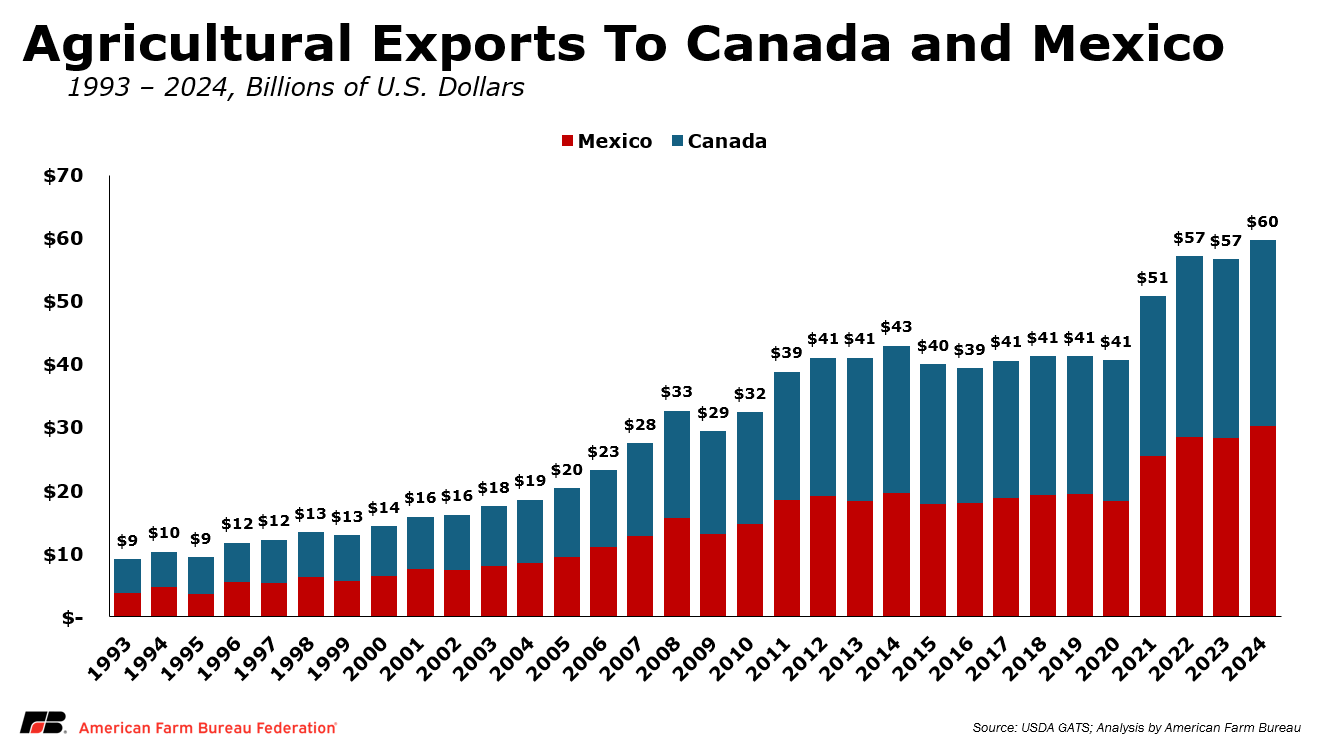
Major commodities such as corn, pork, dairy and poultry count Mexico as their largest export destination. For other commodities, such as soybeans, Mexico is their second-largest export market (behind China).
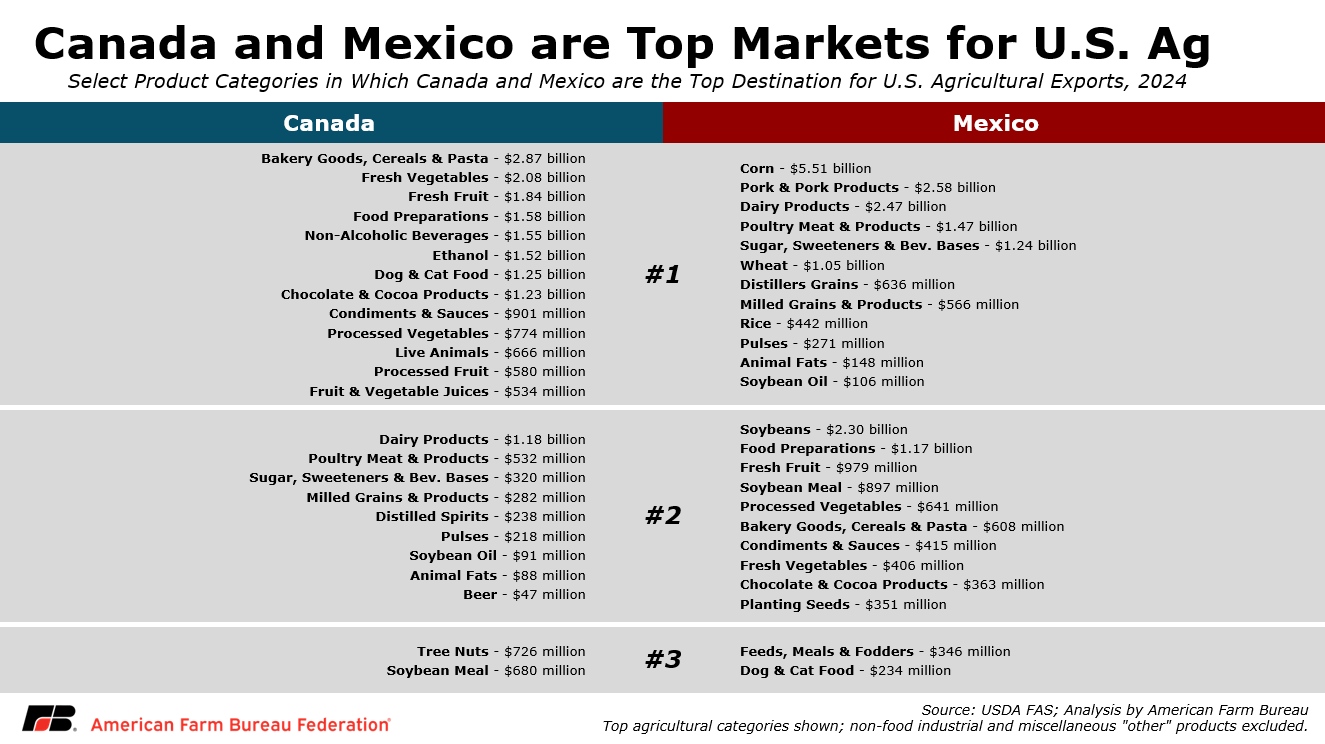
The importance of the Canadian market should not be overlooked. After Mexico, Canada represents the second-largest trading partner for U.S. agriculture and is the largest export market for U.S. forestry products, fresh fruits and vegetables, and ethanol. That relationship has existed since the Canada-U.S. Free Trade Agreement was implemented in the late 1980s (later replaced by the trilateral NAFTA).
Due to the USMCA, many goods will cross a North American border multiple times along the supply chain. As an example, Canada exports live hogs to the U.S. for finishing and processing. That pork is then returned to Canada as ham and other premium pork products, highlighting the importance of the integration of North American supply chains, and the jobs and economic boost they provide along the way. This scenario is repeated in a variety of other agricultural sectors, including beef and dairy.
U.S. agriculture also relies on imports from both countries. Canada is the world’s largest producer of potash, a critical mineral necessary for both plant and animal health. Potash is an important component of fertilizer application for U.S. farmers, and we are heavily reliant on imports to meet that demand. On average, Canadian potash accounts for 85% of the potash imports into the U.S. And for your weekend festivities, Mexico is a major exporter of both distilled spirits and beer for thirsty U.S. consumers.
When the USMCA entered into force in 2020, it was widely praised as a much-needed modernization of NAFTA. Six years later, while the agreement is still pivotal for the long-term success and stability of the rural economy, there are additional improvements that can be made to address lingering trade irritants. Canada’s administration of its tariff rate quota (TRQ) for dairy, as an example, favors Canadian processors above retailers and importers. This administrative system results in U.S. dairy maintaining a smaller-than-intended portion of the TRQs across multiple dairy products.
While there remain concerns with imports of Mexican produce into the U.S. during key harvest periods, the USMCA also serves as an example of how trade disputes can be resolved within the confines of the agreement. In 2023, the U.S. successfully challenged Mexico’s presidential decree, which called for a phaseout of genetically engineered corn for human consumption. The U.S. filed a formal dispute under the USMCA dispute settlement chapter, and Canada supported the U.S.’s legal challenge. After multiple rounds of technical consultations, a dispute settlement panel found in favor of the U.S., and the decree was revoked as it was found to be counter to Mexico’s commitments under the USMCA. A functional dispute-settlement mechanism is critical to ensuring the tenants of a trade agreement are adhered to and can function as intended.
Review and Renew
The current non-renewal status of the USMCA for another 16 years creates a new wrinkle in the fabric of the American rural economy. There are more questions than answers about the future of the North American trilateral trade relationship, particularly when it comes to the ongoing and ever-evolving U.S. tariff landscape. While the administration seeks to replicate its global tariff scheme, it is heartening to see many of these new tariff orders continue to contain a carveout for USMCA-compliant goods, meaning products imported under the agreement are exempt from additional tariffs.
(It should be noted the Presidential Proclamations outlining potential new tariffs against Canada under Section 338 of the Trade Act of 1930 do not contain an exemption for USMCA-compliant goods. Should they come to pass, those tariffs would go into effect on Aug. 19, 2026).
America’s farmers and ranchers produce high-quality products that are in demand around the world, and robust trade agreements like the USMCA set a level playing field to expand markets and help boost the farm economy. U.S. farmers and ranchers are facing the toughest economy in a generation, making it even more important that we protect and expand market access to help ensure the economic sustainability of family farms and ranches. The USMCA has facilitated the flow of commerce among all three countries, at a cost savings to American farmers and ranchers. It is critically important that we take this opportunity to improve the agreement for the betterment of U.S. agriculture, but at the end of the day, the U.S. must renew the USMCA.
- AFBF policy supports a strong and equitable trading relationship with Mexico and Canada.