Completing the Job: The House Farm Bill Proposal

Daniel Munch
Former AFBF Economist
Faith Parum, Ph.D.
Deputy Chief Economist
Key Takeaways
- Farm bill provisions included in the One Big Beautiful Bill Act strengthened parts of the farm safety net, but reconciliation rules left major farm bill titles unfinished. The new Farm, Food, and National Security Act (FFNSA) text is designed to complete full reauthorization across conservation, rural development, research, trade, forestry, energy and specialty crop programs that have not yet been fully reauthorized.
- The proposal makes targeted “implementation” upgrades, not just funding changes, aimed at improving program access and delivery. Across conservation and rural development, FFNSA emphasizes flexibility, streamlined delivery and expanded technical support (e.g., precision ag eligibility and higher cost-share options, third-party technical assistance, updated broadband and water tools), which can reduce transaction costs and speed on-farm adoption.
- FFNSA contains consequential regulatory and market-structure provisions that go beyond budget items, including pesticide labeling uniformity and interstate commerce protections. These provisions are intended to reduce compliance fragmentation and litigation uncertainty while maintaining federal oversight.
The farm bill is the cornerstone of U.S. agriculture and food policy. Scheduled for renewal every five years, the legislation covers a broad range of programs addressing nearly every aspect of agriculture and rural life. The most recent farm bill was enacted in 2018 and has since been extended three times, with the current extension set to expire on Sept. 30, 2026.
In 2024, the House Agriculture Committee advanced the Farm, Food, and National Security Act of 2024 with bipartisan committee support, but the bill was never scheduled for a House floor vote. As farm bill negotiations stalled, Congress turned to budget reconciliation in 2025, using the One Big Beautiful Bill Act (OBBBA) to address major gaps in the farm safety net that fit reconciliation rules, delivering meaningful commodity policy updates, but leaving many non-budget items and full title-by-title reauthorization unfinished.
The House Agriculture Committee has now released updated legislative text for the Farm, Food, and National Security Act of 2026 with the goal of advancing the remaining provisions of the farm bill. In this Market Intel, we outline what’s included in the draft and what it could mean for farmers, ranchers and rural communities.
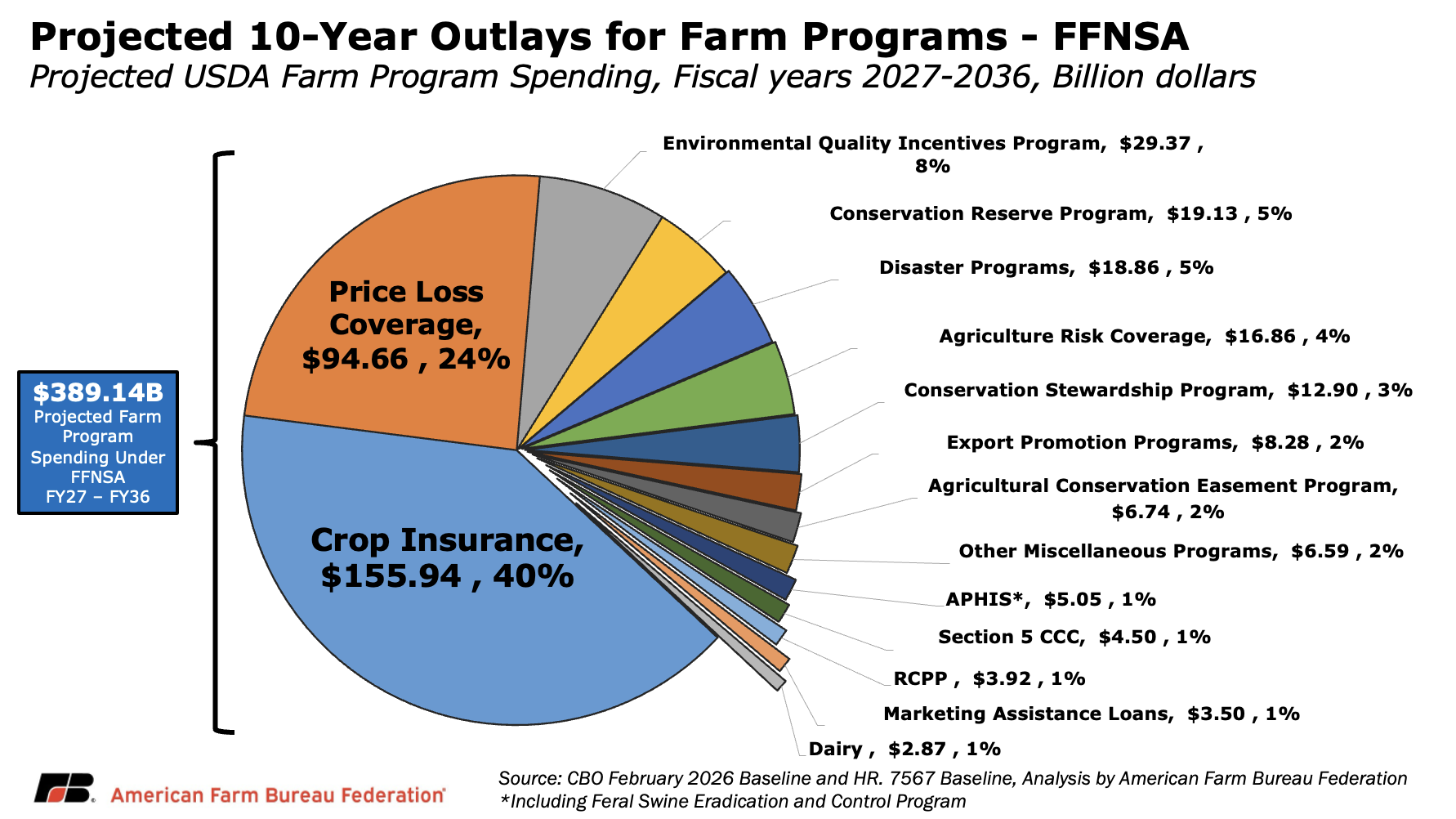
If Congress fails to enact a new farm bill or again extend the 2018 legislation, USDA would be forced to revert to permanent law, triggering commodity support based on outdated 1930s and 1940s price formulas. That could require government purchases or nonrecourse loans far above market value, creating severe market distortions and excessive federal spending. Meanwhile, modern crops such as soybeans, peanuts, sunflowers and canola have no support under permanent law and would lose their safety net entirely.
Congress temporarily avoided that outcome last year by including a one-year extension of the 2018 farm bill as part of the fiscal year 2026 continuing appropriations bill. That measure continued current program authorities through Sept. 30, 2026, including the long-standing suspension of permanent price support provisions. The FFNSA would extend that suspension through 2031.
In addition to extending the suspension of permanent law, the new Title I text includes several structural updates to commodity-related assistance. It modernizes the Tree Assistance Program by expanding eligibility and allowing advance payments, improving cash flow and reducing recovery delays for orchard and nursery operations after disaster losses. It establishes a standing Specialty Crop Emergency Assistance Framework, providing a more predictable, sales-based approach to disaster and market disruption aid for higher-value specialty producers. The bill also creates permanent block grant authority for future supplemental disaster assistance, allowing faster state-level deployment and reducing uncertainty around ad hoc relief.
On the dairy side, extensions of the Dairy Forward Pricing Program and related authorities improve risk management flexibility, while the new mandatory processing cost reporting framework institutionalizes regular cost data collection to improve transparency and confidence in federal milk pricing. Ensuring marketing and sugar loans continue during funding lapses protects short-term liquidity in times of fiscal disruption, and expanded storage facility loans help producers manage input volatility and post-harvest risk.
Title II: Conservation
Conservation programs are a core component of the modern farm bill, supporting environmental stewardship while providing producers with tools to manage risk and improve land productivity. Demand for these programs often far outpaces funding and availability, so updates to conservation programs are needed to improve access and flexibility. OBBBA took a measured approach to conservation programs. It secured increased long-term funding for the Environmental Quality Incentives Program (EQIP), Conservation Stewardship Program (CSP), and Agricultural Conservation Easement Program (ACEP) by rolling leftover Inflation Reduction Act (IRA) funds into the farm bill baseline through 2031. However, OBBBA did not reauthorize the broader conservation title and notably left out the Conservation Reserve Program (CRP).
The new FFNSA language fills that gap. The bill reauthorizes CRP through 2031, restoring continuity for producers considering multiyear land retirement decisions. It also modifies county acreage limitations by combining certain CRP and wetland caps into a single limit, giving USDA greater flexibility to allocate acres within counties and reducing technical enrollment constraints that previously limited participation. The Farmable Wetlands Program is likewise extended.
Working lands programs are strengthened beyond simple reauthorization. EQIP and CSP now explicitly incorporate precision agriculture practices and technology adoption, with cost-share rates of up to 90% for precision implementation. EQIP payment limits increase for fiscal years 2025–2031; CSP minimum payments rise to $4,000; and new five-year accrual periods reset participation limits. A new state soil health grant program is created within CSP. Advance payments are authorized under the Emergency Conservation Program, and the federal cost share for Watershed Protection and Flood Prevention rehabilitation projects increases to 90%, improving producer cash flow and disaster recovery capacity.
Easement, partnership and innovation authorities left unaddressed in OBBBA are restored through 2031, including Agricultural Land Easements and Wetland Reserve Easements within ACEP, the Regional Conservation Partnership Program, mitigation banking authorities, Conservation Innovation Grants under EQIP and watershed programs.
Additionally, the bill converts the Feral Swine Eradication and Control Pilot Program into a permanent program and authorizes $150 million for fiscal years 2025–2031. With feral hog damage to U.S. agriculture estimated at more than $1.6 billion annually, shifting from pilot status to long-term authority provides greater certainty, sustained funding and improved coordination for producers in heavily impacted states.
The legislation also reforms program delivery by expanding the use of third-party technical service providers, establishing clearer certification timelines and requiring periodic review of conservation practice standards. Collectively, these changes move beyond funding continuity to modernize implementation, improve access and strengthen conservation tools through 2031.
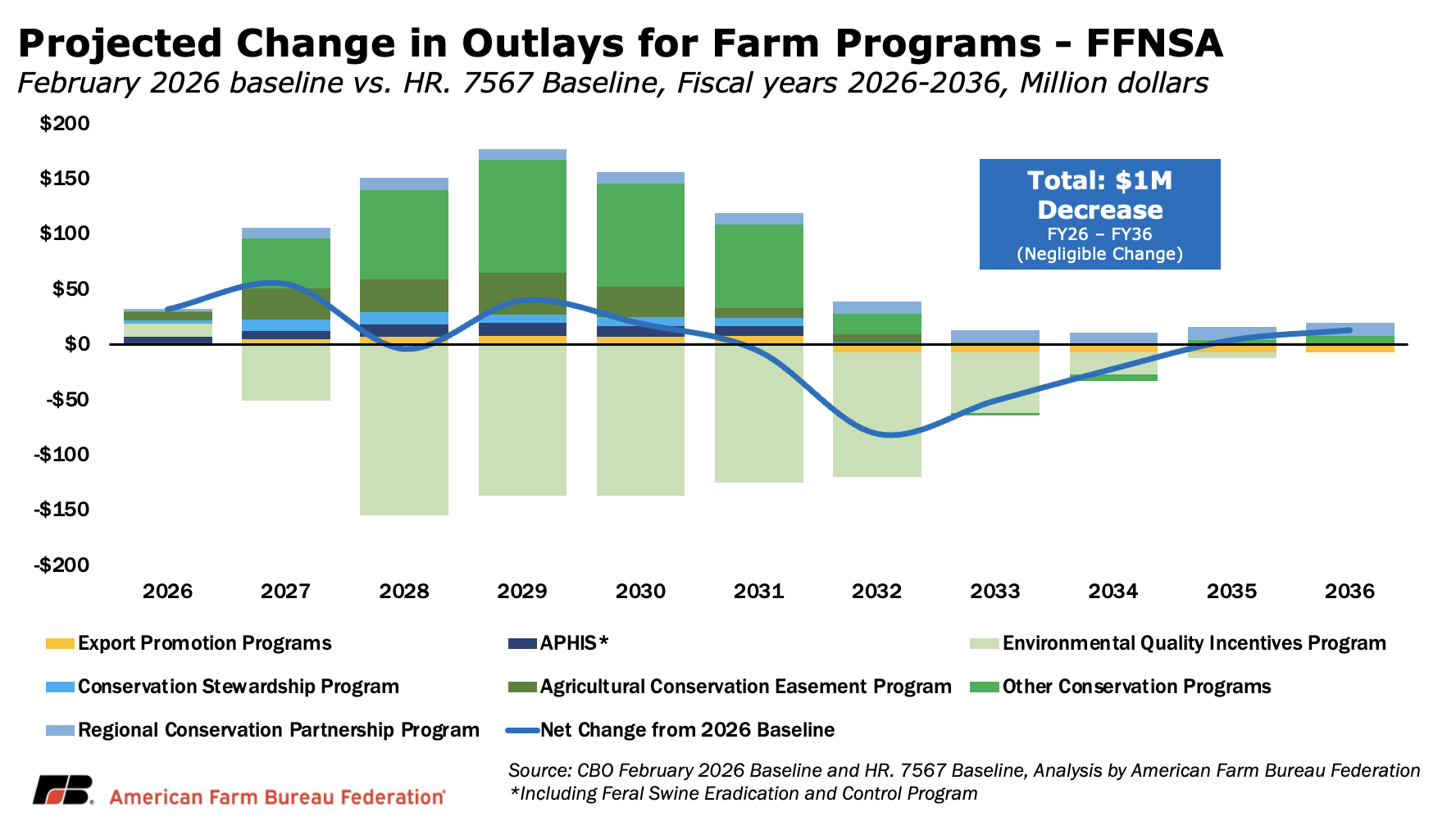
Comparing CBO’s February 2026 baseline to projected outlays under FFNSA shows conservation programs account for most of the scored adjustments over the 2026–2036 window. While EQIP outlays are lower relative to baseline in certain years, those shifts are largely offset by increases in CSP, ACEP and other conservation authorities, resulting in a net decrease of just $1 million over the decade — effectively flat relative to baseline.
Much of the movement occurs within “other conservation programs,” including watershed protection and flood prevention authorities, the Emergency Conservation Program and related restoration efforts, where outlays fluctuate based on project timing and disaster activity. The score reflects a rebalancing of conservation investments rather than a substantive funding cut, maintaining long-term support for working lands and watershed resilience.
OBBBA did not directly raise funding for USDA’s flagship Market Access Program (MAP) or Foreign Market Development program (FMD) due to reconciliation constraints. Instead, OBBBA created a new permanent “Agricultural Trade Promotion and Facilitation Program” with $285 million in mandatory funding per year starting in 2027. FFNSA builds on that structure by consolidating and directing those funds to effectively more than double baseline funding for MAP and FMD, while also doubling funding for the Technical Assistance for Specialty Crops and Emerging Markets Program. The bill further provides $5 million per year in mandatory funding to implement the FRIDGE Act (H.R. 2322), strengthening cold chain and logistics capacity in growth markets.
Beyond funding, FFNSA advances a broader trade and food aid agenda. The bill permanently transfers administration of the Food for Peace program to USDA, aligns humanitarian assistance more closely with U.S. agricultural production and requires that at least 50% of food aid be sourced from U.S.-grown commodities and shipped on U.S. vessels. It also reauthorizes other key international food assistance and market-building tools, including the Food for Progress Program, McGovern-Dole Food for Education Program and Bill Emerson Humanitarian Trust.
The legislation also directs USDA to protect common food names, such as “parmesan” and “bologna,” from unfair foreign restrictions and requires the U.S. Trade Representative to report biennially to Congress on major trade barriers facing specialty crop exports.
Title IV: Nutrition
Title IV continues the farm bill’s nutrition framework while layering in targeted updates to strengthen integrity, modernize delivery and reinforce connections between nutrition assistance and U.S. agriculture. Within the Supplemental Nutrition Assistance Program (SNAP), FFNSA includes a package of program-administration and oversight provisions and makes SNAP online purchasing authority permanent, reflecting how households increasingly access food in today’s retail marketplace.
Beyond SNAP, the bill extends and updates complementary nutrition and food distribution tools that support food security while expanding outlets for U.S. commodities. FFNSA reauthorizes USDA’s fresh fruit and vegetable purchases for schools and service institutions through 2031 and codifies stronger “Buy American” standards in school meals by requiring school food authorities to purchase at least 95% domestic products by AMS food purchase category, with limited exceptions for domestically unavailable foods and a prohibition on certain purchases from China or Russia.
It also reauthorizes and refines the Gus Schumacher Nutrition Incentive Program (GusNIP) by allowing more flexibility in persistent-poverty counties and prioritizing projects that increase year-round access, while expanding eligible incentives beyond fresh produce to all forms of fruits, vegetables and legumes.
Finally, FFNSA expands Dairy Nutrition Incentives Projects to include all forms of fluid milk and certain hard cheeses and increases the program’s authorization level, while establishing a new Local Farmers Feeding Our Communities cooperative agreement program and modestly increasing authorization for the Healthy Food Financing Initiative, steps intended to strengthen local/regional supply chains and improve healthy food access.
Title V: Credit
FFNSA includes an overhaul to USDA farm credit tools. Guaranteed operating loan limits would increase from roughly $2 million to $3 million, and guaranteed farm ownership loans from roughly $2 million to $3.5 million. Direct loan caps would rise from $400,000 to $750,000 for operating loans and from $600,000 to $850,000 for ownership loans, while microloans would double from $50,000 to $100,000. The bill updates the Down Payment Loan Program, streamlines the EZ Guarantee program, a fast-track option for small FSA-guaranteed loans, for quicker access to small loans, and reduces the experience requirements that have historically blocked new and beginning farmers from FSA credit.
Eligibility rules are modernized by reducing experience barriers for beginning farmers and easing entity restrictions to facilitate intergenerational land transfers. The Heirs Property Relending Program is reauthorized, the cooperative lending pilot continues, and the 50% loan target for beginning farmers is reaffirmed. The legislation also authorizes refinancing of certain guaranteed loans into direct loans, providing an additional tool for borrowers facing lender exits or interest rate stress.
Additional provisions strengthen Youth Loans, Tribal Loans, Conservation Loans and Indian Tribe Land Acquisition Loans, create a Beginning Farmer Individual Development Account pilot program, and update loan authorization levels and set-asides to better target underserved borrowers.
While OBBBA kept credit programs running, FFNSA modernizes loan limits, streamlines delivery and expands access tools, recognizing that affordable credit remains central to farm viability, transition planning and rural economic growth.
Title VI: Rural Development
Strong rural communities are essential to a strong farm economy. While the OBBBA farm bill provided relief in many areas, it left out important rural development programs that are administered through the Rural Utilities Service , Rural Housing Service,Business and Industry Loan Guarantees and Community Facilities Grants. FFNSA proposes to reauthorize and modernize these programs.
Importantly, the FFNSA boasts major improvements to rural broadband through the ReConnect Rural Broadband Program, which incorporated the ReConnect Program and Farm Bill Broadband Program. It raises eligibility thresholds from 25/3 Mbps to 50/25 Mbps and set higher buildout targets up to 500/250 Mbps, depending on project length. The proposal also reauthorizes key broadband initiatives including the Middle Mile and Community Connect. Additional provisions expand technical assistance, improve mapping and oversight, and protect against duplicative federal investments. The bill also codifies the Broadband Technical Assistance initiative to help local governments and cooperatives plan and manage broadband projects and required USDA to rely on improved FCC maps to verify eligibility, steps that enhance accountability and prevent overbuilding.
Beyond broadband, the legislation reauthorizes and updates rural water and wastewater infrastructure programs, circuit rider technical assistance and emergency water grants. Rural electric and energy loan authorities are extended, including provisions supporting grid modernization and infrastructure resilience. Business and Industry Loan Guarantee authorities are modernized to improve refinancing flexibility and access to capital for rural enterprises.
Community Facilities Grants and Loan Guarantees are reauthorized to support rural hospitals, public safety facilities and essential community infrastructure. The bill also reauthorizes the Distance Learning and Telemedicine program at $82 million per year, and includes provisions to support precision agriculture adoption through public-private partnerships on cybersecurity and interoperability.
Finally, FFNSA establishes the Expanding Childcare in Rural America Initiative to improve access to child care in rural communities and directs USDA to conduct a full quantitative and qualitative evaluation of funded projects, with findings reported to Congress.
Title VII: Research, Extension and Education
Despite OBBBA’s investments in agricultural research through reconciliation channels, FFNSA includes additional key reauthorizations and reforms across USDA’s research agencies and programs. OBBBA increased funding for the Specialty Crop Research Initiative (SCRI), while FFNSA reserves $30 million per year of SCRI funds for a new Specialty Crop Mechanization and Automation R&D program to assist with chronic farm labor shortages.
Importantly, FFNSA reauthorizes core USDA research authorities that OBBBA left untouched, including the Hatch Act for agricultural experiment stations and the Smith-Lever Act for cooperative Extensions. It also authorizes funding for programs like the Agriculture and Food Research Initiative (AFRI), Beginning Farmer and Rancher Development Program, the Agriculture Advanced Research and Development Authority (AgArda) designed to fund high-risk ag innovation.
FFNSA reauthorizes the Farm and Ranch Stress Assistance Network (FRSAN), which helps connect producers with mental health services, but it was not included in OBBBA. As financial pressures, natural disasters and market uncertainty continue to take a toll, this network plays a vital role in supporting the well-being of producers and their families. FFNSA also codifies workforce development initiatives to support veteran farmers and disabled farmers.
Title VIII: Forestry
Unlike traditional farm bills, OBBBA did not include a standalone forestry title. Because reconciliation rules limit policy changes that do not have a direct budgetary impact, the bill largely maintained existing forestry programs at baseline levels. It also rescinded $450 million in unobligated Inflation Reduction Act funding that had been designated for forest restoration activities.
In contrast, FFNSA delivers a comprehensive forestry title focused on wildfire prevention, forest restoration, rural economic development and regulatory streamlining. The bill expands the Good Neighbor Authority to allow counties and tribes to retain and reinvest timber receipts, extends stewardship contracting terms to 20 years and increases acreage thresholds for categorical exclusions under the National Environmental Policy Act for hazardous fuels reduction and forest restoration projects. It clarifies emergency authorities for wildfire, insect and disease outbreaks and includes the “Cottonwood fix” to reduce duplicative Endangered Species Act consultation requirements.
The legislation strengthens active forest management by expanding prescribed fire authorities, reauthorizing agroforestry and biochar programs, supporting tree nursery capacity and improving forest inventory, mapping and data collection systems. It directs the Forest Service to develop a strategy for utilizing livestock grazing as a wildfire risk reduction and recovery tool and enhances grants for wood energy systems, biomass utilization and innovative forest product markets to support rural economies.
Additional provisions bolster community wildfire defense planning, update tribal forestry contracting authorities and provide targeted emergency tools to protect high-value and at-risk landscapes, including giant sequoia groves. Together, these reforms aim to accelerate project implementation, reduce administrative delays and strengthen the connection between forest health and rural economic stability.
Title IX: Energy
OBBBA reauthorized the Bioenergy Program for Advanced Biofuels but made no changes to the Rural Energy for America Program (REAP), which provides funding for energy efficiency upgrades and on-farm solar, wind and other renewable systems, or other energy programs such as BioPreferred (the federal procurement initiative for biobased products) and the Section 9003 biorefinery loan program (provides loan guarantees for building or retrofitting commercial refineries). FFNSA reauthorizes these programs, increasing REAP’s maximum loan guarantee to $50 million and classified sustainable aviation fuel (SAF) as an eligible biofuel, as well as establishing a USDA-wide strategy to advance SAF production.
Title X: Horticulture, Marketing and Regulatory Reform
While OBBBA provided targeted funding increases for specialty crop producers, it did not reauthorize several marketing, organic and outreach programs. FFNSA restores and strengthens a range of initiatives relevant to local and regional food systems, organic agriculture and smaller-scale producers.
The bill reauthorizes the Specialty Crop Block Grant Program and the Local Agriculture Market Program with $50 million in annual mandatory funding, ensuring continued support for the Farmers Market and Local Food Promotion Program, Value-Added Producer Grants and regional food partnerships. Eligibility is expanded to include food hubs, and USDA is directed to simplify application processes for smaller-scale projects.
FFNSA also reauthorizes the Organic Agriculture Research and Extension Initiative and expands the Organic Agriculture Data Initiative, directing USDA to collect and publish cost-of-production data for organic dairy producers. It extends the Organic Certification Cost Share Program at $8 million annually and instructs USDA to provide greater technical assistance to farmers transitioning to organic.
Plant health and pest prevention authorities would also be extended, including the Plant Pest and Disease Management and Disaster Prevention Program and the National Clean Plant Network. The Office of Urban Agriculture is made permanent, and USDA is required to examine procurement barriers facing small and regional farms supplying school meal and nutrition programs. The Hemp Production Program is formally reauthorized, providing regulatory certainty for state and tribal hemp production plans.
The bill includes significant regulatory reforms under the Federal Insecticide, Fungicide, and Rodenticide Act. It clarifies federal primacy over pesticide labeling, limits states from imposing requirements inconsistent with EPA-approved labels, and reinforces that lawful use of a federally registered pesticide consistent with its label cannot serve as the basis for conflicting state standards. The legislation also strengthens interagency coordination, updates EPA registration review timelines and seeks to reduce duplicative regulatory delays while maintaining environmental and safety safeguards.
Together, these provisions fill in the policy and programmatic gaps left by OBBBA, reinforcing support for farmers growing fruits, vegetables, nuts, nursery crops and other specialty products.
Title XI: Crop Insurance
Crop insurance remains the foundation of the farm safety net. OBBBA made several targeted improvements, including increased premium support for beginning farmers, expanded eligibility for the Supplemental Coverage Option, adjustments to federal premium support levels to make higher coverage more affordable and creation of a pilot program for poultry growers facing utility-related production risks.
Many of these provisions originated in the 2024 FFNSA framework. FFNSA builds on those reforms with additional policy modernization and specialty crop expansion. The bill proposes the creation of a specialty crop advisory committee to guide research priorities, improve outreach and accelerate product development. It directs USDA’s Risk Management Agency to expand actuarial research and policy development for underserved commodities, including wine grapes, mushrooms and pulse crops.
The legislation also reforms the approval process for privately developed insurance products under Section 508(h), establishing clearer review timelines and greater transparency to ensure new policies reach farmers more quickly. Additional updates strengthen participation incentives and improve data collection to support actuarially sound coverage for a broader range of crops and production systems.
Title XII: Miscellaneous
This title includes a broad set of provisions addressing animal health, supply chain resilience, national security and regulatory harmonization across agriculture.
FFNSA further codifies and expands the use of detector dogs (Beagle Brigade) at ports of entry, authorizes a USDA review of the Cattle Fever Tick Eradication Program and strengthens broader animal health preparedness. The bill directs USDA to negotiate regionalization protocols with trading partners to limit export disruptions during disease outbreaks and enhances coordination and readiness planning for emerging animal health threats.
To strengthen local meat capacity, the bill allows livestock auction market owners to invest in small-scale packing facilities, expands technical assistance for Hazard Analysis and Critical Control Points implementation and establishes a federally overseen pilot permitting limited intrastate retail sales from certain custom-exempt facilities. These provisions aim to improve regional slaughter capacity while maintaining food safety oversight.
On national security, FFNSA modernizes the Agricultural Foreign Investment Disclosure Act by strengthening reporting requirements, increasing enforcement mechanisms and requiring creation of a public online database of foreign ownership of U.S. farmland. It directs coordination with the Committee on Foreign Investment in the United States for sensitive land transactions and authorizes recurring agro-defense readiness assessments and interagency simulation exercises to safeguard the agricultural supply chain against cyber, biological and geopolitical risks.
Finally, the House bill includes a fix to California’s Proposition 12 by prohibiting any state from imposing agricultural production requirements on products raised in other states, so long as they meet federal and home-state laws. This provision aims to prevent a patchwork of conflicting mandates across states, reducing regulatory burdens and market fragmentation for farmers and livestock producers.
Conclusion
OBBBA made meaningful progress on key farm policy priorities, particularly in strengthening the farm safety net and improving risk management tools. But by design, reconciliation legislation could only address provisions with a direct budget impact. As a result, many essential components of a full farm bill remain unfinished.
The Farm, Food, and National Security Act of 2026 provides the comprehensive framework needed to complete the job. FFNSA brings together the full range of programs that farmers, ranchers and rural communities rely on, including conservation, rural development, trade promotion, research and forestry. Passing FFNSA would restore certainty at a time when producers face elevated input costs, volatile markets and tightening financial conditions.
With the current farm bill extension set to expire on Sept. 30, timely action is critical. Advancing FFNSA would move U.S. agriculture beyond short-term extensions and partial reforms toward a stable and predictable policy environment. A complete farm bill ensures that producers have the tools they need to manage risk, remain competitive and continue producing a safe, abundant and affordable food supply.
Passing FFNSA is an important step toward strengthening U.S. agriculture and reinforcing the principle that food security is national security.