U.S.-China Trade Talks Signal New Agricultural Commitments

Faith Parum, Ph.D.
Deputy Chief Economist
Key Takeaways
- New Chinese purchase commitments could boost demand for key U.S. exports including soybeans, cotton, sorghum and other agricultural products.
- The reopening of beef and poultry trade restores access to a major global market and creates immediate opportunities for U.S. livestock producers.
- The agreement creates two new institutions to improve bilateral economic relationship, the Board of Trade and the Board of Investment.
- As with previous trade agreements, implementation will determine the long-term impact for U.S. farmers and ranchers.
Following the Trump-Xi meetings in Beijing, the White House announced a new series of trade commitments aimed at expanding bilateral commerce, including several provisions directly affecting U.S. agriculture. For farmers and ranchers facing prolonged tight margins, the announcement offers potential export opportunities in a market that remains critical for a range of U.S. commodities.
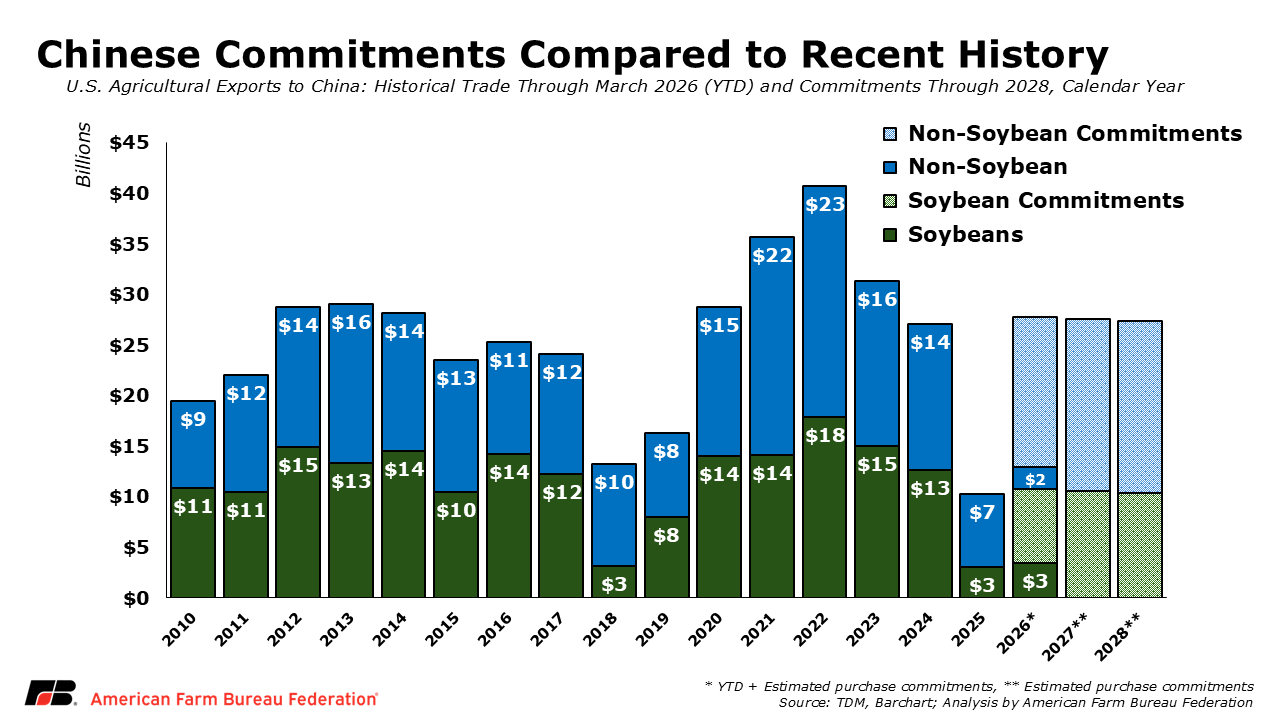
According to the White House, China committed to purchasing at least $17 billion annually in additional U.S. agricultural products in 2026 (prorated), 2027 and 2028, separate from soybean purchase commitments announced in late 2025. The agreement also includes the restoration of market access for certain U.S. livestock products and reciprocal tariff reductions intended to facilitate agricultural trade.
Additionally, the two countries established two bilateral boards aimed at strengthening the economic relationship. The first, the Board of Trade, will identify non-strategic goods eligible for tariff elimination on up to $30 billion worth of trade, with the goal of expanding bilateral commerce. The second, the Board of Investment, will provide recommendations on non-strategic, non-sensitive sectors where Chinese investment in the United States could proceed without additional review by the Department of the Treasury.
As with previous U.S.-China agricultural agreements, the commitments are significant, but the long-term impact for U.S. agriculture will depend on how the agreement is implemented and enforced.
Putting the Purchase Commitments in Context
U.S. agricultural exports to China reached a record $40.9 billion in 2022, driven largely by strong soybean shipments and post-pandemic demand recovery. Since then, exports have moderated as China diversified suppliers, particularly toward South America, while broader trade uncertainty and softer demand weighed on purchasing. By 2024, U.S. agricultural exports to China had declined to approximately $27 billion. Based on current estimates, the latest reported purchase commitments could move trade back toward levels seen earlier this decade. These projections convert the previously announced 25 million metric ton soybean commitment into estimated dollar values using September futures prices for the projected year and combine those estimates with the newly announced $17 billion in additional annual agricultural purchases.
Livestock
Beyond broader agricultural purchase commitments, the agreement includes specific market access gains for U.S. livestock producers. China agreed to restore market access for U.S. beef by renewing expired plant registrations and approving new facilities, reopening an important export channel for American producers. Many of the eligible U.S. beef plant registrations had been allowed to lapse in 2024, effectively restricting access for a large share of U.S. exporters amid broader trade tensions, even as China cited regulatory and administrative requirements for renewals.
Although the United States is currently importing beef to supplement domestic supplies, export access to China remains economically important because of strong demand for U.S. variety meats and offal, which often command significantly higher prices in Asian markets than in the domestic market, adding value across the cattle supply chain.
The agreement also resumes poultry imports from U.S. states recognized by USDA as free from Highly Pathogenic Avian Influenza (HPAI), easing restrictions that have disrupted trade for poultry producers.
Conclusion
The latest U.S.-China agreement signals renewed agricultural trade opportunities at a time when many farmers and ranchers continue to face tight margins and market uncertainty. Expanded purchase commitments, reciprocal tariff reductions and restored livestock market access could provide meaningful support if fully implemented.
At the same time, previous U.S.-China agricultural agreements have shown that announced commitments do not always translate into sustained export growth. For U.S. agriculture, the long-term impact of this agreement will depend on implementation of the agreement.