AEWR Changes for 2026-2027

Cameron Castillo
Associate Economist
Key Takeaways
- The Department of Labor's 2026-2027 H-2A wage rates are the first full annual update under the methodology prescribed by its October 2025 Interim Final Rule.
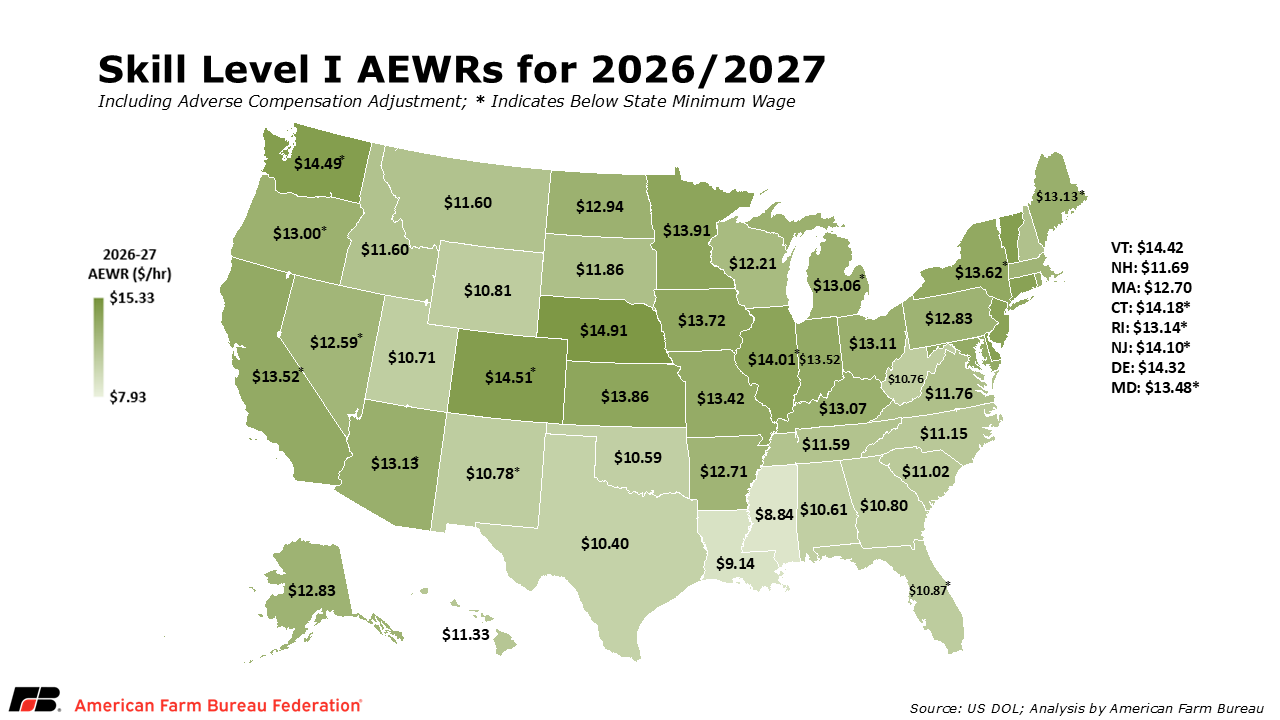
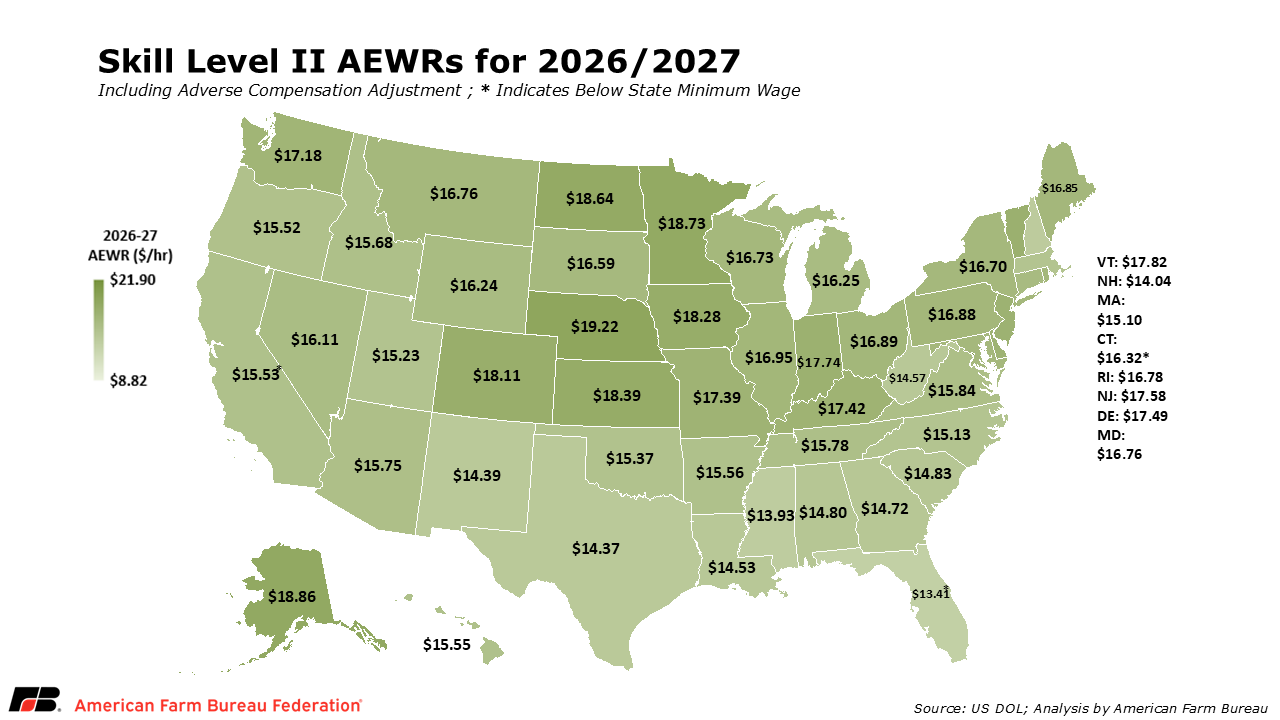
- Skill Level I AEWRs average $12.31 per hour nationally, up 3.5% from 2025-2026; Skill Level II AEWRs average $16.07 per hour, up 2.1%.
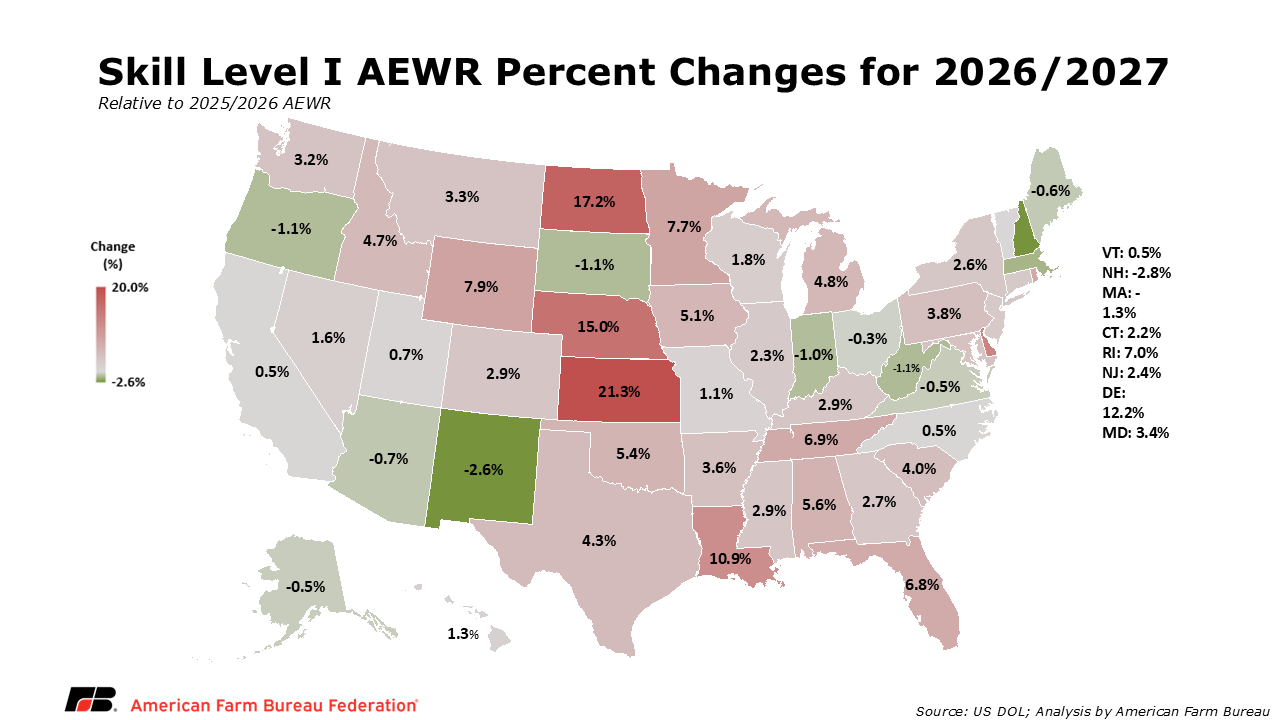
- Skill Level I increases affect 39 states; Kansas posted the largest jump at +21.3%, while New Hampshire posted the largest decrease at -2.8%.
- The bipartisan Securing Agriculture’s Workforce Act, if passed, would institute caps to reduce large year-over-year AEWR increases.
H-2A Adverse Effect Wage Rates (AEWRs) for 2026-2027 are set to increase across the country, with a handful of exceptions. Released by the U.S. Department of Labor's (DOL) Office of Foreign Labor Certification, AEWRs represent the federally mandated minimum wage for H-2A guestworkers in each state. Notably, this set of AEWRs is the first full-year iteration of wages based on DOL's new Occupational Employment and Wage Statistics (OEWS) survey, as stipulated by the department’s Interim Final Rule (IFR) issued in October 2025. While these wage rates are a significant improvement from the previous wage structure, congressional action is still needed to ensure farm and ranchers can continue to grow the nutritious food our country depends on for our health and well-being.
This Farm Bureau Intel breaks down notable AEWR changes from 2025-2026 by state and skill level, and highlights how farm labor legislation currently under consideration by Congress would help farmers and ranchers who employ H-2A workers.
Methodology: OEWS Skill Levels and the Adverse Compensation Adjustment
Under the IFR, DOL assigns each state an AEWR for two occupational skill levels drawn from OEWS wage data for field and livestock workers: Skill Level I, which corresponds to entry-level farm labor duties, and Skill Level II, which corresponds to more experienced or supervisory-adjacent roles. Drawing from May 2025 OEWS estimates rather than the May 2024 data that was used to establish the initial 2025-2026 IFR rates, the 2026-2027 rates mark the first complete annual update under the rule..
A notable addition to the AEWR calculation included in the IFR is the Adverse Compensation Adjustment (ACA). Expressed as an hourly rate, the ACA is calculated as the weighted average of rents for four-bedroom housing units in the relevant state or territory, based on data from the U.S. Department of Housing and Urban Development. The ACA is applied on top of the OEWS-derived wage for H-2A positions specifically. In practice, this change allows H-2A employers to account for the cost of housing and transportation they’re required to offer to H-2A workers for the length of their contract.
The 2026-2027 Wage Rates by State
Skill Level I AEWRs for 2026-2027 range from $8.84 per hour in Mississippi to $14.91 in Nebraska, with a simple average of $12.31 across all 50 U.S. states and territories, a 3.5% increase from the previous year’s average of $11.89/hour. Level II rates run from $13.41 in Florida to $19.22 in Nebraska, averaging $16.07 per hour nationwide, up from $15.76 a year earlier (a 2.1% increase overall). Importantly, H-2A employers are required to pay their H-2A employees the highest wage rate among five distinct wage categories: the AEWR, the state minimum wage, the prevailing wage, the collective bargaining wage, and the local minimum wage. Several states have minimum wages higher than their AEWR for 2026-2027, as indicated in the maps below.
Notable Wage Changes for 2026-2027
Comparing the finalized 2026-2027 rates to the 2025-2026 IFR rates shows an increase overall, though the magnitude varies widely by state and there were a few states that decreased. For Skill Level I, 39 of 54 jurisdictions (50 states plus D.C., Puerto Rico, Guam, and the U.S. Virgin Islands) had an increase, and 15 had a decrease. Kansas recorded the largest increase in the country, up 21.3%, from $11.43 to $13.86 per hour, followed by Nebraska (+15%) and North Dakota (+17.2%). New Hampshire posted the largest decrease, down 2.8% to $11.69.
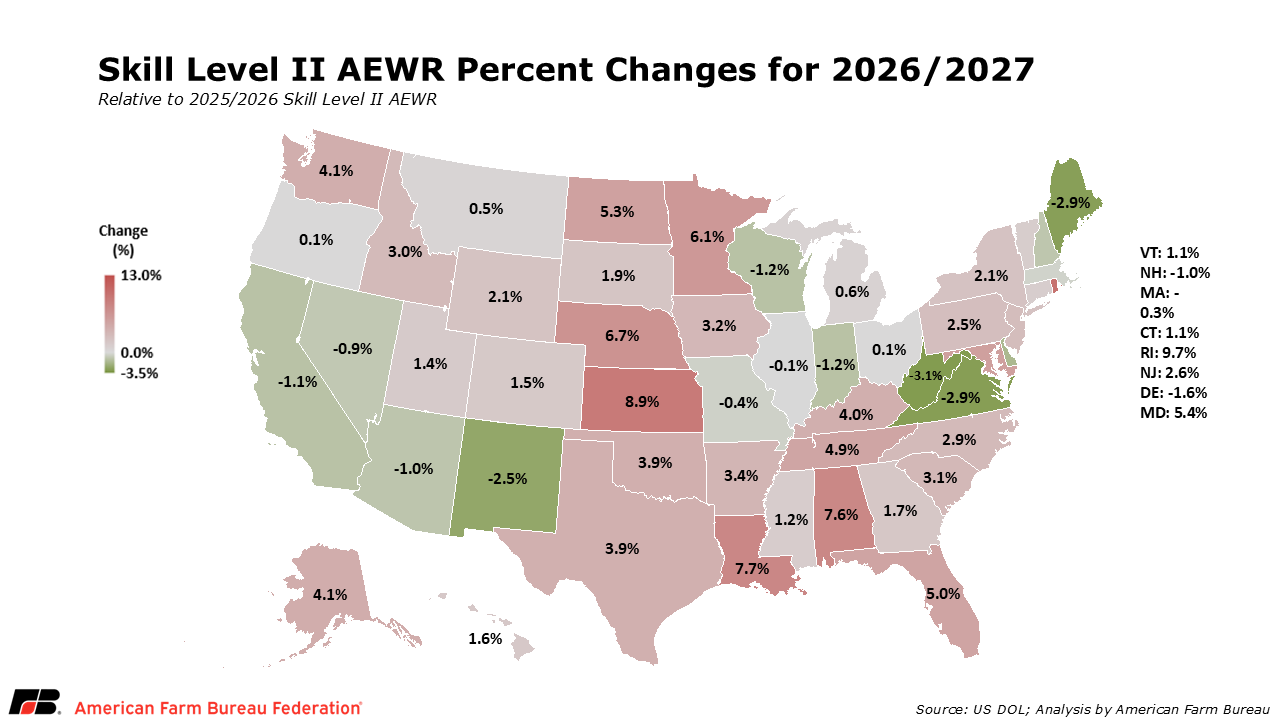
Skill Level II rates moved in the same direction: wages increased in 39 states and territories and decreased in 15, with a total average increase of 2.1% across the board. Rhode Island had the largest increase (+9.7%, to $16.78), while West Virginia posted the steepest decline (-3.1%, to $14.57).
Impact on Farm Labor Costs
Labor remains one of the largest and least flexible costs on a diversified farm operation, and this year's update lands at a time when farm income is already under pressure from soft commodity prices and elevated input costs. A double-digit AEWR increase in a state like Kansas, Nebraska or Louisiana flows directly into per-acre production costs for the specialty crop and livestock farms that rely on H-2A labor to market their products. As DOL issues subsequent annual updates under the IFR framework, growers should expect continued year-over-year volatility in these rates and should build that uncertainty into multiyear labor cost planning.
SAWA’s Solution to AEWR Volatility
Legislation introduced by House Agriculture Committee Chairman G.T. Thompson this summer seeks to address the potential for volatile yearly swings in the AEWR. The Securing Agriculture’s Workforce Act (SAWA) includes provisions that would limit year-over-year AEWR increases to no more than 3.25%, while capping decreases at 1.5%.
If this provision were the existing law prior to the release of this year’s AEWRs, farmers in several states would see significant wage savings via smaller upward swings in the year-over-year AEWR for their states. For example, in Louisiana, the 2026-2027 ACA-adjusted Skill Level I AEWR increase of 90 cents per hour (10.9 % year-over-year) would have been limited to an increase of just 27 cents per hour, (3.25% year-over-year). While a 63 cents per hour wage difference may seem negligible, Louisiana farmers could expect to save nearly $8.5 million in wage costs for Skill Level I H-2A workers alone.
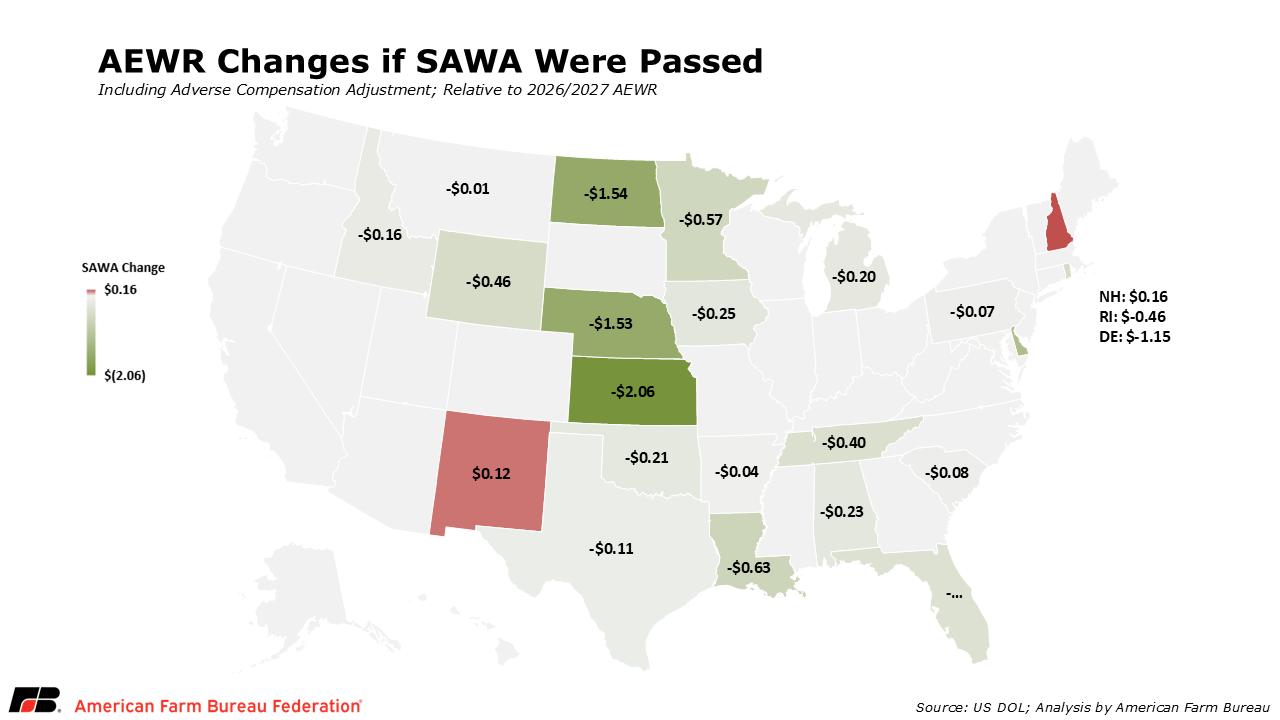
Ultimately, SAWA offers a much-needed solution to address the year-to-year swings in AEWRs, reducing production expense uncertainty for growers who rely on the H-2A visa program to market their products.
Conclusion
DOL’s October 2025 Interim Final Rule made significant strides to move the H-2A program away from the costly wage structure promulgated by the now-defunct Farm Labor Survey. The 2026-2027 AEWRs for Skill Level I and II wages under the H-2A visa program represent the first full year of wages under the new methodology. Wages increased overall, with some states experiencing massive swings that will only add to record-high costs associated with producing an agricultural commodity in 2026. Congress could take significant steps toward codifying the current methodology while curtailing these costly increases by passing the bipartisan Securing Agriculture’s Workforce Act.