Risk Management Options for 2026: Corn, Soybeans and Wheat
TOPICS
Farm Policy
Faith Parum, Ph.D.
Deputy Chief Economist
Following the February price discovery period, USDA’s Risk Management Agency (RMA) has finalized spring crop insurance prices for the 2026 crop year, establishing the revenue guarantees farmers will use to manage risk. Projected prices reflect current market supply and demand expectations and provide an important opportunity to protect against further price or revenue declines. Risk management and marketing strategies are critically important when input costs are high.
This Market Intel reviews farm bill-related risk management tools for corn, soybeans and wheat for the 2026 crop year, including crop insurance as well as Agriculture Risk Coverage (ARC) and Price Loss Coverage (PLC) programs. While for the 2025 crop year, provisions in the One Big Beautiful Bill Act allow farmers to automatically receive the higher payment between ARC and PLC, for crop year 2026, farmers will still be required to make an election between the two programs.
Risk Management Coverage for 2026
Several key price benchmarks help frame the financial outlook for farmers heading into the 2026 growing season, including spring prices for crop insurance, estimated break-even levels and farm program benchmarks.
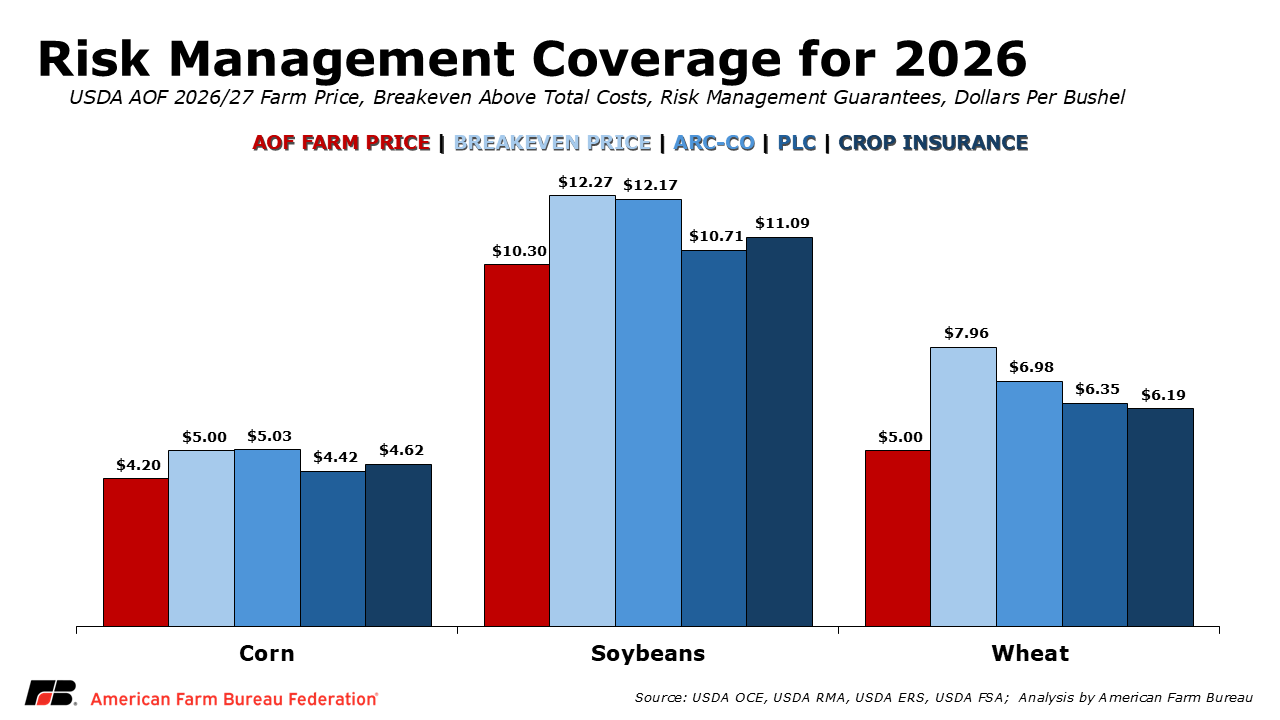
USDA’s Agricultural Outlook Forum (AOF) projects 2026 marketing year average prices of $4.20 per bushel for corn, $10.30 per bushel for soybeans and $5 per bushel for wheat. In comparison, estimated national average break-even prices, the price needed to cover total production costs, i.e., variable and fixed production expenses, are approximately $5 per bushel for corn, $12.27 per bushel for soybeans and $7.96 per bushel for wheat.
Across major row crops, projected market prices remain below estimated break-even levels, suggesting continued margin pressure for many producers. While input costs have moderated from recent peaks, production expenses remain elevated compared to historical averages, leaving expected returns tight heading into the 2026 crop year.
Against this backdrop, crop insurance spring prices and farm program benchmarks provide important reference points for evaluating potential revenue outcomes and downside risk in the 2026 crop year. These benchmarks help define the level of protection available through the farm safety net and provide context for producer risk management decisions.
Crop Insurance Spring Prices
Crop insurance spring prices are determined using futures market averages during a month-long discovery period. For corn and soybeans, prices are based on average daily settlement prices for the December corn and November soybean futures contracts during February, while wheat prices are based on September Chicago futures contracts.
Following the discovery period, farmers can purchase revenue protection policies that insure a percentage of expected revenue based on projected prices and expected yields. Policies with the harvest price option use the higher of the spring or harvest price when calculating guarantees, providing protection against both yield and price risk.
Additionally, policy changes enacted through the One Big Beautiful Bill Act (OBBBA) significantly expanded supplemental and area-based coverage options. The legislation raised the maximum coverage level for area-based insurance plans to 95% and increased the premium subsidy for those plans from 65% to 80%. In addition, the bill expands eligibility for the Supplemental Coverage Option (SCO), allowing producers enrolled in ARC to purchase SCO coverage, an option that was previously limited to those enrolled in PLC. Together, these changes provide producers with greater flexibility to stack individual and area-based coverage and tailor risk management strategies amid continued market volatility and elevated production costs.
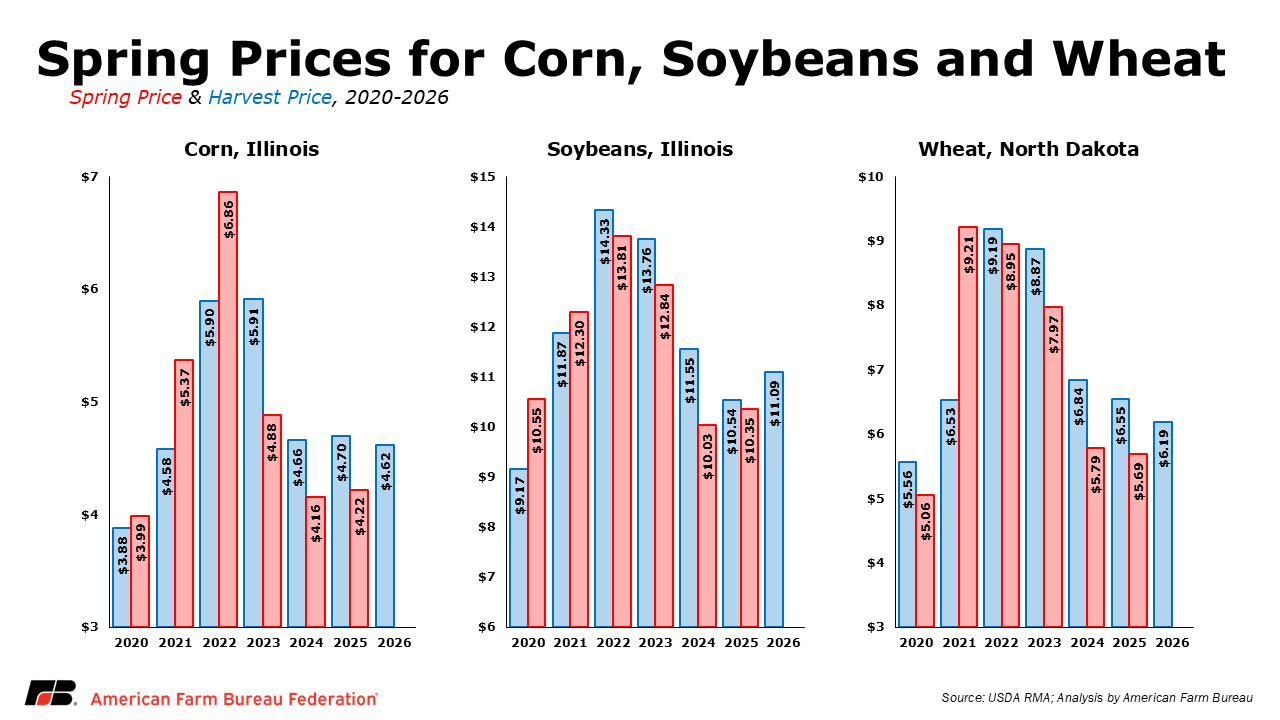
For 2026, spring prices were finalized at approximately $4.62 per bushel for corn, $11.09 per bushel for soybeans and $6.19 per bushel for wheat. Compared to 2025, corn spring prices declined slightly from $4.70 per bushel (down 1.7%), soybean spring prices increased from $10.54 per bushel (up 5.2%) and wheat spring prices declined from $6.55 per bushel (down 5.5%).
Based on the spring prices in 2026, the soybean-to-corn price ratio is approximately 2.4. Historical acreage relationships suggest that ratios above roughly 2.2 have been associated with increases in soybean acreage, while ratios near or above 2.4 have often corresponded with reductions in corn acreage. USDA’s early outlook from AOF projects soybean acreage will increase modestly in 2026 to 85 million acres, while corn acres and wheat acres are projected at 94 million and 45 million acres, respectively.
Agriculture Risk Coverage
Agriculture Risk Coverage (ARC) provides revenue-based support when revenue falls below benchmark levels. Farmers can choose between ARC-County (ARC-CO) and ARC-Individual (ARC-IC) coverage options. ARC-CO triggers payments when average revenue for a crop in a county falls below benchmark revenue levels, while ARC-IC triggers payments when combined revenue across covered crops on an individual farm falls below its historical benchmark.
ARC benchmark prices are based on moving averages of historical market prices and yields and are designed to provide support during periods of revenue declines. Estimated 2026 ARC benchmark prices are approximately $5.03 per bushel for corn, $12.17 per bushel for soybeans and $6.98 per bushel for wheat. These benchmark prices are unchanged from 2025.
Price Loss Coverage
Price Loss Coverage (PLC) provides price-based support when the national marketing year average (MYA) price for a covered commodity falls below its effective reference price. PLC is triggered by price outcomes rather than yield outcomes, and payments are calculated using historical base acres and the farm’s PLC program yield.
Effective reference prices are based on statutory reference prices and an escalation formula tied to a moving average of recent MYA prices, with the effective reference price capped at 115% of the statutory reference price. Estimated effective reference prices for the 2026/27 crop year are approximately $4.42 per bushel for corn, $10.71 per bushel for soybeans and $6.35 per bushel for wheat. These levels are unchanged from 2025.
A Strong Safety Net for Risk Management
Together, crop insurance and either ARC or PLC provide layers of protection against risk. Crop insurance provides both area-based and farm-level protection during the growing season, while ARC and PLC provide additional support based on county revenue outcomes or national price conditions. With commodity prices remaining relatively low and production expenses still elevated, a strong and reliable farm safety net remains essential for helping farmers manage risk and navigate uncertain market conditions.