Tracking Farmer Bridge Assistance Program Payments

Faith Parum, Ph.D.
Economist
Cameron Castillo
Associate Economist
Key Takeaways
- The Farmer Bridge Assistance (FBA) Program provides support for row crop farmers in the midst of a historic farm economy downturn.
- Nearly $9.6 billion in FBA payments have already been disbursed, with corn and soybean acres receiving the largest share of assistance to date.
- Specialty crop farmers are still awaiting details pertaining to payments under the Assistance for Specialty Crop Farmers (ASCF) program, while sugar producers have been separately allocated $150 million in assistance with distribution details still being finalized.
- With farm financial conditions deteriorating and fertilizer and fuel prices rising, farmers will continue to face losses, underscoring the need for additional support.
In December 2025, USDA announced $12 billion in one time bridge payments, with $11 billion set aside for row crop producers in the Farmer Bridge Assistance program (FBA), and the remaining $1 billion reserved for specialty crop and sugar growers in the Assistance for Specialty Crop Farmers (ASCF) program. Given the historic economic losses facing the American agriculture sector, the FBA was designed to serve as an economic bridge for farmers ahead of the Agriculture Risk Coverage and Price Loss Coverage enhancements enacted in the One Big Beautiful Bill Act, which take effect later this year.
On February 23, USDA opened enrollment for farmers who planted program crops during the 2025 crop year. The deadline to submit a completed FBA payment application to USDA’s Farm Service Agency (FSA) was April 17. As of the publication of this Market Intel, nearly $9.6 billion in FBA payments had been disbursed, with nearly 500,000 applications approved by the FSA.
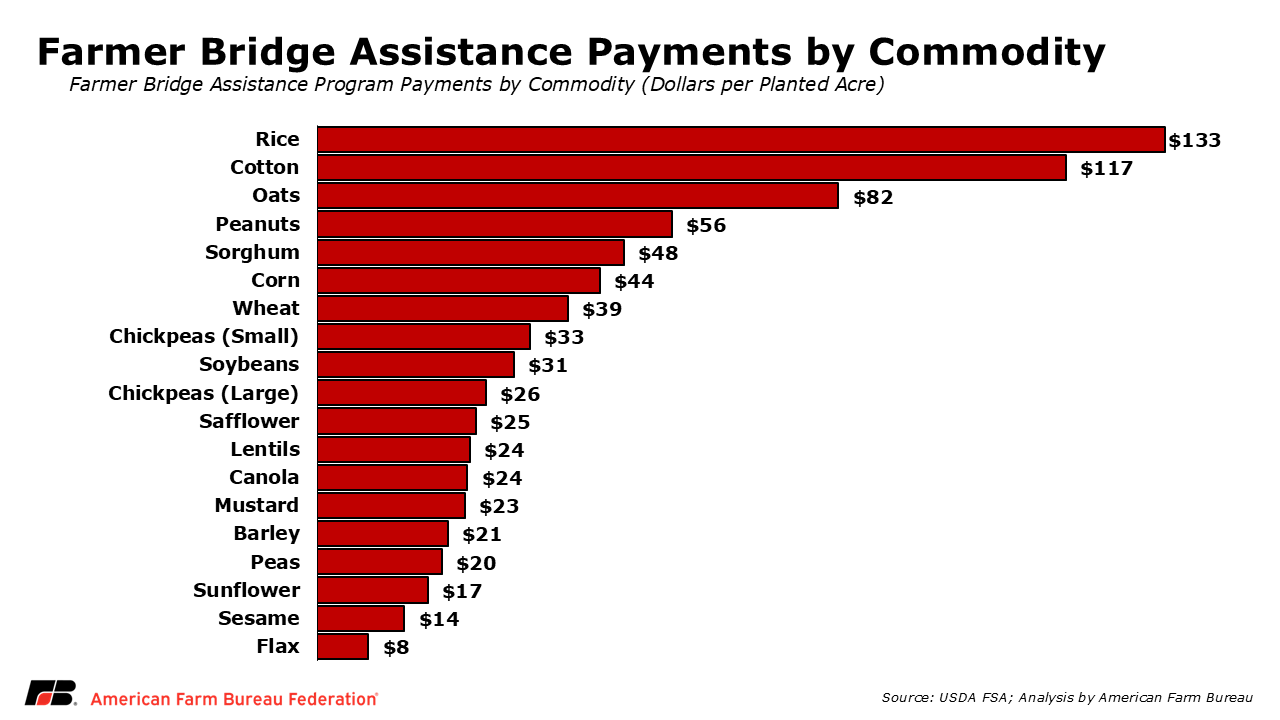
FBA payments are calculated based on a flat, per-acre payment for all acres planted to eligible commodities in 2025. As we discussed in our January 2026 FBA Market Intel, per-acre payment rates were calculated based on FSA-reported planted acres, USDA-Economic Research Service cost-of-production estimates, World Agricultural Supply and Demand Estimates (WASDE) yield and price projections, and economic modeling assumptions.
Per-acre payment rates are highest for crops that experienced the most severe losses in 2025, such as cotton and rice. More broadly, however, record-low commodity prices and persistently high input costs pushed returns into negative territory across the country. Even where per-acre losses were smaller and payment rates lower, farmers nationwide continue to face significant financial strain. Additionally, payments from FBA cover only a share of losses that farmers are facing. As a result, all nine principal row crops are forecasted to have negative returns even after accounting for federal assistance.
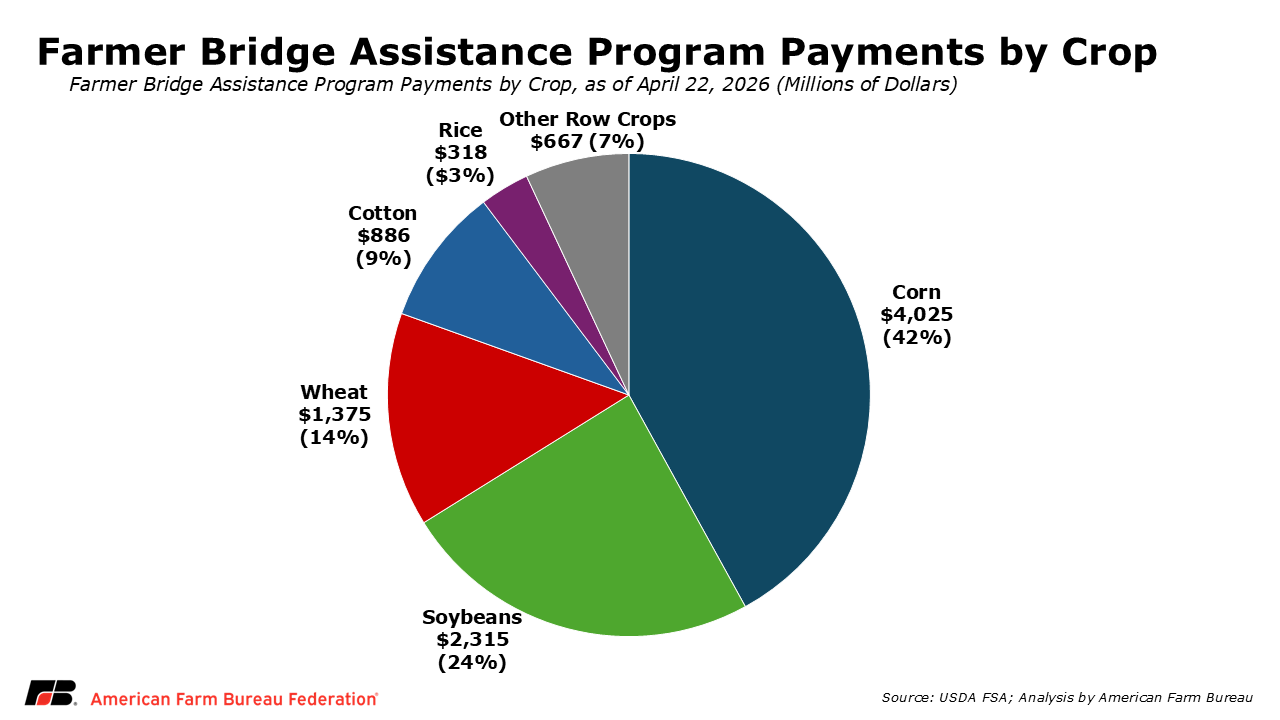
Corn and soybean acres have received the majority of FBA payments, with corn payments alone accounting for nearly 42% ($3.45 billion) of the program’s disbursements. Soybeans ($2.27 billion), wheat ($1.34 billion), cotton ($874 million), and rice ($307 million) round out the top five. Payments made on the program’s other eligible row crops total $652 million. These totals are expected to increase as additional applications are processed and approved.
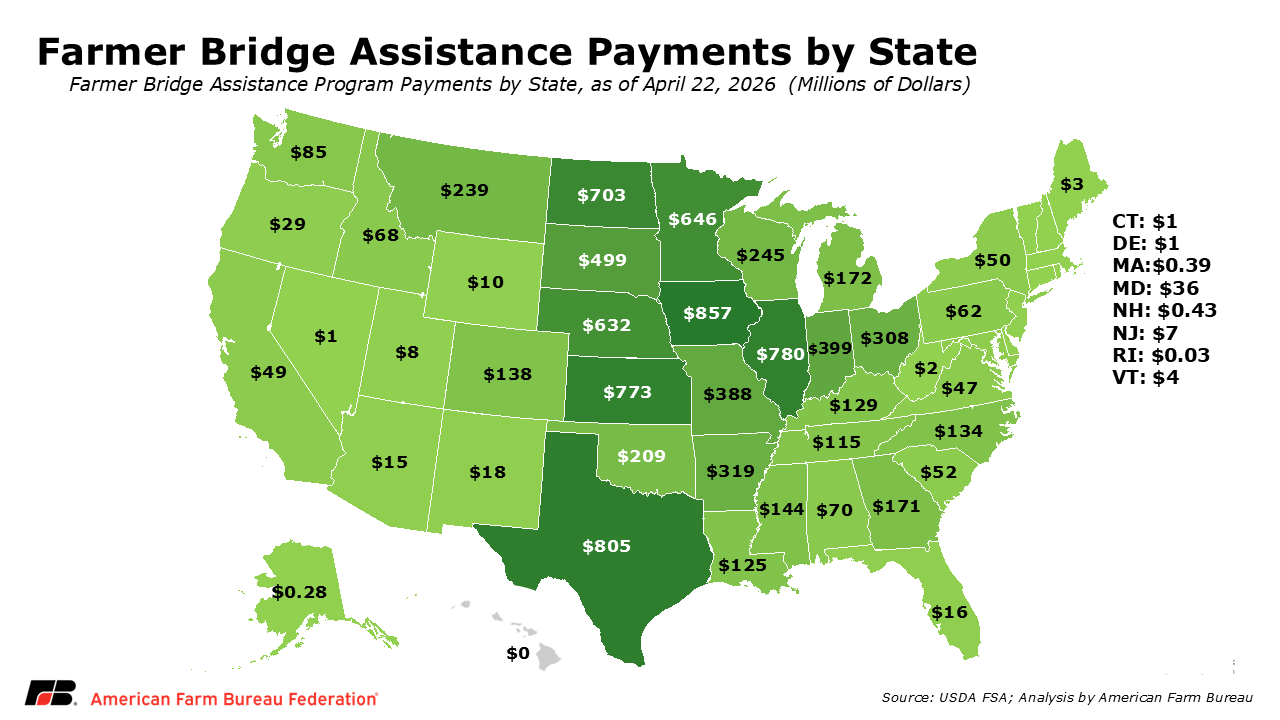
Iowa has received the highest total of FBA payments so far, with farmers in the Hawkeye State receiving $843 million in payments from FSA. Texas and Illinois are a close second and third, respectively, with farmers in those states receiving $784 million and $765 million in FBA payments, respectively.
It is important to note that specialty crops are not covered commodities under the FBA program, so regions such as the Northeast and Pacific Northwest have received substantially less in payments than producers in the Midwest and South. In addition to the $11 billion allocated for row crop farmers, specialty crop farmers have been allocated a portion of the remaining $1 billion in bridge assistance payments under the Assistance for Specialty Crop Farmers (ASCF) program. Farmers have until April 24 to report 2025 acres to FSA for ASCF payment consideration. While the ASCF program is a welcome step, it represents only a small share of the total economic losses faced by specialty crop farmers.
Conclusion
The Farmer Bridge Assistance program provides some much-needed financial support to row crop farmers facing multiple years of negative or near-breakeven returns due to depressed market prices, high input costs and market volatility. While farm safety net improvements enacted through OBBBA — increased reference prices, enhanced crop insurance premium support, and increased marketing assistance loan rates — will strengthen protection moving forward, FBA is helping farmers bridge the immediate downturn facing the farm economy in 2026. However, with farm finances continuing to worsen and fertilizer and fuel prices rising, additional economic assistance in upcoming legislation is needed to help producers manage mounting pressures and sustain production. That need is further underscored by remaining gaps, as specialty crop and sugar growers continue to face significant uncovered losses and sectors such as alfalfa, aquaculture and timber were not included in the program.

