Senate Permitting Bill Needs Additional Protections for Agriculture
Managing Director, Government Affairs
Senior Director, Government Affairs
Director, Government Affairs

Courtney Briggs
Managing Director, Government Affairs
Shelby Hagenauer
Senior Director, Government Affairs
Autumn Lankford Higgins
Director, Government Affairs
Key Takeaways
- AFBF supports modernizing federal permitting. An efficient, predictable and transparent system helps farmers and ranchers maintain their operations, invest in infrastructure and support the nation’s food and fiber supply.
- The Senate package makes real progress on environmental review, clarifying the National Environmental Policy Act, shortening Endangered Species Act consultation timelines and narrowing National Historic Preservation Act review, including for USDA farm loans and cost-share projects.
- The legislation comes up short for agriculture in two important areas: energy policy and Clean Water Act provisions.
- Meaningful reform should reduce delays, eliminate duplicative reviews, respect state and local decision-making and give landowners certainty.
On Sept. 30, leaders of the Senate Energy and Natural Resources and Environment and Public Works committees introduced the Bipartisan American Affordability and Jobs Act of 2026 (BAAJA; S. 5653). The 417-page bill is the most comprehensive permitting package Congress has considered in years. It rewrites procedures under the National Environmental Policy Act (NEPA), the Clean Water Act (CWA) and the Endangered Species Act (ESA) and dedicates an entire title to electric transmission.
Farmers and ranchers need affordable, reliable power, and they own and manage much of the land new lines will cross. This Policy Intel examines where BAAJA advances agriculture’s interests and three areas in which it falls short: energy policy, Clean Water Act provisions and environmental review laws.
Energy Policy
How Transmission Lines are Sited Today
Unlike interstate natural gas pipelines, which the Federal Energy Regulatory Commission (FERC) approves, transmission lines have traditionally been sited by states. State utility commissions review routes, hold hearings and determine public need, and state law generally governs whether and how developers may use eminent domain.
Federal Power Act Section 216 gives FERC limited “backstop” authority to permit an interstate line when a state does not act, but only within National Interest Electric Transmission Corridors designated by the Department of Energy (DOE). FERC has never issued a backstop permit, so nearly every siting dispute involving farmland has been decided in a state forum under state rules.
What BAAJA Would Change
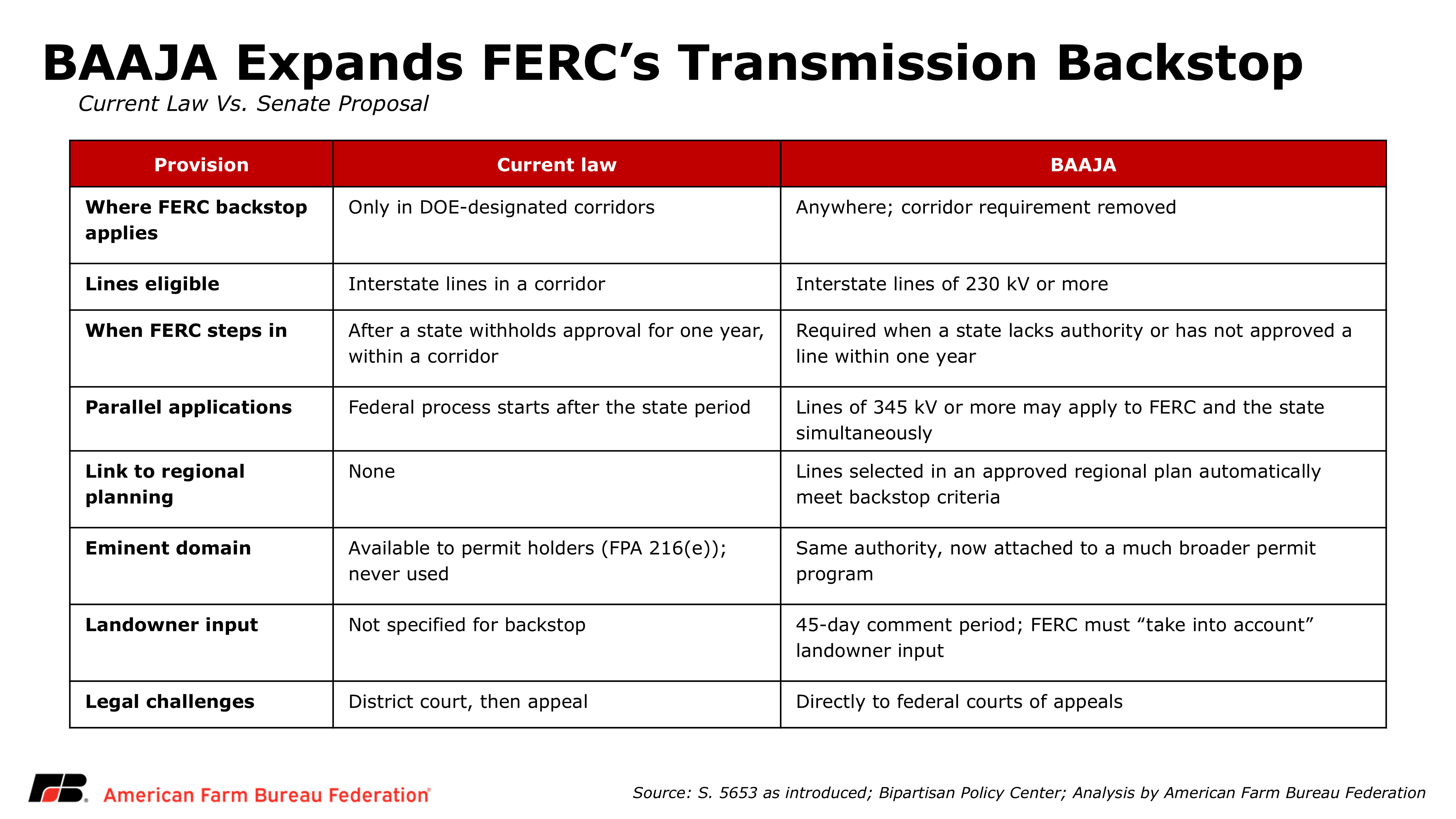
The legislation turns this dormant backstop into working federal siting authority.
Eminent Domain Moves Off the Shelf
Section 216(e) of current law lets a backstop permit holder condemn rights-of-way in federal court, but without any permits, that authority has gone unused. By removing the corridor requirement and setting a 230 kV threshold, BAAJA would make federal condemnation available to far more projects nationwide.
That matters even if condemnation is never filed. Easements are negotiated in the shadow of eminent domain, and a developer with federal condemnation authority has less incentive to offer fair terms. A federal permit could also let developers bypass state landowner protections such as limits on merchant lines, attorney fee provisions and enhanced compensation. The bill does not require developers to document good-faith negotiations before condemning.
State Authority on a One-Year Clock
If a state has not approved a qualifying line within one year, FERC must take up the permit. For a contested, multi-county route, that is little time to notify landowners, hold hearings, weigh alternatives and decide. Allowing developers of lines of 345 kV or more to file with FERC and the state simultaneously adds pressure on regulators to work on the developer’s schedule.
Because projects selected in regional plans automatically qualify for a federal permit, decisions by utilities and grid operators could substitute for a state’s finding that a route across specific farms is needed. Even if FERC never acts, the possibility of federal override will shape state proceedings.
Limited Recourse for Landowners
The bill requires a 45-day comment period and directs FERC to “take into account” landowner input. It does not require direct written notice to each landowner, help with legal or appraisal costs, or a clear standard for weighing landowner concerns.
The bill’s judicial review changes narrow the window further. Challenges to environmental reviews would face a 150-day filing deadline, down from six years, and only issues raised during the comment period could be litigated. FERC transmission permits would go directly to federal courts of appeals. A landowner who learns of a route late or lacks counsel may have no practical recourse.
The Footprint on Working Land
Agriculture is the nation’s largest private land use. Expanded high-voltage transmission will cross substantial farm and ranch land, with impacts well beyond the tower footprint:
- Lost production and efficiency: Towers take ground out of production and force planters, sprayers, combines and center pivots to work around them, adding time and fuel and leaving point rows.
- Soil and drainage damage: Heavy equipment compacts soil and can break drainage tile and irrigation lines, with yield losses that can persist for years.
- Disruption to livestock and access: Construction interrupts fencing, field access and livestock movement, and maintenance crews return for the life of the line.
- Lasting limits on land use and value: Easement restrictions on building, planting and improvements travel with the land through sale or inheritance.
Yet the transmission title does not direct FERC to avoid productive farmland, prefer existing rights-of-way or public land, or set construction and restoration standards for agricultural land. BAAJA’s NEPA changes, which build the transmission line sponsor’s goals into a review’s purpose and need and drop alternatives that don’t meet them, could further narrow the routes considered.
The legislation also exempts upgrades within existing rights-of-way, such as reconductoring, from environmental and historic preservation review. While using existing corridors can reduce the need for new routes, many older easements were negotiated for a specific line and voltage, and upgrades can add to the burden on the property without new notice or compensation.
Clean Water Act Provisions
BAAJA includes a few constructive CWA changes. Extending Section 404 permits from five to 10 years would improve predictability and reduce paperwork for landowners. New language on Section 404(c) could also limit duplicative or prolonged federal review of permitted projects.
However, the package falls well short of the House-passed Promoting Efficient Review for Modern Infrastructure Today (PERMIT) Act (H.R. 3898) on agriculture’s most pressing CWA issues. It omits Waters of the United States (WOTUS) reforms that would clarify the scope of federal jurisdiction, including exemptions for ephemeral features, groundwater, prior converted cropland and waste treatment systems. Farmers and ranchers need to know where federal jurisdiction begins and ends to manage and improve their land.
The package also fails to clarify the agricultural stormwater exemption. Uncertainty over its scope has fueled litigation that could set troubling precedents for agriculture. Clear statutory language is needed to ensure routine farming activities do not trigger federal permitting requirements.
The Good: Modernizing Environmental Review Laws
This is where BAAJA delivers the most for agriculture. NEPA, ESA and the National Historic Preservation Act (NHPA) directly affect farmers and ranchers, and their regulatory reach has grown over time. AFBF supports modernizing these laws to protect land-use and water rights and to cut delays in permits and approvals on federal land, including forest and land management projects often tied up in litigation for years.
- NEPA: The bill clarifies that NEPA is a procedural statute, narrows the scope of projects requiring review and sets review deadlines. Lawsuits must be filed within 150 days by parties who substantially participated in the comment process, and courts would generally send flawed reviews back to agencies for correction rather than vacating them.
- ESA: Consultation timelines would be shortened to align with NEPA, so producers are not waiting years to learn whether a project affects listed species. Qualified state agencies could take on some consultation duties from the U.S. Fish and Wildlife Service, though applicants could opt out.
- NHPA: The bill narrows “undertakings” from any federal permit or approval to projects under substantial federal control. It excludes projects whose only federal involvement is a loan, loan guarantee or cost-share, such as a USDA farm loan, as well as minor repair, maintenance, rehabilitation and stabilization. Reviews would follow set timelines, tied to the NEPA schedule where both apply, reducing years-long waits on State Historic Preservation Offices. As with NEPA, flawed reviews would generally be remanded rather than vacated, and challenges would face a 150-day deadline.
Together, these changes would give farmers, ranchers and foresters more certainty when they need federal approval for an action or permit and reduce litigation over federal land management.
Bottom Line
Farm Bureau shares BAAJA’s goal of timely, predictable permitting, and the bill’s environmental review reforms and Section 404 improvements are real progress. But the package leaves key agricultural priorities unaddressed.
Its transmission title would shift siting authority from states to federal regulators and broaden federal eminent domain, while giving landowners limited notice, short windows to participate and narrow avenues for challenge. Those changes come as demand for new high-voltage lines, most of which are routed across farm and ranch land, is rising quickly. The bill also omits the WOTUS and stormwater clarity farmers and ranchers need.
Congress should build on the bill’s progress while ensuring permitting reform works for the farmers and ranchers whose land it affects.