H-2A Program Use Continues to Soar

Samantha Ayoub
Former AFBF Economist
Key Takeaways
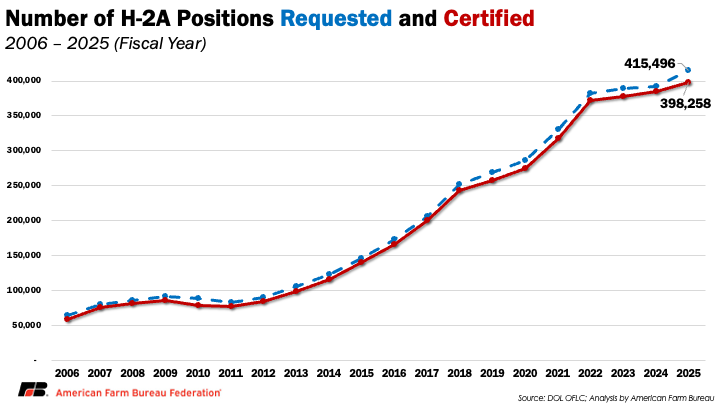
- The H-2A program continues to grow with 398,258 positions certified in fiscal year 2025.
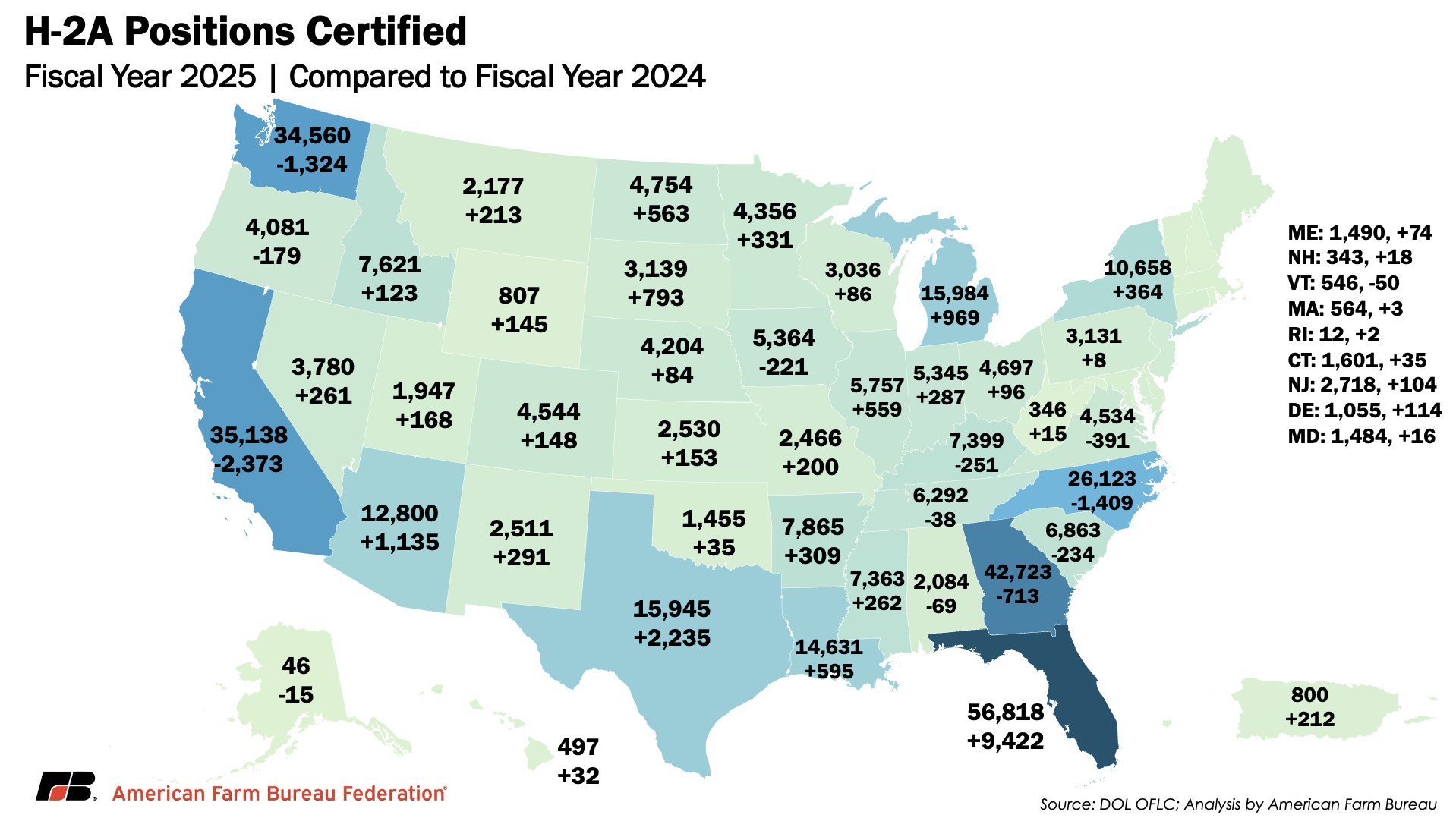
- Nearly 50% of the certifications in FY 2025 work in just five states: Florida, Georgia, California, Washington and North Carolina. Florida far outpaces all other states, accounting for over 14% of FY 2025 certifications alone.
- The primary requirement of any H-2A certification reaffirms that no domestic workers desire the position. Low unemployment, falling labor participation rates and general uninterest in agricultural work all continue to strain domestic labor shortages. Only 182 positions out of over 415,000 advertised (less than 0.04%) received a domestic applicant in fiscal year 2025.
The H-2A program continues to grow, with 13,358 more positions certified in fiscal year 2025 (October 2024-September 2025) than fiscal year 2024. This marks the first year in program history that over 400,000 workers were requested, highlighting the continued domestic labor shortages American farmers and ranchers face.
2025 H-2A Demand
Nationwide, 398,258 positions were certified in FY 2025 as eligible for an H-2A worker. These are positions that arise from a proven lack of domestic interest in the seasonal jobs, let alone shortages in employees who work throughout the year. The H-2A program has grown 185% in the last 10 years. While growth has slowed in the last three years, over 13,300 additional workers were certified in 2025 compared to 2024.
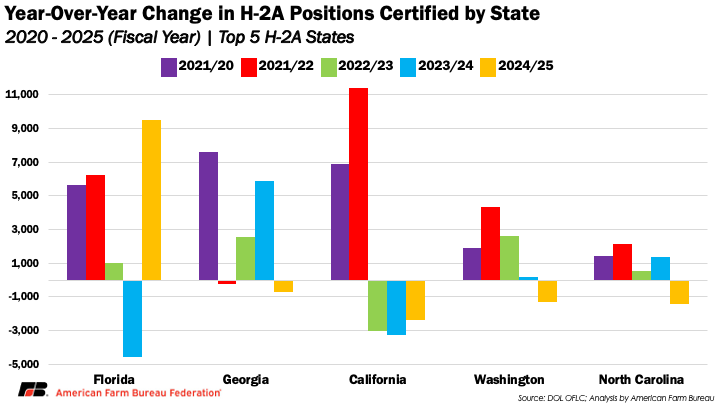
Nearly 50% of the certifications in FY 2025 work in the top five user states: Florida, Georgia, California, Washington and North Carolina. Florida far outpaces all other states, accounting for over 14% of FY 2025 certifications and adding over 9,000 additional workers from 2024, despite a 10% increase in their Adverse Effect Wage Rate (AEWR) during the fiscal year. Interestingly, the other four leader states all decreased in certifications, with California certifying over 2,000 fewer workers in 2025 than in 2024, their third straight year of decline in H-2A use.
Outside of these top five, expansion in H-2A use is the norm for most states. Thirty-eight states increased their demand for H-2A workers, including the remaining five states that round out top 10 usage. Declines in H-2A use were concentrated in the Southeast and on the West Coast.
Application Woes
Numerous regulations have compelled H-2A users to be more specific and exclusive on their job descriptions, driving up the number of applications each farmer must submit during the year. For example, the 2023 disaggregation rule, which was vacated in August 2025, required the highest wage to be paid based off job duties, not the entirety of the contract, incentivizing farmers to separate tasks into distinct positions. Rules like this caused the number of positions per application to decrease. The average number of positions per application was 19 in fiscal years 2024 and 2025, compared to 23 in 2018. Each additional application increases farmers’ costs as application fees quickly add up and takes months to process. Recent changes to H-2A regulations and other deregulation efforts give employers the ability to expand contracts to cover more workers and decrease application costs, which could increase use of the H-2A program.
A Tight U.S. Labor Market
Increasing H-2A demand is a direct reflection of the U.S. labor force. The primary advertising requirement of any H-2A certification proves that no domestic workers seek the position. If a domestic worker applies to public postings of the positions, regardless of whether they show up for work or last the season, that position is no longer eligible for an H-2A worker. In fiscal year 2025, only 182 positions, less than 0.04% of requested positions, received a domestic applicant.
This is partially due to a limited American labor force. While the U.S. labor force has grown by nearly 12 million people in the last 10 years, the participation rate, or share of all U.S. citizens between the ages of 15 and 64 who are employed or actively seeking employment, has been falling since the early 2000s. The official U.S. unemployment rate is also low: 4.4% in September 2025, less than a percentage point higher than the pre-pandemic rate of 3.5%, and lower than the 5% unemployment rate a decade ago. The same pattern is true when including marginally attached workers – those who would be open to work and have actively searched in the last year but have not applied in the past month.
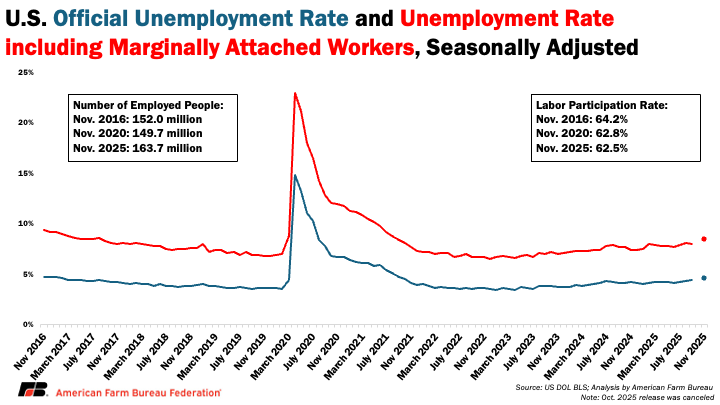
As long as these domestic labor force trends continue and American workers remain uninterested in seasonal farm work, farmers and ranchers will continue to turn to alternative labor recruitment to ensure a dependable food system. Mechanization in these labor-intensive industries requires much more upfront investment, research and development and will likely be cost prohibitive for small farmers; so, guestworker programs remain a crucial resource for sustaining American food production.
Conclusion
The H-2A program remains the pinnacle program for meeting seasonal agricultural worker demand. With nearly 400,000 positions certified in fiscal year 2025, American farmers and ranchers continue to rely more heavily on the program. However, it is far from meeting the needs of all of U.S. agriculture. Nonseasonal industries like dairy, mushrooms or greenhouses are largely unable to use the H-2A program due to regulatory contract limits. Additionally, only 80% of positions certified receive visas to work in the United States. So, even farmers with proven labor shortages may not be able to meet their peak employee needs via the H-2A program.
The costs of using this program, from unpredictable wage increases to application costs and nonwage benefits, have also long been a barrier for many farmers. Recent changes to the AEWR methodology seek to correct years of uncontrolled wage inflation and recognize the large nonwage costs of utilizing the H-2A program. These changes, along with additional flexibility in work contract timelines and job duties, will hopefully make the H-2A program more accessible to other farmers, leading to continued growth of the program