SDRP Payments Expand for 2023–2024 Losses, While New Disasters Emerge

Daniel Munch
Former AFBF Economist
Key Takeaways
- USDA has delivered $6.7 billion in SDRP payments for 2023–2024 disaster losses, providing needed relief, though nearly 60% of authorized funding remains to be distributed.
- USDA’s decision to increase the SDRP payment factor from 35% to 70%, along with extending the application deadline to Aug. 12, will provide additional support to growers still recovering from disasters.
- Disaster assistance timelines vary, with farmers in Maine, Massachusetts, Connecticut and Hawaii still awaiting payments as block grant programs are still being finalized.
- While this assistance is a welcome step, a new round of losses is already emerging without dedicated support, including an estimated $5.7 billion in uncovered crop losses in 2025 and early 2026 impacts such as a Florida freeze exceeding $3.1 billion, alongside expanding drought conditions.
USDA is increasing disaster assistance for farmers still recovering from the severe weather events of 2023 and 2024, raising Supplemental Disaster Relief Program (SDRP) payments from 35% to 70% and triggering a second round of payments. The change will accelerate delivery of the $16.09 billion in authorized aid and help reduce a portion of uncovered losses from recent disasters. However, while this support is still working its way to producers, some more than two years after losses occurred, new disaster impacts are already building across the country, highlighting the gap between when losses happen and when assistance arrives.
Background
U.S. agriculture faced a series of compounding natural disasters across 2023 and 2024, including atmospheric river flooding in California, prolonged drought across the Plains and West, major wildfires such as the Smokehouse Creek Fire in Texas and Oklahoma, Midwest flooding along the Mississippi River system and multiple hurricanes, including Hurricane Helene and Hurricane Milton, which caused significant damage to specialty crops and infrastructure across the Southeast. Together, these events created widespread and overlapping losses across both crop and livestock sectors, with AFBF estimating roughly $41 billion in crop losses across the two years, including a substantial share falling outside existing risk management programs.
In response, Congress authorized disaster assistance through the American Relief Act of 2025, including $16.09 billion for crop, tree and vine losses under SDRP. SDRP builds on earlier ad hoc programs such as the Wildfire and Hurricane Indemnity Program Plus (WHIP+) and the Emergency Relief Program (ERP), using a framework that compares a producer’s expected crop value to post-disaster production and provides a partial payment on the remaining loss.
The program is delivered in two stages. Stage 1 uses existing crop insurance and Noninsured Crop Disaster Assistance Program (NAP) records to calculate losses and apply a flat payment factor, originally set at 35%, allowing for faster delivery of assistance. Stage 2 extends support to losses not fully captured by those programs, including shallow losses, quality loss, uninsured crops and certain specialty crop, tree and quality-related losses, often relying on USDA-assigned yields, prices or plant values where farm-level data are unavailable.
It’s important to note, not all farmers are receiving assistance through SDRP. Under the American Relief Act, certain states, including Connecticut, Hawaii, Maine and Massachusetts, are delivering disaster assistance through state-administered block grants rather than the federal SDRP process. As a result, farmers with losses in these states are not currently eligible for SDRP payments, and are still waiting for aid as block grant programs are finalized.
SDRP Payments So Far
To date, USDA has distributed approximately $6.7 billion of the $16.09 billion authorized for SDRP, leaving roughly $9.4 billion, or about 58%, still available for additional payments and applicants. Early distributions have been concentrated in major field crop states, with the largest payments going to Minnesota ($726 million), Kansas ($708 million), Texas ($630 million) and Iowa ($598 million).
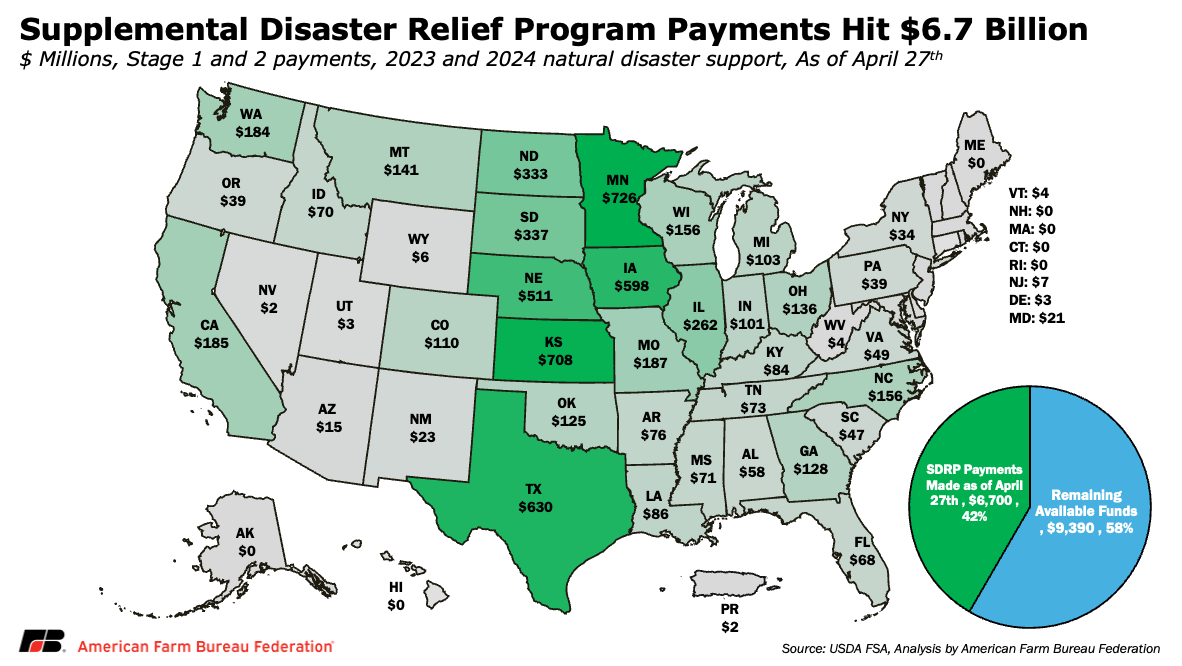
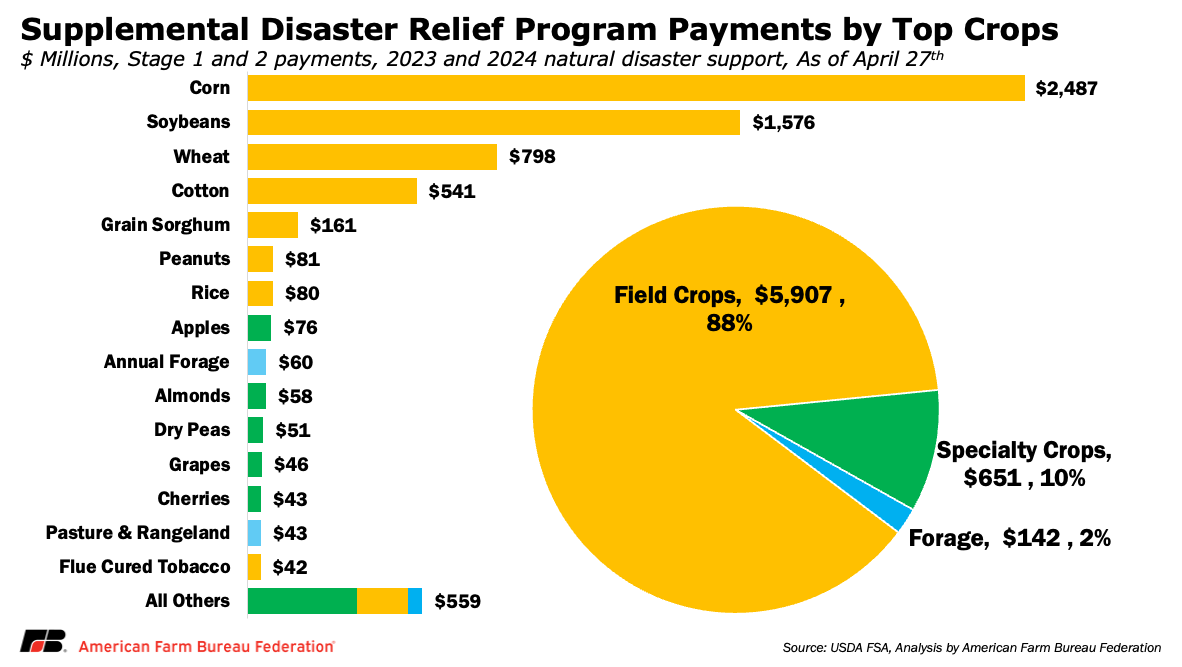
This distribution reflects, in part, how SDRP Stage 1 was designed. Because Stage 1 relies on existing crop insurance and NAP records, payments for commodities with well-established insurance coverage were processed more quickly and with fewer administrative hurdles. As a result, row crops have received the bulk of early assistance. Corn alone has accounted for $2.49 billion in payments, followed by soybeans ($1.6 billion), wheat ($798 million) and cotton ($548 million).
In contrast, specialty crop producers, including fruit, vegetable and nut growers, have received a smaller share of assistance to date, accounting for about $651 million, or roughly 10% of total SDRP payments, despite representing closer to 20% of total disaster-related losses based on prior AFBF analysis. This gap reflects longstanding challenges in delivering disaster assistance to specialty crops, where insurance coverage is more limited and production systems are more variable.
Stage 2 of SDRP was designed to address coverage gaps by covering uninsured crops, shallow losses and other damages not fully captured by traditional risk management programs. However, these payments require USDA to assign county yields, market prices or plant values in place of farm-level records, adding complexity to the process. In many cases, FSA is still working through these calculations, which has delayed payments for some producers and required additional documentation for losses that occurred up to two years ago.
Complicating matters further, some farmers have received notifications of potential overpayments following routine data updates between USDA’s Risk Management Agency and Farm Service Agency. When updated acreage or production data result in lower calculated losses, previously issued payments may be adjusted, requiring repayment of the difference. While these instances have created uncertainty for affected farmers, the recent increase in the SDRP payment factor may help offset some of these adjustments as additional funds are distributed.
How the Plus-Up Works
USDA’s recent announcement to increase the SDRP payment factor from 35% to 70% is a straightforward but significant change. Under the original program design, all calculated losses, regardless of crop or category, were multiplied by a 35% factor to ensure funding could be distributed across all applicants. USDA indicated at the time that this factor could be increased if sufficient funds remained. With roughly 58% of funding still available, the agency has now implemented that adjustment.
For farmers, this means previously approved payments will effectively be doubled. Farmers who have already received SDRP payments will automatically receive a second payment equal to the initial amount, bringing total assistance up to 70% of their calculated eligible loss. Growers who have not yet applied or been processed will receive the full 70% payment in a single disbursement.
To illustrate, consider a farmer with a crop insurance policy covering 65% of an expected crop value of $500,000. After a qualifying disaster, the harvested crop is valued at $250,000, generating a gross indemnity of $75,000. After subtracting $3,500 in premiums and fees, the net indemnity totals $71,500. Under SDRP, USDA recalculates expected value using a disaster-adjusted factor, in this case 87.5%, bringing the adjusted value to $437,500. Subtracting the $250,000 production value results in a total loss of $187,500. After accounting for the $71,500 insurance payment, the remaining eligible loss is $116,000.
Originally, applying the 35% payment factor resulted in an SDRP payment of $40,600. With the updated 70% factor, the total payment increases to $81,200, meaning the producer receives an additional $40,600 through the second payment. As a result, the farmer’s remaining uncovered loss is reduced further — from $137,900 to $97,300.
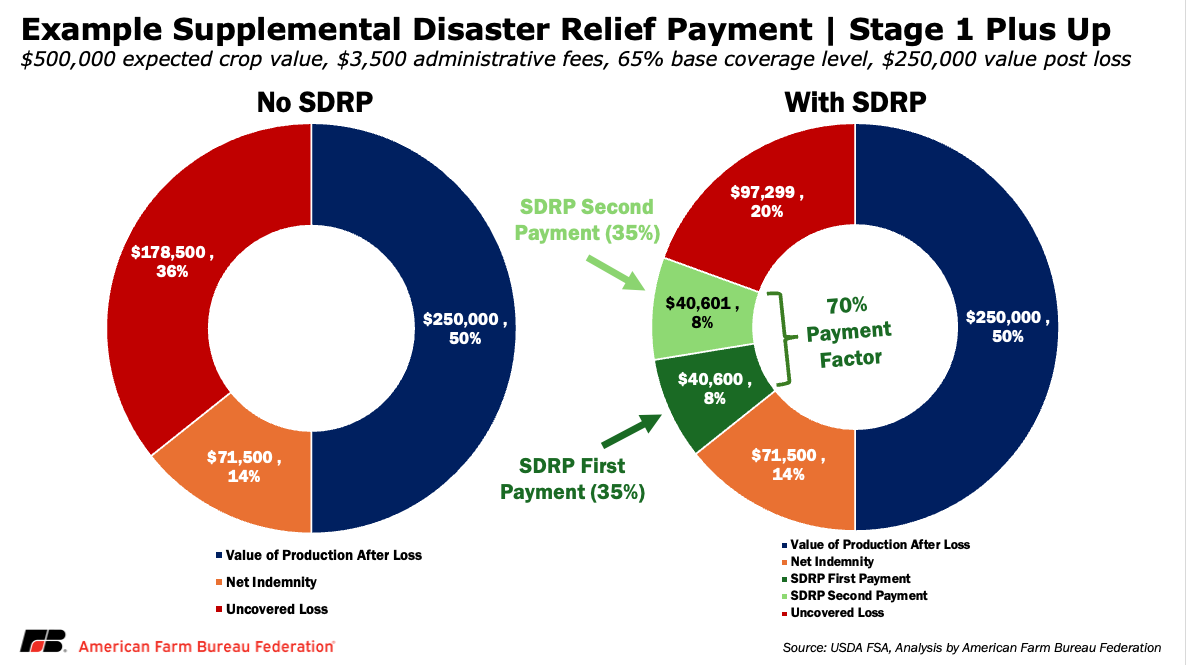
Importantly, the underlying loss calculation does not change. USDA is not revising yields, prices or indemnities. The adjustment simply increases the share of calculated losses covered by the program, delivering additional assistance through a second round of payments.
Disaster Losses Continue to Build
While SDRP payments continue to roll out for 2023 and 2024 losses, many farmers are already facing a new round of disasters without comparable support. Early 2025 brought continued drought across the Southern Plains and West, limiting forage availability and tightening irrigation supplies, while wildfire activity again damaged rangeland and infrastructure in already stressed regions. In the Southeast, storm systems and excessive rainfall created localized flooding and disease pressure in specialty crops and hurricane-related risks once again threatened high-value fruit and vegetable production.
Using AFBF’s standard disaster estimation approach, these events resulted in approximately $5.7 billion in uncovered crop losses in 2025, losses that remain after crop insurance indemnities are paid and that typically form the basis for ad hoc disaster assistance.
Losses were concentrated in key agricultural states. Texas recorded the largest losses at $648 million, driven primarily by cotton impacts, followed by California, where freeze and wildfire damage affected grapes, almonds, cherries and other specialty crops, and Florida, where losses continued to ripple through citrus production following late 2024 storm impacts.
By commodity, fruits and nuts accounted for the largest share of losses at $1.5 billion (27%), underscoring the vulnerability of perennial and specialty crops. Row crops also experienced significant impacts, with corn and soybeans each accounting for 14% of losses and wheat, 13%. By cause of loss, hurricanes, tropical storms, flooding and excessive precipitation accounted for 44% ($2.5 billion), while drought, wildfire and heat conditions contributed 34% ($1.9 billion). The remaining 22% stemmed from hail, freezes, tornadoes and other weather events.
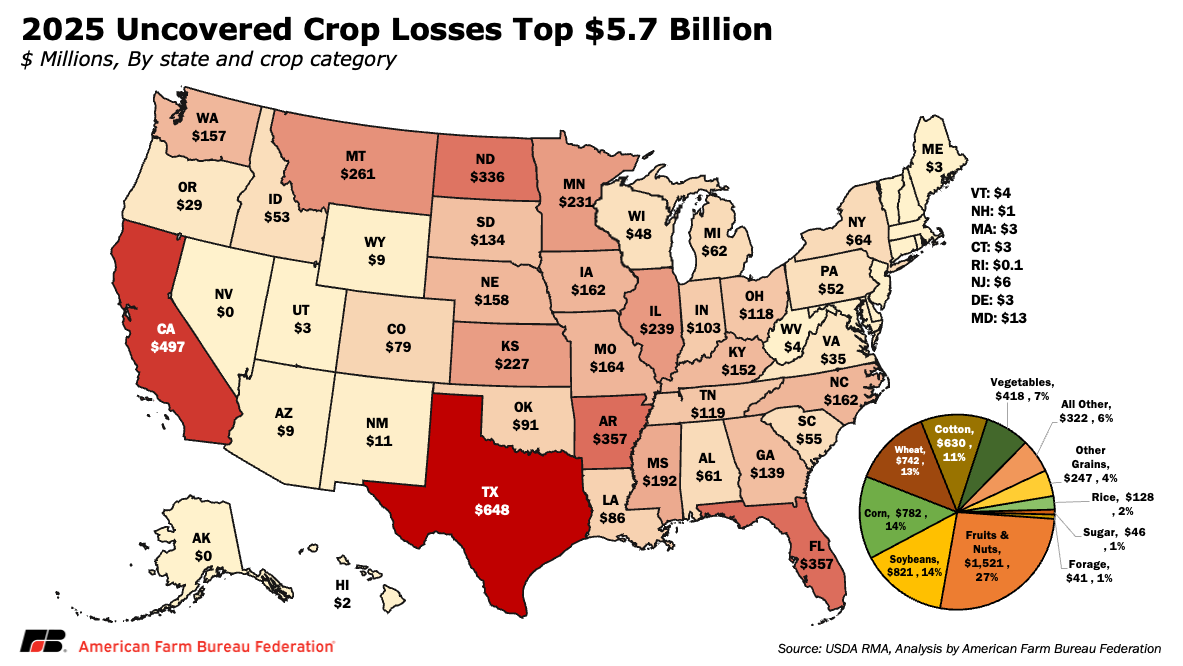
These estimates build on USDA Risk Management Agency indemnity data but adjust for both uninsured acreage and uncovered losses on insured acres. Because indemnities capture only a portion of total economic damage, AFBF applies a factor based on insurance coverage levels and participation rates to approximate full losses. As a result, these figures should be viewed as a more complete representation of disaster-related impacts, though they still exclude losses to livestock, timber and infrastructure.
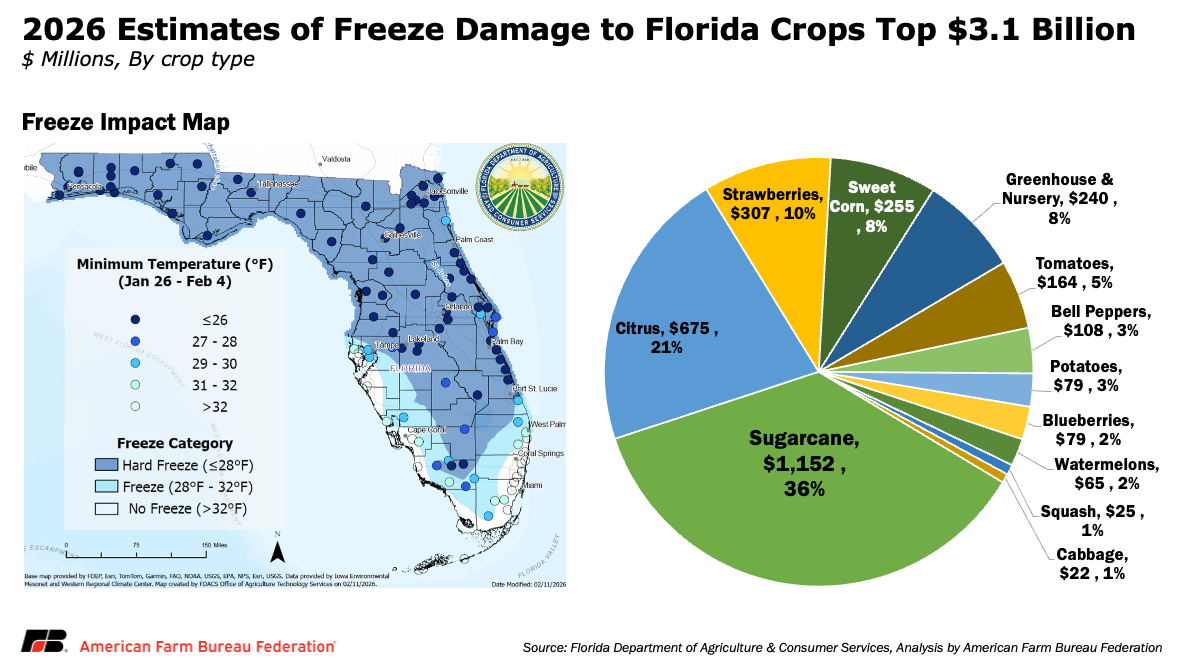
Looking ahead, early 2026 conditions suggest losses are already mounting, though comprehensive data remains limited and uneven across regions. While only a handful of events have been formally quantified to date, early reports point to widespread impacts across multiple states and commodities. A severe freeze in Florida, with broader but less quantified impacts also reported in Georgia and Alabama, is estimated to have caused more than $3.1 billion in agricultural losses, with impacts reported across 66 of 67 counties and more than 63,000 acres of horticultural crops. Damage was particularly severe in high-value crops, including $1.15 billion in sugarcane losses, more than $670 million in citrus losses and nearly $720 million in vegetables and melons, with some crops experiencing 80% to 90% production losses during peak season.
Beyond Florida, wildfire outbreaks in the central U.S., including Nebraska, have already impacted pasture and livestock operations, while below-normal snowpack across key Western basins is raising concerns about irrigation water availability heading into the growing season. Freeze and frost events are also emerging as a broader regional risk. In the Mid-Atlantic, a late-April freeze in Virginia damaged wine grape production following early budbreak, with growers reporting widespread bud loss and reduced yield potential. Similar cold events in the Northeast and Pacific Northwest add further pressure. At the same time, expanding drought conditions across much of the country are emerging as a central risk, not only reducing crop yields but also increasing input costs in certain production systems.
Importantly, the Florida freeze estimate reflects only a single event in one state and does not capture additional 2026 losses already occurring across the country. As a result, total disaster-related impacts for 2025 and 2026 remain incomplete but are likely to grow.
Conclusion
USDA’s decision to increase SDRP payments is a meaningful step, helping move more of the $16.09 billion in authorized aid to farmers still recovering from 2023 and 2024 disasters. For many farmers who experienced devastating losses, some losing entire crops or homes, this support is arriving after more than two years, underscoring the importance of delivering assistance as quickly as possible to be most helpful.
At the same time, disaster impacts build. An estimated $5.7 billion in uncovered losses in 2025 and early 2026 damage already mounting beyond $3.1 billion highlight a familiar challenge: assistance is tied to past events, while risk continues in real time. The SDRP plus-up helps close part of the gap, but the pace of recent disasters reinforces the need for timely, effective support as new losses emerge.