Threats to Interstate Commerce

photo credit: Getty Images
Bernt Nelson
Economist
This Market Intel is part of a series examining six priority policy areas - trade, biofuels, whole milk in schools, interstate commerce, transparent input markets and prioritizing U.S.-grown produce - and how each can help strengthen the farm economy and rural communities.
Key Takeaways
- State laws passed by ballot initiative or ballot measure bypass the normal legislative process. Many ballot initiatives provide voters with minimal information about the issue before they head to the polls.
- State laws on farm practices could fragment the marketplace. These laws allow one state to enforce its own production preferences on other states, creating a patchwork of laws that disrupt interstate commerce.
- Laws such as California’s Proposition 12 have resulted in increased costs to farmers, higher prices paid by consumers for regulated products and costly disruptions to supply chains.
Recent state-level mandates and laws on farm practices, such as California’s Proposition 12 and Massachusetts’s Question 3, create a patchwork of laws that increase costs for farmers and consumers alike and disrupt interstate commerce. Both California’s Proposition 12 and Massachusetts’ Question 3 ban in-state sales of products from animals that are raised in a manner not consistent with their state’s law, even if the farmer is not in the state.
These state laws allow a single state to impose its production preference on other states, claiming improvements to animal welfare, human health and sustainability. However, USDA’s Food Safety Inspection Service already ensures food safety through its authority under the Federal Meat Inspection Act, the Poultry Products Inspection Act, and the Egg Products Inspection Act as well as humane animal handling through the Humane Methods of Slaughter Act. This includes production practices that are now banned by laws like CA Proposition 12 and MA Question 3.
Taking the Ballot Route
Ballot initiative supporters in California and Massachusetts mounted well-funded campaigns that succeeded in getting their ballots approved but failed to present an unbiased picture of the production practices voters were considering or the full repercussions of the ballots passing. Their efforts were designed to circumvent the fact-finding and debate that would occur in the normal legislative process.
This Market Intel will examine the state laws that could cause monumental disruptions to interstate commerce, animal welfare and long-term farm sustainability.
Animal Welfare
Perhaps two of the most well-known animal welfare ballot initiatives are California’s Proposition 2 and Proposition 12. California’s Proposition 2, passed in 2008 and implemented on Jan. 1, 2015, required calves raised for veal, egg-laying hens and pregnant pigs be confined only in a way that allows these animals to lie down, stand up, fully extend their limbs and turn around. The minimum requirements established in these rules were developed without the generally accepted views of experts in animal welfare or the knowledge and experience of farmers.
More space for livestock is not always beneficial. Sows (female pigs), for example, behave more aggressively to establish a hierarchy of dominance in a group. Sows are particularly vulnerable to stress and injuries from fighting during the weeks after weaning and conception. Individual stalls provide protection for sows during these high-risk periods.
Proposition 12 built on Proposition 2 by prohibiting all sales of pork, veal and eggs that were not produced in a way that meets the state’s production standards – even if farm production occurs outside of California. Specifically, Proposition 12 mandates that breeding pigs must have a minimum of 24 square feet of usable floor space per pig; veal calves must each have at least 43 square feet per calf; and laying hens must be in cage-free housing with 1 to 1.5 square feet per hen, depending on the housing system. Supporters of Proposition 12 and similar laws have claimed it would improve animal welfare and food safety.
Massachusetts Question 3 went into full effect in 2023. This regulation, similar to Proposition 12, bans the sale of veal, pork, and eggs in Massachusetts from animals that do not meet the state’s standards. Question 3 applies to egg-laying hens, breeding pigs and calves raised for veal. Egg-laying hens must be kept in cage-free housing with 1.5 square feet of space in floor-based barns, and 1 square foot per bird for aviaries, along with enrichments such as perches and nesting boxes. Breeding pigs must be kept in gestation crates big enough for the hog to lie down, stand up, fully extend its limbs and turn around freely. Calves raised for veal must be able to lie down, stand up, fully extend their limbs and turn around freely. While this appears similar to CA Proposition 12 ,there are differences. For example, Question 3 bans the sale of eggs from egg-laying hens not provided with enrichments like perches and nesting boxes, in addition to its specific space requirements.
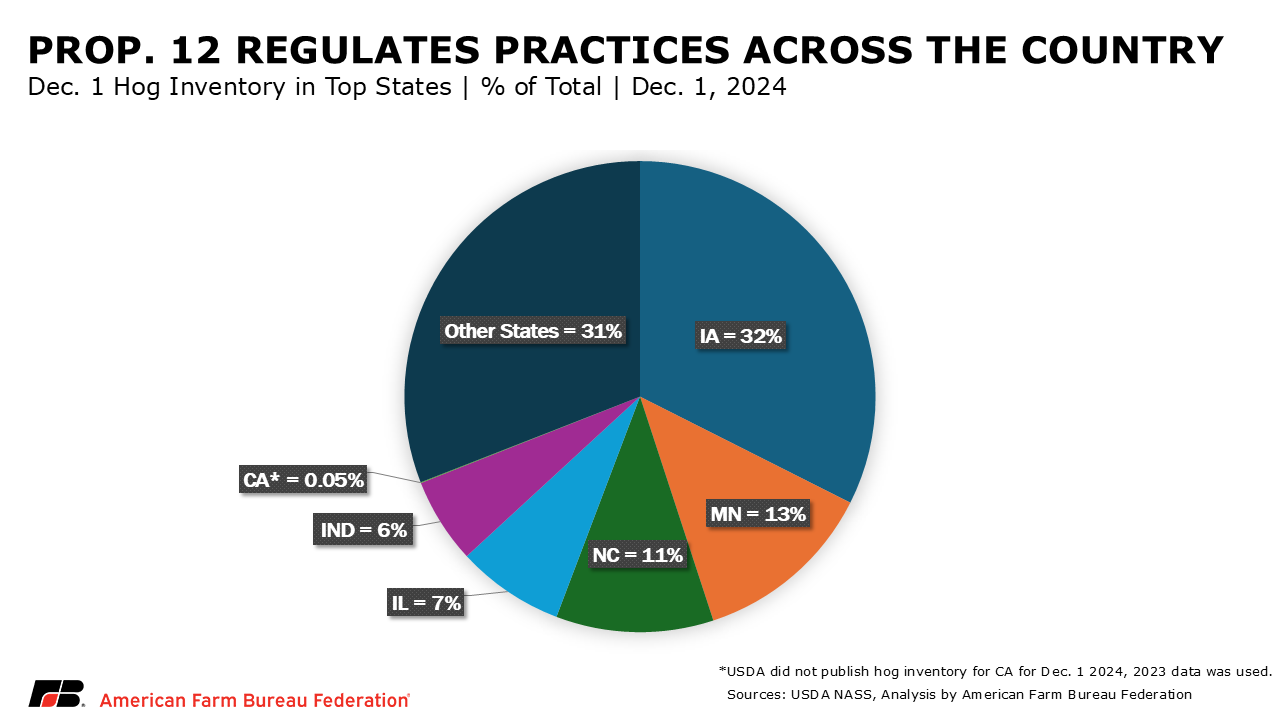
Proposition 12 took effect on Jan. 1, 2024. According to data from USDA’s National Agricultural Statistics Service, California is home to less than 1% of the U.S. hog inventory, which means top-producing states such as Iowa, home to nearly 33% of hogs in the U.S., are subject to regulations and inspections from a state with hardly any domestic hog production of its own. California requires pork from about 8% of North American sows to meet its demand. Most farms that use conventional methods to raise hogs required substantial changes to meet the new standards set forth by Proposition 12. When the law was passed, almost no farms in any state followed the standards set forth by the ballot initiative.
There are three ways hog farmers can comply with Proposition 12: Reduce herd size and reconfigure existing barns or build new barns. These costly options range from $600-$4,000 per head for a farm using conventional production methods.
Ultimately, consumers pay the bill for the disruption caused by these laws. Farmers are price-takers, not price-makers. A farmer who has invested in complying with laws like Proposition 12 is at the mercy of a packer to pay a premium for a product they can sell in Massachusetts or California - though even that premium may not cover the farmer's costs. When packers pay farmers more, they likely pass that cost on to retailers, who then charge shoppers more for pork.
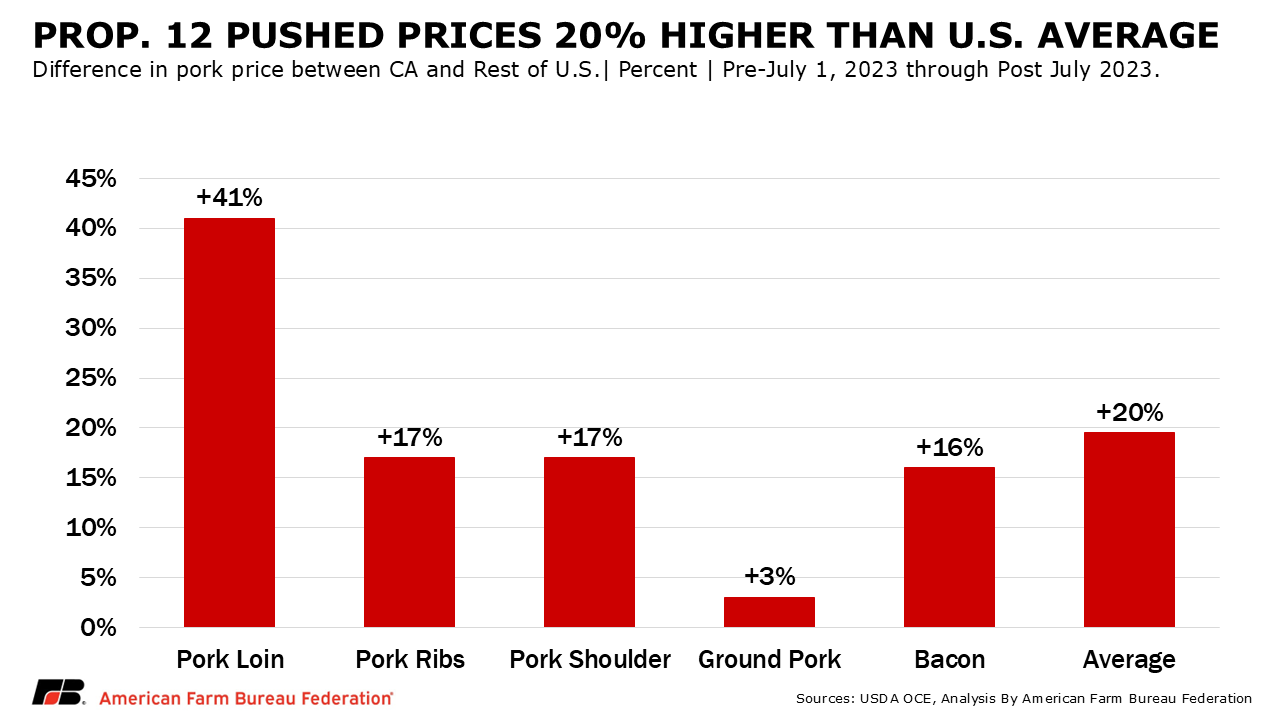
According to a study by the University of California’s Gianni Foundation, prices for Proposition 12-compliant pork products rose by an average of 20% leading up to the full implementation of the law. Pork loins had the greatest increase in price, as high as 41%. When Proposition 12 went into effect, prices went up, making pork, a nutritious and typically affordable protein source, less affordable. Further, the Gianni Foundation study showed the impact of the higher prices on people’s pork purchases, with California’s share of consumption falling from 10% of all U.S. pork to 8% when Proposition 12 took full effect on Jan. 1, 2024.
Conclusion
State laws and mandates that create a patchwork of farm production regulations are a threat to interstate commerce, a vital element of the U.S. economy. Laws such as CA Proposition 12 have resulted in increased costs to farmers and ultimately higher prices paid by consumers for the regulated products.
There have been several attempts to challenge state laws that impose farming practice regulations on farmers in other states. Most notably, in 2023 the Supreme Court reached a fractured decision upholding Proposition 12, whereby five of the nine justices concluded that the law was constitutional, but reached that result through differing and conflicting rationales.
Congress has proposed a solution to the interstate commerce issues outlined in this Market Intel. The Commerce Clause grants Congress the power to regulate trade among the states. Under proposed legislation, states and localities would still be allowed to be enforce production requirements within their jurisdictions but could not impose standards on farms in other states. For example, under section 12007 of the proposed 2024 farm bill introduced in the House, California’s Proposition 12 regulations would only be applicable to producers in California and would otherwise not impact producers outside its borders.

