Updated Farm Bill Math Confirms Challenging Farm Economy

photo credit: Tennessee Farm Bureau, Used with Permission
John Newton, Ph.D.
Vice President of Public Policy and Economic Analysis
Key Takeaways
- The One Big Beautiful Bill Act (OBBBA) made significant modifications to USDA mandatory farm programs and the Supplemental Nutrition Assistance Program (SNAP). Following these changes, the Congressional Budget Office (CBO) now projects 10-year spending for farm and nutrition programs at $1.4 trillion.
- Despite persistent low crop prices, high input costs and tight margins, current farm bill safety net programs delivered only about $2 billion for the 2024 crop year, according to CBO. With support from the OBBBA-enhanced programs not arriving until fiscal year 2027, many farms continue to face financial strain — making additional bridge assistance critical for weathering the upcoming growing season.
- While OBBBA made a historic investment in farm bill risk management tools, several farm bill programs were left out, and Congress must still pass a bipartisan farm bill reauthorization to address those remaining gaps.
Following several years of high input costs, declining crop prices and stagnant congressional investments in critical farm programs including risk management tools, trade promotion programs, marketing assistance loans and disaster programs, Congress advanced a historic investment in farm bill programs as part of the One Big Beautiful Bill Act (OBBBA).
However, not every program in the farm bill was addressed in the OBBBA, e.g., the Conservation Reserve Program, and efforts continue to pass a bipartisan farm bill reauthorization for those programs. To facilitate this effort, CBO recently provided an early release of their baseline projections for USDA's mandatory farm programs and the SNAP. CBO’s full 2026 budget and economic outlook is expected to be released in early February.
Updated Farm Bill Math
According to CBO’s February 2026 baseline, total outlays for SNAP and USDA mandatory farm programs such as Price Loss Coverage (PLC), Agriculture Risk Coverage (ARC), federal crop insurance and voluntary conservation programs are projected at $1.4 trillion from fiscal year 2027 to 2036 – in line with the January 2025 baseline projections.
At slightly more than 70% of total projected spending for farm bill programs, the largest projected outlay for USDA farm and nutrition programs is SNAP at $985 billion over 10 years. Largely due to lower participation rates (dropping from 39 million beneficiaries in 2026 to 34 million beneficiaries in 2035), projected outlays for SNAP have declined by $139 billion, or 12%, from the January 2025 baseline. While SNAP projected outlays have declined since the January 2025 baseline, the average benefit per recipient is projected to rise from $187 per person per month in 2026 to just under $230 per person per month in 2036 – an increase of 23%.
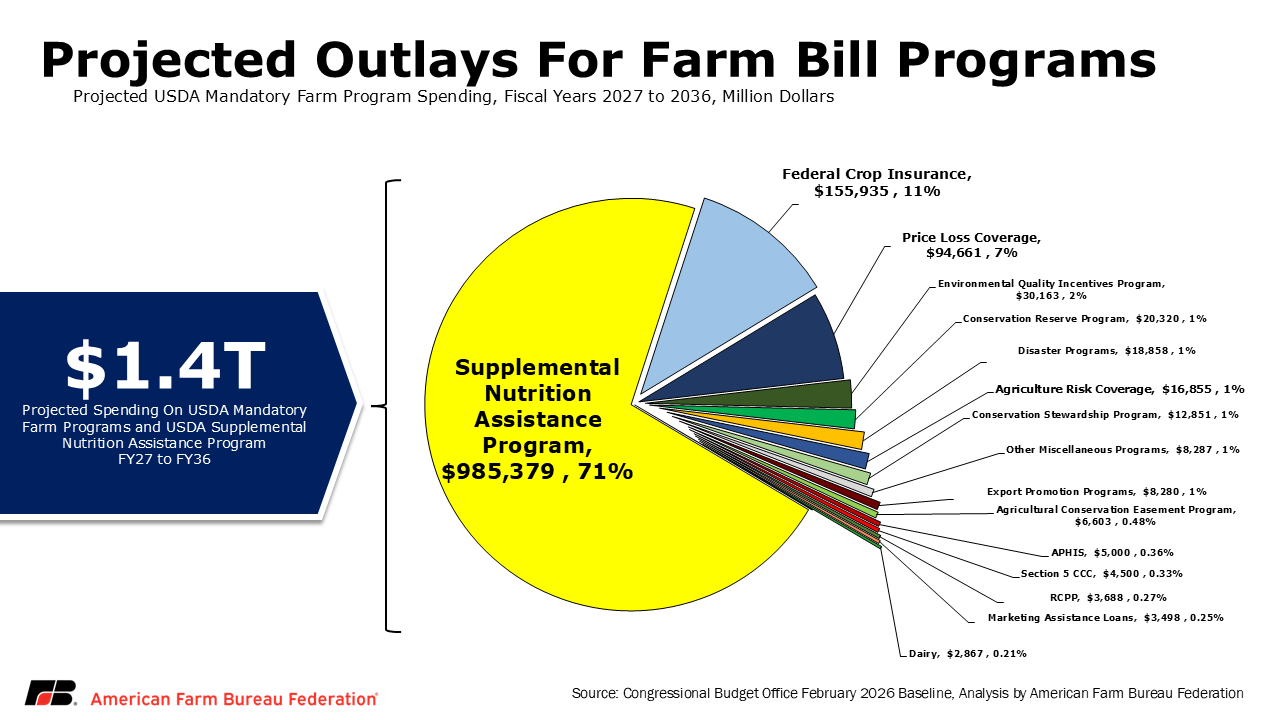
When it comes to farm programs, projected outlays for federal crop insurance, including delivery expenses and the premium cost share are nearly $156 billion over 10 years, representing 11% of total outlays – and up 17%, or $23 billion, from the January 2025 baseline. The increase in projected outlays for crop insurance is due to improvements made in the OBBBA, including enhanced premium support for beginning farmers, higher premium support across coverage levels, expanded eligibility for the Supplemental Coverage Option and the creation of a new pilot insurance product for contract poultry growers to make crop insurance more affordable and more accessible for farmers.
Following crop insurance, projected outlays for USDA commodity support programs such as PLC, ARC, Dairy Margin Coverage, marketing assistance loans and disaster programs total nearly $134 billion over 10 years, up significantly from CBO’s January 2025 baseline. This increase in projected outlays was expected as Congress made a significant investment in important risk management programs by increasing reference prices, improving coverage under ARC, and allowing the creation of up to 30 million new base acres for eligible farmers, among other improvements.
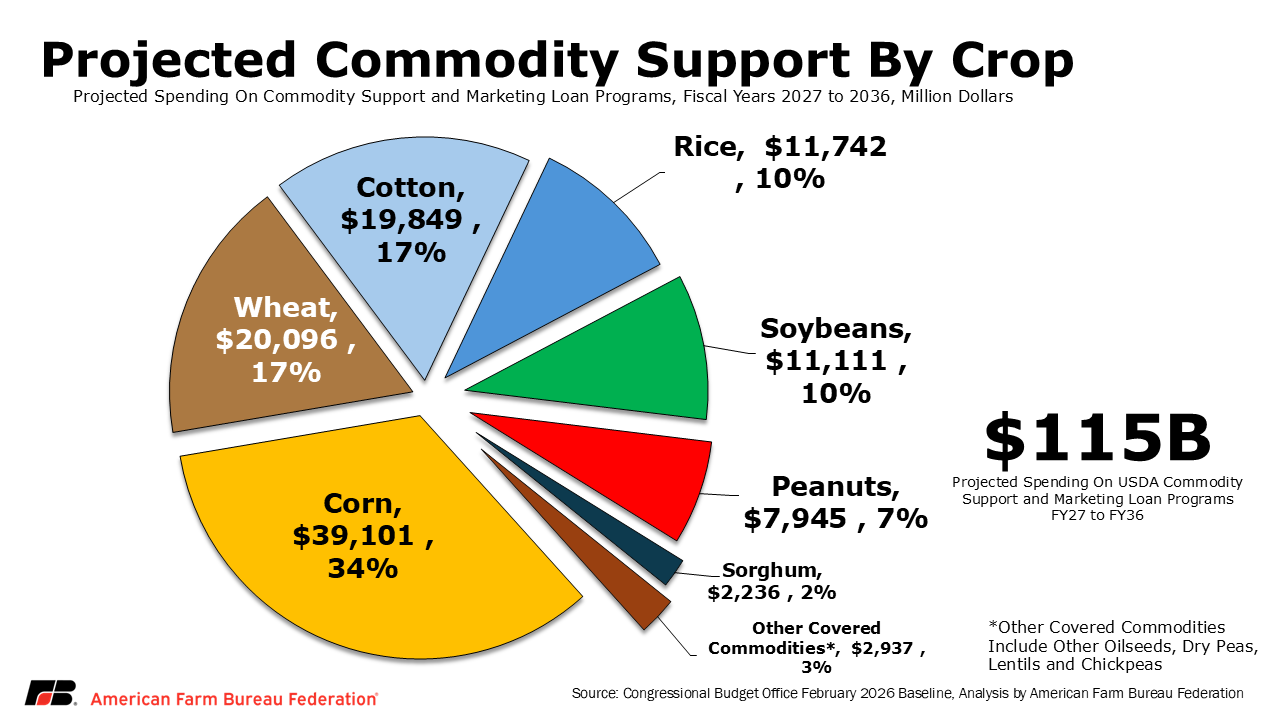
Of the $134 billion in commodity support program payments, approximately $115 billion in projected outlays are for ARC, PLC and marketing loan programs. Of that total, projected outlays are the highest for corn at more than $39 billion over 10 years, followed by wheat at more than $20 billion, and cotton at just under $10 billion. Across the major program crops, over 60% of projected outlays, or nearly $73 billion, will flow to eligible corn, soybean, wheat and sorghum acres, while approximately one-third, or $39
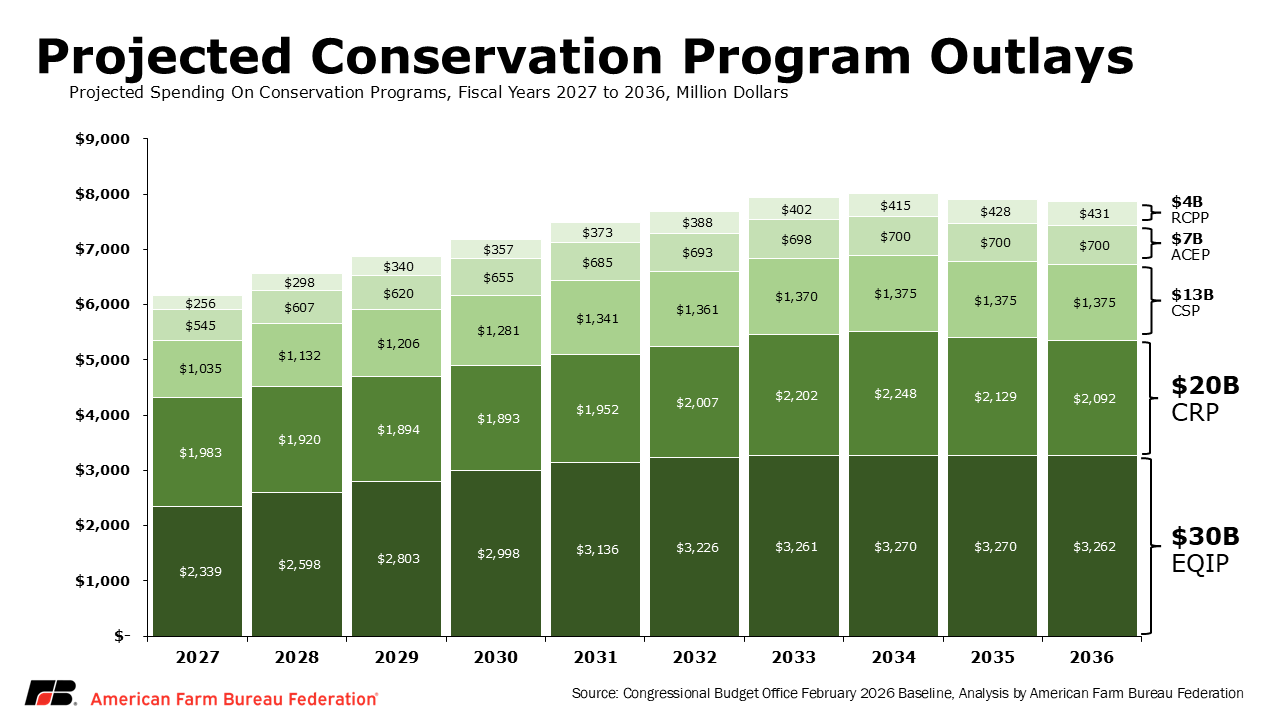
Following critical risk management tools such as crop insurance and commodity programs, projected outlays for USDA voluntary conservation programs including the Conservation Reserve Program or the Environmental Quality Incentives Program (EQIP) are $73 billion – largely unchanged from the January 2025 CBO baseline. OBBBA made changes to working lands USDA conservation programs to permanently increase access and the availability of conservation financial and technical resources to address local resource needs such as water quality, soil health, wildlife habitat management and regenerative agriculture, among others.
Why Additional Bridge Assistance Is Needed
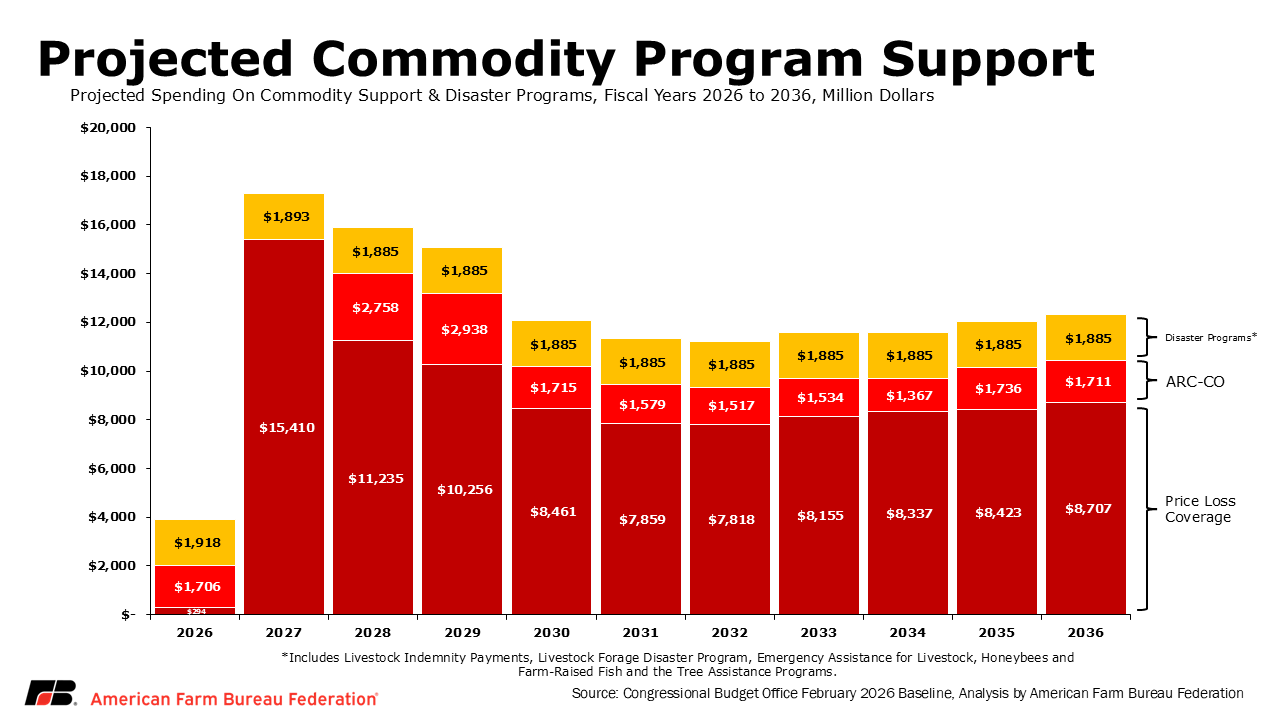
When OBBBA passed, leaders in Congress knew the additional investment in farm bill programs would not reach the farm quickly. Enhancements made and effective for the 2025 crop year will not be delivered to farmers until fiscal year 2027 – when commodity program support is expected to top $15 billion.
In the interim, farmers are still operating with an outdated safety net for crops grown in any of the prior years when the farm economy turned sour, e.g., 2023 and 2024. As evidence, despite historically low crop prices and tight margins approaching the fourth or fifth consecutive year for some crops, commodity program support delivered for 2024 crops was just over $2 billion – highlighting the need for economic assistance beyond those authorized under the Emergency Commodity Assistance Program, Marketing Assistance for Specialty Crops or the Farmer Bridge Assistance Program – especially given the uncertain farm economic outlook for 2026.
Help (and Hopefully More) Is on The Way
The Congressional Budget Office’s February 2026 baseline for mandatory farm programs highlights the significant investments made in critical farm risk management tools and is projecting total outlays for those programs at $392 billion from fiscal years 2027 to 2036. Of the $392 billion, additional investments of more than $60 billion in important risk management tools such as Price Loss Coverage and Agriculture Risk Coverage and more than $23 billion for federal crop insurance are now projected by CBO.
These investments can’t come soon enough in farm country, as farmers continue to face mounting economic pressures related to historic inflation in input costs, low commodity prices, trade uncertainty and lack of new domestic demand catalysts such as year-round E15. While congressional leaders and industry stakeholders, led by Farm Bureau, have recognized the need for additional support, the runway is getting shorter in farm country, and should the outlook for 2026 not improve, for some farmers the enhancements made in the One Big Beautiful Bill Act will come far too late.